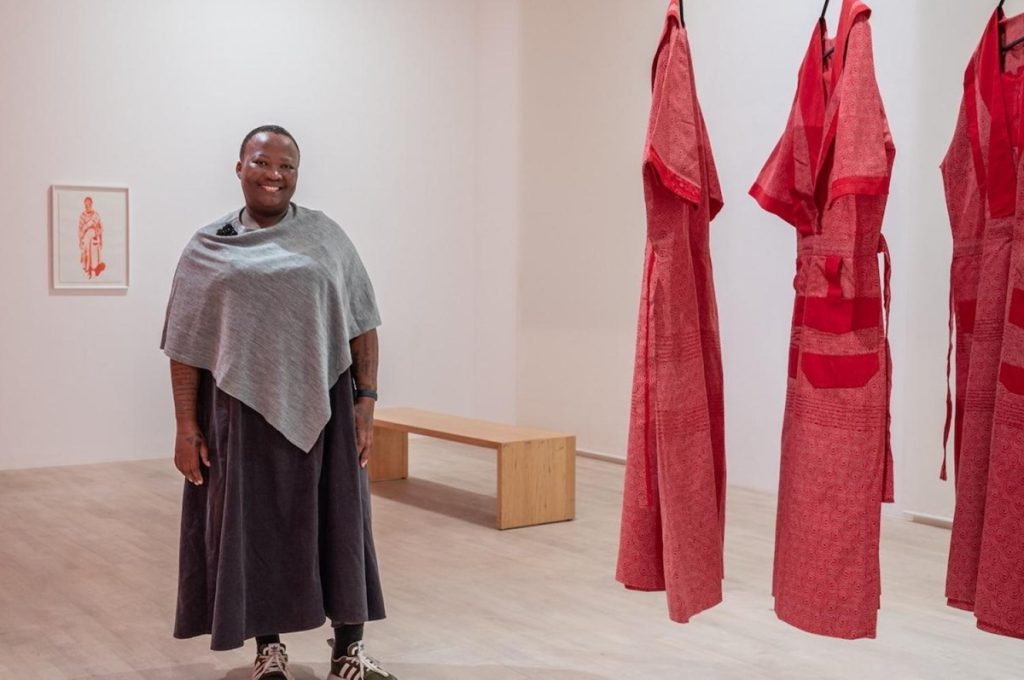
South African interdisciplinary artist Senzeni Marasela is an active and attentive presence at the ongoing Venice Biennale. Marasela’s Venice Biennale work, which combines a wide range of artistic practices, including photography, video, prints, and mixed-media installations involving textiles and embroidery, and through which she conveys her message, captures the active attention of art lovers. Marasela’s creative worlds are broad, encompassing history, memory, and personal narrative, emphasising historical gaps and overlooked figures.
Senzeni Marasela completed a residency at the South African National Gallery immediately after graduating from the University of Witswatersrand in Johannesburg in 1998. Her work for the Gallery’s Fresh exhibition series was the result of this residency. The United States, Europe, and South Africa have all had numerous exhibitions of Marasela’s artwork. In addition to certain private collections such as the Leridon collection in Paris, the Harry David collection in Athens, and the Sindika Dokolo collection in Angola, her work may be found in notable local and international collections,, including the Newark Museum, the Smithsonian Institution, and MoMA, New York.
As part of the interview series, a conversation with Venice Biennale artists, Abirpothi, featuring South African artist Senzeni Marasela. The artist discusses in detail her work and her presence in the Venice Biennale.
Q: As you return to the Venice Biennale, how do you see your current participation extending or transforming the conversations you began during the 56th Biennale in 2015?
Senzeni Marasela: Yes, it is a continuation of the programme because Theodora’s body of work has always been concerned with land: how land is occupied and how Black female bodies position themselves within questions of land. As South Africans, we have a complex relationship with land due to long histories of dispossession. In 2015, I travelled to Italy and created a performance where I built an island and constructed a ‘no man’s land’ around it. I attempted to write stories about myself within that space, but the process was interrupted by people constantly walking through it. That experience reflected a pattern I had encountered throughout my performances: discomfort with how I questioned space, ownership, and history. My current work continues that inquiry into land, but now focuses on mining and the grief carried by the land itself.
Q: Your work often moves between personal memory and collective history. How do you negotiate the boundary between autobiography and the political history of Black South African womanhood?
Senzeni Marasela: Growing up in South Africa at the end of apartheid and entering the post-Mandela era shaped me deeply. The Truth and Reconciliation Commission brought discoveries about histories that many of us had never known. Some of those truths were shocking because they had happened so close to where we lived. My work attempts to position myself within those histories and explore how they continue to affect Black women.
Q: The figure of Theodorah Mthetyane has become central to your practice. What does Theodorah allow you to say that perhaps Senzeni Marasela alone cannot?
Senzeni Marasela: Theodora is both a subject and a guide in my work. I loosely named the persona after my mother, who, like many Black women of her generation, lived in circumstances where speaking freely was difficult. I see Theodora and me as a link between the past and the future.
Q: Waiting is a recurring condition in your work — waiting for return, recognition, justice, or belonging. Why does “waiting” remain such a powerful political and emotional space in your artistic language?
Senzeni Marasela: Waiting is central in my work because Black women have historically waited for husbands, rights, land, autonomy, and social change. The work was strongly influenced by literature, particularly narratives about women who wait under painful conditions.
Q: In works such as Waiting for Gebane, Johannesburg appears both as a site of aspiration and disappearance. What does the city represent for you within the histories of migration, labour, and displacement in South Africa?
Senzeni Marasela: Johannesburg is important in my work because it represents migration, transition, and displacement. The city was built around systems that separated families through migrant labour and mining. It became a place where Black families were fragmented.
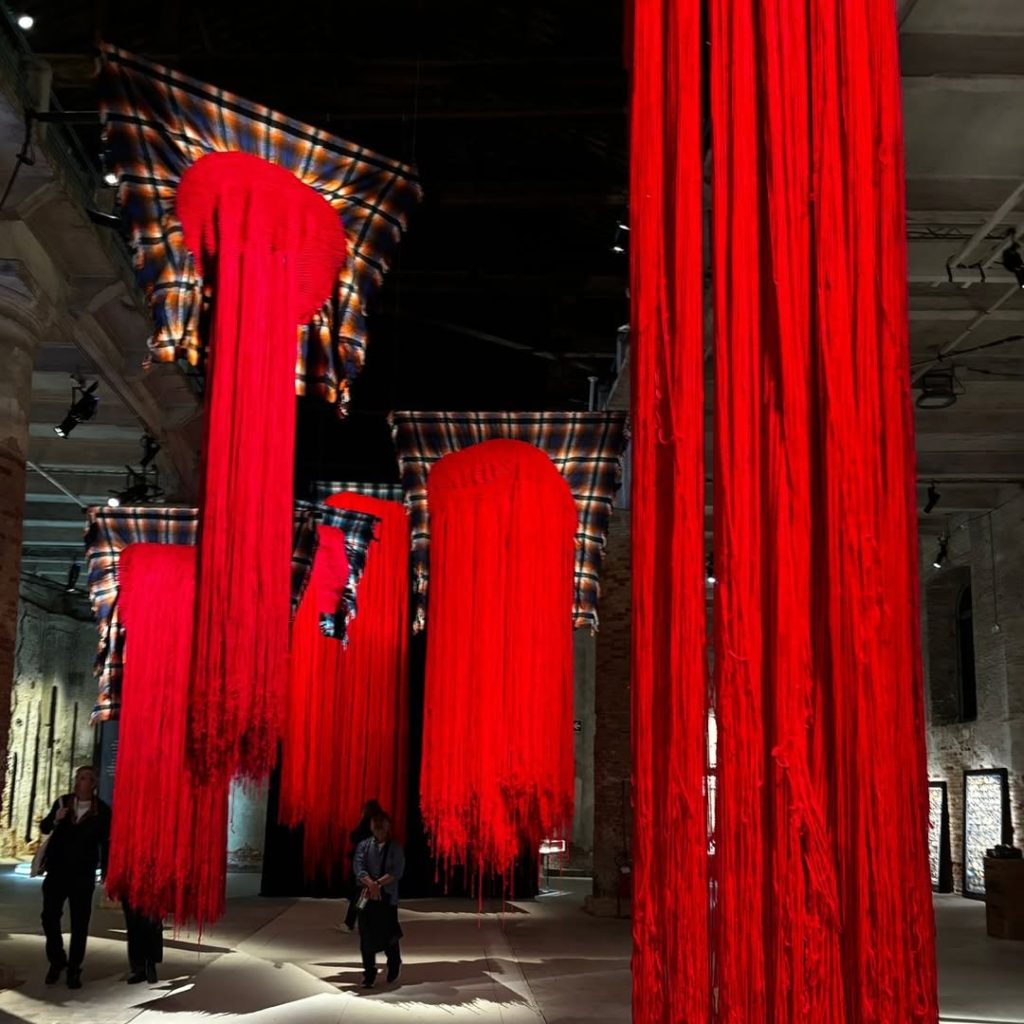
Q: Your use of the colour red carries layers of meaning — from red dust and drought to violence, labour, memory, and womanhood. How has this colour evolved as a political and symbolic language within your practice?
Senzeni Marasela: The colour red is significant because of stories my father told me about ‘red dust’ — a period associated with violence and unrest. Red represents omission, pain, violence, and forgotten histories, but it is also a colour of consciousness and awareness.
Q: You frequently work with textiles such as ishweshwe and Kaffir line fabric. How do these materials function as archives of Black women’s histories and lived experiences?
Senzeni Marasela: The fabrics I use carry colonial histories but also became markers of status and identity within Black communities. They carry ceremonial meanings and document different stages of Black womanhood.
Q: Much of your work centres on women who have been overlooked, abandoned, or erased from dominant historical narratives. Do you see your practice as an act of historical repair or re-inscription?
Senzeni Marasela: I see my work as an act of historical repair. My work questions access, mourning, and the ability of people to maintain relationships with ancestors and loved ones who have died.
Q: In your performances, especially Ijermani Lam, the body becomes a site of endurance and repetition. What happens to identity when performance stretches over years rather than hours or days?
Senzeni Marasela: The performance became durational because I wanted to compel people to look at me and, by extension, confront the histories surrounding Black women and the body occupying space.
Q: Your work draws connections between figures such as your mother, Sarah Baartman, Winnie Madikizela-Mandela, Penelope, and Miss Havisham. What interests you about linking mythological, historical, and personal women across different geographies and time periods?
Senzeni Marasela: Many of these women waited publicly and painfully. Waiting itself becomes a shared condition among women in both historical and mythological contexts.
Q: As a Global South artist, how do you position your work within international art spaces like the Venice Biennale, where African histories are often framed through Western institutional lenses?
Senzeni Marasela: Although I insist on being called an African artist, I also recognise how colonial histories shaped artistic institutions and the circulation of images. Telling stories from my perspective is important because historically, we have not participated equally in telling our own stories.
Q: Your practice deals deeply with movement, migration, and nomadic identity. Do you think contemporary Black identity is always shaped by displacement, or is your work searching for another form of rootedness?
Senzeni Marasela: All art is political because artists are shaped by their environments, histories, and experiences. Black identity has continuously been shaped by displacement and colonial histories.
Q: The politics of labour — particularly the migrant labour system during and after apartheid — quietly runs through your work. How important is it for you to foreground the emotional and familial consequences of these economic systems?
Senzeni Marasela: I was deeply affected by migrant labour because my own family was shaped by it. My parents migrated to Johannesburg, and I became part of the first generation of children raised within that context.
Q: Many of your works move between fragility and resilience, intimacy and resistance. What do you hope audiences at the Venice Biennale understand about Black South African women through these layered narratives?
Senzeni Marasela: The fragility of thread and fabric interests me because they can tear, unravel, and carry softness. I created memorial works around mining tragedies to acknowledge histories often excluded from public memory.
Q: Across photography, embroidery, performance, installation, and video, your practice continuously returns to memory, absence, and survival. What would you say is the central political and emotional message you have been insisting on through your work over the years?
Senzeni Marasela: At the centre of my work is the absence of Black women’s voices and stories. Through Theodora, I attempt to speak into those silences and create space for histories that have been ignored.
Krispin Joseph PX, a poet and journalist, completed an MFA in art history and visual studies at the University of Hyderabad and an MA in sociology and cultural anthropology from the Central European University, Vienna.