The inaugural edition of the sā Ladakh Biennale, titled Signals from Another Star, will take place from 1–10 August 2026 across the high-altitude landscapes of Ladakh, marking a significant new entry into the global biennale circuit. Positioned at over 3,000 metres, the event is being framed as the world’s highest regenerative art biennale, unfolding across eight sites along the historic Leh–Kargil corridor.
Curated by Vishal K Dar, with Tsering Motup Siddho as Associate Curator, the biennale brings together 12 international and Ladakhi artists and artist duos. Conceived as a “field of signals,” the exhibition foregrounds site-responsive practices that engage deeply with land, ecology, memory, and the layered histories of the Silk Route. The curatorial framework proposes art as a mode of ecological responsibility, asking how creative practices can respond meaningfully to climate urgencies through sustained engagement with place.
The biennale’s geographic spread covering Leh, Basgo, Likir, Nurla, Lamayuru, Henasku, Mulbekh, and Kargil transforms villages, open terrains, and community spaces into sites of artistic intervention. This distributed format emphasizes movement and encounter, positioning the exhibition as a journey across 230 kilometres of fragile Himalayan ecology.
Participating artists include Agnieszka Kurant, Anna Jermolaewa, Avantika Bawa, Himali Singh Soin, Jitish Kallat, Grazia Toderi, and Peter Kogler, alongside a strong cohort of Ladakhi practitioners such as Arunima Dazess Wangchuk, Chemat Dorjey, Jigmet Angmo, Skarma Sonam Tashi, and Tenzin Olden. The list reflects a deliberate dialogue between global contemporary practices and deeply localised artistic vocabularies.
Extending beyond the exhibition, the biennale will host three Special Projects. These include a community-led exhibition in Leh’s Old Town featuring Ladakhi artists; an international collaboration with Austria-based museum in progress as part of its raising flags initiative; and a research-driven intervention by Ayan Biswas in Kargil, focusing on medicinal plants through workshops and a culminating biomass-based installation.
Grounded in the Ladakhi term ‘sā’, meaning soil, the biennale positions regeneration not just as a theme but as a working methodology. Residencies, workshops, and educational initiatives form a core part of the programme, emphasizing ethical engagement with local communities and long-term ecological awareness.
The biennale is supported by a wide network of cultural and institutional partners, including LAMO, Pro Helvetia, the Austrian Cultural Forum, Rubin Museum of Himalayan Art, Fremantle Biennale, and the Dharamshala International Film Festival, among others. This collaborative framework underscores its ambition to function as a transnational platform rooted in local context.
Founded in 2023 as a land art initiative by Tenzin Jamyang, Raki Nikahetiya, and Sagar Singh, sā Ladakh has rapidly evolved into a biennale-scale platform. With its inaugural edition, it signals a shift towards new models of exhibition-making—ones that are decentralised, ecologically attentive, and embedded within lived landscapes rather than institutional enclosures.
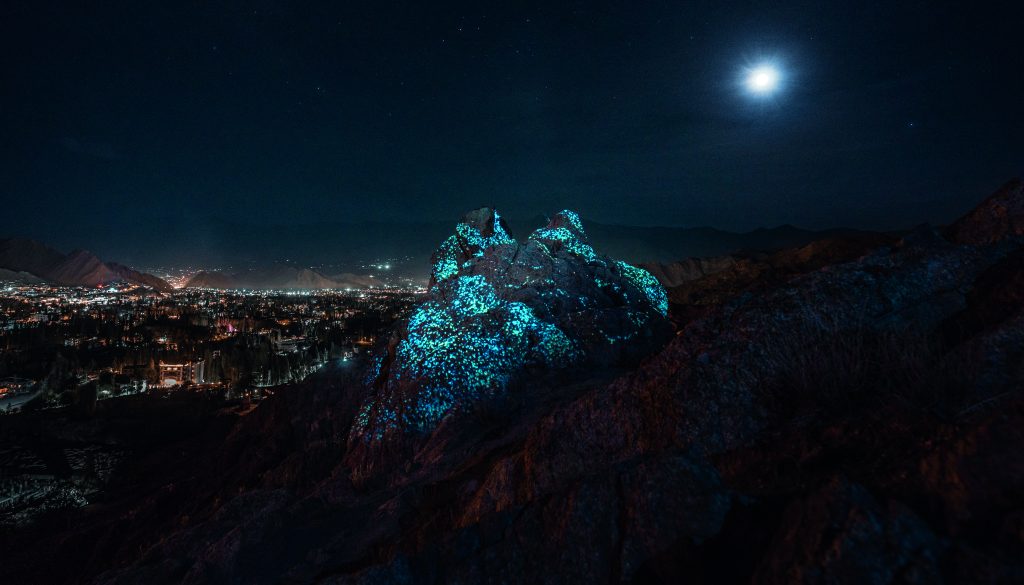
Cover image: CHU, 2023, by Philipp Frank, Germany. sā Ladakh, Edition One, 2023, Diskovalley Bike Park, Leh, Ladakh, India. Photo by Philipp Frank. Courtesy of sā Ladakh Biennale

Contributor