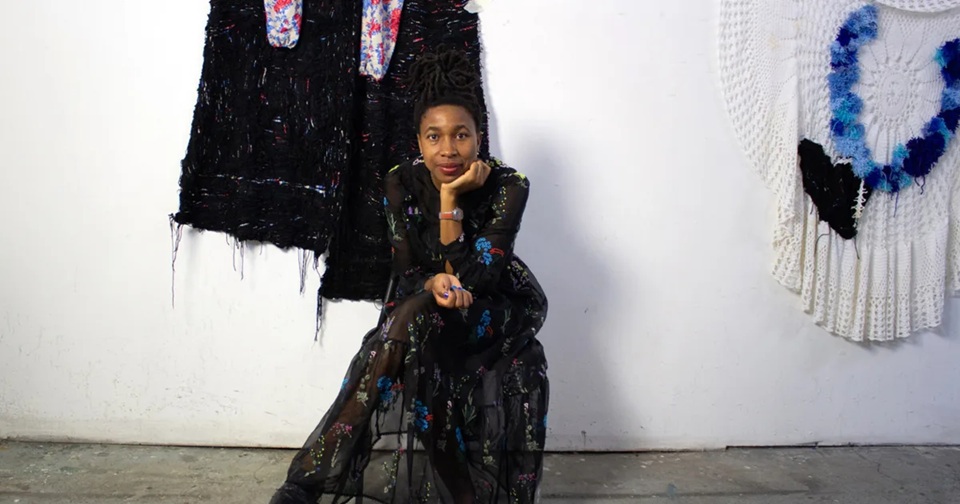
The presence of Zimbabwe-based mixed-media textile artist Georgina Maxim at the Venice Biennale paves the way for discussions about Global South art and the political contexts in which artists from the Global South advocate. Georgina Maxim blends more than ten years of curatorial and arts administration experience with a unique artistic practice. Maxim is also a co-founder of Village Unhu, an artist-run space that supports professional and up-and-coming artists. Her work focuses on textiles, using weaving, quilting, and embroidery to disassemble and reassemble used clothing to create one-of-a-kind items that serve as storytelling and memory vehicles. Maxim’s artwork defies easy classification by incorporating personal experiences with used clothing.
She has had numerous exhibitions, including at the Goethe Institute in Brazil, the National Gallery of Zimbabwe, Delta Gallery in Harare, 31 PROJECT in Paris, and Mojo Gallery in Dubai. She was notable for representing Zimbabwe in the 58th Venice Biennale in 2019. Maxim’s curatorial approach is enhanced by her master’s degree from the University of Bayreuth. The Bargoin Museum (France, 2020), FRAC Nouvelle-Aquitaine (France, 2021), MuCAT (Ivory Coast, 2022), Somerset House (UK, 2022), HKW Berlin (Germany, 2023), and the 2024 group exhibition Unravel: The Power and Politics of Textiles in Art at Barbican Centre (London) and Stedelijk Museum (Amsterdam) are among her most recent exhibitions.
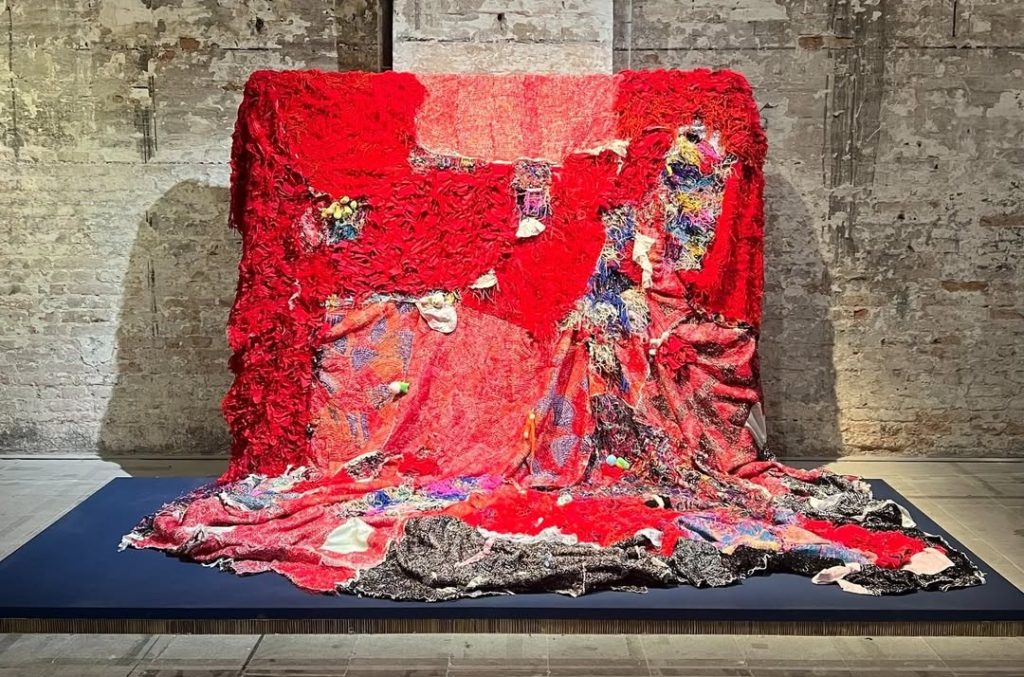
The majority of the artwork on display at the Biennale features handwritten writing, fabrics, and discarded garments. Georgina Maxim views material as a medium for lived histories, gaining significance by care, repetition, and revision.
As part of the interview series, a conversation with Venice Biennale artists, Abirpothi, featuring Zimbabwe-based mixed-media textile artist Georgina Maxim. The artist discusses in detail her work and her presence in the Venice Biennale.
Q: Your works at the current Venice Biennale seem to hold memory, grief, repair, and intimacy together through cloth and stitching. What does it mean for you to bring such deeply personal and tactile histories into a global exhibition space like Venice?
Georgina Maxim: I have found a way to these granny things, granny ways of being the custodians of traditions, words, stories: everyone has a granny that is almost a vault of memories, things and recipes, you name it. And cloth is almost like that, a material that absorbs everything in all aspects and using cloth is also to save it from the ravages of time by stitching it. To simply say I am putting myself out there is not enough. The fact that my work is about memory of… then it should be the beginning of connecting with…
Q: In Borrowed Books and Underlined Statements, fragments of borrowed texts are stitched into fabric panels. What draws you to the act of borrowing, underlining, and re-stitching language rather than authoring a fixed statement of your own? –
Georgina Maxim: I liken borrowing to the library system. For a while, the book belongs to you. For a while, the book takes you to many imaginary places. For a while, the book enriches your words and other interesting statements. But reality returns when you have to return it, and when it’s a late return, a small punishment is given, a small fine or a two-week ban from collecting books. If you are lucky, you will get a clean book. If you are double-lucky, there is always that one person who underlines statements, which stops you from continuing to read and makes you wonder why these words and statements were underlined. I borrowed “No Longer Human” by Osamu Dazai from my husband; it was a necessary disturbance to read his underlined passages.
Q: The Shona stitching technique, dhungemutunge, appears central to your practice. How do you see this “quick and haphazard” stitch functioning politically, especially in relation to repair, survival, and histories from the Global South?
Georgina Maxim: Dhungemutunge is a Shona word that remains difficult to translate. It’s a stitch found on cotton or tobacco bales: Zimbabwe was once known as the breadbasket of Africa. It’s also a stitch that was used after a caesarean birth and to mend a wound from a nasty mishap. The stitch, too, can be used to quickly repair a torn garment – but never to be reworked again. So, it stays in its awkwardness until the garment is no longer used. In my world, this stitch is a temporary solution to a permanent problem. We live in a world where almost everything must be given a quick, haphazard solution, and everyone is expected to be a cheerleader.
Q: Your work often transforms discarded or second-hand clothing into archives of lived experience. What kinds of stories do you believe garments carry that other materials cannot?
Georgina Maxim: It is not only discarded or second-hand clothing, but the majority are also passed down, collected from deceased close relatives, and others’ “borrowed and not returned” clothes. I have a strong sense that clothes are very much a second skin. I have given myself time to see how anyone has a lucky skirt, a lucky dress, or a good-vibe confidence-boosting blouse – something good always happens when wearing that particular garment. This, for me, is a second skin, a chance to become one with and alive in these mentioned garments, and to invest in the good things that will definitely happen when wearing them; nothing ever goes wrong in this garment. Such stories need to be kept longer, with care and memory. Notice that I often wear women’s clothes. There is a huge responsibility when wearing a dress or a skirt bestowed upon you; you can’t afford to be reckless or not to embrace your femininity.
Q: In many ways, your practice resists perfection: mismatched threads, borrowed fabrics, reject buttons, visible repairs. Is this rejection of Polish also a rejection of dominant ideas about value, beauty, and completion?
Georgina Maxim: In our girls’ bedroom, a sewing needle was always pinned to the curtain. The last person to use it always had to return it to the same place with a thread dangling for easy identification. The next user never bothered to change the thread to match the repair needed. It didn’t mean we didn’t care, but we just didn’t have that many threads to match the clothes we always needed to repair, and the repairs were supposed to be done. And we were not naughty either, we just had many things to do, and parks to slide down, and swings to get yourself hooked on, or a fence to jump over to see your neighbour. Indeed, it is both, but more of the beauty in growing up, making do with what is available, and finding more in these elements.
Q: 33 Letters of Knowing You Will Reply turns private correspondence with your late sister into a public installation. How did you negotiate the tension between intimacy and exhibition while creating this work?
Georgina Maxim: I want to remember her longer than I have known her. She was the mother of my children. It’s a beautiful custom in Zimbabwe where children are lucky to have many mothers, depending on how many sisters they have. You begin to see your children live longer with your younger sister, and even in your death. The letters are an encouragement to anyone who has lost a sister or a sister figure. Koyo Kouoh was a sister to many. I met Koyo at the age of 19 in Harare at Gallery Delta during my student attachment months. I was inspired to become such a lady, a woman. I had to remember all these emotions of awe and sorrow and find the in-between, and the letters provided the right relief. My sister was 33.
Q: Grief in your work is never monumental or theatrical; it accumulates quietly through repetition, touch, and labour. Why is slowness and softness important to the way you speak about loss? –
Georgina Maxim: You can never hurry to recover from loss. It’s an important process to mould you and reflect on what it really means. It took me becoming a mother to realise the loss that I have kept silent because of not having my own mother. It was in a vision of sorts, or maybe deep thoughts of hers, that I felt the strong presence of her absence. The realisation that I do not have her, and ever since then, I search for her, in images, in my face and mannerisms, in stories, in the one garment that belonged to her. It’s the same with my grandmother, the same with my sister, the same grief just sits quietly, and you become best friends with it.
Q: The black stitched panels introduced into Borrowed Books and Underlined Statements interrupt the earlier red field. What kinds of disruptions or contradictions were you interested in bringing into the work through this shift?
Georgina Maxim: Eventually, this work will be completed. Each time I see it, I want to add more to it. The black panels are supposed to signify the pencil notes in those borrowed books, those necessary disturbances. I think they worked well, no?
Q: You have repeatedly described sewing as “a good deed to the heart.” How much of your practice is about self-repair, and how much is about collective or historical healing?
Georgina Maxim: A good deed to the heart indeed it is. You are alone but not lonely in this process. Your heart is at its calmest, your mind is not very distant from what is in your hands, the needles, the cloth. You might be surprised to find the garment revealing the things that make soothing gestures and bring clarity. In our history, we find that communities are the most effective means of achieving anything. For a while, I traded on the grounds of ‘healing through stitches. And began defining stitches in the following:
– When women came together once every week to knit, sew, cook and relieve each other from the worries in the homes. Everyone was good at something; today, religion has taken over these gatherings.
-the statement of “I was in stitches” as a point of laughing wholeheartedly
– and to have evidence of stitches from a scar, to be allowed to show off this scar as a point of survival and encouragement to everyone.
Q: Your artworks seem to search constantly for absent figures — your mother, your sister, anonymous wearers of clothing. Is your practice ultimately about preserving presence, or learning how to live with absence?
Georgina Maxim: I might have to say both preserving, like how we preserve our tomatoes, gherkins, and such, and living with absence, because skipping a heartbeat is not always reserved for the good things, but also for the sad parts in our lives.
Q: As both an artist and co-founder of Village Unhu, you have long invested in collective artistic infrastructures in Zimbabwe. How has community-building shaped your understanding of art beyond the individual artist?
Georgina Maxim: All we are doing, Misheck Masamvu and I, is what we wished someone would do for us when we chose to do art.
Q: Textile practices have often been dismissed historically as craft, domestic labour, or women’s work. How do you position your practice within wider conversations about the politics of textiles in contemporary art?
Georgina Maxim: I believe my participation in the group exhibition Unravel: The power and politics of textiles in art made me very aware of how vital every artist using textiles is in shifting the definitions embedded in history. The fact that textile is a tool for translating or confronting fear, absence, violence, resistance, political injustice, and so much more shows that it is not inferior but rather a movement that has been pinned down for centuries.
Q: Your work frequently deals with archives, but not in the traditional institutional sense. Instead, memory appears through fragments, repairs, stains, and handwritten notes. What interests you about fragile or incomplete archives?
Georgina Maxim: My grandmother was a primary school teacher. She carried a basket to school, and in it there was always the file of lesson plans, a flask of tea, and a set of knitting needles. My interest was with the knitting needles, and I always took them and ruined the stitch. So, she taught me this skill in a strange way; whilst she was knitting, she would ask about school, my friends, the dogs outside, but seated in a way that I could see the knitting slowly. She always slowed this act whenever she noticed I had taken her things, until the day she gave me and let me finish. Having someone pass down this knowledge is a huge burden, I have since noticed. Many who view my work see someone, feel, and are driven to a memory of joy or sorrow because the work holds or contains fragments of someone or something. Is this a crisis that needs to be dealt with care and healing? Yes, just like how my grandmother Faith-Mary slowed down moments of teaching.
Q: Across your practice, there is a recurring insistence that repair need not hide its scars. Do you think your work is ultimately arguing for a different way of understanding vulnerability, history, and survival?
Georgina Maxim: Yes, of course, what is the point of not allowing yourself to melt?
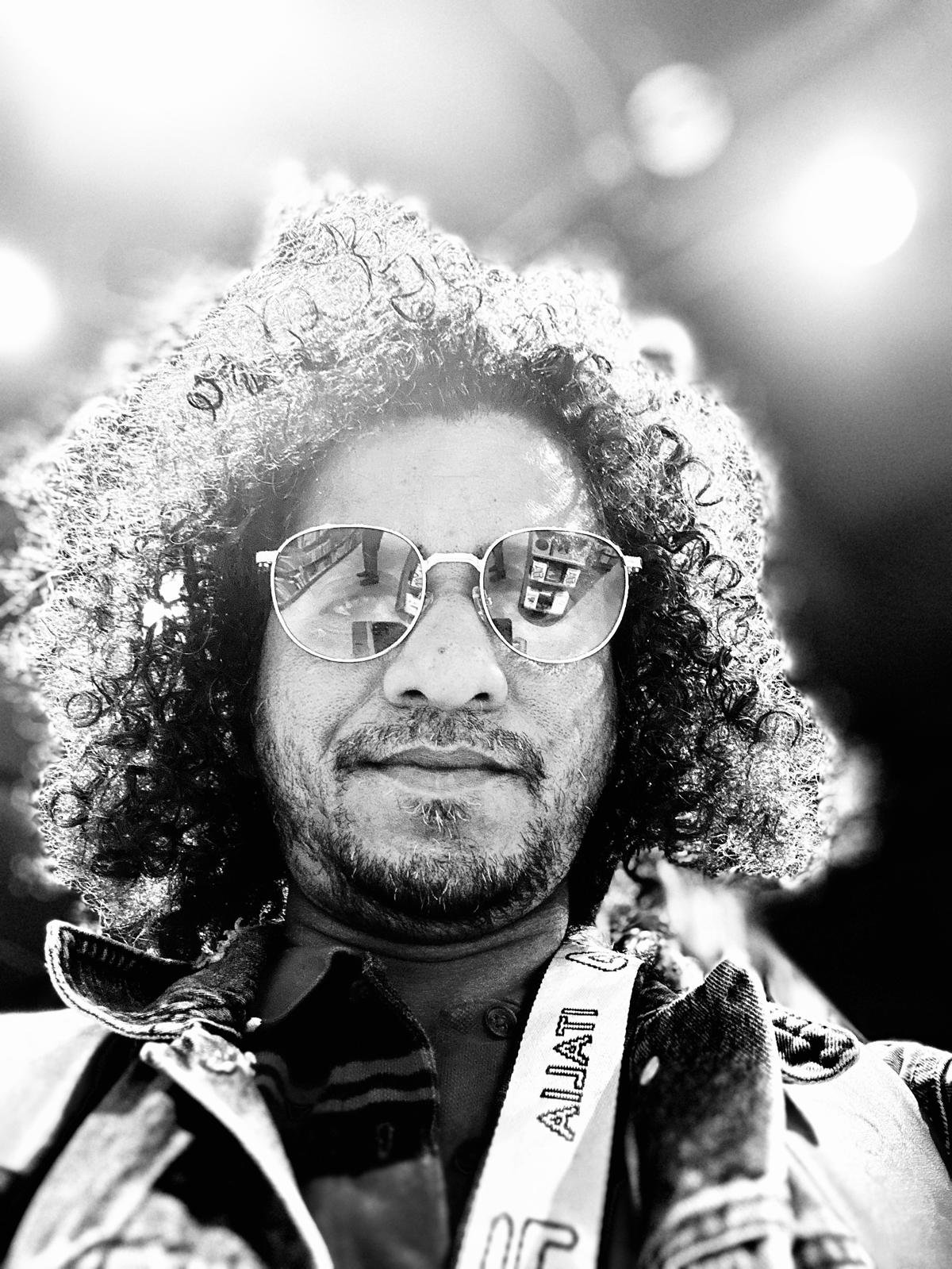
Krispin Joseph PX, a poet and journalist, completed an MFA in art history and visual studies at the University of Hyderabad and an MA in sociology and cultural anthropology from the Central European University, Vienna.