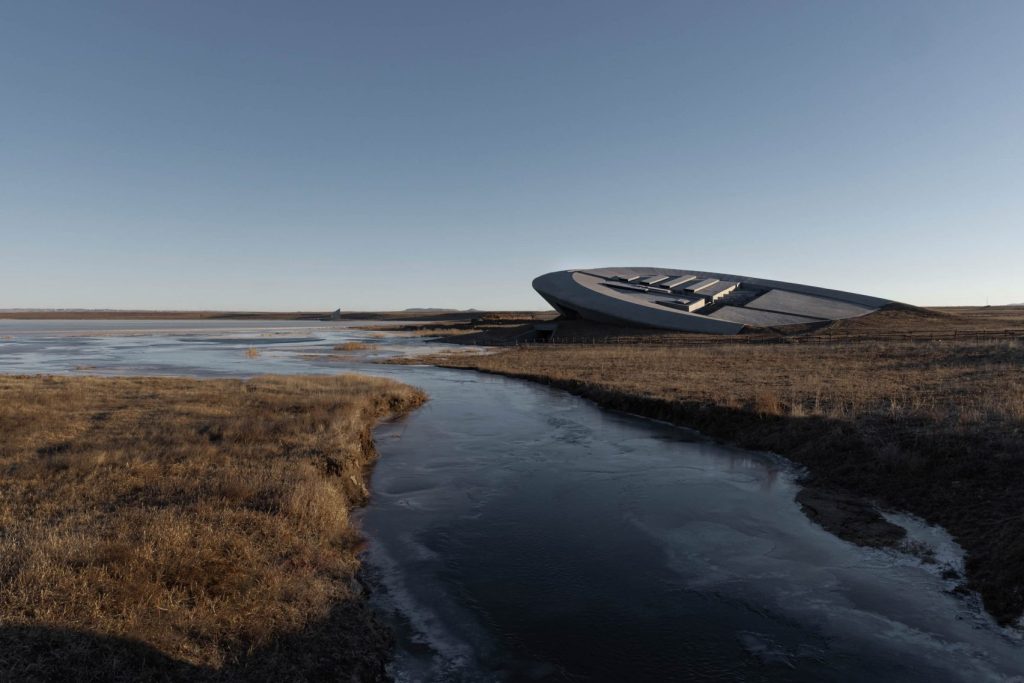
Büro Ziyu Zhuang has completed Prairie Ark, a public gallery on the shores of Lake Laoli in the Ulanchabu Steppes of Inner Mongolia, about 160 kilometres west of Beijing. The building reads like a flying saucer that has come to rest on the grasslands, lower and more horizontal than a conventional museum.
Studio founder Ziyu Zhuang rejects familiar Mongolian clichés such as yurts, nomadic tents and Genghis Khan motifs. Instead, the team stages an alien-like volume that sharpens the sense of distance from the city and foregrounds the raw scale of the steppe.
Low, circular form in the grasslands
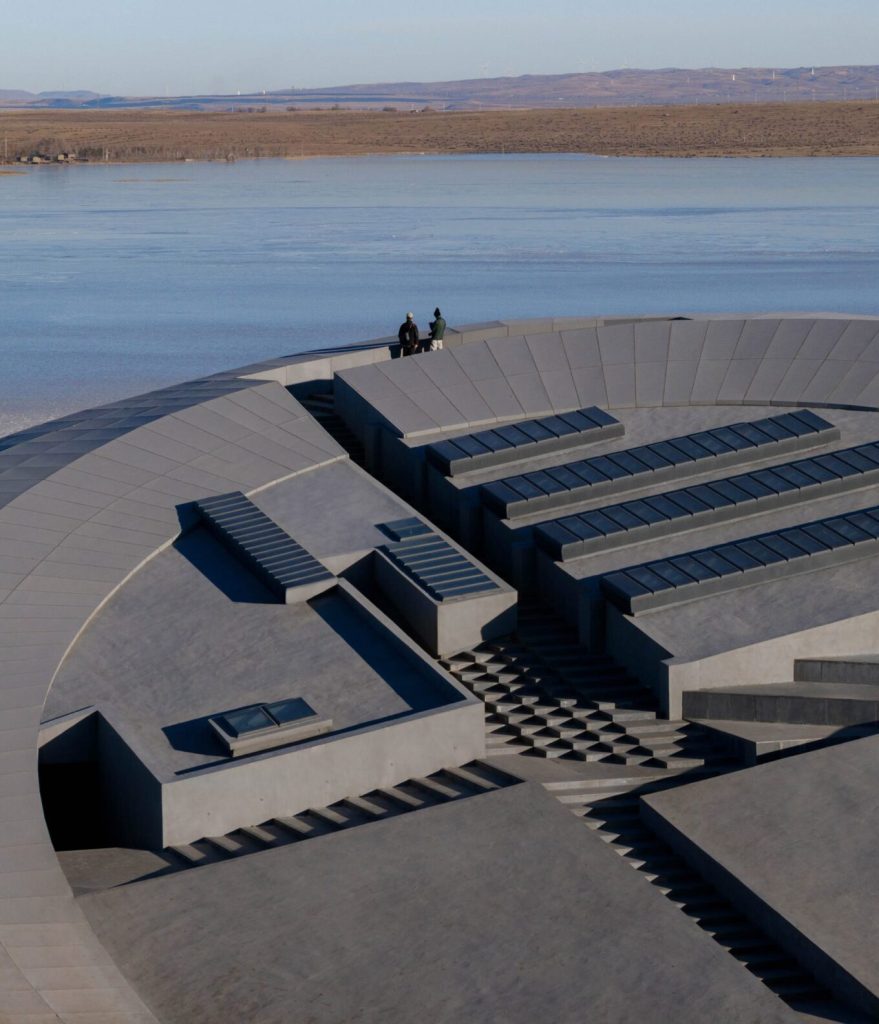
Prairie Ark sits as a compact ring that hugs the ground, with a soft, sloping profile rather than vertical façades. From a distance, the gallery appears almost weightless, like a disc skimming the prairie surface. The circular footprint creates a continuous edge against the flat horizon. The architects use this edge to frame long views of grass, water and sky instead of urban surroundings.
Visitors approach the building not through a front door but by walking directly up onto a terraced roof from the surrounding grassland. This roof acts as a new topography, tilting gently and inviting people to climb, linger and survey the steppe. An opening at the top cuts through the volume and serves as the main entrance to the gallery. The architects describe this void as a “natural cut through the landscape,” a gesture that extends the prairie into the body of the building rather than stopping at its edge.
A bright, flexible interior
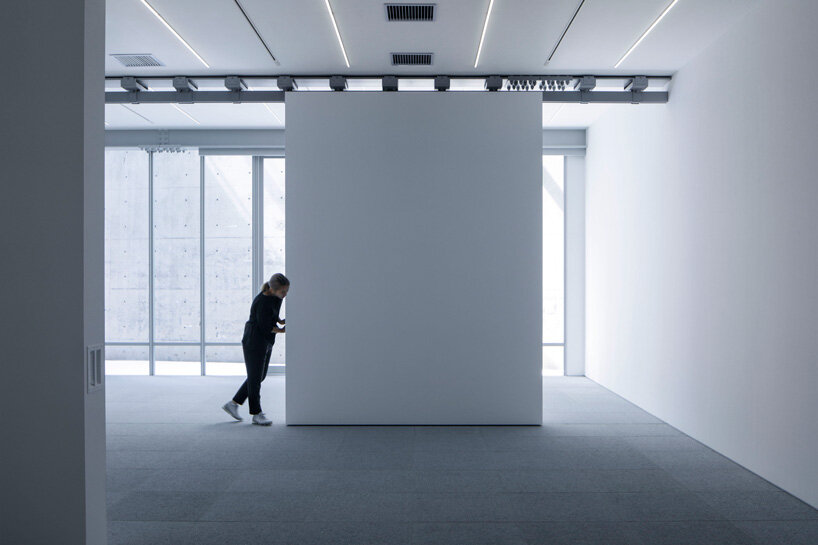
Inside, Prairie Ark functions as a multipurpose hall rather than a rigid sequence of white cubes. The main floor remains open and free of internal partitions, ready to host exhibitions, conferences, brand events and social gatherings. A multi-level ceiling steps and folds above this hall, with skylights that pull daylight deep into the interior. The varying ceiling heights and shafts of light set up different atmospheres within the single open room, allowing curators to shape zones without solid walls.
Nomads’ Beacon Tower as vertical counterpoint
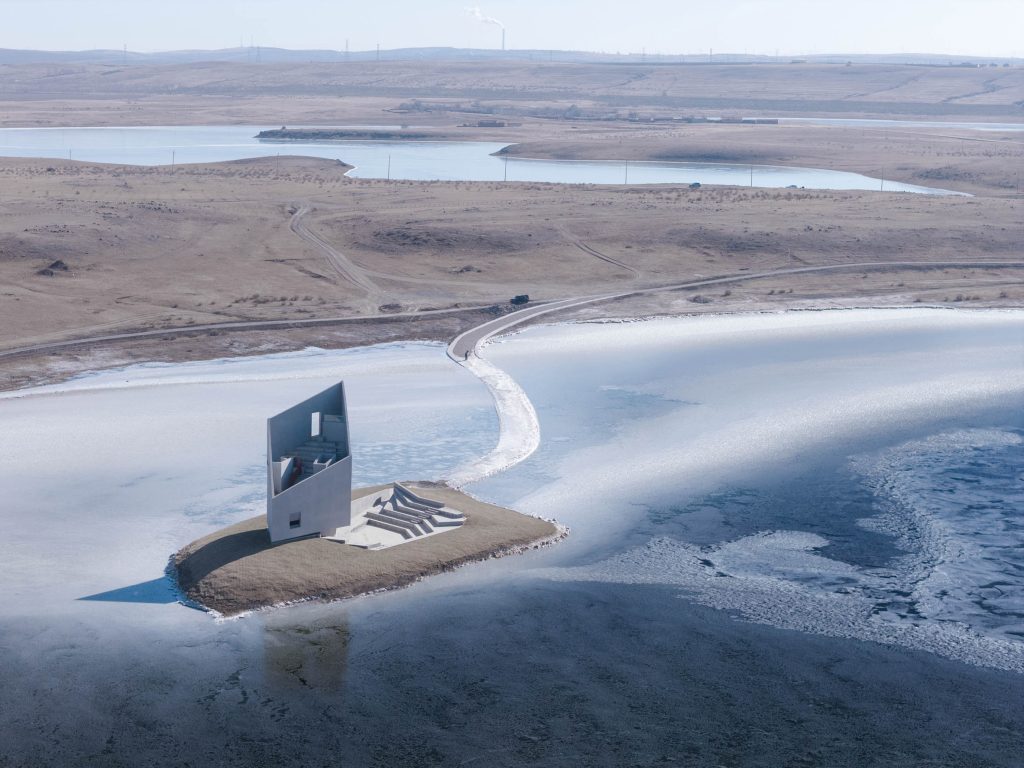
Next to the low circular gallery, the studio has added Nomads’ Beacon Tower as a slender vertical landmark. Its form recalls the smoke signals of ancient beacons and the watchtowers along the Great Wall of China, translating those images into a contemporary silhouette. One route to the tower carries visitors across the water and through a small open-air amphitheatre before they enter the structure.
Stairs coil around a central chimney to reach a terraced roof deck, where visitors gain panoramic views over Lake Laoli and the surrounding steppe. In summer, rising water levels partially flood the approach to the tower. The path then turns the tower into an island-like monument, heightening its sense of remoteness and aligning it with the gallery’s theme of isolation from urban life.
With Prairie Ark, Büro Ziyu Zhuang uses a UFO-like form to question how cultural buildings can sit in fragile landscapes without resorting to tourist stereotypes. The gallery and its beacon tower together script a new way to enter, view and inhabit the Inner Mongolian grasslands as a vast, open interior

Contributor