Why Design for Disability Matters
Every object, building and screen we use was designed by someone, and every design carries assumptions about the person who will use it. For most of history, that imagined person could see, hear, walk, read and grip without difficulty. Anyone who could not was left to adapt, or was simply left out.
The scale of that exclusion is large. The World Health Organization estimates that around 1.3 billion people, roughly one in six worldwide, live with a significant disability. Many more experience temporary or situational limitations: a broken arm, a crying baby on one hip, bright sunlight on a phone screen, or the gradual changes that come with age.
Design for disability starts from a simple idea. If design creates barriers, design can also remove them. This article introduces what that means, the thinking behind it and the designs that have changed everyday life.
What Is Design for Disability?
Design for disability is the practice of creating products, spaces, services and systems that people with physical, sensory, cognitive or mental health impairments can use independently, safely and with dignity. It covers everything from a wheelchair ramp to a screen reader to a medication label written in plain language.
The field rests on an important shift in how disability is understood. The older medical model treats disability as a problem located in a person’s body, something to be cured or corrected. The social model, developed by disabled activists in the 1970s and 1980s, argues instead that people are disabled largely by their surroundings. A wheelchair user is not disabled by their legs so much as by a flight of stairs with no lift.
Seen this way, disability becomes a design problem, and designers become part of the solution.
Accessible, Universal and Inclusive Design
Several overlapping terms describe this work, and they are worth separating.
Accessible design focuses on meeting specific needs and standards, so that people with disabilities can use something at all. Building codes and digital guidelines such as the Web Content Accessibility Guidelines (WCAG) set out these requirements.
Universal design aims higher. Coined by architect Ronald Mace in the 1980s, it seeks to create one design that works for as many people as possible, without the need for special adaptations.
Inclusive design treats diversity as a starting point. It involves people with disabilities directly in the design process and accepts that one solution may not fit everyone, so it often offers choices.
Assistive technology sits alongside these approaches. Wheelchairs, hearing aids and prosthetics are designed for particular individuals and needs.
The Seven Principles of Universal Design
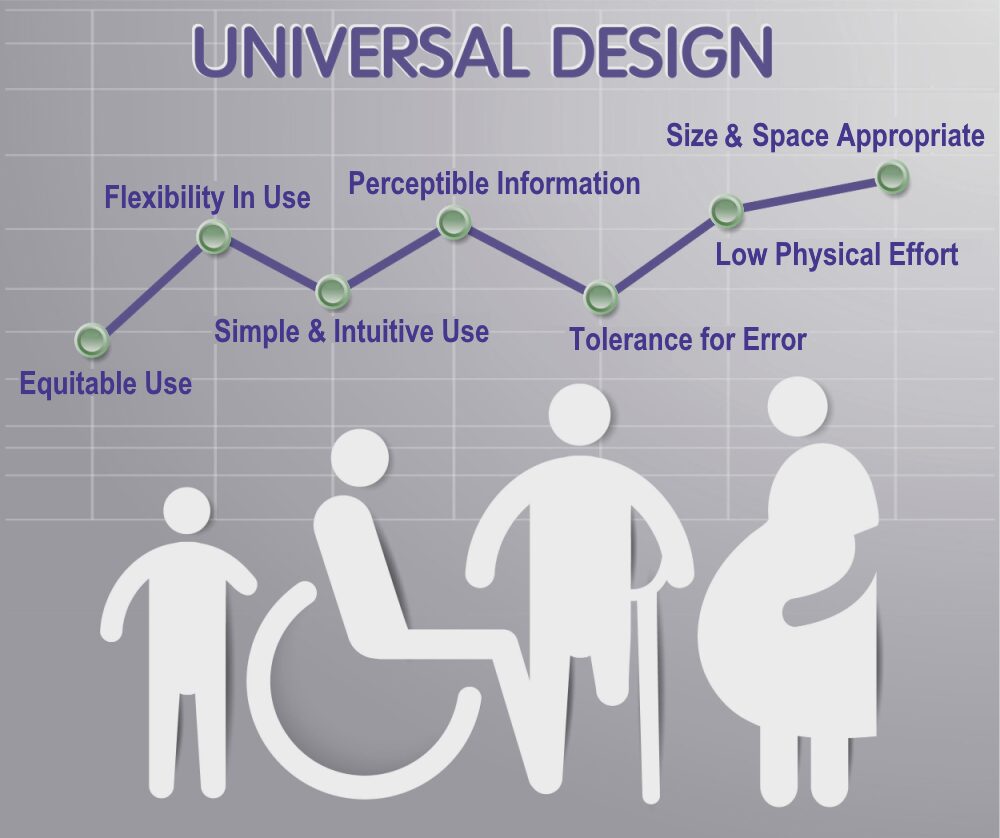
In 1997, a team at North Carolina State University led by Ronald Mace published seven principles that still guide designers today:
- Equitable use: the design is useful to people with diverse abilities.
- Flexibility in use: it accommodates a range of preferences, such as left- or right-handed use.
- Simple and intuitive use: it is easy to understand, whatever a person’s experience or language.
- Perceptible information: it communicates through more than one sense, such as sound plus light.
- Tolerance for error: it limits the harm caused by mistakes.
- Low physical effort: it can be used comfortably with little strain.
- Size and space for approach and use: it leaves room for any body size, posture or mobility aid.
Together, these principles turn good intentions into criteria a designer can actually test.
Key Designs: Buildings and Mobility
The most visible designs for disability are found in the built environment. Ramps and lifts give wheelchair users, people with walkers and parents with prams a way past steps. Wide doorways, level thresholds and automatic doors remove the need to push, pull or squeeze through. Accessible toilets provide grab rails, turning space and lower fixtures.
Lever door handles are a simple but powerful example. Unlike round knobs, they can be opened with an elbow, a closed fist or a hand weakened by arthritis.
In public spaces, tactile paving guides people with visual impairments. Its raised dots warn of a hazard such as a platform edge, while raised bars indicate a direction of travel. Low-floor buses, kneeling vehicles and step-free stations extend this thinking to transport, so that a journey is accessible from start to finish.
Key Designs: Sensory, Cognitive and Digital
For people with sensory impairments, good design means offering information in more than one form. Braille on lift buttons and medicine packaging, audible signals at pedestrian crossings and high-contrast signage support people who are blind or have low vision. Captions, visual alarms and hearing loops do the same for people who are deaf or hard of hearing.
Cognitive accessibility is less visible but equally important. Plain language, clear icons, consistent layouts and step-by-step instructions help people with learning disabilities, dementia or brain injuries.
Digital design has opened a major new front. Screen readers convert text to speech, voice control replaces the mouse, and adjustable text sizes help people with low vision. Accessible websites provide text descriptions for images and allow full navigation by keyboard. The smartphone, with its built-in accessibility features, has become one of the most powerful assistive devices ever made.
Design and Disability at the V&A
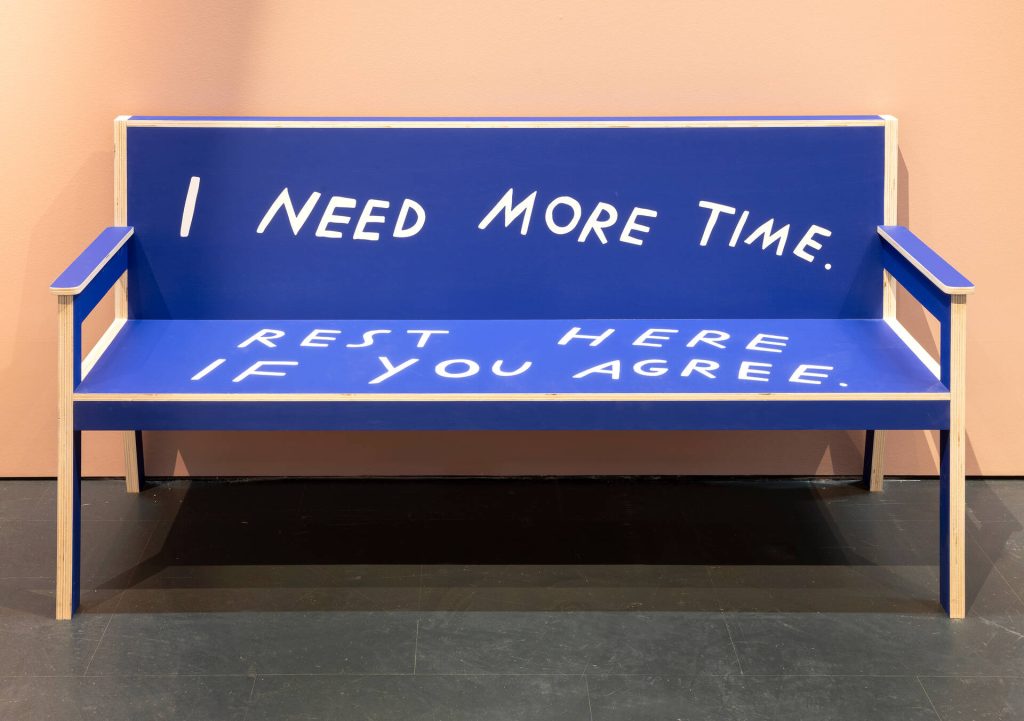
The field’s growing profile was captured by the V&A’s landmark exhibition Design and Disability, which ran at V&A South Kensington from 7 June 2025 to 15 February 2026. The exhibition celebrated disable people as designers in their own right, tracing their contributions from the 1940s to today. Around 170 objects spanning fashion, art, architecture and photography were arranged in three sections: Visibility, Tools and Living. Exhibits ranged from zines and protest banners to hacked household objects, adapted game controllers and a voting device for blind voters. The show also practised what it preached, with rest spaces, tactile maps, audio description and plain-English guides. The Guardian called it “a world-shaping, boundary-breaking joy of a show”.
The Curb-Cut Effect: Design That Helps Everyone
In the early 1970s, disability activists in Berkeley, California, campaigned for small ramps cut into pavement kerbs so wheelchair users could cross the street. Once installed, the curb cuts turned out to help almost everyone: cyclists, delivery workers, travellers with suitcases and parents with pushchairs.
This “curb-cut effect” appears again and again. Captions designed for deaf viewers are now used in noisy cafes and on silent phone feeds. Text messaging, audiobooks and voice assistants all have roots in technologies developed with disabled people in mind.
Athmaja Biju is the Editor at Abir Pothi. She is a Translator and Writer working on Visual Culture.