“It is said that India’s history could be written through a history of her textiles.”
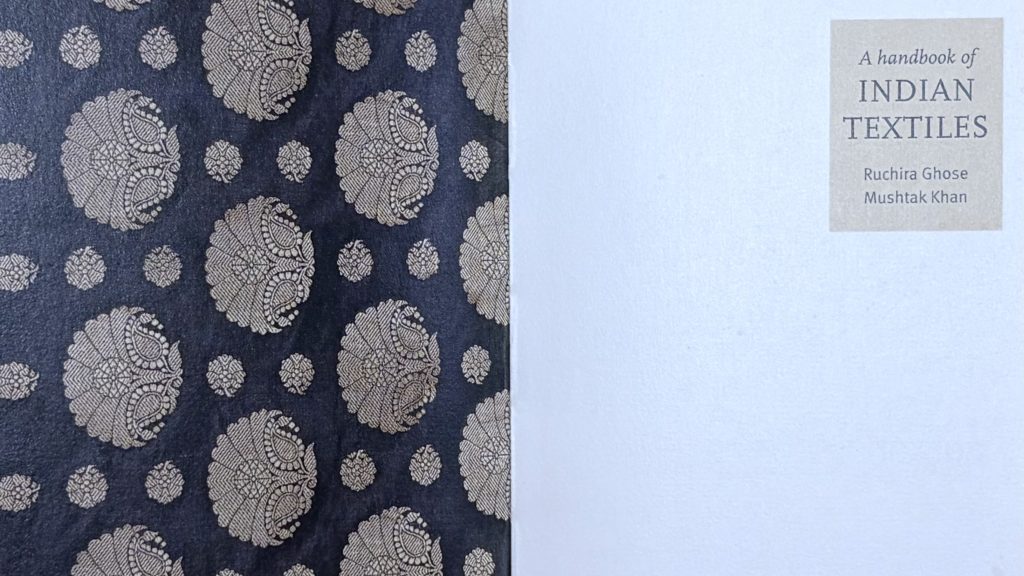
With its roots in the Indus Valley civilization, the history of Indian textiles has been traced back over 50o0 years. The Indian textile landscape can seem like a daunting subject to approach with such an extensive history and the sheer regional diversity of textiles. However, A Handbook of Indian Textiles by Ruchira Ghose and Mushtak Khan, published by Arthshila is a great introduction for any textile enthusiast looking for a threshold into the vibrant world of Indian textiles. The compact handbook maps out an expansive assortment of Indian textiles based on their geographical origins.
Textiles can be explored through various frameworks: where they are made, the process of making them, their history, their cultural significance, etc. Instead of claiming to be an exhaustive directory, the handbook focuses on one such aspect of textile making: the technique. Rather than becoming entangled in a plethora of historical accounts or academic debates, the book grounds itself in the material aspect of the craft, demystifying the labour that goes into the making of textiles. The individual descriptions delve into mechanical processes that make each textile’s craft unique. For example, the Balarampuram sari in Kerala is prepared with warp yarn that is sized with a brush, making the threads rounded which gives the fabric its smooth finish. The emphasis on the craft helps readers understand the intricate handiwork required to engineer these textiles and appreciate the artisanship behind it.
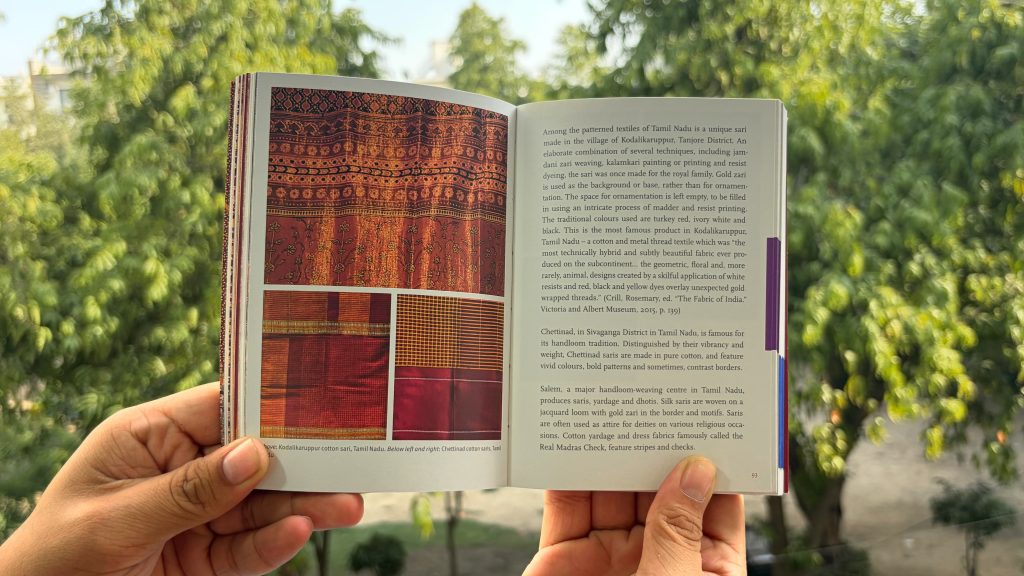
The aim is to introduce the reader to an array of textiles and traditions, prioritising brevity and scale. As stated in the preface, the handbook is not made for specialists or researchers looking for comprehensive historical or cultural accounts, it is simply an introduction for those beginning to explore the world of Indian textile art. To make the handbook more categorical and easier to navigate, it has been divided into three sections based on the design production of the textiles: pre-loom, on-loom, and post-loom. Each section opens with a national density map that charts the concentration of the textiles through the states of India. Interspersed with facts about Indian textiles, the handbook catalogues the textiles with pictures and a brief description with emphasis on the technique used to craft it. The pictures transform the handbook into a visual directory of Indian textiles that can be readily browsed through to delve deeper instead of the standard textbook approach.
For design students, craft lovers, and textile enthusiasts looking for a panoramic introduction to India’s textile heritage, the handbook is a good reference and introduction to the textile arts.

Contributor