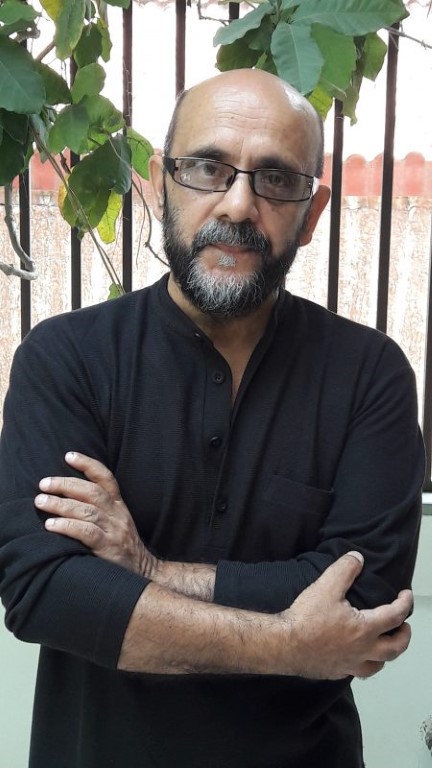
Dr. Suresh Sheth, a renowned painter, writer, and art critic from Gujarat, passed away on September 26, 2026, at the age of 88. His passing came as a shock to Gujarat’s art community.
Sheth taught painting, art history, and aesthetics at the C.N. College of Fine Arts for several decades and held numerous solo exhibitions during his career. For ten years, he wrote extensively on art criticism and the artistic journeys of prominent artists for The Times of India. He also contributed articles on art and culture to newspapers such as Divya Bhaskar and Sambhav.
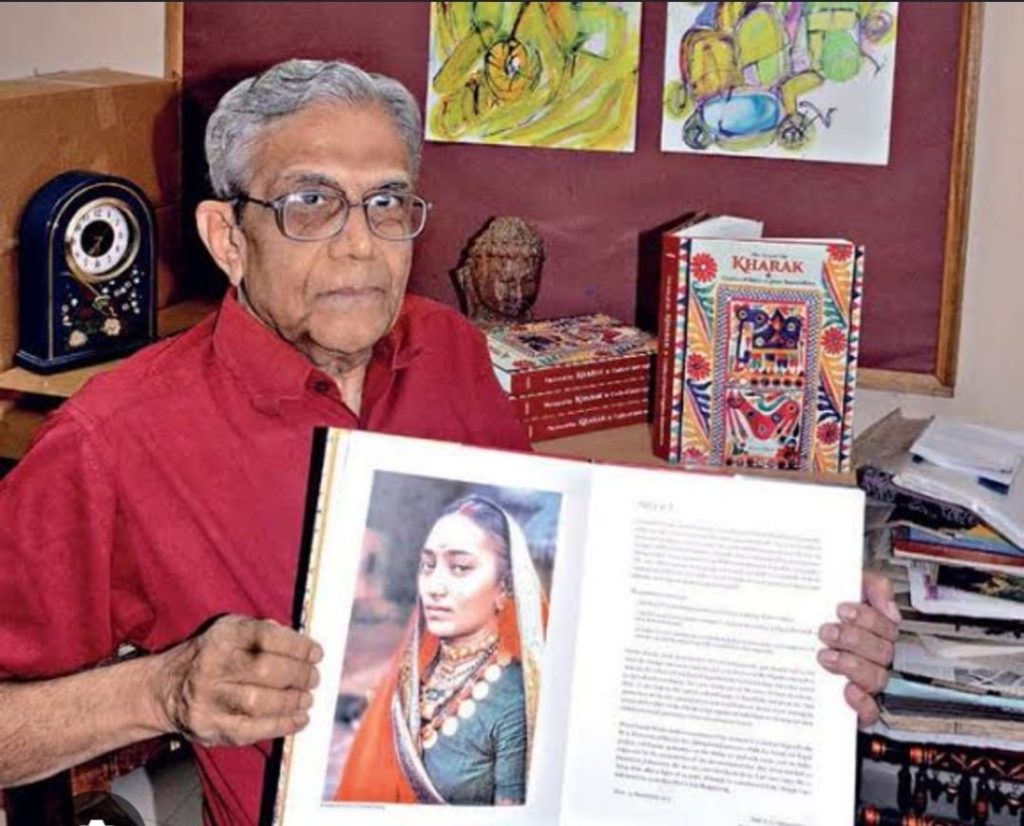
He earned his Ph.D. from the Faculty of Fine Arts, Vadodara, conducting his research under the guidance of the eminent artist and art critic K.G. Subramanyan. His doctoral research focused on the mural paintings, embroidery, and artistic craftsmanship of the Kharak community of the Mahuva region in Saurashtra, in his native Bhavnagar district. As was customary at the time, the oral examination for his doctoral thesis was conducted in Delhi by the renowned writer Dr. Mulk Raj Anand.
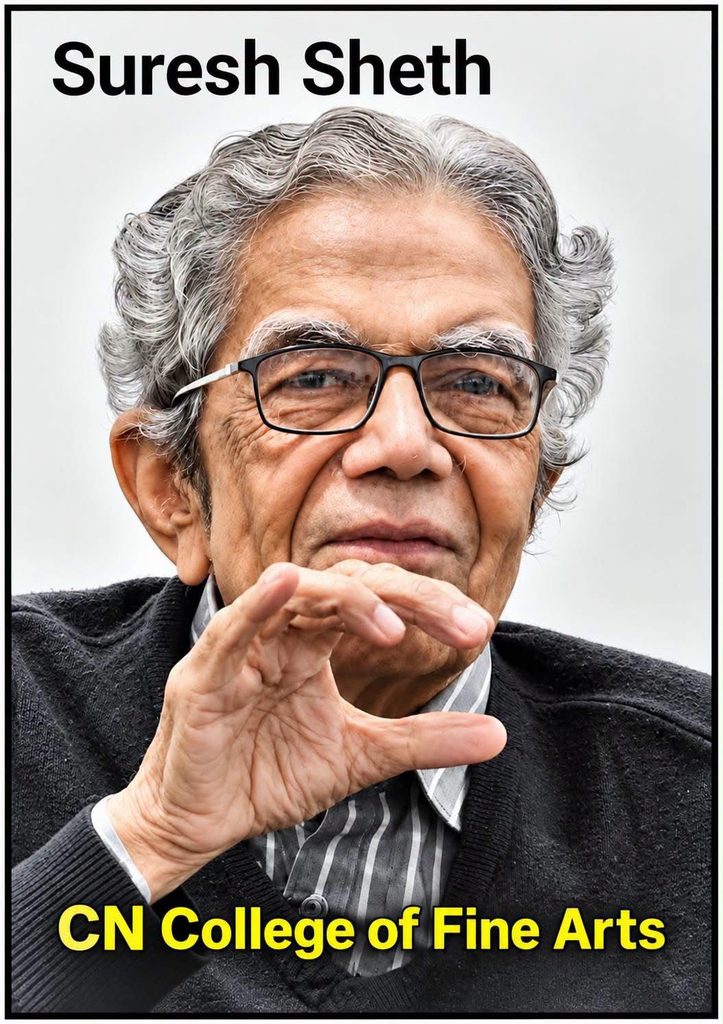
Sureshbhai was a simple, unassuming, and candid person. He came from the prominent Nagarsheth family of Bhavnagar, and an air of aristocratic refinement was evident in his demeanour. His paintings were marked by a vivid and distinctive imagination. Colour and ink were his preferred mediums, through which he created countless works. Alongside his paintings, he also wrote short, imaginative stories.
The simplicity of his personality found its way into his art, while the depth of his research experience enriched his visual language. He gave a distinctive identity to recurring motifs such as parrots, sparrows, elephants, and horses through spontaneous brushwork and sketches. Elements from his surroundings and memories—the rocky coastline of Mahuva, boats, a British-era bungalow, the streets of Bhavnagar, and the Thakorji Haveli—evoke a sense of childhood nostalgia that runs through his playful artistic style.
At the same time, Sheth approached the rapidly urbanising landscape of Ahmedabad with a fresh and inventive perspective. Overbridges, traffic, and petrol pumps became subjects for his imagination. He often took contemporary issues, infused them with elements of fantasy, and presented imaginative solutions with a lighthearted sense of humour. His work occasionally carried a gentle satire of modern lifestyles.
A spectrum of prismatic colours can be seen in his ink drawings, where one can also sense the influence of his mentor, K.G. Subramanyan. Sureshbhai shared a deep mentor-disciple bond with Mani-da, as Subramanyan was affectionately known. Every Diwali, Mani-da would unfailingly send his students greeting cards featuring his own line drawings.
Sureshbhai’s wife, Renuben Sheth, is also a writer and professor. On the occasion of their wedding, their friend and world-renowned painter Bhupen Khakhar gifted them one of his watercolour paintings. Sheth also maintained close friendships with celebrated painters Amit Ambalal and Gulam Sheikh, bonds that were forged during their years at the Faculty of Fine Arts in Vadodara. The artists would frequently meet to discuss various aspects of the art world and its evolving trends.
Sheth made it a point to exhibit his paintings every year or two. In the truest sense, he created art for the sheer joy of making and sharing it, without any strong commercial ambition. His practice was driven less by the desire to sell and more by the impulse to communicate and share his work with others.
In the final years of his creative journey, Sheth experimented with paper-cut collage. He greatly admired the paper collages created by the renowned artist Henri Matisse during the later years of his life, when failing health had limited his ability to paint, and was influenced by this approach to some extent.
Sheth’s own experience of more than five decades in picture composition and dimensionality found expression in these works. With minimal lines and shapes, he could create a sense of depth and spatiality within a picture.
Sheth joined the C.N. College of Fine Arts as a faculty member in 1981. After retiring in 1995, he continued to teach as visiting faculty until 2023. Over this long tenure, generations of artists studied art history under his guidance. He was a favourite among students, in part ause of his humorous nature. He had a particular ability to explain complex ideas surrounding modern art movements and aesthetics through lighthearted and relatable examples. He also enjoyed sharing tea and biscuits with students and colleagues, making his interactions with them warm and informal.
A significant part of Sheth’s intellectual and artistic practice was devoted to documenting traditional artistic practices and craft traditions. Under the aegis of the All India Handloom and Handicrafts Board, he conducted research and wrote extensively on subjects including the Dhablas (traditional blankets) of Saurashtra and Kutch, becembroidered Mojdis (footwear) of North Gujarat and Kutch, the wall paintings and embroidery traditions of farming communities, and the handicrafts of the Banjara people of Jalgaon district.
His book on the folk art of Saurashtra, Pili Bhomka (Yellow Land), co-authored with Ushakant Mehta, was published in 1967. Another important work, Kharak Jati ni Kala-Sanskruti (Art and Culture of the Kharak Community), was published by the Information Department of the Government of Gujarat.
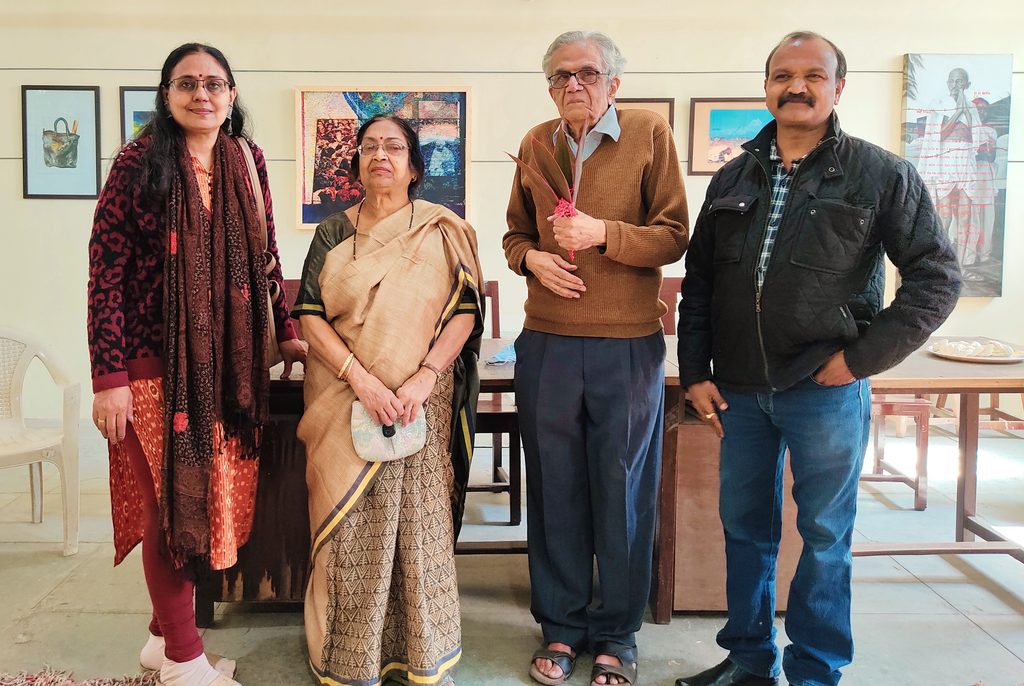
A Gujarati translation of this significant research work was later published by the Gujarat Kala Pratishthan, Surat—a translation project that I had the good fortune to undertake. The book was launched in the presence of members of the Kharak community and Sant Shri Morari Bapu.
In 2018, a collection of Sheth’s imaginative stories, Udti Vartaao (Flying Tales), was published. The work was also translated into English.
Dr. Suresh Sheth leaves behind a rich legacy as an artist, teacher, writer, critic, researcher, and chronicler of Gujarat’s artistic and cultural traditions. His work brought together research and imagination, memory and humour, tradition and contemporary life. Above all, his practice reflected a deep curiosity about the world around him—and a generous desire to share that curiosity with others.
Featuring Image Courtesy: Gayatri Trivedi
This Article is written by Gayatri Trivedi, Lecturer, C.N. College of Fine Arts

Contributor