Registrations for the inaugural CII Banaras Biennale, a month-long, city-wide cultural platform that takes Banaras as its central subject is open now. Titled “KASHI / LIGHT — The City as Sensorium”, the Biennale will run from 27 November to 31 December 2026 across Varanasi, weaving together visual art, textiles, craft, music, performance, scholarship and public programmes into a living conversation between inherited knowledge and contemporary practice.
A City as Subject
Unlike conventional biennales that import art into a neutral exhibition space, the Banaras Biennale is conceived as an immersion into the city’s existing cultural ecology. Its curatorial frame — KASHI / LIGHT approaches Banaras through what can be seen, heard, touched, remembered and reimagined: a place shaped by overlapping histories and continuing acts of cultural production.
The programming deliberately moves beyond the idea of “tradition” as something fixed in the past. Instead, it asks how forms, practices and knowledge continue to be used, interpreted and transformed in the present, in museums, archives, workshops, institutions and public spaces that become sites of encounter between the inherited and the newly made.
Institutional Anchors and City-Wide Venues
The Biennale is being organised in partnership with Banaras Hindu University (BHU), with Bharat Kala Bhawan serving as a key institutional partner and Jnana Pravaha, a centre for cultural studies hosting curated dialogues and residencies.
Core venues include:
- Banaras Hindu University campus: Academic engagement, student participation, public lectures and masterclasses
- Bharat Kala Bhawan: Exhibitions and artefact-based programming anchored in the museum’s collections
- Jnana Pravaha: Curated dialogues, residencies and scholarly conversations
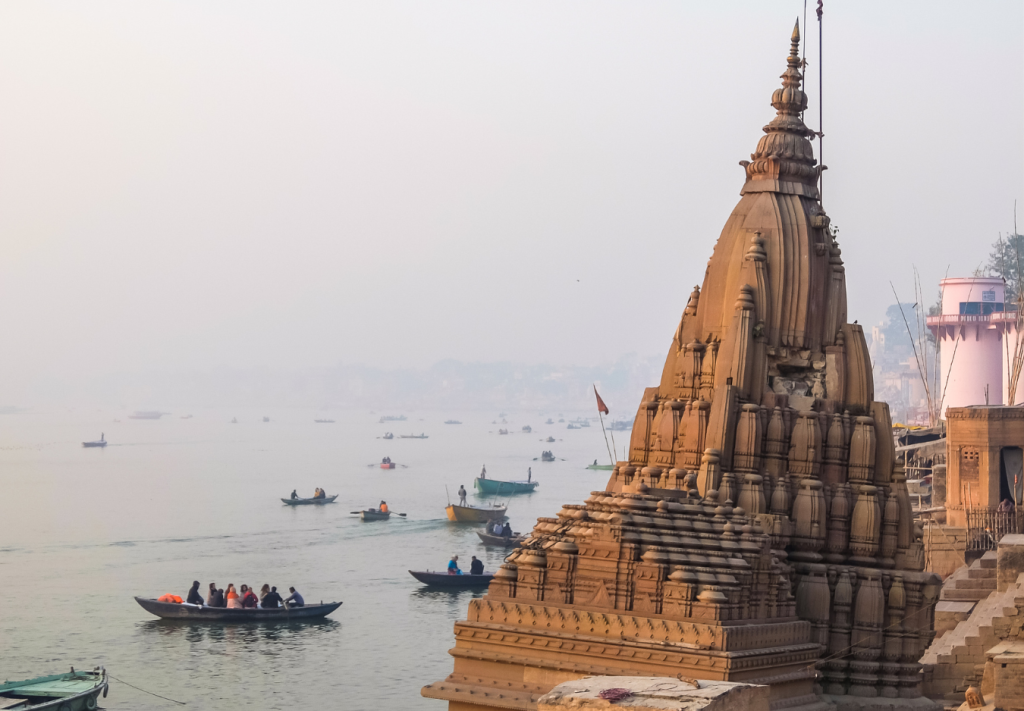
- Public ghats and neighbourhoods: Including Namo Ghat and Tulsi Ghat, extending the programme into everyday urban lifehellobanaras+1
This multi-venue structure turns the entire city into an open-air cultural platform, with visual art, photography and sculpture sitting alongside khayal and dhrupad, and Banaras’ own folk repertoire of kajri, chaiti and thumri.
Curators, Practitioners and the “Sutradhar” Ethos
The curators of the CII Banaras Biennale 2026 are Gayatri Sinha as the Lead Curator, Pramod Kumar KG focusing on Textiles & Crafts, and Anjan Chakraverty representing Jnana Pravaha.
The curatorial team reflects a wider network connecting cultural practitioners, business families, academia, government and India’s newer museum-and-archive ecology.
Beyond Exhibitions: Craft, Enterprise and the Weaver Economy
The Biennale is explicitly linked to the city’s material and economic life. Organisers have proposed skill-training and employment centres, along with support programmes aimed at an estimated 4,000 to 5,000 weaver families in Ramnagar, Lohta and Badi Bazar, an attempt to route some of the season’s attention, and some of its buyers, back to the looms that made the city’s name.
Alongside the cultural programme, the event is expected to draw around 1,000 entrepreneurs, including a top-100 group of Indian business leaders and delegates from Italy, Spain, the United States and other European countries. Invitations have been extended to the Prime Minister, the Uttar Pradesh Chief Minister and the Governor, signalling the event’s positioning at the intersection of culture, enterprise and policy.
The Biennale will also host the inaugural Banaras Film Festival, adding a cinema dimension to the broader arts programming and further expanding the range of contemporary practice in dialogue with the city.
For India’s art and design ecosystem, the Banaras Biennale represents a significant experiment in how large-scale cultural platforms can be rooted in living heritage rather than imported models. By treating Banaras as both setting and subject, and by embedding the programme in institutions like BHU, Bharat Kala Bhawan and Jnana Pravaha, the Biennale attempts to build a durable infrastructure for culture that connects scholarship, practice and community.

Contributor