We are currently in the midst of many wars. While the Russia-Ukrainian war that started on February 24, 2022, is ongoing, America and Israel together attacked Iran, while Israel’s attacks on Palestinians continue. The response given by writer Arundhati Roy to the question of how to look at the war is noteworthy: “Once weapons were manufactured to fight wars. Now wars are manufactured to sell weapons.” The idea shared here is that war itself has become a manufactured market for weapons. In short, war is variously situated in the war market.
Among all these various arguments, the question of how artists respond to war is very relevant. Against the backdrop of the ongoing Russia-Ukraine war, I explore the works of Ukrainian artist Zhanna Kadyrova, which were once exhibited at the Kochi Muziris Biennale and are now on display in two different galleries and museums.
On wartime
The Futurist Manifesto, written by Italian poet and thinker Filippo Tommaso Marinetti, is a hymn that glorifies war: ‘War is beautiful because thanks to gas masks, terror-including megaphones, flame-throwers, and small tanks man’s dominion over the subject machine is proven. War is beautiful because it ushers in the dreamt-of metalization of the human body. War is beautiful because it enriches a meadow in bloom by adding the fiery orchids of machine guns. War is beautiful because it combines rifle fire, a barrage of bullets, lulls in the firing, and the scents and smells of putrescence into a symphony. These excerpts written by Marinetti are cited by the German thinker Walter Benjamin in his essay ‘The Work of Art in the Age of Mechanical Reproduction.’ The Futurist art movement blindly followed the idea that war is one of humanity’s greatest creations. By the time they realised the reality, war had already taken the lives of many members of the Futurist art group. It’s also a historical fact that many of them couldn’t even foresee the brutality in Marinetti’s ‘Beautiful War,’ which claimed the lives of so many.
War is not a concept brought forward by modernity. There have been countless people who viewed human society as a creation of war, and others who saw war as an art form. Among them are thinkers, warriors, strategists, and leaders. The conclusion of the Kalinga War (261 BCE) deeply affected Emperor Ashoka. After that, when he adopted and spread Buddhism, the very history of India changed. Thinkers, including Plato, have reflected on the concept of war and sometimes concluded that war is good. There is a strong argument that the power of the city-states that united to stop Persia’s attack was also the reason they later stood together and formed modern Greece. That might have been what inspired the Futurist art movement to glorify war.
There are so many war stories, and the logic behind war is that post-war societies will become better communities and that life will later unfold in societies with better systems. People’s attention is drawn to the speed at which war creates things. In capitalist logic, war is the centralisation of new creations as well as a country’s entire resources. Even if we accept the idea that concentrating all a country’s resources on a cause leads to progress that outweighs all other setbacks, we cannot ignore the destruction it causes.
For someone watching video footage of three parallel wars, and for someone experiencing war only through footage, the question is: how much of the war can they really understand just by watching it? In an age when everything is a visual experience, theorists argue that war is too. Wars that don’t happen in our own country are served up on our dining tables along with breakfast, lunch, and dinner. Seeing huge bombs explode over human-made structures in villages and cities, taking a deep breath, eating a little more rice/chapati, and letting out a long sigh—it’s like experiencing a day of war. It’s probably the TV channel heads who best understand how visual beings humans are. After the FIFA World Cup, the most-watched scenes will be war visuals. Even during news hours and annual ‘celebration’ times, you can see channels offering comprehensive coverage of war, as if it were a celebration.
Art of Zhanna Kadyrova
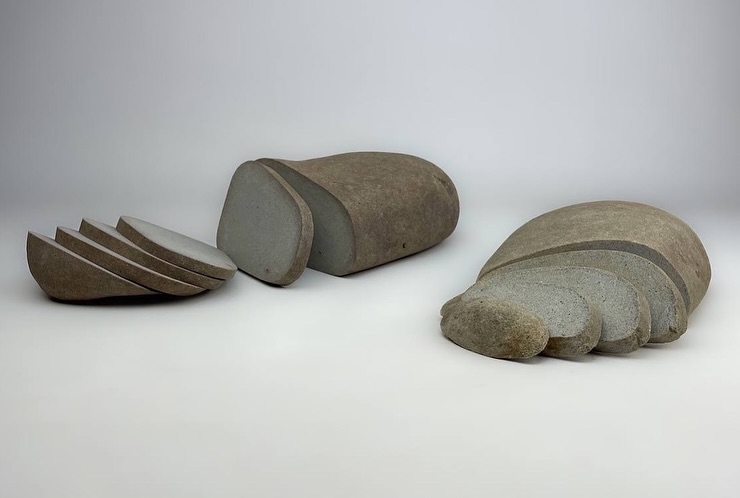
Meanwhile, in the middle of a war, what does art precisely matter? Who thinks about art during a war? Who can make art? And if you do manage to create art, who will even see it? Who needs art while everybody is running for shelter and a piece of bread? Zhanna Kadyrova, an artist who fled Kyiv at the start of the Russia-Ukraine war and now works in Kyiv, created the artwork Palianytsia, which goes beyond being visually striking to ask questions about what war really is. This artwork, which was also displayed at the 2022 Kochi-Muziris Biennale, continues to remind people of war. Right now, the piece is sharing its ‘war memories’ in exhibitions both at the Ukrainian Museum in New York and the Wilhelm-Hack-Museum in Germany.
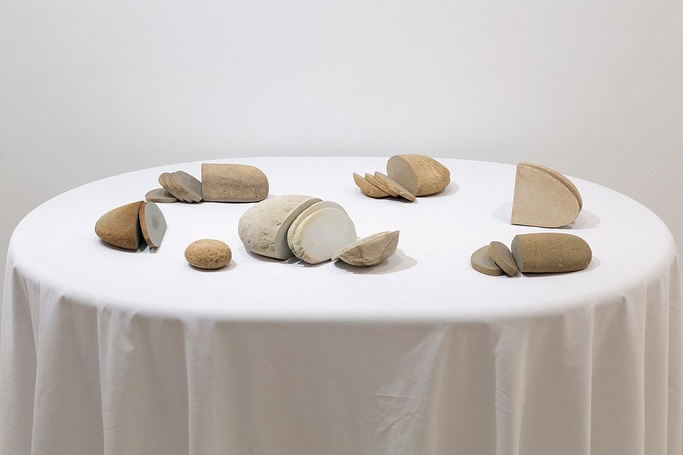
The artwork’s theme is war. But we need to read and understand the devastation of war from that piece of art (stone). The artwork is like a loaf of bread that hasn’t been sprinkled with blood. If you ask what kind of war is in the bread, you’d initially have to say that it was war that created this stone bread.
There’s no precise answer to how to describe a piece of stone bread as an artwork telling about war. If you see war as the gunfire, alarms, destruction, and the ruined city remains, then Zhanna’s art is just bread from a country. But some stories/facts behind the bread might help change that perception. Zhanna’s artwork is titled ‘Palianytsia’. This title forever changes the connotations of this artwork. This title highlights the semiotic differences between Russians and Ukrainians. Zhanna chose this word because it is famous for being hard for Russians to pronounce properly. This word is a shortcut for identifying Russians entering Ukraine.
To put it plainly, this word works as a linguistic password in the borders of Ukraine. The specific combination of vowels and consonants in ‘Palianytsia’ makes it incredibly difficult for native Russian speakers to pronounce correctly. When a Russian speaker tries to say it, it usually sounds closer to ‘palyanitsa’ or ‘palinitsa’. Ukrainian soldiers and citizens have used the word at checkpoints to quickly reveal Russian saboteurs or troops trying to pass as locals.
Palianytsia is also the name of a bread served in the spirit of hospitality and holds sacred status in Ukrainian culture, symbolising hospitality, well-being, security, and the sun. Historically, it was torn by hand rather than cut with a knife to show respect. After the Russian attack began, we can see that the defence prepared by the Ukrainian people around the world was perhaps more effective than weapons. It becomes a word that people in a neighbouring country cannot pronounce, a word that becomes the name of a bread, a bread that separates friend and foe. The Ukrainian people have etched this bread into their language. This is the magic of how a language becomes the shield of a people. This bread is a symbol of a word that has become a nation’s shield, and then an artwork.
‘I am now one among a hundred million Ukrainians turned into war refugees,’ Zhanna Kadyrova wrote to me in reply to an email I sent during the Kochi Binnale in 2022. Leaving one’s homeland and home to flee to foreign lands. The various crises in between, the attacks and abuses that women and children experience. War brings unimaginable cruelty and exposes it openly. That shadow and its anxieties are what also came through in Zhanna’s email.
Zhanna’s family and a few friends left their home in Kyiv and reached a village near the Hungarian border, 700 kilometres away, under the condition that Russia could attack Ukraine at any time. The village in the Carpathian Mountains of western Ukraine, which Zhanna herself described as ‘the safest place in the world,’ protected Zhanna and her family from the horrors of war. That sparsely populated village is rich with rivers. To overcome the wounds of the war and the circumstances of having to leave their homeland, Zhanna and her family later travelled extensively throughout that village and the Carpathian Mountains. Amid the worries of various places, she noticed the pebbles in the river. Having left her home and studio, believing it was impossible to continue her artistic work, the river pebbles presented Zhanna with a new creation and concept.
The bread called Palianytsia, baked in wheat dough, has been recreated on the pebbles of the Rika River. The Rika is a river that flows through the Carpathian Mountains, stretching about 1,145 kilometres and nurturing life in western Ukraine. On the stones shaped by the flow of the Rika, the most complex days of Zhanna and the Ukrainian people are reflected in it. War has destroyed Ukraine. Despite the immense resilience of the Ukrainian people, all the creations built over the years have been destroyed. The Ukrainian people are now in exile. The art piece named Palianytsia by Zhanna symbolises both exile and resistance. War is not a means to defeat or destroy a people. War destroys constructions, not their people. The people will rise stronger in their language and culture, and build everything from scratch. The history of this resilience will be something the Ukrainian people have to tell after the war.
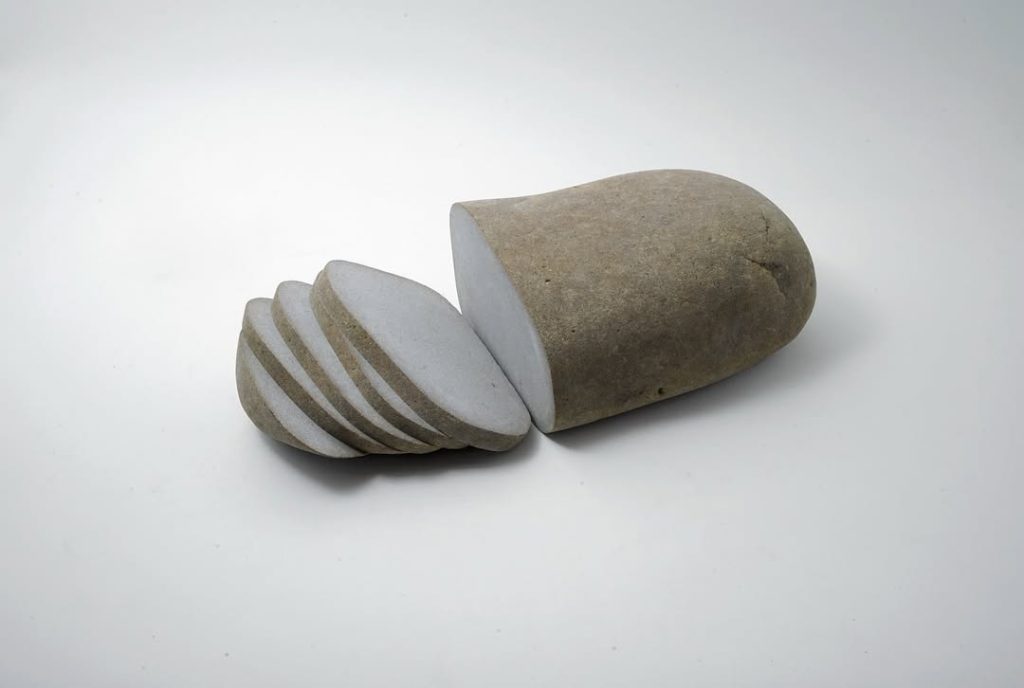
The video shown along with the installation depicts collecting stones from riverbanks, cutting them, and organising their first exhibition at a village house. The video was filmed by Ivan Sautkin, a prominent director in contemporary Ukrainian cinema. The director and his family fled Kyiv with Zhanna’s group before the war. This art piece is becoming a way to cope with the horrors of the war. The villagers in the video talk about how the nightmare of war has entered their lives. They overcome the fear of war through artistic practice.
Are the wars happening now affecting you in any way? Do you feel safe? Does the idea of a sudden military move that could hit your home at any time scare you? Does fear run through your nerves between the streets and your home? These are the many questions an artist asks. The truth is, even someone not directly affected by war is still impacted by it. Can a person, beyond just having the interest to see or spread someone else’s problems, really feel sorrow at another person’s suffering? That’s doubtful!
Ukraine occupies a strategically important position between Russia and Europe. While there are countless reasons for the war, the ultimate goal is to gain dominance. Meanwhile, numerous events that turn into brutal spectacles are right in front of our eyes, captured on video. But then, there’s an art piece that doesn’t immediately confront us yet has the potential to endure for ages—Zhanna Kadyrova’s Palianytsia. Humans have reached this point by stacking stone upon stone. Do humans have the same closeness or kinship with stones as they do with other objects? Stones have moulded us, and we have remoulded the stones. But since life is not just of the past but also contemporary, we need to consider not only the history of stones but also their present existence and material nature.
Zhanna is exploring and trying to understand the work ‘Stones’ both as a material and in its essence, in the post-war context. Palianytsia says that stones can convey not just history, but also the shifting human lives and the issues of the times. A stone shaped by a river’s flow becomes both a mark of human conditions and a work of art.
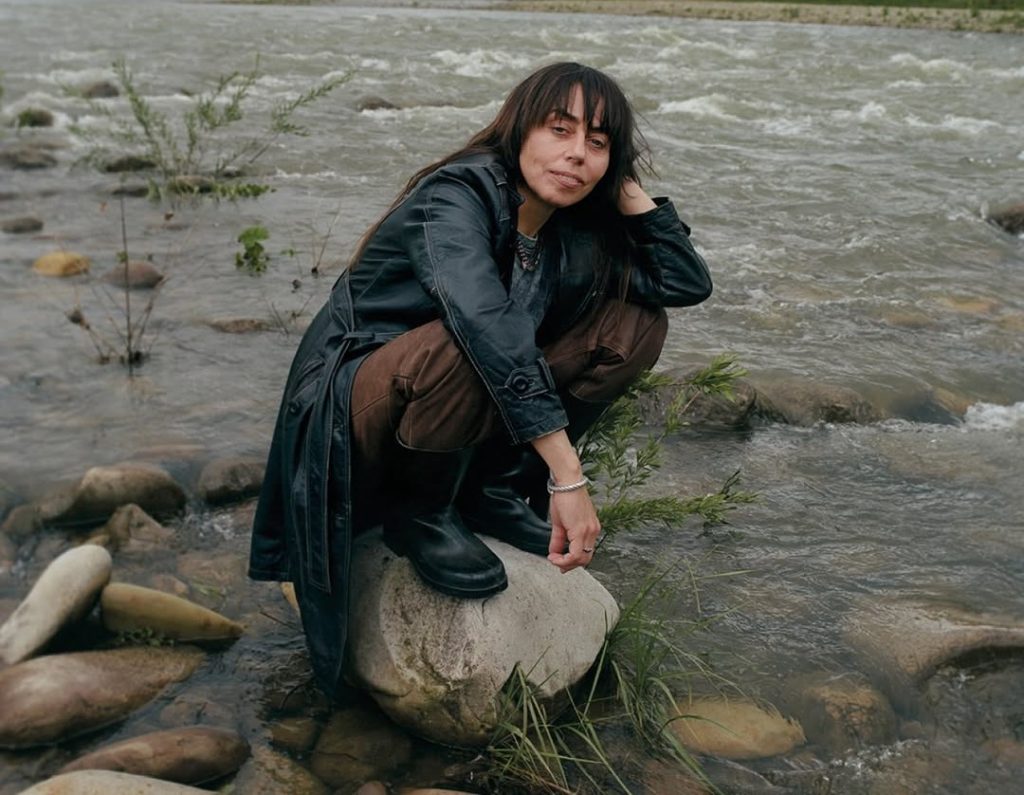
Feature image: Artist Kadyrova Zhanna (Image: Artist Instagram)
Krispin Joseph PX, a poet and journalist, completed an MFA in art history and visual studies at the University of Hyderabad and an MA in sociology and cultural anthropology from the Central European University, Vienna.