Samar Hussaini Palestinian Art: War, Memory and Identity
In a world where conflict frequently shapes society, Samar Hussaini Palestinian art offers a powerful perspective on War, identity, displacement, and memory. War continues to play a major role in political, historical, artistic, and cultural narratives. Ongoing geopolitical concerns and conflicts in the Middle East remind us that War transforms civilisations, geography, memory, and identities rather than remaining only a remote historical experience.
Artists often respond to conflict not by depicting violence directly but by translating its emotional, psychological, and historical consequences into visual language. Art thus becomes a space where trauma, memory, resistance, and identity are negotiated and communicated. After a sudden attack against Iran, the world is now engulfed by War. In the context of ongoing wars and clashes, I examine how War is reflected in art. As a starting point for these investigations, I examine how conflict manifests in Palestinian art. This inquiry proceeds with reference to the works of Palestinian artist Samar Hussaini.
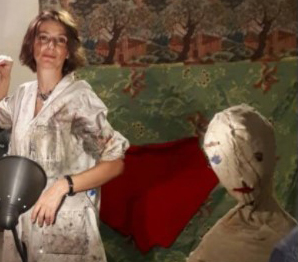
Hussaini had a prosperous career in advertising and received numerous accolades for her design work, including the Silver and Gold accolades from DTC and Creative Recognition from The One Show RX. She has won numerous honours in fine art, including the Innovative Fine Art Award from the Catharine Lorillard Wolfe Art Club in New York, for her unwavering dedication to the medium despite her career success. Hussaini’s involvement in the Venice Biennale supplemental group exhibit, “From Palestine with Love,” sponsored by the Palestine Museum, earned her global recognition in 2022. Around the world, her work has been displayed in numerous esteemed galleries, museums, group exhibitions, and solo exhibitions.
Art, War and Palestinian Identity
There are many reasons to begin a war, and War raises numerous questions. There is an atmosphere in which many questions and discussions take place, including why there is War, who benefits from War, and what the victories and fortifications are. Even amid doubts and discussions about whether War questions the conscience of humanity and destroys it, wars continue, even today, continually, anywhere. In today’s geopolitical landscape, War seems inevitable.
History is not an innocent child who is afraid of War, since it has evolved through numerous wars and conflicts. One cannot ignore the fact that, while remembering its horrors, War is sometimes inevitable. We must not forget that history is also of wars and that there is no history without War. But what is the purpose of the wars happening now, even though the subject of this article is not War; instead, it is how War is reflected in art.
There are many factors behind the condition of War. The injuries and traumas it causes are reflected in the ways those who experience them respond. These traumas often have narratives in different forms. In these narratives, War need not blaze with intensity; it need not even appear. The narrative of War usually does not reflect the War itself; instead, it can be many things, such as memory or metaphor. In Peter Paret’s book Imagined Battles, it is said about artistic representations of War, ‘Artists depict war as they know it, as they imagine it.’ Just as War is a collective experience, it is also personal. Everyone experiences different kinds of wars. Its descriptions and representations will also be different.
Palestinian Art and Cultural Identity
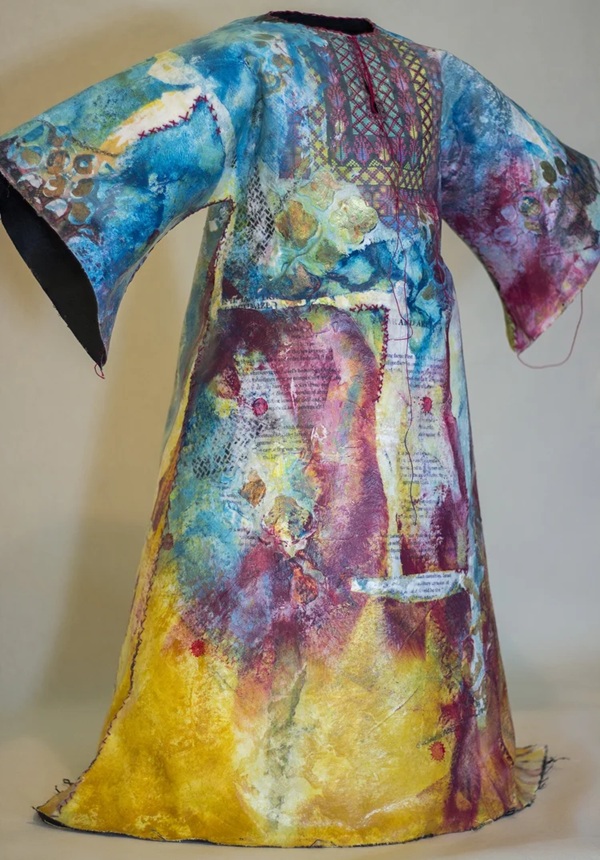
Samar Hussaini, born in America to a first-generation Arab-American refugee-immigrant parent, reimagines what it means to be both an Arab-American and a woman working and living in 21st-century America through her brilliant mixed-media works. She creates airy, thought-provoking abstract works that honour the rich, intricate heritage of Arab culture by layering acrylic paint, ink, collage, charcoal, and gold leaf on her canvases. Through this lens, Samar Hussaini Palestinian art connects clothing, memory, displacement, and cultural identity, transforming the thob into a powerful artistic record of a homeland remembered through generations.
Samar Hussaini Palestinian art explores displacement, belonging, and cultural identity through contemporary mixed-media practices. She claims that “my mission is to use art as a catalyst for dialogue and empathy, fostering appreciation for diverse cultural experiences while promoting understanding across boundaries” and uses creative embroidery to capture the experiences of diaspora communities by fusing tradition with modern expression.
Samar Hussaini’s Palestinian Art and the Thob
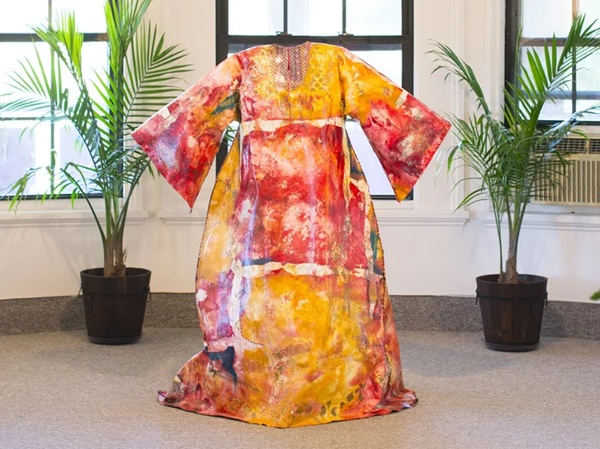
The Thob, a traditional Palestinian garment, features cross-stitched embroidery that reflects regional identity and customs. By reimagining the Thob as a mixed-media canvas, Samar Hussaini preserves customs that Palestinian families pass from one generation to another. In addition to offering thought-provoking concepts of communication and Hope, Hussaini aims to visualise complex problems that enhance her uniqueness as a Palestinian-American artist.
What seems important to note among the artworks Hussaini presents is the reconstructed Palestinian traditional dress, the Thob. As Chad Elias (2018) mentions in his book Posthumous Images, it ‘create an alternative paradigm of representation in which a range of pressing issues,’ that is, War and its memory, ‘the traumatic aftereffects of civil war violence, the curtailment of civil liberties, continuing sectarian divisions, border hostilities, the social cost of reconstruction, can be publicly articulated and worked through’. Samar Hussaini, born in America, carries the wounds and memories of her father, who had to leave his homeland, Nakba, Jerusalem, during the ethnic cleansing in 1948. She knows about War, ethnic cleansing, and exile as stories, the experiences of others.
Still, the knowledge and pain she gains from the experiences of her father, who lived through it, and from others they share with her, and others are real with hideous pain. War wounds, especially in diaspora, in exile, carry memories of loss in multiple layers, including lost homeland, trauma, and it becomes embodied pain, like a second skin.
The Thob as Memory and Resistance
As Jacques Rancière says, Hussaini creates a ‘fictional archives’ through recasting the Thob and her own interpretation of it. She altered both as inscribed clothing and as a symbol of resistance and protest, embodying what can be described as a ‘constructed, at times playful, relationship to their history’, and becomes a bearing that firmly declares itself to be extremely political. When talking about fiction, Foucault says, ‘I have never written anything other than fiction.’ Additionally, he says, ‘It seems possible to me to make fiction work within truth.’ That is, fiction is not opposed to reality. One could say it is a kind of reality, one that is not stated directly.
In the article ‘Refashioning the Meanings of Dress in Palestinian Transnational Communities,’ Enaya Othman states that the thob transformed ‘traditional dress into a site of socio-political agency, economic empowerment, and national identity-making’. Othman argues that in a post-Nakba period, the thobs function as ‘tangible material testaments of Palestinian life’. In this context, we need the artistic creation of the thob to be seen.
While being an artistic creation, it is also a statement. Looking through the thob, in Hussaini’s artwork, its presence, as Othman argues, ‘is an ongoing practice that blends memory with adaptation and tradition with reinvention’. Thob is not just an attire but a memory, a garment woven with resistance and protest. In diaspora homes, many such thobs serve as material reminders of places left behind and of a Palestine remembered as a whole, as Othman stated. Thus, in Hussaini’s art, the thob is a political statement.
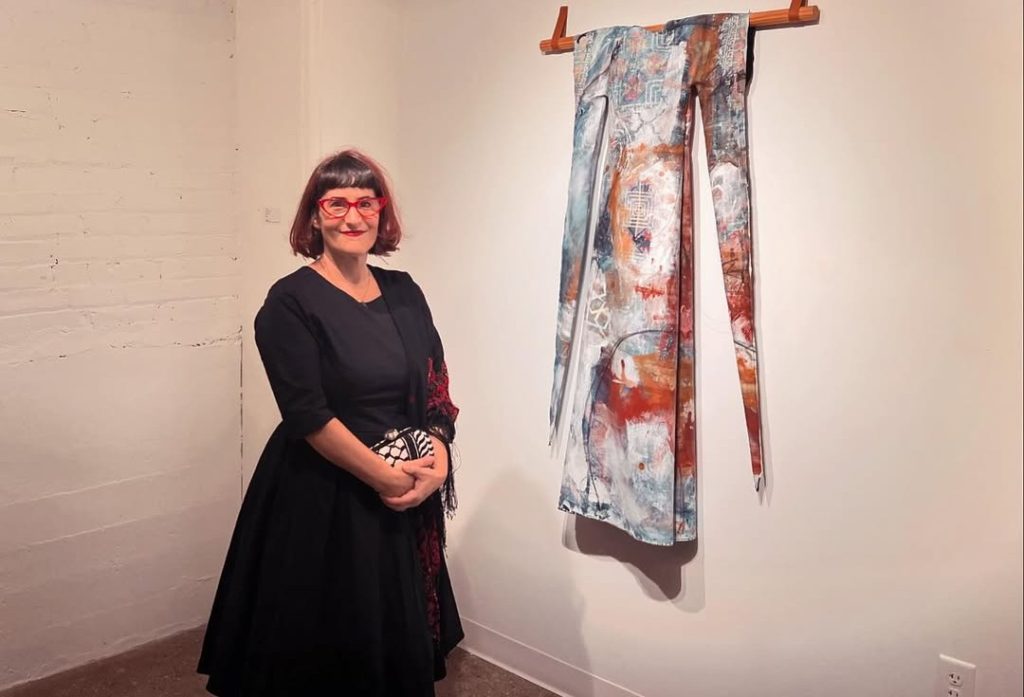
According to the information on the artist’s website, the work Legacy (2016) is where thob enters Hussaini’s creations as a political statement. Later, it can be seen recurring in various works such as Hope (2017), Resilient Legacy 2 (2017), Resilient Legacy (2017), Rise Up (2017), Her Endurance Prevailed (2021), Their Courage is Boundless (2021), She Refuses to Be Held Back (2021), Bound Determination (2022), Breathing Moment (2022), Welcome All Exiles (2022) as memories of the homeland and as reflections of the ongoing acts of aggression, portraying a past that is revisited.
From Traditional Dress to Political Statement
The artist says that each sculpted dress represents an identity and tells the story of scattered refugees. Conflict fragmented their culture and disrupted their way of life. Through this, a diaspora and a collective future standing resilience are emerging. Those clothes represent families who lost their homes, land, and way of life. Families pass these memories from one generation to another. Through the things expressed, the artist is making a significant assertion about who the lost land belongs to. The artist says she is opening the possibility of dialogue among those living as refugees. The art creation simultaneously envisions dialogue on Hope and the future and opens spaces for it. Heather Marie Akou argues that the relationship between national identity and dress is rooted in the modern concept of the nation. Generally, such relationships, which are part of everyday life, take on or are used in new ways when objects are involved in issues such as War or ethnic conflict.
Before the atrocities of the Nakba, thob embodied marital status, social standing, and personal histories, but the events of 1948 altered its meaning and purpose. Othman argues that both the thob and its use were transformed into a ‘contested terrain of belonging.’ And in exile, the thob and its embroidery came to serve as anchors for a shared memory of the land, functioning as portable monuments to an interrupted past. Othman says that for many Palestinian families in the diaspora, thobs are preserved as precious heirlooms, their fabrics and stitches carrying stories that might otherwise fade. The Palestinian people give such political sanctity to the thob. This is the context in which Samar Hussaini’s artworks, especially the thob-sculptured dresses, are situated.
Through this lens, Samar Hussaini Palestinian art connects clothing, memory, displacement, and cultural identity, transforming the thob into a powerful artistic record of a homeland remembered through generations.

Contributor