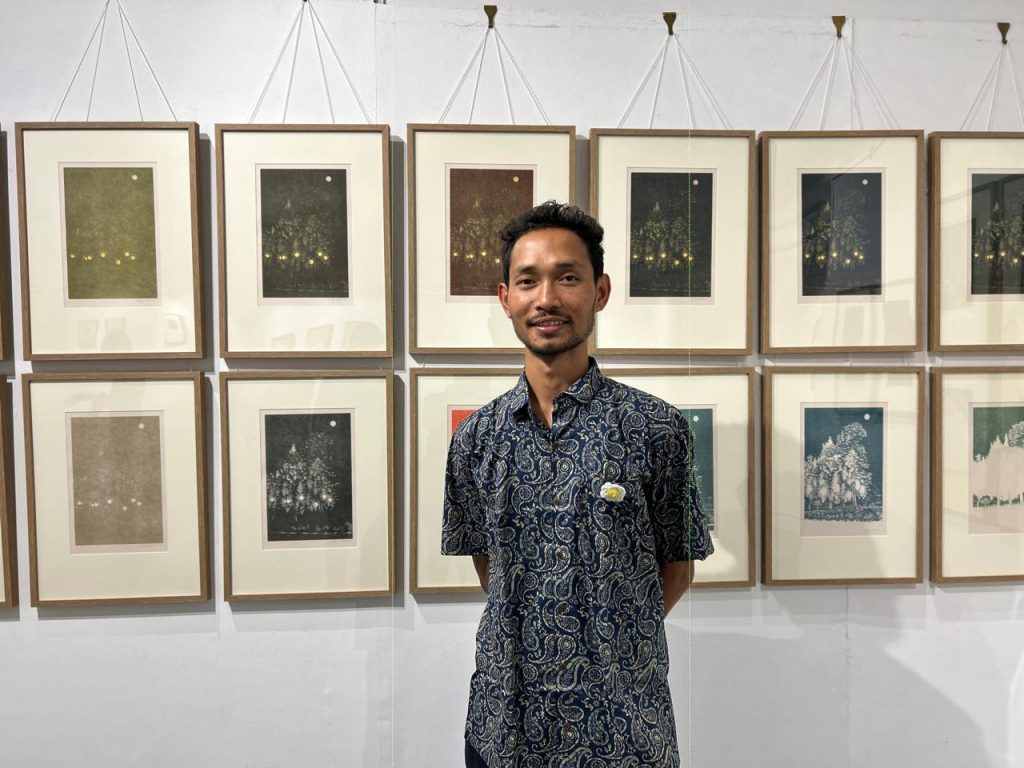
The solo exhibition of young artist Raja Boro, Echoes of the Earth: A Woodcut Diary, who came from a village in Assam to Shantiniketan in Bengal and later to Baroda University, is notable both for reflecting the paths he travelled and for echoing the places he visited.
Fundamentally, the exhibition is both a material meditation and a personal cartography. His works are an intimate mapping of memory, labour, and environment translated through the challenging medium of woodcut printmaking. Biographically, Raja Boro‘s journey from Murara, a hamlet in Rangia, Assam, to the art-educational settings of Santiniketan and Baroda serves as the framework for his intellectual and artistic development. The pieces exhibited in the show translate geography into a visual language by seemingly carrying remnants of human experience, such as fields traversed, skies witnessed, and rhythms internalised.
The curatorial endeavour brought the exhibition into a broader institutional, gallery context. Since its founding in 2019, the Ushaarth Art Foundation has promoted discussion of Indian visual art, assisted up-and-coming artists, and built welcoming environments for participation. In this regard, the Varshita New Artist Award, established in 2025 by Prayag Shukla in honour of Varshita Venkatesh, is a gesture that is both memorial and forward-thinking, aiming to support the voices of new artists. As the 2026 recipient, Raja Boro exemplifies this goal with a deeply ingrained yet broadly applicable practice.
Boro‘s art is deeply influenced by his early experiences. He formed what the curator refers to as “a deep bond with nature” while growing up in his mother’s mustard fields and walking to school every day through forests and water sources. His artistic philosophy later expresses this closeness to the natural world: “Nature is ever-giving, always nourishing. I sense a connection to the energy of nature. It eventually becomes my work after passing through me and my thoughts. Such a declaration is more than just poetry; it offers a prism through which the exhibition may be interpreted as a continuous conversation between the artist and the ecological continuity in which he lives.
This connection is emphasised by curator Shruti Lakhanpal Tandon, who notes that Boro’s imagery, which includes trees in different stages of bloom, expansive skies, and mustard fields glowing in direct sunlight, “reminds us of the majestic purity of nature…” and “makes us pause—to consider a life that may aspire towards the same.” Her curatorial framing places the pieces in a contemplative register, encouraging viewers to interact with simplicity, sustainability, and coexistence both visually and morally.
Technically speaking, Raja Boro’s work is distinguished by his meticulous use of colored woodcut. The pieces are “small in size, intricate, and with a great level of detailing,” necessitating “multiple coloured blocks” and thus “great artistry, patience, and control,” according to Uday Jain, Director of Dhoomimal Gallery. The painstaking nature of woodcut printing becomes inextricably linked to the work’s thematic themes, making this emphasis on method essential. The meticulous, laborious process of printing and carving reflects the growth and cultivation cycles portrayed in the pictures.
Jain emphasises that Raja Boro’s emphasis on nature “is not restricted to time or geography,” highlighting the universality ingrained in his vision.² However, ironically, the recurrent themes of rice and mustard fields are given authenticity and emotional depth by the very distinctiveness of his origins—his membership in the Bodo community in Rangia. The outcome is a corpus of work that alternates between the local and the global, the individual and the universal.
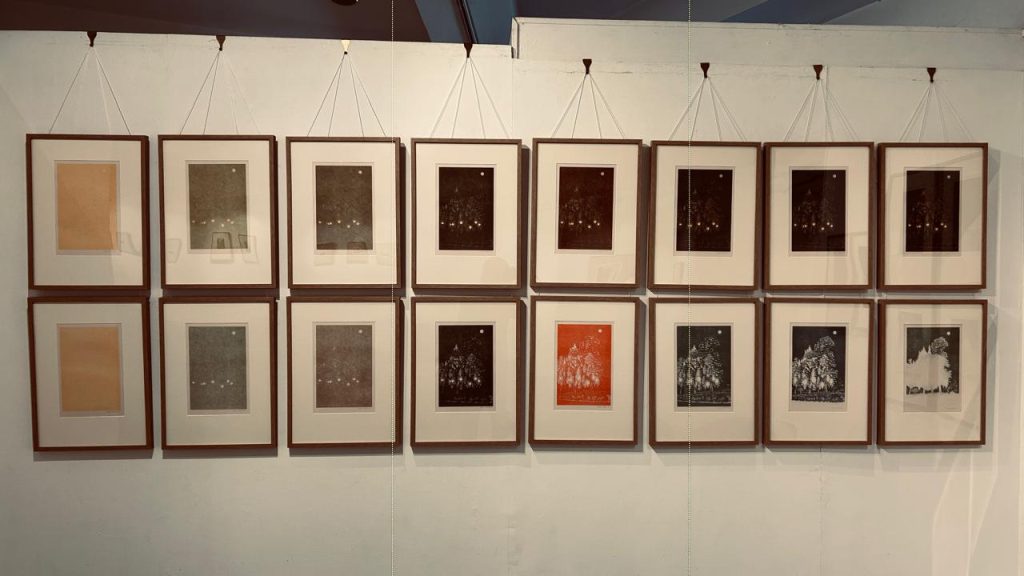
Additionally, Raja Boro’s prints have a clear, impactful quality. They have “an almost meditative quality” that inspires “peace, stillness, and calm,” according to Jain.² Prayag Shukla echoes and elaborates on this contemplative aspect, describing the pieces as “not only emotive but… irresistibly attractive for their affinity with nature,” with colours that seem “ever fresh, suggestive of rich harvest and greenery.”³ According to Shukla, seeing becomes a cycle: “Once one is introduced to his works, one is bound to come to them again and again.”
These reactions highlight the experience aspect of the presentation. Instead of overpowering the observer, the prints captivate them with their subtle tonalities, rhythmic arrangements, and almost tactile feeling of surface. According to Shukla,³ “soft, gentle, encircling” presence fosters a peaceful immersion in which attention is both expected and rewarded.
Crucially, Raja Boro’s educational background—from a Bachelor of Science in Chemistry at Guwahati University to formal instruction in printmaking at Santiniketan and Baroda—adds an additional dimension to his work. The printmaking studio, where he remembers using chemicals to create “an almost magical feeling of discovery when the print emerged from the etching plate,” is where his early interest in chemistry finds an unexpected resonance. His work’s conceptual foundations are enhanced by this convergence of creative inquiry and scientific interest, which presents printmaking as both a technical and alchemical process.
The exhibition also reflects Raja Boro’s growing presence within contemporary art circuits. His participation in events such as the Kochi-Muziris Biennale (2025), along with numerous residencies, workshops, and awards—including the Ravi Jain Memorial Award (2022) and the Varshita Young Artist Award (2026)—signals his emergence as a significant voice in Indian printmaking. Jain’s assertion that Boro is “one of the most promising and recognised names in contemporary print making in India² thus appears less as a projection and more as a recognition of an already unfolding trajectory.
In the end, ‘Echoes of the Earth: A Woodcut Diary’ is more of an expression of sensibility than a collection of artwork. It challenges viewers to reevaluate their relationship to nature through quiet, unwavering focus rather than spectacular gestures or didactic narratives. Boro’s prints offer an alternative temporality in a time of ecological anxiety and fast-paced living: mindful, attentive, and intricately linked to cycles of care and regeneration.
Citations
¹ Shruti Lakhanpal Tandon, Curator, Founder – Ushaarth Art Foundation
² Uday Jain, Director, Dhoomimal Gallery
³ Prayag Shukla

Contributor