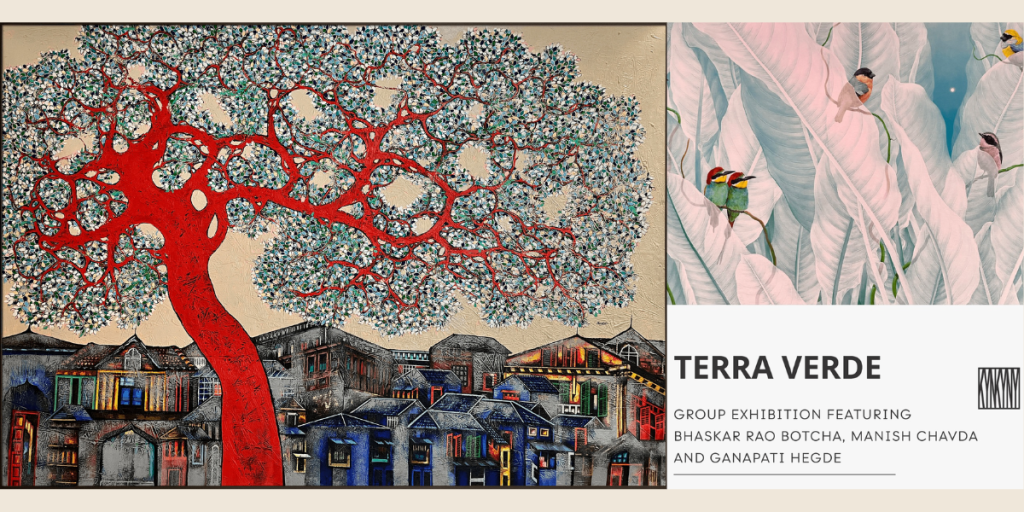
KYNKYNY Art Gallery in Bangalore is currently presenting the Terra Verde, a group show of new works by Bhaskar Rao Botcha, Ganapati Hegde, and Manish Chavda. Running from 27 March to 25 April 2026, the show is free to attend and open Tuesday through Saturday. Devoid of human figures, the paintings collectively make a case for attentiveness — to trees, birds, botanical life, and the ecosystems sustaining them.

The title means “green earth” in Italian, signalling the central concern directly. However, the works resist easy environmental messaging. Each artist brings a distinct visual language and philosophical position to his engagement with nature, making Terra Verde a show worth reading carefully.
Three Artists, One Shared Concern
The pairing of three painters with markedly different practices is one of the exhibition’s quiet strengths. Bhaskar Rao Botcha works with acrylic on canvas, Ganapati Hegde uses a hybrid of oil and acrylic, and Manish Chavda builds images through transparent layers of oil pigment. Together, they demonstrate that ecological attentiveness in painting does not demand a single aesthetic approach.
In addition, all three works are displayed without human figuration — a deliberate choice that repositions the viewer as observer rather than protagonist. This curatorial decision gives the show an unusual internal coherence despite its stylistic range.
Bhaskar Rao Botcha: Trees as Monuments
Botcha positions trees as the dominant presence in his canvases. Synthesised from years of accumulated visual memory, they fill the picture plane — monumental, solitary, and authoritative. The effect sits closer to portraiture than landscape. Each tree carries weight, presence, and what the exhibition describes as “innate energy and wisdom.”
Having previously worked with cityscapes, Botcha brings a subtle urban sensibility to these paintings. The contrast is deliberate: his trees do not occupy a pastoral idyll but exist against the implied pressure of development. Across mythological and spiritual traditions, the tree of life recurs as a symbol of sustenance and continuity. Botcha activates this quietly, using contrasting hues and balanced acrylic compositions to do much of the interpretive work.
Ganapati Hegde: Satire in the Forest
Hegde’s approach is considerably more theatrical. His paintings combine botanical accuracy with fantasy storytelling — grayscale areas sit alongside jewel-toned colour, and imaginary characters inhabit settings that feel simultaneously familiar and invented. The result is playful, but the underlying intention is pointed.
Growing up near the forests of the Western Ghats, Hegde brings ecological knowledge and personal memory to his visual metaphors. Prior experience in design has sharpened his instinct for narrative staging and compositional rhythm. Therefore, even the most whimsical scenes carry the weight of social commentary — nature here is not backdrop, but protagonist. The scenarios that unfold within it are often quietly, productively satirical.
Manish Chavda: The Bird Kingdom, Up Close
Chavda works with restraint. His paintings present individual birds — bee-eaters, bulbuls, parakeets, munias, robins — against near-monochromatic backgrounds of foliage. The detail is fine enough to recall the miniature painting tradition, but the register is intimate rather than archival.
By naming recognisable species from local landscapes, Chavda makes an implicit argument: these birds are not exotic or remote. They are neighbours. Positioning them in near-solitude, or occasionally in pairs, his transparent layers of oil pigment create a luminous, unhurried quality that asks viewers to slow down and register what already exists in their immediate world.
Terra Verde : Nature Without Nostalgia
What keeps the show from slipping into sentimentality is its willingness to sit with loss and change, rather than simply celebrating what remains. The curatorial text references Mary Oliver’s poem In Blackwater Woods — specifically, its lines about loving what is mortal and knowing when to let go. This is not the language of preservation campaigns. It is the language of grief and acceptance, and it gives the Terra Verde exhibition emotional complexity that extends beyond its visual pleasures.
In the current moment — when urban expansion in Indian cities continues at pace — art that invites attentiveness carries practical stakes. However, none of these works read as polemic. They operate in the register of invitation: to notice, to feel, and, as Oliver wrote, to tell about it.
That restraint is significant. In an art world that increasingly rewards loudness, all three artists work quietly. As a result, the show rewards viewers who are willing to stay, to look slowly, and to let the images accumulate meaning over time.
About KYNKYNY Art Gallery
Founded in 2004 by Namu Kini and Vivek Radhakrishnan, KYNKYNY Art Gallery is among Bangalore’s most established contemporary art spaces. With over two decades of exhibition history, the gallery has built a sustained reputation for thoughtful curation and a long-term commitment to Indian contemporary artists.
Its programme spans painting, sculpture, and mixed media, engaging consistently with narratives of cultural memory, environmental concern, and socio-political inquiry. Beyond exhibitions, the gallery offers curatorial consultancy, commissioned artworks for private and architectural projects, and personalised art advisory services for collectors.
Visit and Event Details
- Exhibition: Terra Verde — Bhaskar Rao Botcha, Ganapati Hegde, Manish Chavda
- Dates: 27 March – 25 April 2026
- Venue: KYNKYNY Art Gallery, 104 Embassy Square, 148 Infantry Road, Bangalore 560001
- Timings: Monday–Saturday, 11:00 AM – 6:00 PM (Closed Sundays)
- Entry: Free
Athmaja Biju is the Editor at Abir Pothi. She is a Translator and Writer working on Visual Culture.