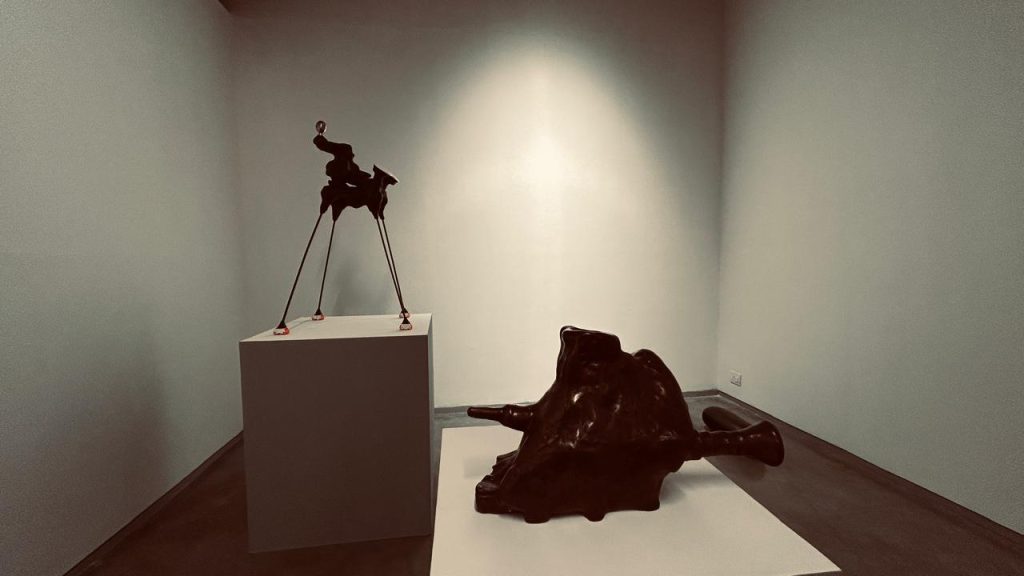
Murari Jha’s solo exhibition at Nature Morte Gallery, which ran from April 18 to May 17, brings together a body of work that reflects his ongoing engagement with memory, the body, and the idea of objects. According to the gallery, the exhibited works, made in a variety of materials (stone, bronze, wood, brass, synthetic putty, and aluminium), reference animals, tools, architectural details, insects, toys, and vegetables and erase distinctions between these categorisations.
Artist Bio
Murari Jha (born 1988, Bihar) is a contemporary Indian artist whose multidisciplinary practice spans painting, installation, and durational performance. Jha completed his BFA in Painting from Patna University in 2010 and his MFA in Painting from Dr B.R. Ambedkar University, Agra, in 2012, graduating as a Gold Medallist in both. In 2023, Nature Morte presented a solo exhibition, Baggage from the Longest March, at its Vasant Vihar, New Delhi, gallery. His works have been included in group exhibitions at the Sculpture Park at Madhavendra Palace, Jaipur (2024), the Mumbai Art Room (2018), the Italian Cultural Centre in New Delhi and the Clark House Initiative in Mumbai (both 2016), among other venues.
Durational performance remains central to Jha’s practice, with key presentations including A Magician from “The Longest March” (KNMA, 2023), Samay Pahaad Ho Gaya Hai (Kochi, 2022), Far from My Home: Machaan (Goethe-Institut, 2020), Good Sleep (Unidee/Inlaks, Italy, 2017), and Dhaan (Theertha International Artist Collective, Sri Lanka, 2017). In 2023, he was co-commissioned to present works with Samdani Art Foundation (Bangladesh), Kiran Nadar Museum of Art (New Delhi) in the collaborative exhibition Very Small Feelings. He has participated in residencies with HH Art Spaces (Goa), Unidee/Inlaks (Italy), Theertha International Artist Collective (Sri Lanka), and 1shanthiroad (Bangalore), among others.
The Future of Nostalgia
First of all, it is necessary to examine what the show’s title, ‘The Future of Nostalgia’, evokes. The artist named his show after being inspired by the celebrated book ‘The Future of Nostalgia’ by cultural theorist Svetlana Boym, who was born and raised in Russia, emigrated to America for survival, and lived there. In the review written by Peter Fritzsche, this is what is said about the book: ‘In this original, ambitious book, Boym explores one of the most familiar but least analysed perspectives on the contemporary world, the melancholic mourning for a lost time and a lost place’. The book’s title raises questions such as ‘Do you miss it?’ about the homeland, and about the woman who had to leave her country to save her own life, in short, a diasporic experience.
Svetlana Boym’s question about nostalgia is from the soul. Someone who had to leave her homeland and is living in pain recollecting ‘homeland’ and its retraced past. As a person of Jewish descent, she faced systemic discrimination—including being barred from studying at Leningrad University due to anti-Jewish quotas—which prompted her departure. That question is political; Boym approached it theoretically, drawing on meaningful questions arising from the social conditions she had experienced.
For Boym, exile is not just about losing a place, but also about gaining a unique perspective on time and history. That is, it happens between attempts to retrieve what has been lost and laments for what is irrevocably lost, in the extreme, in Boym’s own words, ‘Nostalgia is a sentiment of loss and displacement, but it is also a romance with one’s own fantasy.’
To the question of why nostalgia is a special kind of inquiry, Boym gives the answer, ‘a different sense of time.’ That is, ‘like travelling into another temporal zone where everybody was late but somehow there was always time.’ It is not merely about objects, nor can it be reduced to objects or confined to descriptions; it is a feeling, which Boym himself calls ‘a symptom of our age, a historical emotion.’
Art of Murari Jha
The note in the gallery says, ‘Murari Jha approaches nostalgia not as a return to the past, but as a way of shaping what lies ahead, a longing not only for what has been, but for a different pace and rhythm of life.’ Here, ‘memory becomes active, something that continues to shift and inform how we imagine ourselves and the world around us.’
‘Every deep thinker is more afraid of being understood than of being misunderstood,’ said Friedrich Nietzsche. The fear of how what one has said might be interpreted (from a statement to the title of a book) can trouble every thinker. We may wonder if the effects of that trouble can be seen here as well. This exhibition has many forms that ‘feel at once familiar and unsettled.’ Most of them are sentences found in exhibition catalogues (similar or identical to other exhibitions as well), as someone who has gone through exhibitions and catalogues would understand. For example, it should be examined how genuine a reflection the statement ‘these are not fixed images, but traces: of touch, movement, and time’ is.
One thing that becomes clear as you move through the artworks in the show is the artist’s immense practice across various media. Stone, bronze, wood, brass, synthetic putty, and aluminium—these and other media are used, either mixed or not, in the gallery space to form various representations such as animals, tools, architectural details, insects, toys, and vegetables. Material is seen as material, medium as medium, animal as animal, and architecture as architecture. However, it is noteworthy that each has a fluid identity, thereby validating the argument that ‘sculptures move between association and abstraction.’
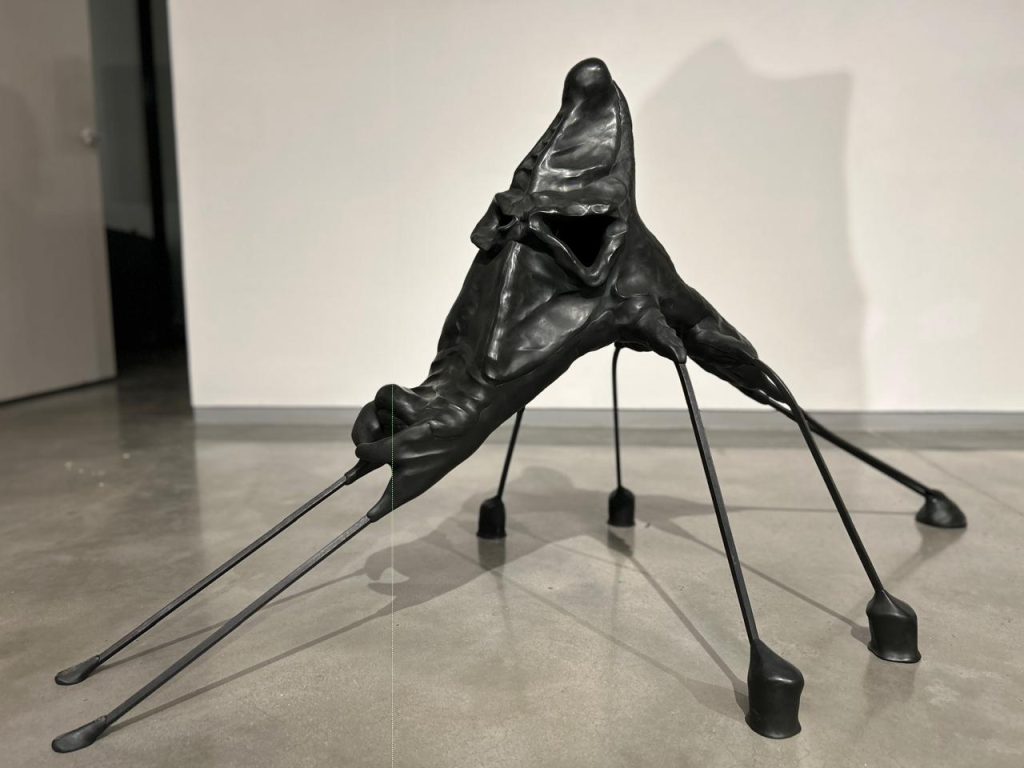
The key point is the artist’s argument to ‘erase distinctions between categorisations.’ Nietzsche’s statement that if you kill a cockroach, you become a hero, and if you kill a butterfly, you become a villain is worth mentioning here because both categories are distinct. Humans have been categorising things (animals, fruits, buildings, tools, insects, toys, vegetables) for centuries. Each category is arranged in a hierarchical order. Animals, flowers, trees, tools, toys, and fruits have all been classified. It should also be remembered that this is a space where distinctions between the rich and the poor are also reflected. One must also ask how accessible the gallery where this exhibition takes place is to the general public. If a class is considered as a category, it is true that the artist himself knows that he cannot even handle the ‘categorisations’ of the audience who come to see his show. This is an argument that raises many kinds of questions, titled ‘erase distinctions between categorisations’.
The artist has endured the inherent anatomical permanence in each with an abstract element, and, through practical experience, has succeeded. Even then, animals remain animals, architecture remains architecture, insects remain insects, flowers remain flowers, toys remain toys, and vegetables remain vegetables. Slight differences do not transform one into another.
Deleuze says that there are no significant differences between the past, present, and future. The question is whether all this happens at the boundaries of a process or is a continuation of it. However, Svetlana Boym, in the context of her own experiences, presents arguments under ‘the future of nostalgia,’ which should be read carefully as advocating ‘erase distinctions between categorisations, even if sculptures are actors in a theatrical tableau where the visual representation of things is disconnected from any preconceived meanings.
If objects are stretched from their form to the abstract, does that mean they can be said to be disconnected from any preconceived meanings? Form and formlessness are part of artistic explorations. Each inquiry may begin in form and end in formlessness, or begin in formlessness and end in form. Deleuze himself states that form and content are inseparable and are one and the same. Svetlana Boym describes the first symptom of nostalgia as ‘the ability to hear voices or see ghosts.’ There are situations in which one can hear their ghost language when interacting with materials. In depth, there would be room for ghostly sound in materials and forms. They (animals or tools) may undergo their own morphological transformations. What artists usually say is, ‘I have no responsibility for any of this. Everything just happened that way,’ but in any case, Murari Jha does not say this.
When attending exhibitions, it seems true what Marx said: ‘Everything seems pregnant with its contrary.’ The gallery atmospheres in which ‘sabalten bodies’ are welcomed with doubt and granted access to the ‘elite bodies’, along with the artworks, altogether comprise a celebration of contradictions. It is gratifying, in light of Marx, to think that the art world of capitalist times is like this.
Celebrated works of each era will have a connection with the truth/falsehood of that time. Truth and falsehood are not two sides or borders of a coin, but merely possibilities lying intertwined. Not only art, but the artist is also a creation of the time; both art and the artist not only represent that era, but also reflect it.
I am not saying that the title ‘The Future of Nostalgia’ ambiguously represents the artworks in the exhibition. Just as it is not merely the title of a book, that expression also has an independent stance and the circumstances created through it.
Krispin Joseph PX, a poet and journalist, completed an MFA in art history and visual studies at the University of Hyderabad and an MA in sociology and cultural anthropology from the Central European University, Vienna.