Abirpothi

Krispin JosephPX

Krispin Joseph PX, a poet and journalist, completed an MFA in art history and visual studies at the University of Hyderabad and an MA in sociology and cultural anthropology from the Central European University, Vienna.

Alwar Balasubramaniam: ‘Tracing the Self’, Body, and Becoming

The creative world of Alwar Balasubramaniam, known as “Bala,” spans decades of exciting practice. His techniques, which began with an intense focus on painting and printmaking, evolved dramatically after 2000, when he turned toward sculpture and immersive installations—an ongoing exploration now culminating in his role as India’s representative at the upcoming Venice Biennale. As we […]

Alwar Balasubramaniam: ‘Tracing the Self’, Body, and Becoming Read More »

Archiving the Vanishing: Kulpreet Singh’s ‘Extinction Archive’ and the Aesthetics of Loss

The Extinction Archive project by artist Kulpreet Singh, produced by KNMA on the view of India Art Fair 2026, depicts animals and plants at peril and spans over 900 endangered species, painted on pesticide-dipped rice paper, making the magnitude and accumulation of what is vanishing clear. This show has attracted the attention of art lovers

Archiving the Vanishing: Kulpreet Singh’s ‘Extinction Archive’ and the Aesthetics of Loss Read More »

Jogen Chowdhury: Memoirs of an Indian Dream and Alchemy of Expression

On This Day Jogen Chowdhury (born 16th February 1939 is an eminent Indian artist considered one of the most important and seminal figures in the history of postcolonial Indian Art. Jogen knows his painting bonded to Partition, the landscape, folk tales, and figurative and political injustice-motivated compositions. He was born and brought up in an

Jogen Chowdhury: Memoirs of an Indian Dream and Alchemy of Expression Read More »

Girjesh Kumar Singh’s Haal Mukaam, or Current Address: Reading the Politics of Demolition vs Constructive Art

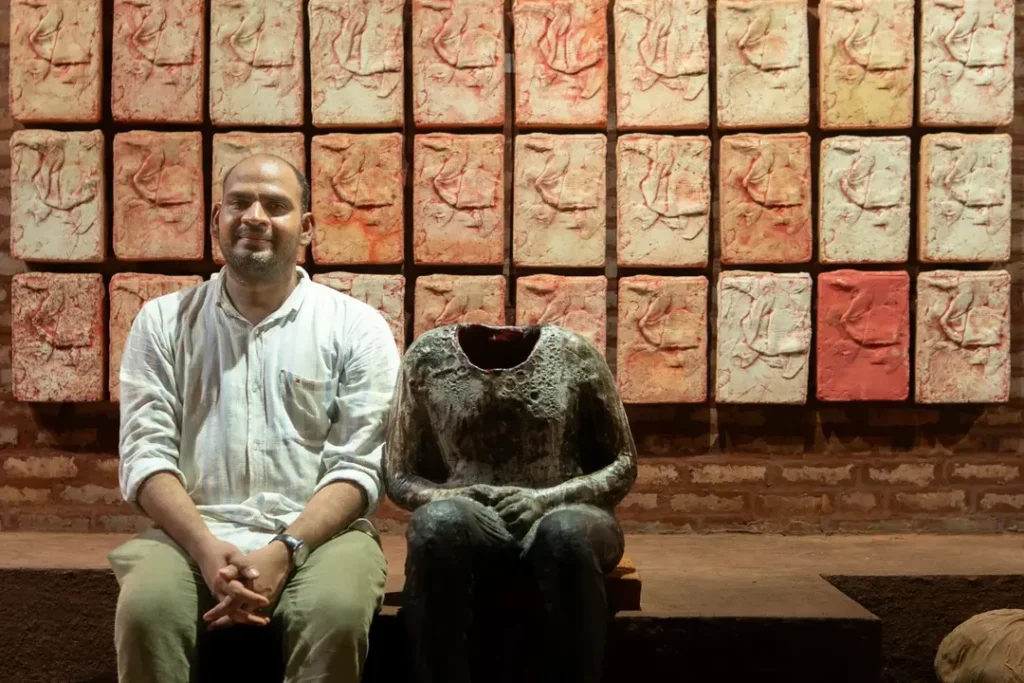
“Haal Mukaam: Current Address”, a solo show by Girjesh Kumar Singh, on view at the India Art Fair 2026, profoundly asks questions about home, identity, and what home is. The artist uses bricks and mortar from demolished houses to make these artworks, recasting them into rhetorics of loss, memory, and changed landscapes. Singh’s practice is

Girjesh Kumar Singh’s Haal Mukaam, or Current Address: Reading the Politics of Demolition vs Constructive Art Read More »

Capturing the Portfolio of the Marginalised: Decoding the Pixel Activism of Palani Kumar

“Don’t shoot what it looks like. Shoot what it feels like” David Alan Harvey As a medium, photography has always maintained its ‘photojournalistic’ ‘news photography’ nature. But Tamil photojournalist and activist Palani Kumar, who uses photography as a tool to give a voice to the ‘voiceless’, sees it beyond its aesthetic appeal and uses it

Capturing the Portfolio of the Marginalised: Decoding the Pixel Activism of Palani Kumar Read More »

Archives of Resistance: The Panjeri Artists’ Union and the Assemblage of Anti-Caste Art

The Panjeri Artists’ Union is an anti-caste art collective based in Banipur, West Bengal, through their project, ‘Assemblies of Hope Amidst the Death-Worlds: A 100-Day Work Proposition’, which is a central highlight of the 6th Kochi-Muziris Biennale (2025–2026). This project, set up at the front of the main venue, Aspinwall House, is an ‘assemblage’ that

Archives of Resistance: The Panjeri Artists’ Union and the Assemblage of Anti-Caste Art Read More »

The Ghosts Who Sing: Melancholy as Resistance in Jompet Kuswidananto’s ‘Ghost Ballad’

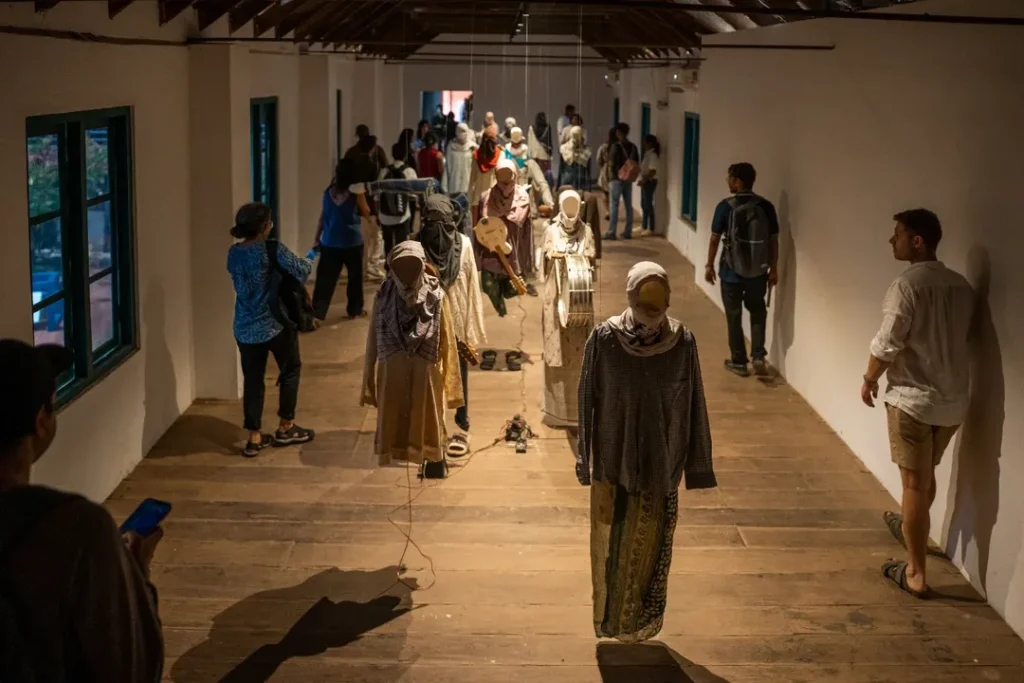
At the 6th Kochi-Muziris Biennale (2025–26), Indonesian artist Jompet Kuswidananto presents ‘Ghost Ballad,’ a site-specific installation at Pepper House, marking the journey from dictatorship to democracy and bringing together once-thriving, banned music and performances. The work uses his signature objects of ‘bodiless’ figures to gather the fractured chronology of Indonesia, acting as a bridge between

The Ghosts Who Sing: Melancholy as Resistance in Jompet Kuswidananto’s ‘Ghost Ballad’ Read More »

Ibrahim Mahama’s ‘Parliament of Ghosts’: Stitched Sacks in conversation with refurbished Chairs

The installation “Parliament of Ghosts” by Ibrahim Mahama, displayed at the Kochi-Muziris Biennale, offers reflections on the politics of space, with its colonial undertone. Mahama’s work, which uses stitched jute sacks and chairs, portrays hidden chronologies of trade, labour, and colonial power. At the Biennale, Mahama transforms a room at Anand Warehouse, a colonial-era godown,

Ibrahim Mahama’s ‘Parliament of Ghosts’: Stitched Sacks in conversation with refurbished Chairs Read More »

Adrian Villar Rojas: The decays of Another World in the Fridge

The works in the Rinascimento series by Argentinian artist Adrian Villar Rojas, exhibited at the Kochi-Muziris Biennale, remind one of Barbara Kruger’s famous phrase, ‘I shop, therefore I am.’ If Barbara’s work can be seen as a parody or a comic version of René Descartes’ statement, ‘I think therefore I am,’ which overturned the stream

Adrian Villar Rojas: The decays of Another World in the Fridge Read More »

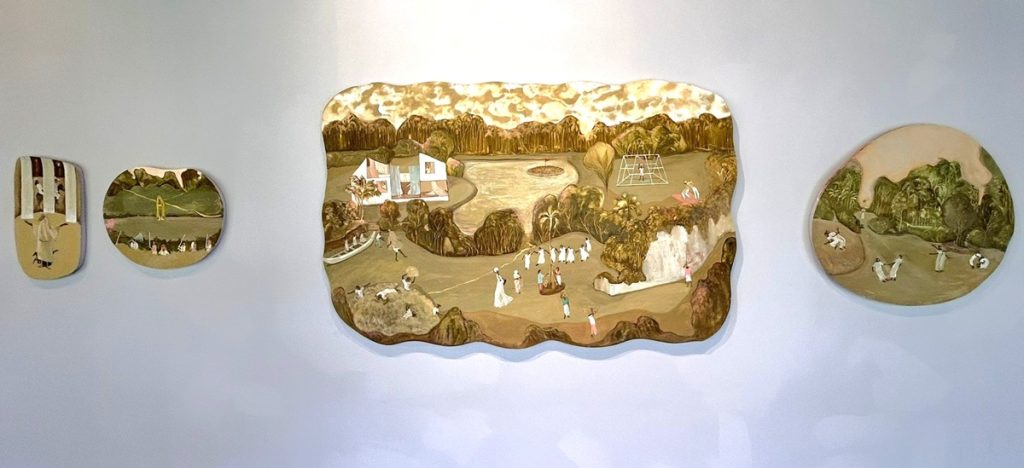
Nityan Unnikrishnan: Hymns for the Drowning and Other Tales

When observing Nityan Unnikrishnan’s artworks displayed at Kochi Muziris Biennale, Deleuze’s phrase ‘To be fully a part of the crowd and at the same time completely outside it, removed from it’ comes to mind. What Deleuze means is not to avoid or withdraw from the crowd, but rather, philosophically, to respond to it. It calls

Nityan Unnikrishnan: Hymns for the Drowning and Other Tales Read More »

Ad