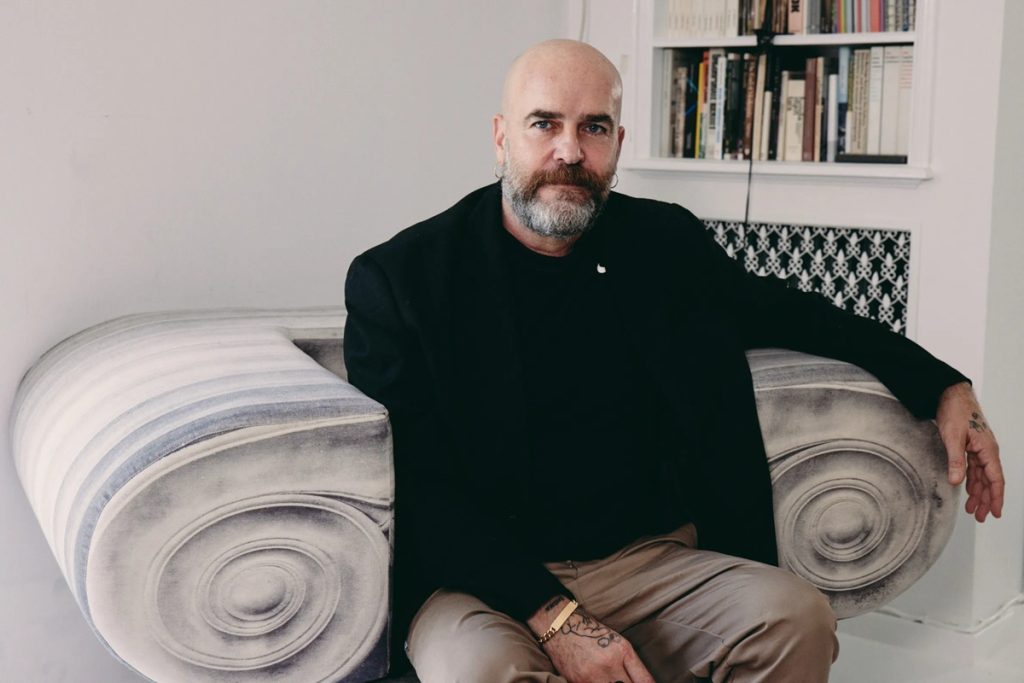
Andreas Angelidakis, an architect and artist from Athens, is making waves at the Venice Biennale with his artwork, which is characterised as providing an anti-fascist escape room with purposefully campy touches. His work encompasses a wide range of disciplines, including publishing, exhibition design, architecture, and curating, and as a self-described internet addict, he uses and creates environments that examine how infrastructure and geography are intimately related to power by fusing online culture with architectural symbolism.
Andreas Angelidaki has created art that resembles a modern Platonic cave, where reality splits into staged realities, projections, reproductions, and algorithmic illusions.
Andreas Angelidakis lives and works in Athens. He is trained as an architect with a Bachelor of Architecture from the Southern California Institute of Architecture and a Master’s degree in Advanced Architectural Design from Columbia University. He has contributed as an artist or curator in a range of global exhibitions, including “The State of the Art of Architecture” at the inaugural Chicago Architecture Biennial, the 12th Baltic Triennial at the Contemporary Art Centre in Vilnius and “Super Superstudio” at PAC Milano, all in 2015, as well as “documenta14” in Athens and Kassel in 2017. In 2019, he participated in the Bergen Assembly, contributing a multifunctional social seating system to Paul B. Preciado’s “Parliament of Bodies” for documenta14, as well as the Biennial of Moving Image at OGR in Torino. Among the exhibitions he has curated are “The System of Objects” at Deste Foundation in Athens, “Super Superstudio” at PAC in Milano, “Fin de Siècle” at Swiss Institute in New York, Period Rooms at Het Nieuwe Instituut Rotterdam, and “OOO Object Oriented Ontology” at Kunsthalle Basel.
As part of the interview series, a conversation with Venice Biennale artists, Abirpothi, featuring Greek artist Andreas Angelidaki. The artist discusses in detail his work and his presence in the Venice Biennale.
Q: What is architecture for you? Why are you treating architecture solely as a political archive rather than a physical entity? Why did you choose to let the structure “speak,” and what history did it want you to learn?
Andreas Angelidakis: Buildings have always been symbols of power and identity; they have always been actors in a performance of truth, otherwise they would still be shelters, protectors, natural caves in the wilderness. Buildings are forced by design to stand in the name of religion, nationality, and Economy, just like the humans they contain. A church contains believers, and in that sense, it is a prison of thought, a cave like the one Plato describes in the Republic.
Ever since I was a child, I have been friends with objects and have designed stories for them so we could do things together and be friends.
Adopting the voice of a building or an object is perhaps the one common thread you find in my entire body of work since 1992, my graduation year, way before I knew about Object-Oriented Ontology.
Grecia, the National Pavilion, had many questions about her Byzantine façade and her Hagia Sophia columns on the porch, forever whispering, “Make Istanbul Constantinople Again,” just as MAGA does about America.
Grecia is the product of a similar historical loop, the ominous 1934, when Austria and Grecia were inaugurated to convince everybody that the AXIS of Hitler and Mussolini was going to Make Europa Great Again.
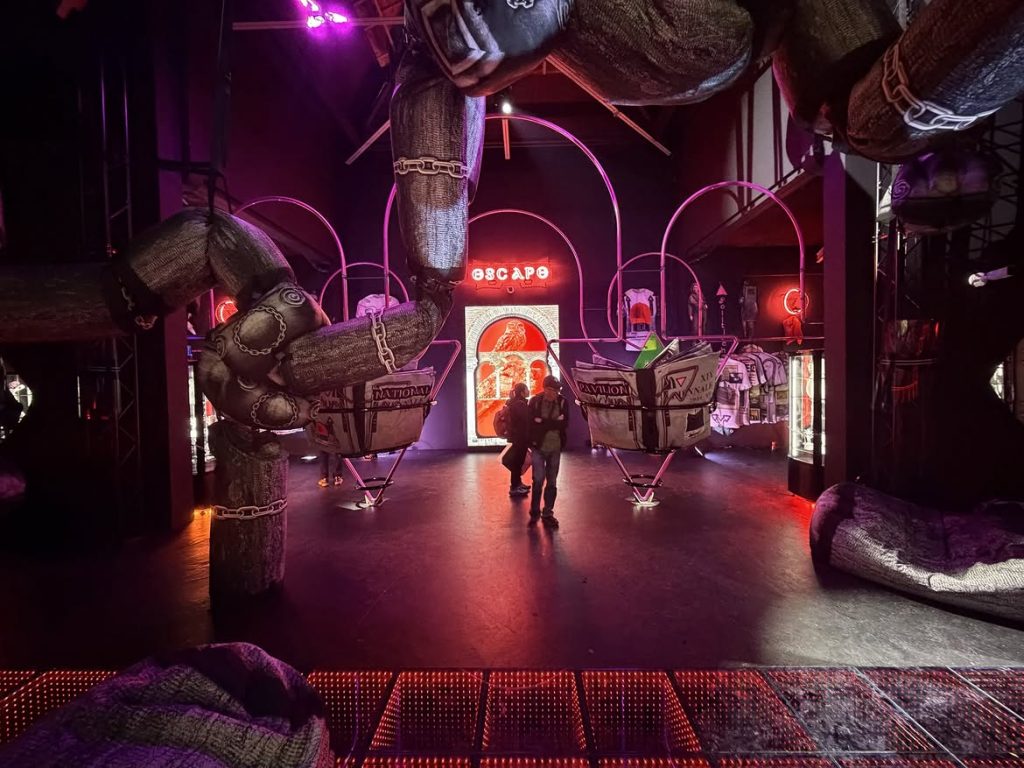
GRECIA decided to study her double history, nation and pavilion, starting in the year when Greece was invited to be part of the Biennale 1904. The minor keys extracted from both those histories are displayed as souvenirs inside the Escape Shop.
Q: You characterise Greece as a nation that has historically embraced contradiction and disintegration rather than adhering to a national identity. Is this your way of criticising the entire idea of the nation-state as a durable cultural construct?
Andreas Angelidakis: Greece, the Nation has always been represented by two types of citizens, Alafranga and Alaturka. A Greek from abroad, a local, a wealthy, educated Greek, and the indigenous Romios.
This binary of oppositions later morphed into royalists of a German king vs nationalists of Venizelos, then Fascists vs Communists, and nowadays State vs Citizen. It was a class war to begin with.
The idea of excavating fragments from both national and pavilion history is simply to mimic life as it unfolds simultaneously on national and personal platforms.
Q: Why are you revisiting 1934—the year of its inauguration and the emergence of European fascism—and frequently connecting that history to modern right-wing politics? What similarities do you notice between the current political environment and that of the 1930s?
Andreas Angelidakis: 1934 is the year that Benito Mussolini invited Adolf Hitler to the Venice Biennale for the first-ever in-person meeting. This was also the year that the two countries in line to join the Axis of fascism and the Nazi party, Austria and Greece, both inaugurated pavilions.
The 30s were the years when fascism was thought of by many people as a solution to their post-World War I problems. But then the world saw what fascism intended, and one part of the world fought against it. The tactics of Trump are basically identical to how fascism and the Nazi party created a sense of impending glory and success, just like MAGA.
Q: Your work created delicate, whimsical sculptures from historical icons, monuments, and ruins. When monuments become places for relaxation, recreation, and group engagement, what political opportunities arise?
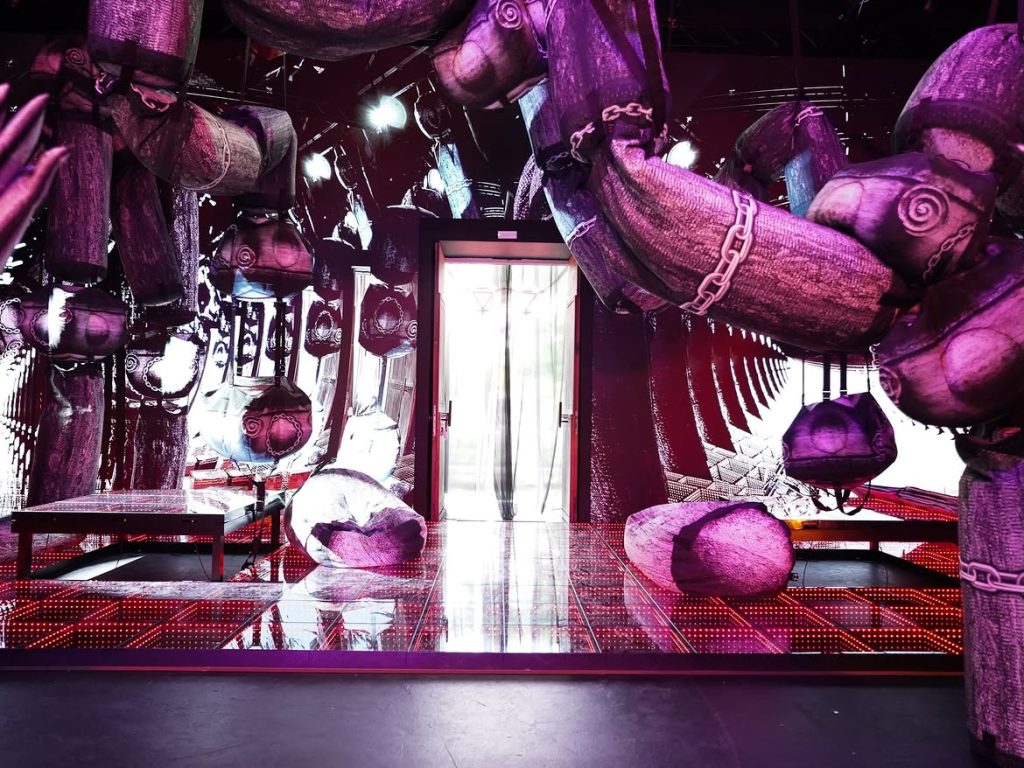
Andreas Angelidakis: When people interact with a space or with others, they make choices and therefore engage, become present to the system they are placed in, in this case, a chimaera of politics and the personal. To get a biannual visitor to engage even a little bit, you have to offer something in exchange, and in my case, I offer a space that appears to transport them both in time and place, but also lots of soft pillows, Poofs to lie down on after walking around in the Giardini for hours. The poofs are all replicas of the two front columns, the two citizens of Grecia, National and Pavilion.
Q: Escape Room places a strong emphasis on humour and theatricality. Why does fun work so well when addressing topics as serious as fascism, nationalism, surveillance, and historical violence?
Andreas Angelidakis: Laughter is a momentary escape from our social programming, a brief moment of truth, just as crying is. Making a dramatic story funny is a safe way to approach subjects dear to many, even if they don’t share my views. By introducing humour in the presentation of trauma, the real story is in the aftertaste. The space looks immediately like a nightclub, later perhaps a church or a pink gym, a monument with a shop attached. Only when you complete the mental diagrams presented as Merch and T-shirts do you get a glimpse of how all these disparate historical elements are connected by loops and exits.
Q: The boundaries between architecture, exhibition design, internet culture, publication, and performance are often clouded in your creations. Do you consider interdisciplinarity to be a political strategy for opposing rigid institutional classifications, or is it also an aesthetic choice?
Andreas Angelidakis: I see it doesn’t necessarily have to be a choice. EXHIBITIONS for me are not just displays; they’re narrative devices. They need more or less than a film studio environment to present an alternate environment. I’ve always wanted to be like Frederic Kiesler, hired by Peggy Guggenheim to experiment with space in a way that reflects a future society.
Q: Why are you using the analogy of Plato’s Cave? Is that the idea of the “escape room” serves as both a philosophical metaphor and a source of amusement? What precisely can viewers be asked—political beliefs, national identities, historical tales, or something more intimate?
Andreas Angelidakis: A past version of themselves, but the work is not a lament; it is a celebration of possibilities.
Q: This pavilion revolves around queerness, both in your attempt to “queer” the national pavilion itself and in allusions to Fire Island, AIDS history, and club culture. How might queerness be used to reconsider public memory, architecture, and history?
Andreas Angelidakis: Queerness is much bigger than sexual orientation, even though it’s favoured by gay men like me. Queerness is whenever you find a way to trick the system. In that sense, rethinking is not enough; thinking from scratch, like a child would, free of historical and social conditioning. Public memory nowadays has shortened dramatically; a few weeks ago is another era. Queerness becomes a way to regain agency in one’s own history. The gag is that in Greek, “story” and “history” are the same word. Every story can be history.
Q: By highlighting underappreciated narratives, forgotten individuals, and cultural marginalia, many of your works challenge the veracity of official histories. As an artist, do you consider yourself more as a historian, a storyteller, or someone who actively destabilises historical certainty?
Andreas Angelidakis: I tell stories with space, and very often the works are site-specific, meaning I excavate the stories from the site itself. To look at a National Narrative is to separate propaganda from fact by looking at all the versions of the story. The result is not a linear history but rather a cloud, a hallucination of realities.
Q: Can you explain how the perception of the internet influenced your work? From a place of freedom to one that is more and more characterised by algorithms, monitoring, and political divisiveness?
Andreas Angelidakis: The internet is just an accelerator; surveillance and political polarisation are ancient, or at least medieval. Byzantium was a total surveillance empire, and now, with algorithms, all is tailored to you. I suppose we can say that the Internet now completely dominates every reality we experience, as opposed to the beginning, when it was perceived as a distant horizon.
Q: You typically define your installations as places rather than objects, asking people to sit, touch, and absorb the work. What happens, particularly in politically sensitive shows, when viewers turn from spectators to participants?
Andreas Angelidakis: Their attention span is short because when the environment is unexpected, people tend to pay more attention.
Space has always been a major player in shaping people’s behaviour. Churches, Mosques and Synagogues all take us to another reality, just as nightclubs, prisons, shopping malls, or even Museums do.
Q: Tourism appears throughout Escape Room through kiosks, souvenirs, and merchandising. What impact do you think tourism will have on how Greece—and maybe many other countries—create and promote their own histories?
Andreas Angelidakis: Modern Greece was born as a souvenir of an ancient civilisation, and because that civilisation was so popular post-Renaissance, France, Britain, and Russia (fact-check alert) got us out of the Ottoman Empire and into theirs. The peak of Ancient Greek Appreciation was during the Grand Tour, but the history taught in the Greek education system is presented as a glorious revolution rather than a redistribution of power. The fact that the exchange contract with the Ottomans precedes the “revolution”, or that the Church was entirely on the Ottoman side, has evaded public consciousness of what Greece is.
Q: Are you constantly aiming to destroy authoritative narratives without replacing them with new facts? Is your practice ultimately about maintaining history open to reinterpretation?
Andreas Angelidakis: DEMOS was the first project in which I looked back at my student work and decided to essentially continue my thesis at Columbia University in 1995 with Keller Easterling for documenta 14 in 2016. I started my own historical loop, a postmodern version of my older work, an archaeology of me.
Historical narratives, like religious texts, are often biased and present a singular perspective. We are the future in these narratives, so we can look at them as a series of decisions our civilisation made. Do we retrace their steps in or do it differently?
Q: You have claimed that ‘art is the herald of change already in motion.’ In light of the current political climate, where do you think artists can still make a significant impact, and where do you think art’s boundaries start?
Andreas Angelidakis: Art is communication, so it’s what you decide to say and when, but whatever intervention will be collateral, it will come from the visitor to the art.
Q: What questions do you hope visitors will have long after they leave the pavilion, representing Greece at the Venice Biennale? If Escape Room succeeds, what type of political or emotional shift should it provoke?
Andreas Angelidakis: I doubt a National Pavilion could ever have real political agency, but the change I was imagining is already happening in American politics with Zohran Mamdani and the escalating influence of Hasan Piker.

Krispin Joseph PX, a poet and journalist, completed an MFA in art history and visual studies at the University of Hyderabad and an MA in sociology and cultural anthropology from the Central European University, Vienna.