The Thapar Gallery’s exhibition of paintings by Indian contemporary artist A. A. Raiba offers insights for anyone interested in Indian art history and its transition to modernity. Two exhibitions are being held at Thapar Contemporary and Thapar Gallery. The exhibitions, organised by Thapar Gallery and Thapar Contemporary, showcase the continuing value of artistic practice throughout generations, from the solitary vision of modernist master A. A. Raiba to the fractured realities explored by eleven contemporary artists today.
Artist Abdul Aziz Raiba, also known as A. A. Raiba, studied miniature painting at JJ School of Art in 1942 before fusing its intrinsic beauty and skill with his modernist ideas. Raiba was a painter with extraordinary technical accuracy and poetic sensibility whose work connected the realms of folk traditions, miniature painting, and the new modernist language in post-independence India. His lifetime visual vocabulary would be profoundly shaped by his early upbringing in Bombay’s coastal neighbourhoods, among its complex cultural and architectural history.
Raiba’s study period also coincided with the emergence of Indian modernity. It was a time when world art underwent various experiments in modernity, and similarly, Indian artists adopted ideas and carried out modern experiments that later came to be called ‘indigenous modernisms.’ It was during this period that Raiba modernised his artistic world. The reflections of this can be seen in the exhibition at Thapar Gallery, which makes this show relevant.
Raiba was greatly influenced by a variety of aspects, including calligraphy, Persian and Mughal miniature art, and the lyrical heritage of Urdu poetry. It would be accurate to say that Raiba created a style that combined national and international tastes while balancing ornamental design and narrative figuration. His surfaces often had the brightness of small paintings, with rhythmic textures and a contemplative intimacy evident in the exhibition’s pieces.
What distinguishes Raiba miniatures from their classical features? With delicate linework and muted yet brilliant colour, his paintings often portrayed images from rural life, metropolitan neighbourhoods, and historical events. Bold shapes and strong outlines that go beyond the fine lines and strokes characteristic of miniature paintings are what distinguish them from miniature forms. Reflections across many layers of Raiba’s artistic exploration, which bring together elements such as life in Kashmir (1957-59), Christian imagery, South Indian landscapes, the life of the Konkani community, and compositions drawn from the Travancore-Cochin folk art vocabulary, make this exhibition remarkable.
The ambiguity at the core of Raiba’s work is encapsulated in the title, “A Unilateral Eclectic.” Despite working during the early stages of Indian modernism, Raiba remained a “solitary loner,” refusing to associate with creative movements or groups, as art historian Shivaji K. Panikkar observes. To comprehend the show, this freedom is essential. Instead of firmly establishing himself in a single style camp, Raiba created a visual language that assimilated various traditions without giving in to any of them. His work demonstrates what Panikkar calls the “multistranded synthesis” of Indian modernism, combining modernist formal experimentation, European academic naturalism, the Bengal School, and Indo-Islamic miniature traditions.
The authority of the line is the first thing that stands out in the presentation. The intentional linear certainty in Raiba’s paintings and sketches sets his work apart from that of many of his contemporaries. Though their thickness and angularity lead them toward a decidedly modernist lexicon, the sharp outlines defining his characters and narrative settings recall the clarity of Pahadi miniatures. Although his forms are streamlined and stylised, they are never static. The work has an underlying tension that keeps the eye moving through the line’s rhythmic confidence, sometimes severe and at other times flexible.
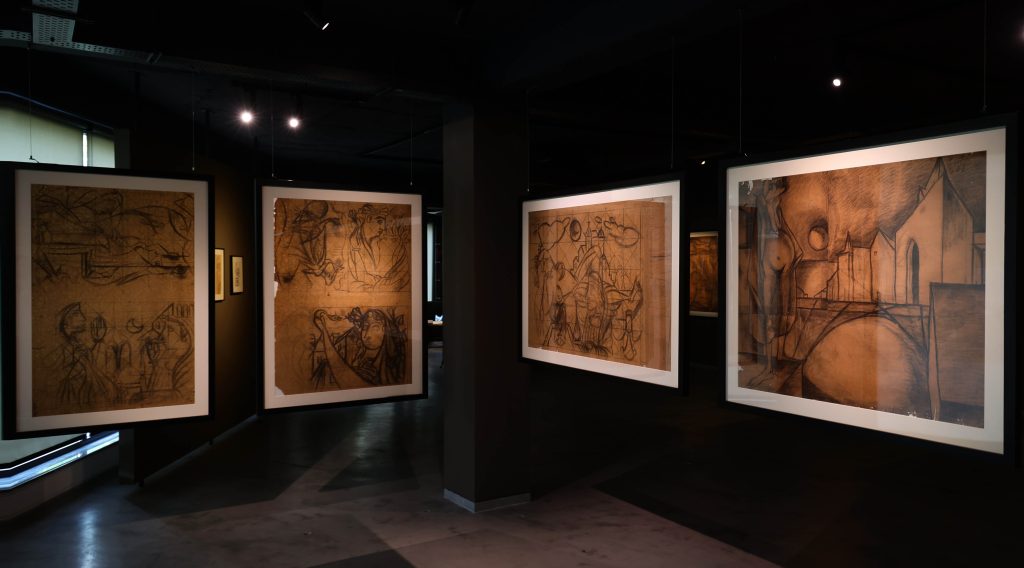
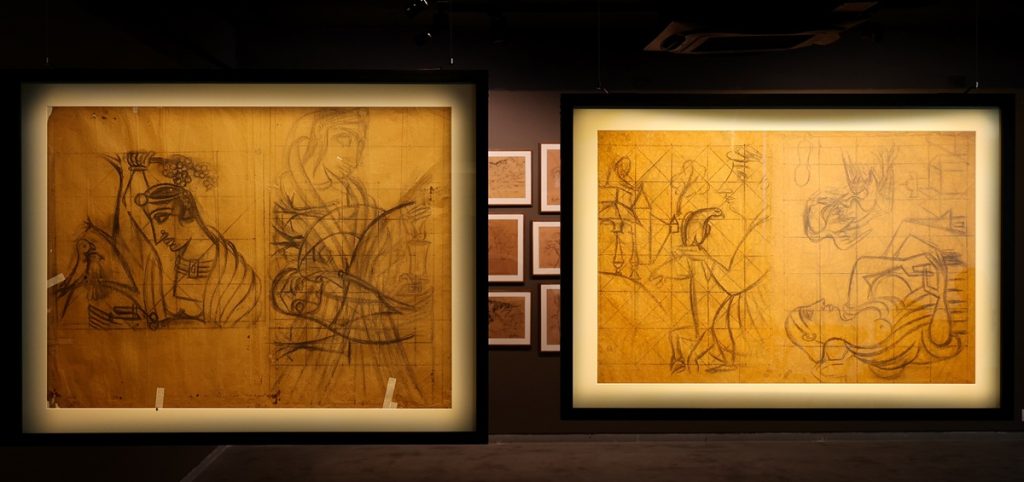
The exhibition’s focus on draftsmanship is really satisfying. Raiba is a highly disciplined artist who pays close attention to compositional structure, as evidenced by his preparatory studies and gridded drawings. The grids themselves become more than just technical tools; they reveal the architecture that underlies the final product. These pieces serve as a reminder to viewers that modernism can also result from accuracy, patience, and construction in a time when discussions of modern art frequently focus on spontaneity. Raiba’s dedication to scale, proportion, and visual coherence is evident in the meticulous conversion of small sketches into bigger murals and paintings.
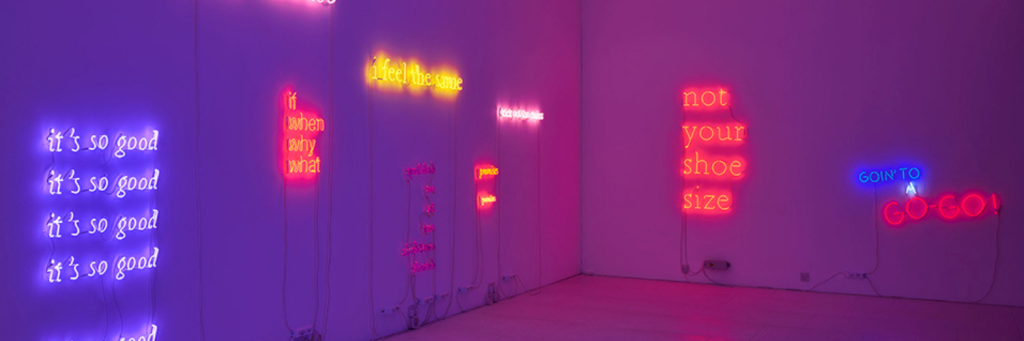
Wild, Ordinary, Enchanting, Excruciating Beauty at Thapar Contemporary shifts toward collective ambiguity if the Raiba show is based on the tenacity of individual vision. The group exhibition, curated by Vaibhav Raj Shah and Jasone Miranda-Bilbao, features eleven contemporary artists working in installation, sculpture, drawing, and moving images. The exhibition portrays modern life as being formed by overlapping crises, fuzzy borders, and systemic failure, where the lines between the political and the personal have grown increasingly hazy.
Amitabh Kumar, Harsha Durugadda, Madhurjya Dey, and Vanshika Babbar are among the participating artists who use a variety of material approaches to address these issues. The pieces foster a state of suspended attention rather than providing closure or overt political commentary. The exhibition’s strength lies in its insistence on ambiguity: rather than seeking clear interpretation to escape pain, spectators are forced to stay in it.
Even though it is thematically urgent, the modern presentation lacks the formal coherence of the Raiba exhibition. Although some pieces effectively suggest vulnerability and tension, the exhibition often relies too heavily on its curatorial framing. Its themes of disintegration and instability are cognitively recognisable within modern curatorial debate. In contrast, Raiba’s works require little mediation. Their visual conviction and formal intelligence come through right away.
In the end, this contrast makes the exhibitions’ coupling fruitful. In one exhibition, a modernist artist who developed an independent visual language from several traditions is revisited; in the other, it explores how contemporary artists negotiate a fragmented present in which solid languages are becoming increasingly elusive. When taken as a whole, they show how artistic activity still functions as a negotiation with uncertainty, whether through the scattered fears of contemporary art or the disciplined individuality of Raiba’s modernism.

Contributor