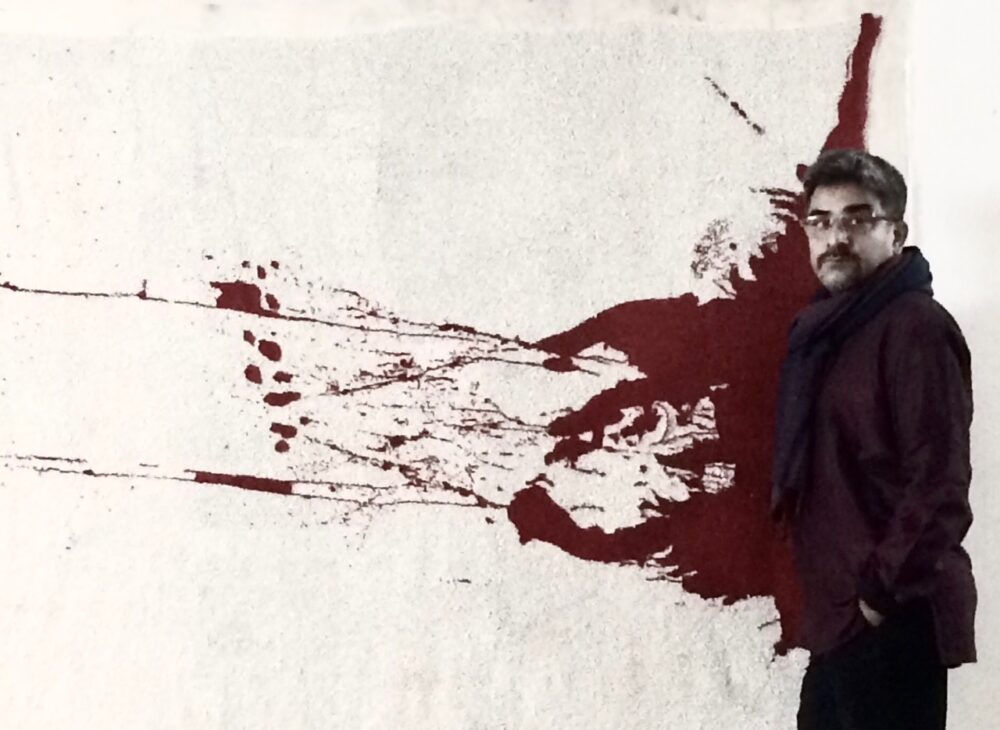
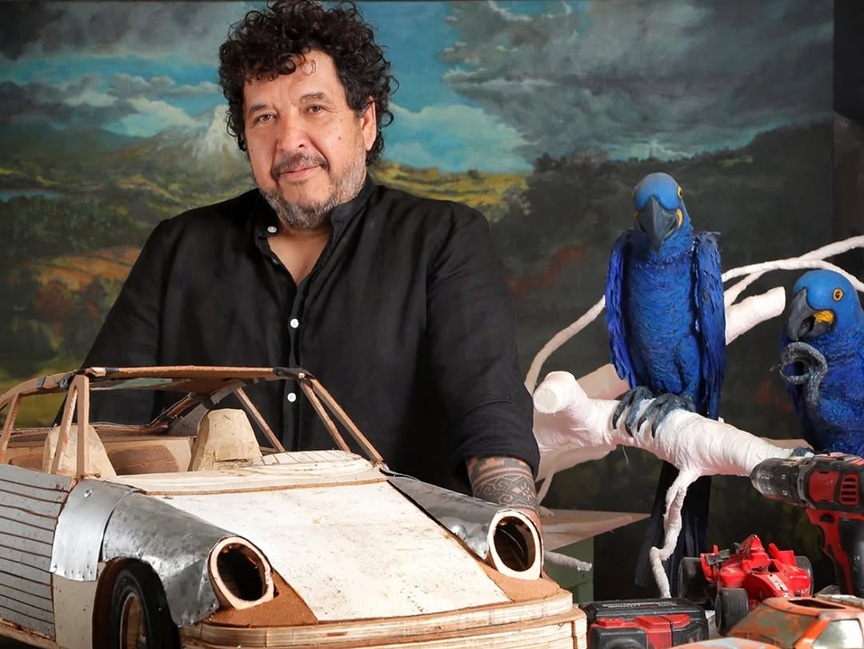
At the ongoing Venice Biennale, the artworks of Chilean artist Norton Maza are attracting the attention of art lovers, just as those of other artists from the Global South, and are making the concept of ‘art’ and politics the centre of discussion. Considering the artist’s family history, especially that his father was arrested after the coup in 1973 and imprisoned for two and a half years before being sent to France with his family in 1975, it is evident that it was not only a diasporic experience that shaped him.
The artist relocated to Cuba in 1980, enrolled in the National School of Art in 1985, and earned a degree in painting and drawing in 1989. He went back to France to study art at the École supérieure des Beaux-Arts in Bordeaux. He later returned to Chile in 1994, where he created much of his work. He designed the trophy presented to the Musa Awards winners in 2020. The award’s design is centred on the muses of the Greek Olympian gods. Her piece Inter-Reality was selected in 2025 to represent Chile at the Venice Biennale in 2026, following a public appeal issued by the Ministry of Culture, Arts, and Heritage.
His work, which is extremely dedicated and political, embraces the raw, emotional reality he confronts in a sarcastic yet ironic, and at once intensely sensitive and provocative manner. He has participated in numerous international exhibitions and biennials. In addition, he has won honours and art residencies. Both public and private collections presently have his artwork.
As part of the interview series, a conversation with Venice Biennale artists, Abirpothi, featuring Chilean artist Norton Maza. The artist discusses in detail his work and his presence in the Venice Biennale.
Q: Inter-Reality explores fragmentation, uncertainty, and competing versions of truth. Do you see this work as a culmination of themes that have appeared throughout your career, from migration and social conflict to environmental collapse and political power?
Norton Maza: Indeed, INTER-REALITY represents the culmination of a process I have been developing over many years. The Biennale marks the end of a cycle. The projects that will emerge from this point onward in my art practice will be oriented toward an opposite pursuit: seeking beauty rather than illustrating drama.
My interest now lies in the search for beauty and, within that gesture, contemporary issues inevitably emerge, though from a different perspective. I am interested in creating works that seduce, enchant, and captivate through the intensity of beauty, whether in sculpture or painting. Yet, ironically, this pursuit of beauty does not imply a complete escape from reality or contemporary conflicts.
Rather, these tensions will appear in a more subtle, almost imperceptible way—more conceptual than formal—as a different means of approaching them. The exaltation of beauty ultimately leads us to question our own gaze and how we relate to it from different vantage points. There is a certain irony in attempting to seek paradise in today’s world.
Q: Your biography is marked by exile, displacement, and movement between Chile, France, and Cuba. How does this personal history inform your understanding of the contemporary global crises of migration and belonging that appear in Inter-Reality?
Norton Maza: Migration and displacement have always been very present aspects of my history, my work and my life. That feeling of belonging everywhere and nowhere at the same time has significantly shaped my creative practice, not only in relation to territory or geography, but also to the resources available in each place.
The reality I lived in Cuba in the 1980s, when I was studying art, is not the same as what I later experienced in Bordeaux, France. The relationship with materials and everyday life was completely different. Chile could be considered an intermediate country, with areas that share certain similarities with Cuba and others that are closer to France. This experience enriches and questions different models of life, economic systems, and diverse forms of precarity.
I began to use very precarious materials precisely because I came from contexts marked by scarcity. And when I lived in cities or countries with higher levels of welfare and access to resources, that reality was also reflected in the materiality of my work and in how people relate to objects and things. I believe this observation has been fundamental to my artistic practice. Even as a child, I began engaging with a wide range of objects and toys: some handcrafted, others purchased. This coexistence between invention, necessity, and consumption has accompanied my way of seeing ever since.
In that sense, INTER-REALITY also proposes a journey: a passage through different perceptions and readings of reality and truth. The work invites the viewer to move through multiple layers of interpretation, confronting perspectives that sometimes contradict each other and at other times complement one another. In a way, this experience reflects my own life trajectory, marked by constant displacement between contexts, cultures, and ways of understanding the world.
Q: Throughout your practice, you often build miniature worlds, dioramas, and simulations. What attracts you to scale, illusion, and constructed realities as tools for discussing real political and social conflicts?
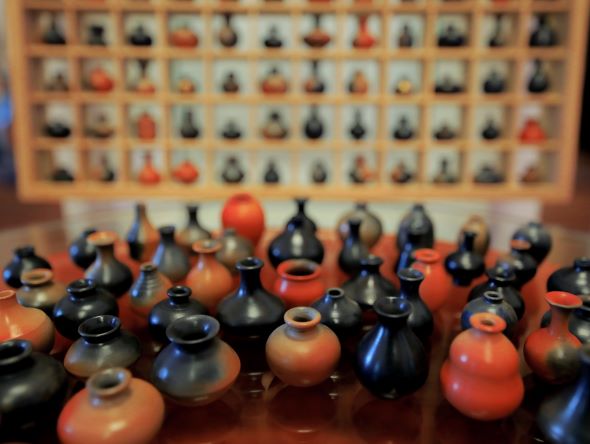
Norton Maza: Since childhood, I have always been fascinated by models: that feeling of being a giant in front of miniature worlds, of observing those small constructions and playing with them. I clearly remember that when I was in Bordeaux, about seven years old, I used to play with a neighbour who had an electric train set. I loved watching the train pass through the tunnel. I still carry that sensation with me today: the impulse to create universes and spaces, even to recreate classical paintings in which the painterly gesture of brush and stain merges with sculpture and small constructions. What is interesting is that at least 90% of the materials used are precarious: recovered materials, waste, and recycled elements, rather than new materials.
I have created large-scale installations that use a train, for example, in a work titled Geographies of Forgetting, curated by Marisa Caichiolo, which was exhibited at the MUSA Museum in Mexico. There, I built a large model, a great illusion, in which the train moved through the space. I have worked with models of different scales, not necessarily measured with scale rulers, but rather human scales. In that sense, I construct and elaborate my own world, which I then use as a deeply playful and important resource within my creative process.
Q: Inter-Reality addresses fake news, disinformation, and the illusion of controlling truth. In an era where competing narratives shape politics, what role can art play in helping audiences navigate uncertainty?
Norton Maza: Art will always be a useful tool in that sense, as it allows us to question our role within society. Art is a very effective vehicle for that. I believe it is essential that many works engage in these themes. Not all art necessarily, but there are works that lead us to question our role in society, how we are part of it, or how we contribute to it. It is undeniable that art plays a crucial role.
Q: Your work frequently critiques economic, political, religious, and institutional power. Has your relationship to power changed over the years, or do you continue to see it as the central antagonist in your artistic practice?
Norton Maza: Over the years, I have been able to perceive, analyse, and study what is happening globally, including economic and political issues, and how all of this affects the human being. Over time, through my years of work and career, I have come to the conclusion that perhaps I must also adopt another way of proceeding or provoking reflection: through beauty. To seek an aesthetic that seduces, an aesthetic that, through beauty, allows us to question the system. For me, this is a major upcoming challenge and a way to approach these issues from a different perspective.
Q: Many of your installations reveal a tension between beautiful surfaces and underlying violence—whether in Geographies of Oblivion, Analogies of Reality, or Fragments of an Impact. Why is this contrast between seduction and discomfort so important to your visual language?
Norton Maza: For me, it is clearly a strategy: to seduce, to attract through the representation of classical painting, through an element that impacts because of its balance, like the analogy of reality in which the truck rests on the museum slab. But now I want to go further. I want to intensify the state of beauty, and very subliminally, almost imperceptibly, speak about underlying issues, about the tensions or the violence that emerges behind all that beauty. That is the major challenge I face today.
Q: Humour, irony, and satire often appear in your work, even when addressing war, migration, inequality, or environmental destruction. What can irony achieve that direct political denunciation cannot?
Norton Maza: Irony is a resource, or humour and satire are mechanisms that allow us to speak about complex issues, incorporating a certain sarcasm that enables us to approach this type of creation in a different way, much more viable than presenting it in all its cruelty. In that case, it would be a work I would reject. In this sense, I am interested in ensuring that the viewer, upon approaching the work, is seduced by it through all its elements.
Q: Inter-Reality proposes coexistence through multiple perspectives rather than fixed truths. Do you see this as a political proposition in itself, particularly at a time when societies are becoming increasingly polarised?
Norton Maza: In a way, I am interested in the work having a certain transversality, and in confronting different perspectives more concretely: a left-wing perspective and a right-wing perspective. To address these themes, one must cover the entire surface, all possible viewpoints on the same subject. So I try to incorporate that multiplicity of expressions within a global context. This strengthens and enriches the understanding of society within a work. Therefore, it is very important for me to create something transversal that can both unify and separate at the same time. It is a contradiction, but a necessary one in order to strengthen the work itself.
Q: Several of your projects transform the debris of conflict—whether stones from the Chilean social uprising, discarded toys, or waste materials—into poetic and symbolic objects. What interests you about the political life of discarded materials?
Norton Maza: I am interested in certain pieces, such as the fragment from the impact series I developed around the social uprising in Chile. In that work, I collected fragments and residues left by the protests and used them as the basis for creating scale models of idyllic places where people are absent, but objects and material remains remain. It becomes a kind of counterpoint to the original object. It is like having a fragment of the Berlin Wall and, on that fragment, the stone itself is constructing a narrative that is opposed to it. For example, if it were a fragment of the Berlin Wall facing the Western side, it could represent the desire for resources, the aspiration to possess something as simple as a luxury car.
What interested me was bringing these two realities into tension. First, the symbolic object that was thrown or blown apart during the protests, which I then used as a surface or territorial space to construct these imaginary worlds: beaches, holiday houses, and so on. I also translated this exercise into another series called The Need to Play, which is essentially like creating a prosthesis. In that case, it was a broken toy that I restored with wood, rebuilding the missing or damaged parts so it could continue to exist.
Q: Your installations often place viewers in morally ambiguous positions, forcing them to question their own assumptions. Is creating discomfort a necessary condition for political art today?
Norton Maza: In my case, it is not about generating discomfort. It is more than the human being is; in a way, it is part of the creation itself. When the viewer enters the work, they become part of it; when they are outside the work, they are an observer. So what becomes interesting is the effect produced on the viewer, but not for political purposes, rather as part of the lived experience of moving through a work of art, how one coexists with it, how one inhabits it. From there, what often arises in the viewer is very interesting: the relationship with the work can collide or become disrupted.
Q: South America occupies a central position within Inter-Reality rather than being presented as a peripheral subject. What does it mean for you to represent Chile at the Venice Biennale while challenging traditional geopolitical hierarchies in contemporary art?
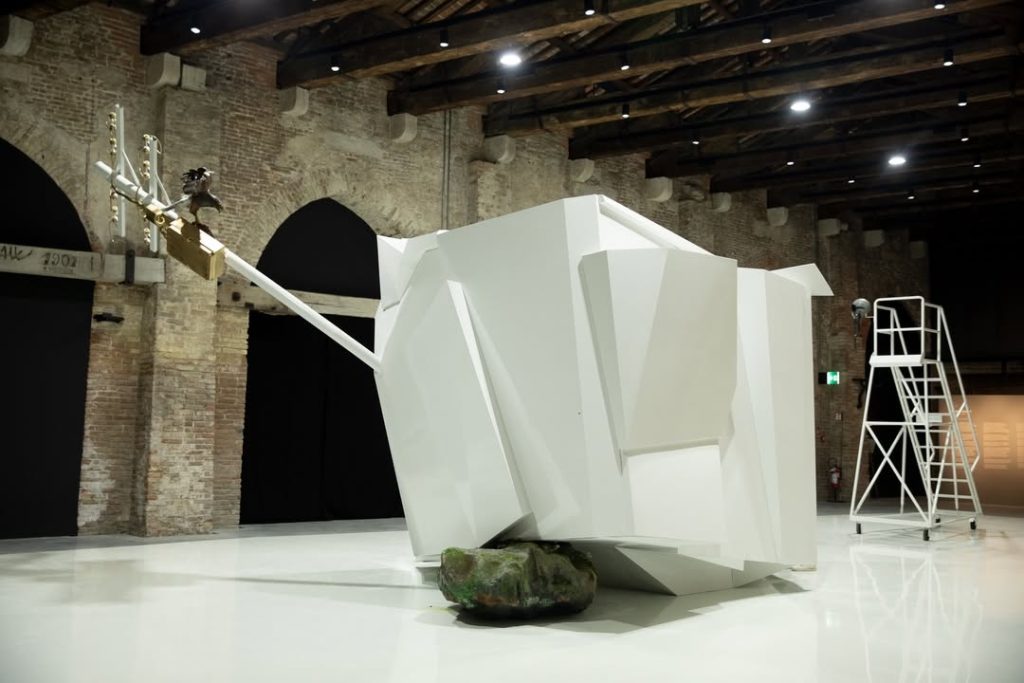
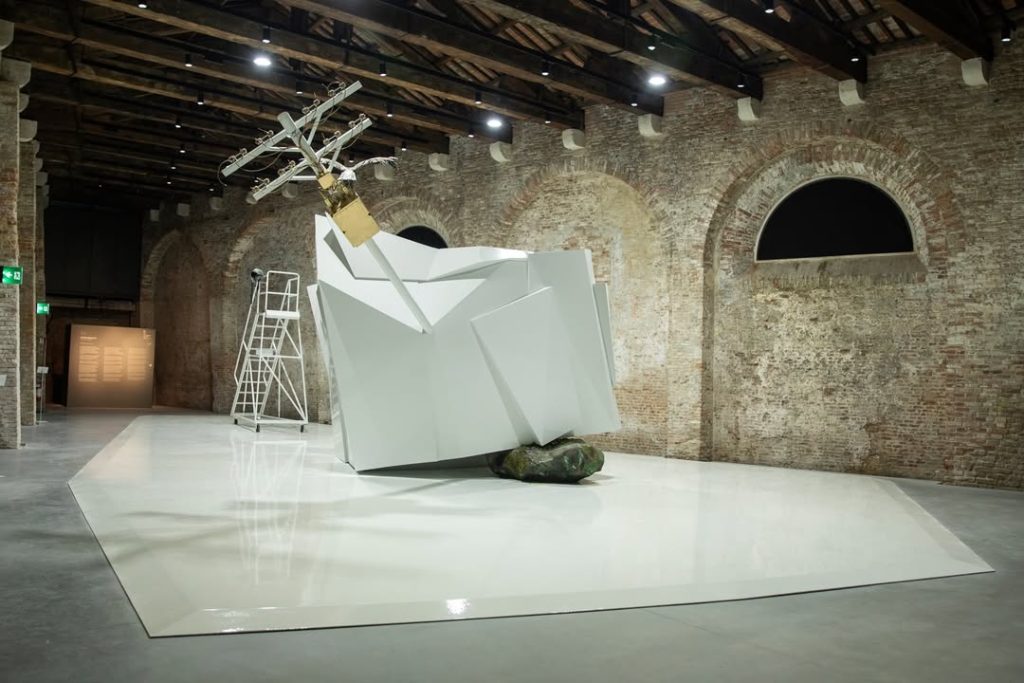
Norton Maza: In the work Interreality, I do not really address Chile directly, or only very little, almost not at all. The only element is the Mapuche chants, which appear in the sound component. Within the installation, there are also Selk’nam chants from Tierra del Fuego, a reference to a genocide and to a people that disappeared, as well as chants from the Mapuche people who live in southern Chile and southern Argentina. These are included in the installation. That is what most closely connects the work to South America, and it relates to Indigenous peoples, which, for me, is very important to make visible and present.
So the work, with its different sound atmospheres within this iceberg-like, gigantic rock-like object, allows the viewer, as they approach and look through the openings, to experience different relationships with nature: the sounds of water, streams, and birds. And within that, every so often, these chants appear. That is the closest link to South America, but it is not a work specifically representing Chile. I am more interested in the work being universal and global.
Q: Your work repeatedly returns to childhood, toys, and play, even when dealing with themes such as war, state violence, and social trauma. Why do you believe play remains such a powerful political and artistic strategy?
Norton Maza: Yes, for me, the playful dimension is very important—the idea of toys, and the possibility of using them as a very powerful tool at certain moments to address difficult themes. I believe that the relationship with toys also reveals or reflects the geographical context one comes from and access to resources. In that sense, the toy becomes a kind of testimony to those conditions. So I consider it a very interesting way to incorporate it into the work and, from there, to propose what one might call an “adult” perspective.
Q: The notion of memory appears throughout your practice, from personal histories of exile to collective memories of protest and conflict. How does Inter-Reality function as a space of memory against forgetting?
Norton Maza: Memory is part of my practice; to put it matter-of-factly, Inter-Reality interweaves intimate, individual memories with broader collective memories and scenarios. Personal exile stories serve as entry points into broader histories of violence, displacement, resistance, and social upheaval. This braid creates a multilayered memory mosaic that acknowledges both private pain and systemic struggles. The materiality of the work anchors memory in the present, preventing it from dissolving into abstraction. This tension between memory and imagination helps transform memory into a living repertoire for future action, rather than a static archive of pain.
Q: Many of your works depict humanity as trapped between self-destruction and survival, whether through environmental crises, migration routes, militarisation, or social inequality. Do you consider your work ultimately pessimistic, or does it still contain a possibility of hope?
Norton Maza: The work Interreality indeed includes sequences that are quite shocking or provocative in relation to how we perceive the present. There is a saying that reality surpasses fiction, and in my case, I simply work with everyday elements. The sculpture related to fentanyl—this figure that appears to be observing inward but cannot actually see, because its eyes are closed and the sculpture itself has no openings—represents a person in an initial state of fentanyl use. It refers to a condition that, in many ways, summarises what contemporary society has become and the forms of human violence present today.
It is a work that makes visible people who are often overlooked, becoming part of the spectacle of human precarity. For example, fentanyl is usually approached as something shocking, almost as a spectacle. But when one encounters that sculpture, where viewers share the space with the figure, it still produces a strong sense of questioning. It speaks to the world we live in today and even raises issues of truth versus fake news: at first people may think it is real, then realize it is not, and from there the question arises—what is real and what is false In that sense, the work ultimately leads us to reflect on these contemporary events, which are far from insignificant and are undeniably very striking.
Q: As visitors enter Inter-Reality at the Venice Biennale, what is the most urgent question you hope they carry with them when they leave the pavilion: a question about truth, power, coexistence, or perhaps about their own place within these fractured realities?
Norton Maza: I think all of those questions are valid, and many more as well. For each visitor, the work will resonate in a different area of their emotions and senses. What matters is that they come out of it questioning things.
Krispin Joseph PX, a poet and journalist, completed an MFA in art history and visual studies at the University of Hyderabad and an MA in sociology and cultural anthropology from the Central European University, Vienna.