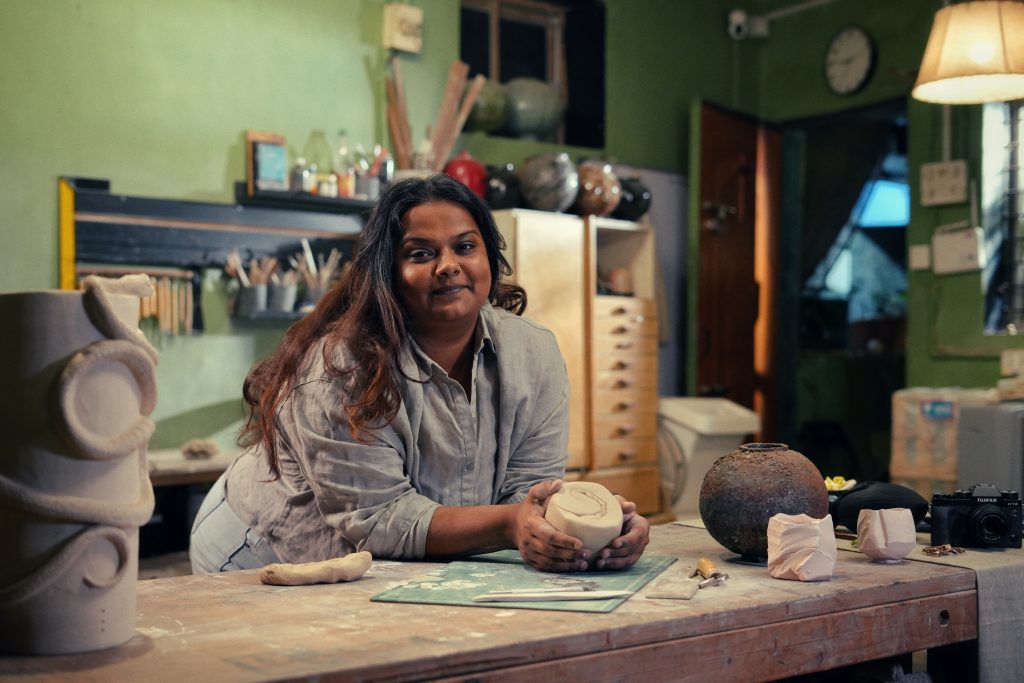
Mumbai-based artist Pooja Chamudiya works with clay as a medium of close observation, allowing landscape, material memory and place to shape her evolving sculptural language. Her practice has been informed by time spent in Goa, Pondicherry, Alibaug and Mumbai, as well as recent periods in Tamba and Tokoname, Japan—locations that have deepened her attention to local material cultures and the quiet formal possibilities of the natural world.
Chamudiya’s recent work moves between organic, floral forms and more elemental explorations of texture, volume and transformation. In January 2026, she presented Emergence, a five-foot ceramic totem interpreting Bhayanaka rasa—the rasa of fear and chaos—for Navrasa at Pinnakin Studio, Alibaug. Her raku-fired ceramics and ceramic chain links were exhibited at The Ceramic Salon – Edition I at the House of Mahendra Doshi, Mumbai, in November 2025, while her banana blossoms and other floral works featured in Nilaya’s Orchard of Opulence during A Gathering of Light in September 2025. Alongside these public presentations, she continues to share her work in intimate, private settings.
As part of Abir Pothi’s Dtalk series, where we uncover the most innovative voices of indian design and architecture, Pooja opens up about her creative process and artistic philosophy.
Q. How would you describe your signature design aesthetic, and how has it evolved while working in India?
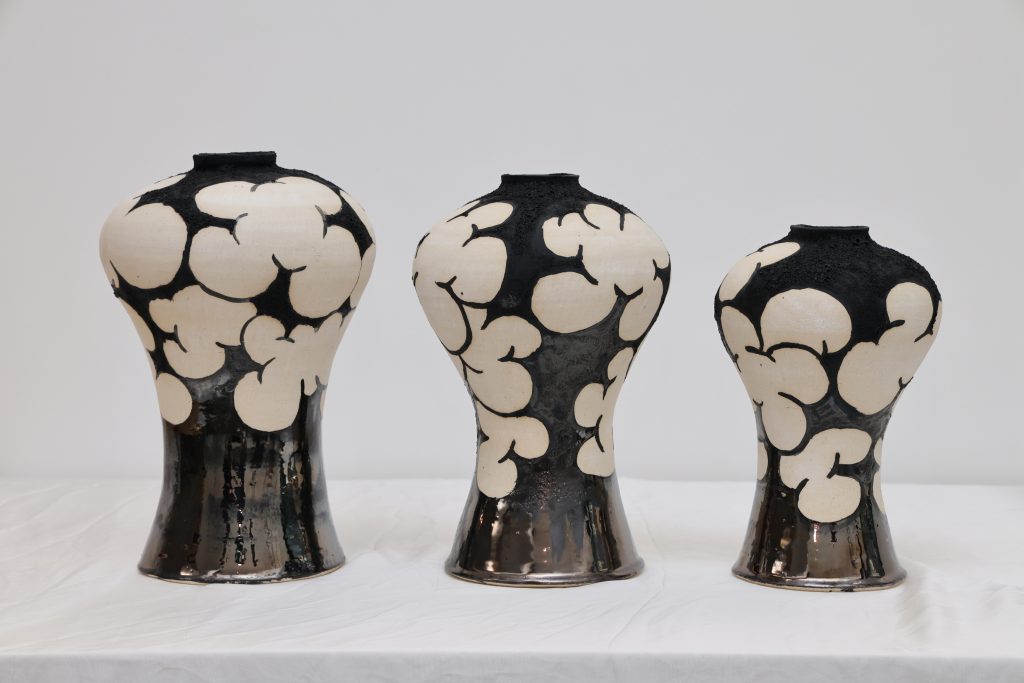
Pooja Chamudiya: Although influenced by the Korean and Japanese craft sensibility, my work reflects the quiet luxury of a contemporary aesthetic. Juxtaposing a sense of softness, like the floating clouds against dark metallic tones, gives the work a distinctively contemporary quality. People practicing clay as an art form live in a very small world, no matter the geographical location. Our shared interests and appreciation for the craft bring us together where we work across borders. My works on vessels are influenced by the Japanese high-fired ceramics and that is what I practice as a studio artist based in Mumbai. I believe that clay, as a medium, moves beyond cultural geographies.
Q. Could you walk us through your creative process? How do you move from initial concept to final execution?
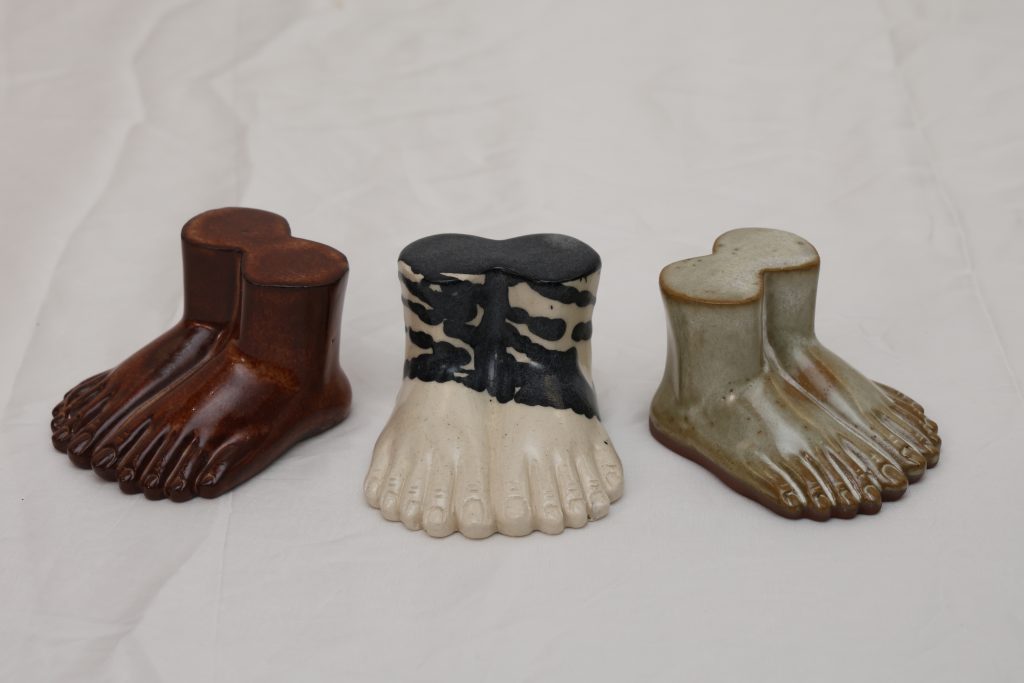
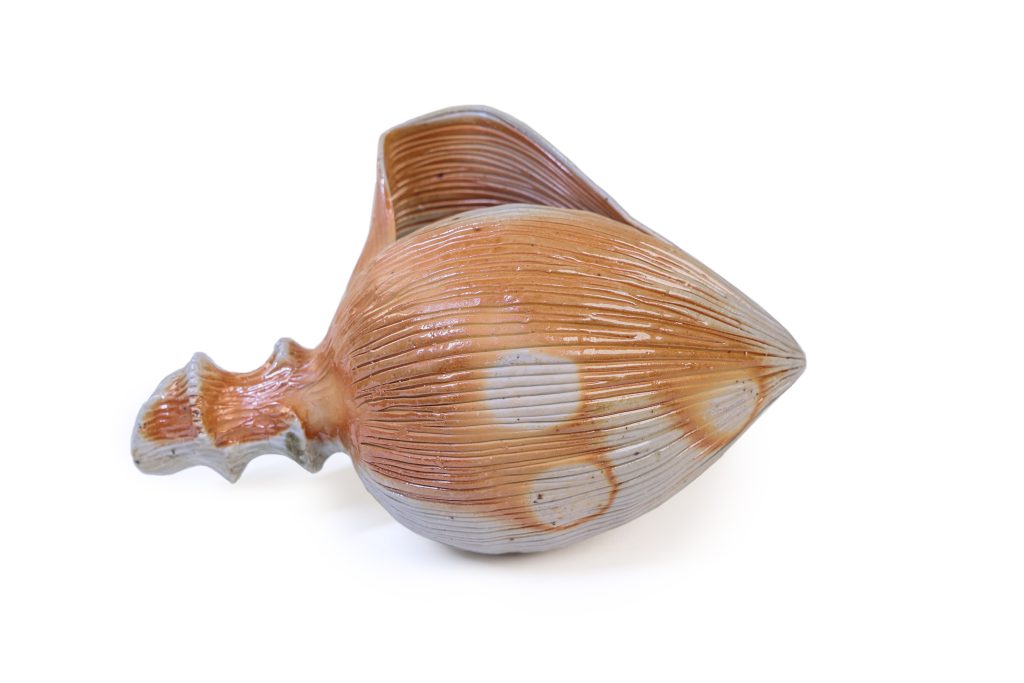
Pooja Chamudiya: I’m an enthusiastic traveller when not in the studio creating. Forms from the forests and the abundance of our markets entice me the most. For example, my work with the banana blossoms comes from a long-standing admiration for (what I call) the jewels of nature.
I let curiosity lead my practice. This curiosity is the fuel that goes into everything I create— whether it is the floating vessels or forms from the wild. Play is another word I return to often. Once I’m back in the studio from my travels, I spend time playing with the forms I experienced and the ones that stayed with me. They don’t immediately have to come to life because I let the ideas brew in my head till they are ready to come to life in physical form. Most works take time to come to life, sometimes years. Slowness is what the material demands, and I must listen.
Q. Looking back at your portfolio, which project represents a significant turning point in your career, and among your recent works, what project are you most proud of and why?
Pooja Chamudiya: In 2022, I came across a documentary on the life and works of a master potter, Lee Kang Hyo. Something about his approach to life and the works he creates moved me immensely. Especially, since I was very new and seeking a sense of true meaning within my practice as a handbuilding artist. That was when I started to explore hand coiling technique and started building floating vessels. The same technique is now the strongest skill I possess. Four years later, I continue to build the floating vessels and expand on many ideas using the same technique of coiling.
Earlier this year, I created ‘Emergence,’ a five-foot-tall ceramic totem inspired by Bhayanaka rasa—the rasa of fear and chaos—for ‘Navrasa,’ a group exhibition of seasoned and emerging ceramic artists at Pinnakin Studio, Alibaug, organised and curated by senior Mumbai-based potter Anjali Aney (January 2026). The work, a five-piece pillar standing nearly 5’6″ tall, was one of the most ambitious pieces I had made to date.
Being invited to participate in the exhibition was an honour. To exhibit alongside some of India’s leading ceramic artists was an achievement I never imagined reaching so early in my journey with clay, and it marked an important milestone in my evolving practice.
Q. What’s your most exciting recent design or art discovery that’s influencing your current thinking?
Pooja Chamudiya: I’m currently working on pushing the boundaries of my current practice and hope to build larger works. I’m also in the process of learning wood firing in depth. Anagama, a Japanese woodfiring technique, is something that has taken over my senses, and I’m actively working towards being able to learn in greater depth. The magic of wood and fire dictating the language of my work is something I’ve been drawn to for a few years now. Wabi-sabi remains a core aspect in my practice. I don’t think I will ever move away from letting go when it’s time.
Q. As you look ahead, what kind of projects or directions would you like to explore?
Pooja Chamudiya: I look forward to more meaningful collaborations with fellow artists. Coiling vessels is my meditative space, and I want to keep practicing vessel building. I’d also like to bring together my two passions: furniture and clay together more closely.
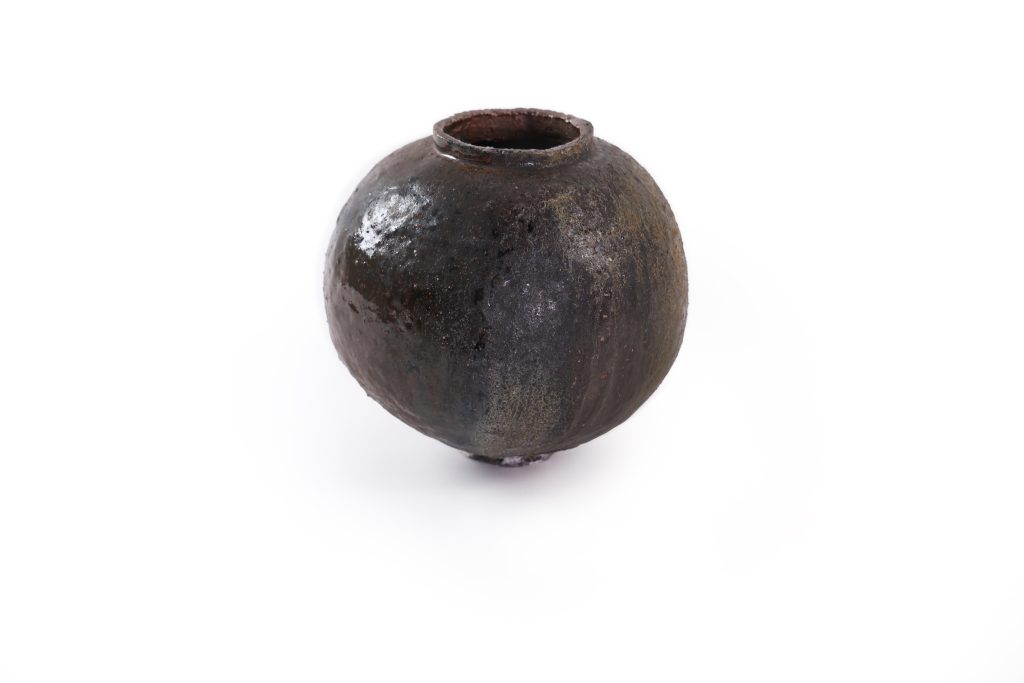
Cover image: Ceramic Vessels, Moon jar series, made with than (clay that is procured from rice paddies) Mumbai, India. 2026 | Image credit: Harish Pednekar/ Pooja Chamudiya

Contributor