Colonialism is considered to no longer exist. It is a system that European countries implemented with profit as the only goal. This is very clearly explained by French-Tunisian writer and essayist Albert Memmi in his book The Coloniser and the Colonised. Since it was implemented solely for profit, the term ‘colonial capitalism’ is also sometimes used.
Colonialism was a profitable mission. Over time, countries did indeed gain independence from colonial rule. But later, we saw colonialism returning in new forms. After colonialism, just by looking at terms like Environmental Racism, Carbon Colonialism, and Toxic Imperialism, one can understand what kinds of colonial forms still exist. Among these, the concept that’s gaining strength is Waste Colonialism.
As the name suggests, ‘waste’ is the main focus here. Used clothes are what tie its threads together. The term Waste Colonialism refers to the practice of dumping used clothes from the global North in the global South. When we examine the figures, Kantamanto Market in Accra, Ghana, receives over 15 million used garments, which is about 40% of each bale, and is immediately discarded because the clothing is of extremely low quality (mainly synthetic/polyester quick fashion). It winds up burning in poisonous open pits, accumulating on beaches, or blocking nearby lagoons.
Obroni Wawu, a common term for secondhand clothes in Ghana, meaning ‘the white man has died clothes’, is the local term for this apparel, since the inhabitants believed that someone would have to die to discard so much clothing.
Arwen Vonck’s master’s thesis discusses clothing waste that reaches the Kantamanto Market in Ghana. ‘Each week, the Global North exports approximately 15 million garments to the market, where they are sorted, repaired, altered and resold to people who are looking to buy unique clothes at a low price. This immense system depends on the labour and skills of over 30.000 people, for whom the market provides employment by giving new value to clothes that others have thrown out. These clothes are often not immediately ready for resale but require cleaning, redyeing, or other repairs to restore their value and make them appealing to customers again. As such, in addition to being vital to Ghana’s economy, Kantamanto is widely celebrated for being a space where creativity, resourcefulness, and circularity are part of everyday life. Here, the value of clothes is not determined by how new or trendy they are, but by the care and effort invested in ensuring each garment gains a new life (Franklin-Wallis, 2023), writes Arwen Vonck.
Arwen Vonck says that the way African countries were exploited by the global North during the colonial period is exactly what happened in the ‘West colonial’ matter as well.
Art and Waste Colonialism
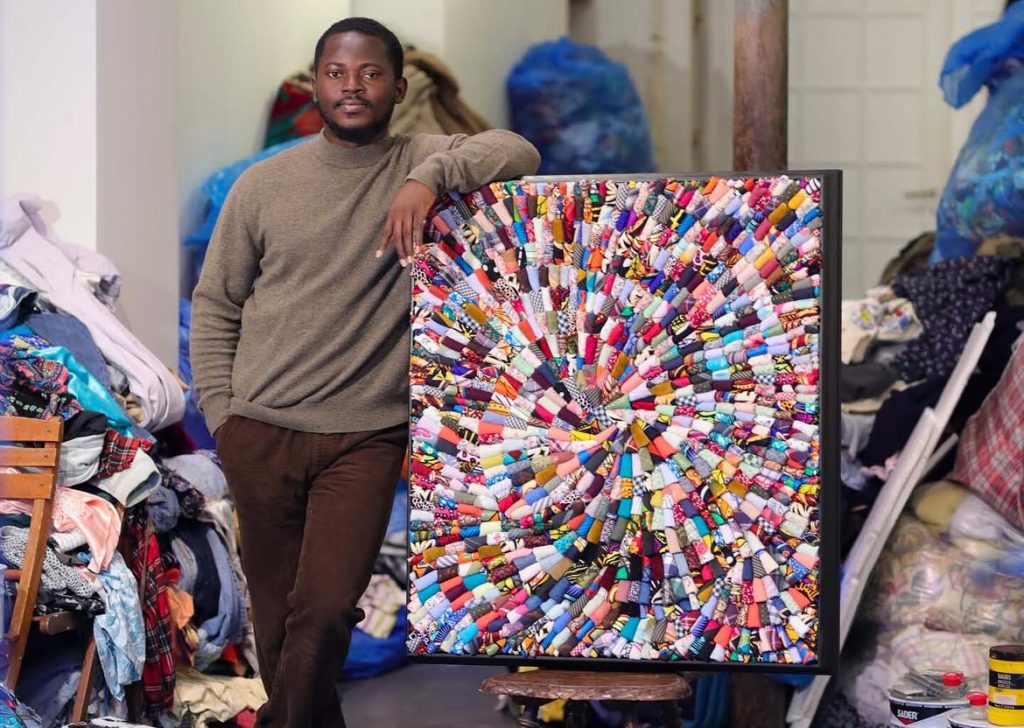
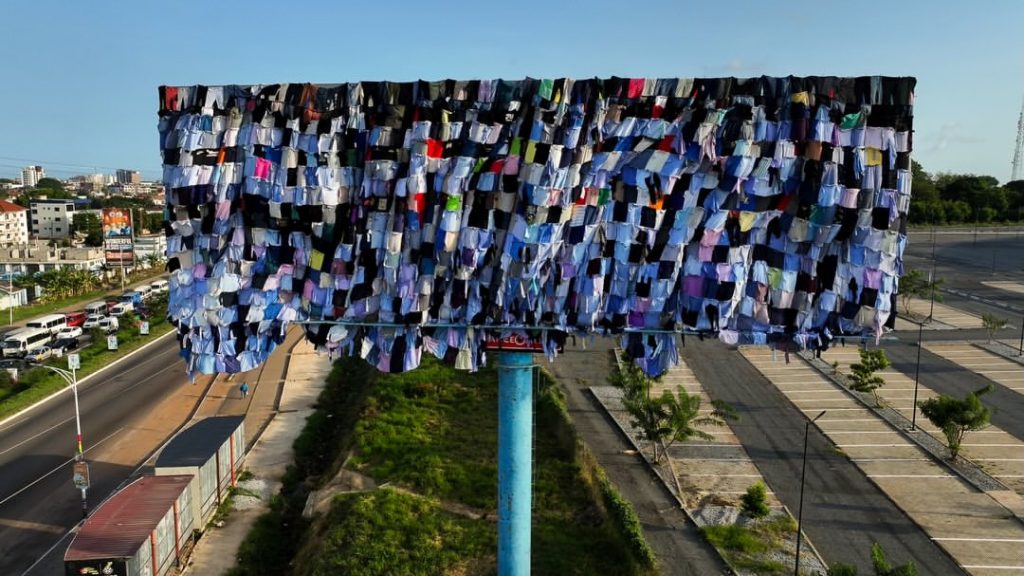
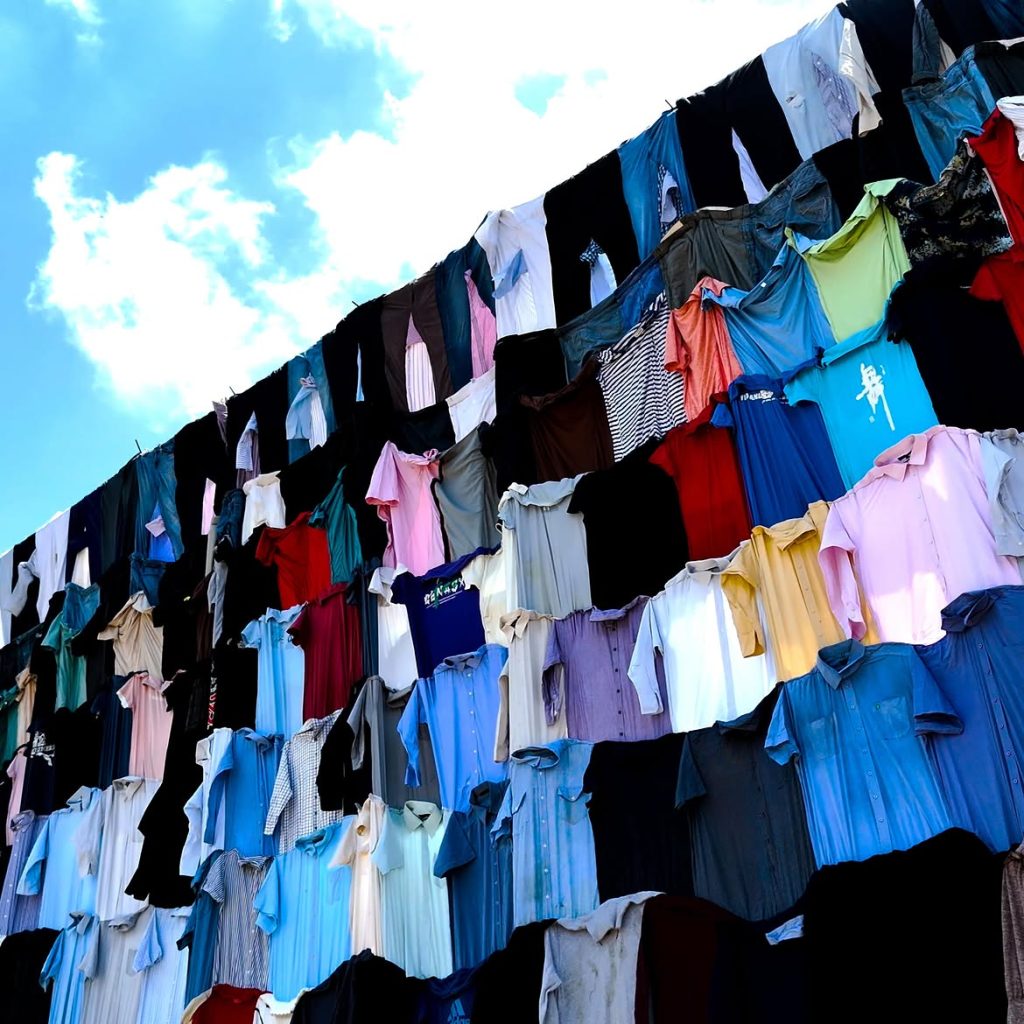
While Western colonialism is an issue, the question of how the art world views it is relevant. Ghanaian artist Emmanuel Aggrey Tieku approaches this topic artistically through his art practices. The artist, a civil engineer, create a potent visual indictment of fast fashion and excessive global consumption using the world’s discarded clothing. Tieku creates enormous fabric installations utilising used clothing gathered from cities throughout Africa and Europe as part of his long-term project How to Heal a Broken World – Fragile Origins, Futile Foundations, transforming waste into a living archive of global consumerism.
Only a small percentage of the 14 million garments that entered Ghana were sold at the Kantamanto market in Accra. The majority of it clogs the city’s rivers or ends up in landfills. As a result, Ghana has become an inadvertent garbage for the excess of the global fashion industry. His art projects showing how one country’s fashion is become another country’s debris.
Emmanuel Aggrey Tieku has been creating artwork utilising old textiles for a long time. He creates expansive textile installations that graphically depict the scale and distribution of fashion waste, using used apparel gathered from global cities. He used about 1,000 kg of abandoned clothing that Emma Rodríguez contributed to AKAA 2025 (Also Known as Africa) art fair in Paris to illustrate how fast fashion pollution is transported from affluent nations to the Global South.
At several points in his writing, Emmanuel Aggrey Tieku celebrates his project, beginning with the Korle Lagoon in Accra, which is notorious as the world’s most polluted body of water. Tieku transform that poisonous stretch of water into a temporary “living garden” featuring more than 100 varieties of flowering plants through a 2.5-kilometre floating textile project. By symbolically connecting pollution, consumption, nature, and hope, that installation aims to prompt people to confront the environmental consequences of our disposable lifestyle.
Emmanuel Aggrey Tieku’s fundamental argument is that creating an installation from leftover fabrics involves more than just making a visual piece. Since weight, tension, balance, compression, and structural integrity all play a role in creating the artwork, it is also crucial to consider the invisible systems those elements have passed through.
“Every garment carries a history of production, consumption, migration, and disposal,” the artist states. It is also important to recognise that he is saying his job is to comprehend how those separate narratives can be combined to form a cohesive whole. However, engineering, his niche, cannot answer every query. It can describe how things are, but not usually why they are important, as he said. In ways that engineering cannot, art enables him to investigate memory, emotion, spirituality, and the human condition. It allows room for creativity, intuition, and ambiguity.
The artist says, ‘Engineering gives me the discipline to build complex ideas with precision.’ But beyond that, the argument that ‘art gives me the freedom to ask questions that don’t have fixed answers’ is also noteworthy. When he talks about ‘materials—not simply as physical objects, but as participants in larger ecological, cultural, and social systems,’ we can see that he’s not just marking the material journey, but rather breaking it down.
Using the vintage clothing his grandma gathered, the artist sets out on his adventure. In this way, the artist’s early years are also linked to his artwork. Grandmother gathered textiles that were more than just materials; she was a guardian of cultural customs. They connected generations, represented social identity, carried history, and commemorated important life events. The artist discovered early on that fabrics might store memories because I grew up around her. They were living archives of culture and human experience rather than passive objects.
Clothes seem anonymous at first glance. However, the personal narratives they once had have been taken away from them, along with the individuals who wore them. The artist, however, does not think their histories vanish. The fact that a garment still bears witness to the institutions that created it even after it is thrown away intrigues me. It bears remnants of labour, mobility, ambition, trade, and environmental impact. In this way, the material’s identity has evolved rather than disappeared. It now discusses the collective reality of the world we have created rather than just one person’s life.
“My grandmother taught me to see textiles as cultural objects,” the artist claims. The concept is that textiles are both a type of culture and an object. When textiles transcend the body and integrate into ecosystems, global economies, and landscapes, they become visible. These two worlds are, in many respects, reconnected by the artist’s creations. He wants to make it possible for us to see textiles as materials that continue to change and have meaning long after we have determined they are no longer valuable, rather than just as short-lived commodities.
Although it was acknowledged that fabric could preserve memory, Western colonialism also acknowledged that it returned as hegemony, a product of colonialism. Even if the materials he works with today are deemed useless by society, they nevertheless hold memories of a different kind—memories of international trade, overproduction, environmental change, and our collective responsibility for the worlds we build.
The idea of a garment striding through lifetimes greatly impresses the artist. Someone had chosen it, worn it, cared for it, and eventually let it go. It had travelled across continents before arriving in Ghana, where it became part of a much larger story about global trade, overproduction, and environmental change. These textiles weren’t simply raw materials; they were witnesses to human behaviour and the systems we have created. That was the turning point.
The content itself requested to be viewed before being put to another use. It was inviting us to take a moment to consider the history it held and the environments it was reshaping. ‘I was able to work with the material without turning it into a product right away because of the art, the artist said. The artist recognised that because textiles usually have a strong sense of identity, the material constantly pushes back when I arrive with a predetermined idea. The weight or texture of a fabric can occasionally alter a piece’s direction. When two materials are arranged together, they can occasionally spark a visual dialogue I did not anticipate. Therefore, my objective is to engage with the material rather than control it.
Waste is a global problem. Perhaps, it will be one of the biggest problems humanity faces. However, developed countries are also choosing the wrong ways to manage waste. That’s why here it’s become a problem to the extent that it’s even called waste colonialism. Tons of waste arrive in Ghana every day under the guise of ‘textiles’.
Infrastructure is not the main distinction when Ghanaian communities are forced to accept levels of trash that would trigger a public health emergency in the Global North; rather, it is the harm permitted to matter. As a result, harm is not only unequally dispersed but also unequally acknowledged. Therefore, there is a deeply ingrained hierarchy in the recognition of pain: whereas certain people’s well-being naturally arouses concern, others’ suffering is systematically disregarded and normalised. Long-standing beliefs that continue to influence how we view and value other persons sustain this unequal response. These concepts, which have been developed and solidified over centuries, continue to determine how people view and value human existence today by determining who is and is not fully capable of reason, agency, and moral worth.

Contributor