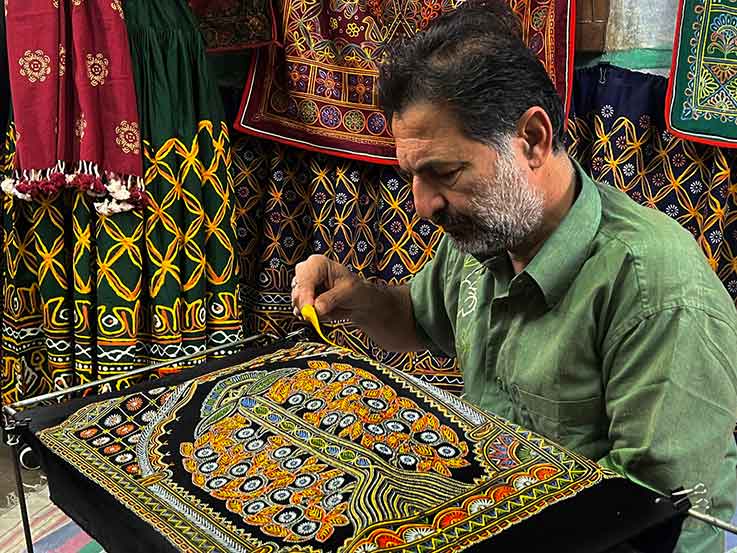
Rogan painting survives today in and around Nirona village in Kutch, Gujarat, where members of the Khatri family continue to practice the technique.
Artisans trace the form to Persian roots and explain that the word “rogan” comes from a Persian term for oil or varnish, which reflects the castor oil base of the paint. Historical records describe Rogan work on bridal textiles, skirts, odhanis and decorative hangings for local communities in Kutch.
Artists boil castor oil for many hours until it becomes a thick gel and then mix it with mineral and synthetic pigments on a grinding stone.
They place the viscous colour on the palm, lift it with a metal stylus and draw out a fine thread of paint that sits on the surface of dark cotton or silk.
By folding the fabric after working on one side, artisans create near perfect mirror images that result in symmetrical patterns, especially in tree of life and floral compositions.
For several generations only a few Khatri families in Nirona kept the practice alive and taught the skill within the household. Media coverage grew after Indian prime minister Narendra Modi presented a Rogan painting to former US president Barack Obama, which placed the village craft in a global diplomatic spotlight. A Geographical Indication tag and craft‑development initiatives now frame Rogan as a rare textile art that symbolizes Kutch’s resilience and its mix of Persian and Gujarati influences.
Rogan painting today appears on panels, scarves, bags and garments for urban customers while it still retains its identity as a slow, hand‑driven technique. Practitioners highlight issues such as the high cost of castor oil, the labour involved in boiling and colour preparation and the pressure to simplify designs for the tourist market. Training programmes for local women and young people in Nirona suggest that this once highly endangered practice now has a fragile but visible future.
Athmaja Biju is the Editor at Abir Pothi. She is a Translator and Writer working on Visual Culture.