The Yale Center for British Art (YCBA) in New Haven, Connecticut has put a remarkable 37-foot-long Indian scroll on public view for the first time. The exhibition Painters, Ports and Profits: Artists and the East India Company, 1750–1850 runs until 21 June.
A Panorama of Lucknow in Scroll
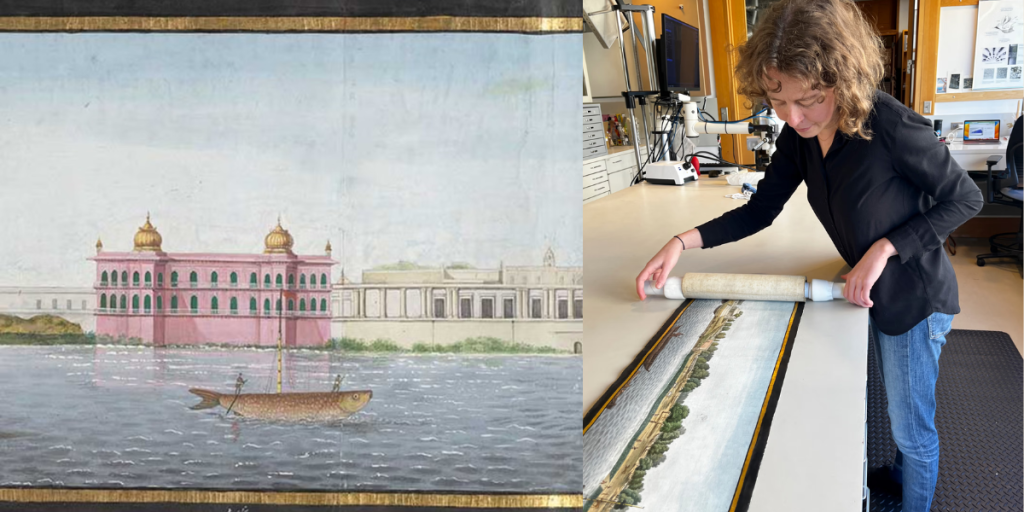
Artists created the scroll between 1821 and 1826. It comprises 33 joined sheets of laid paper, rendered in watercolour, gouache, and gold. The work captures an expansive view of Lucknow in northern India, as seen from across the Gomti River.
Curators Laurel O. Peterson and Holly Shaffer describe it as a form of storytelling. “It allows the viewer to follow a journey along the banks of the river,” they say. The scroll captures palaces, mosques, workshops, warehouses, and everyday structures built during the reign of Ghazi-ud-Din Haidar Shah, who declared independence from the Mughal emperor in 1819.
Mystery Surrounds Origins of the scroll
The scroll carries several unanswered questions. No one knows who painted it or who commissioned it. Its inscriptions place little emphasis on the East India Company. Curators believe an elite woman in the ruler’s retinue may have requested it, or it may have served a military or political purpose.
Two Years of Conservation
YCBA conservators spent two years stabilising the scroll before display. Assistant paper conservator Anita Dey says the scroll’s layered construction — multiple sheets joined together, lined with paper, and backed with cotton textile — created significant structural distortions. The team flattened the object to allow safe unrolling. During conservation, they discovered a watermark from the British mill of James Whatman, which helped narrow the scroll’s date and connect it to broader trade networks.
On Display in Portions
Due to its fragility and size, the museum displays only half the scroll at a time and rotates sections throughout the run. This approach also limits light exposure and gives repeat visitors a reason to return.
Cover image courtesy of the Yale Center for British Art
Athmaja Biju is the Editor at Abir Pothi. She is a Translator and Writer working on Visual Culture.