At Dhi Contemporary, the exhibition What Remains: Heritage Between Memory and the Present brings together six artists—Manu N (Manushya), Martand Khosla, Sangam Vankhade, Saruha Kilaru, Sayantan Samanta, and Sewali Deka—in a sculptural encounter that asks viewers to consider how the past survives in the shifting terrain of the present.
The show presents heritage as a restless, changing force, shaped by memory, omission, displacement, and the lived realities of modern experience, rather than an object to be preserved or a static archive to be treasured. As a result, the exhibition views heritage as a verb that is constantly enacted, questioned, and reconstituted rather than as a noun.
Instability is highlighted by the curatorial framework, which portrays legacy as multi-layered, malleable, and even delicate. Through the materials, stories, and tensions they contain, the works interact with this instability. To investigate how stories endure—or vanish—some artists use experimental archives and speculative reconstructions, while others use technological mediation or performative gestures.
The variety of sculptural languages on display emphasises how ancestry is never unique. Instead, it breaks and multiplies, exposing how individual memory clashes with collective history, how long-held narratives of the digital age are upended, and how political and ecological changes shift the foundation of cultural memory.
The most remarkable thing is how each piece addresses absence just as much as presence. Erasure, forgetfulness, and distortion are viewed as active contributors to heritage formation rather than as failures of memory. Meaning is renegotiated in these voids and silences, which turn into productive spaces. What Remains, the show’s title, becomes a philosophical challenge: heritage is defined by both what endures and what disappears—and by the discussions that take place in the transitional space between clinging to and letting go.
This exhibition challenges the notion that Heritage is commonly imagined as the preserved wonders of the world, such as isolated monuments, cracked mosaics, frozen behind glass, protected as historical emblems. It questions whether Heritage has been reduced to static buildings, curated ruins, and institutional approval. This exhibition argues that Heritage is no longer only something inherited from the past or safeguarded by authority and funding. Instead, it is increasingly shaped by ordinary people who recognise their everyday labour, care, and discipline as meaningful acts worth sustaining. In this sense, Heritage is not accidental or purely historical; it is an ongoing, conscious process.
The exhibition points out that we are living in an age in which Heritage is produced in the present, for the future: not only as a physical form, but also as spatial cognition, memory, and responsibility. These sculptures ask: can the mundane become Heritage? Does Heritage require validation from governing bodies, or does accountability itself legitimise it? The exhibition proposes a sustainable, self-authored idea of Heritage: one continuously made, lived, and reshaped.
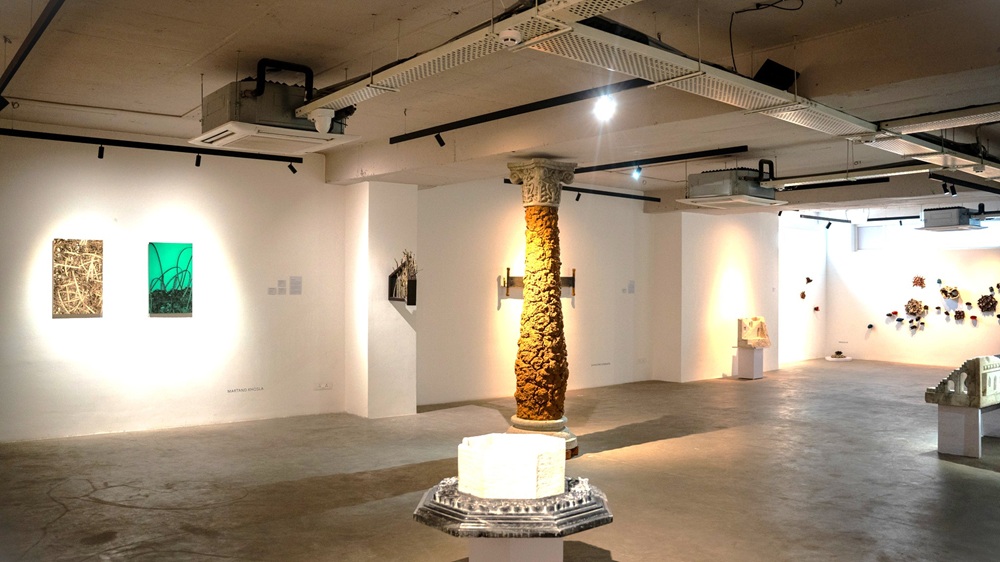
Exhibited view of Art
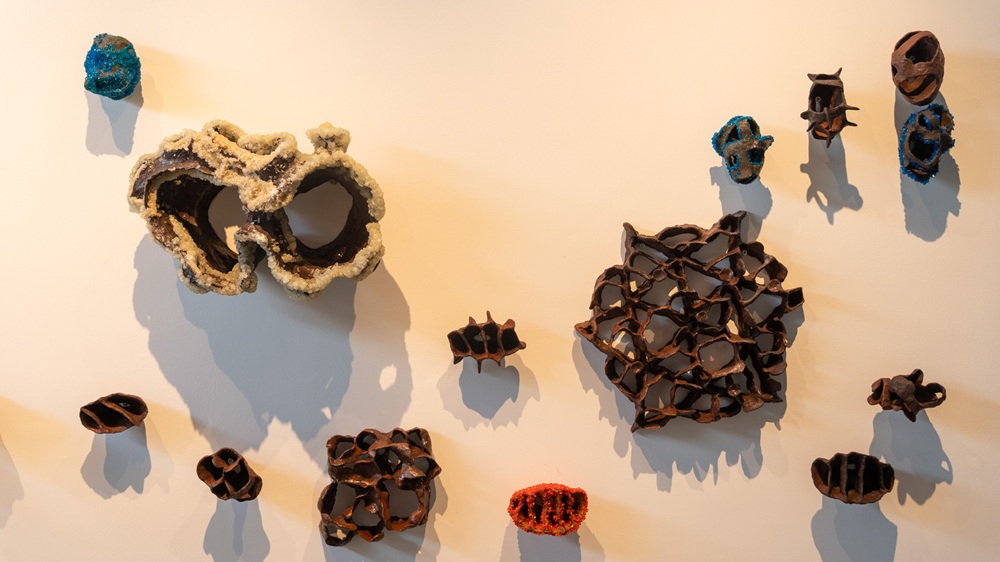
Manu N (Manushya) ‘s Edaphic Cells series functions more like a living system than a single sculpture, and the connections between its forms reveal the work’s significance. There are several hand-formed terracotta structures in the piece, some of which feature brightly coloured, mineral-like textures or salt-crystal coverings. The asymmetrical, open shapes, replete with voids and folds, produce shadows that resemble the branching, concealed architecture of subterranean life.
Fragmented Heritage (Marble, 2024), a stone sculpture by Sangam Vankhade, most likely recreates the facade of an old building. It is a subdued but impactful reflection on how history endures in bits and pieces, ruins, and fragmentary recollection. Steps that drop from both sides and lead to what looks to be an old marble pavilion, shrine, or entrance hall make up the sculpture’s partially carved architectural structure. Through its incomplete objects—ruins, broken temples, collapsed stairways, and isolated columns—the sculpture reflects how heritage reaches us, and it gives the situation a regulated, modern form.
Rasna, a delicate and glowing glass sculpture by Saruha Kilaru, is a flame-worked piece placed inside a blown-glass matka. It combines two worlds into a single translucent form, and it is among the exhibition’s most subtly poetic pieces. The observer initially sees what appears to be a fresh, flowering plant in a glass container resembling a fishbowl. The glossy foliage, strong green stalks, and bright red and purple blooms’ tips give them an almost lifelike appearance.
The sculpture Opulent (Brass, Iron, 2025) by Sayantan Samanta combines industrial structure with organic shapes. It presents a lyrical conflict between structure and nature, between order and chaos. A strong, geometric iron frame that is fixed to the wall makes up the sculpture. A collection of thin, branching brass objects, resembling dry branches or saplings, grows upward within this frame. The piece is a perfect fit for the exhibition’s theme, which is heritage as something dynamic and ever-changing rather than static.
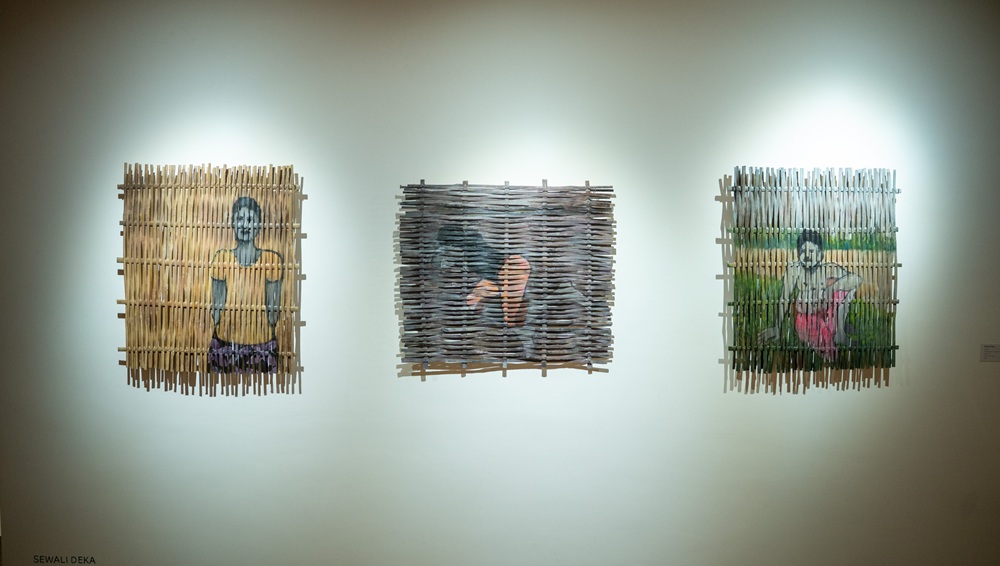
Sewali Deka created a series of three woven-panel paintings titled Untitled (Enamel paint on bamboo fence, 2018). It turns a simple, rural material into a surface of portraiture and recollection, making it one of the exhibition’s most philosophically dense pieces. The artist applies paint directly to a woven bamboo fence, a prevalent material in working-class and agrarian areas throughout India, particularly in the Northeast, rather than to canvas or paper. By turning it into a surface that can hold images, Deka transforms a commonplace item into a location for cultural and individual narratives.
Some pieces feel like memories trying to re-establish themselves before slipping away again, while others read like pieces uncovered from potential futures. Such actions force viewers to identify their own role in the creation—and destruction—of heritage and to place themselves within the continuity of the past and present.
What Remains: Heritage Between Memory shows that heritage is a dynamic, changing constellation of memories, absences, and tangible alterations rather than a set inheritance. The six artists assembled at Dhi Contemporary demonstrate how the past is constantly being rewritten—sometimes subtly, sometimes via disruption—using terracotta, marble, glass, brass, bamboo, and other materials.
Their artworks demand that we reinterpret, examine, and reinvent the stories they inherit, not because they remain intact. The exhibition reframes heritage as an active, changing activity by bringing viewers into this restless terrain. This practice takes place in the delicate space between remembering and forgetting, presence and loss, what has disappeared and what is left.

Contributor