On This Day
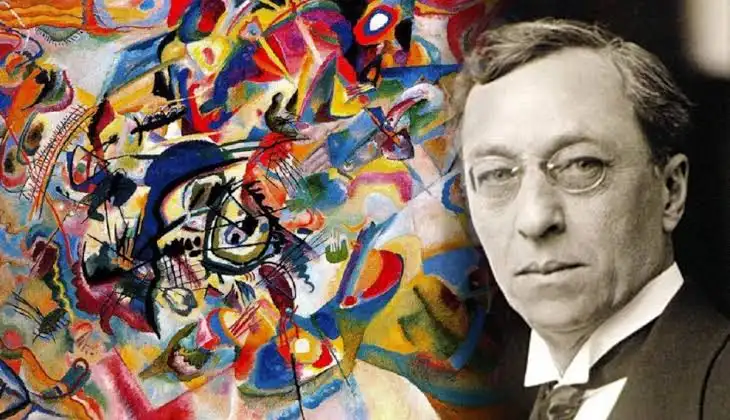
Wassily Kandinsky is an artist who transformed painting into a language of pure feeling and sound. Born on 16 December 1866 in Moscow, he is widely regarded as one of the pioneers, and often the “father” of abstract art.

Early Life
Kandinsky initially studied law and economics and did not fully commit to art until his early thirties, after being deeply moved by an exhibition of Monet and a performance of Wagner’s Lohengrin. These encounters convinced him that colour and form could resonate like music, independent of recognizable subject matter. He moved to Munich in 1896, entering a vibrant avant‑garde scene that shaped his early experiments with expressive colour and symbolist imagery.
Toward Pure Abstraction
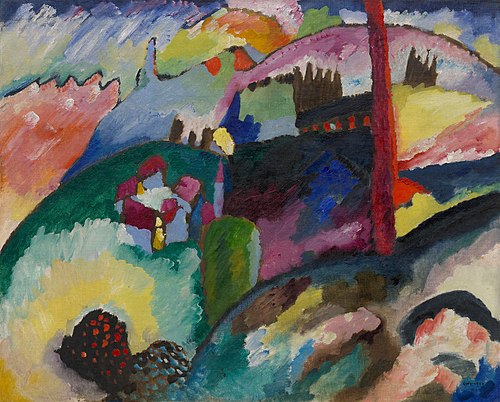
Through the 1900s, Kandinsky’s landscapes and figure scenes became increasingly simplified, with bold colours and swirling lines overpowering descriptive detail. Around 1910, he produced some of the first fully abstract works, including an untitled watercolor often cited as a landmark in non‑objective painting. He co‑founded the Blue Rider (Der Blaue Reiter) group in 1911, aligning with artists like Franz Marc to champion spiritual, expressive art over naturalistic depiction.
Colour, Sound, and “Inner Necessity”
Central to Kandinsky’s practice was the belief in “inner necessity”—the idea that true art arises from an artist’s inner spiritual impulse rather than external appearances. Synesthetic in his perceptions, he described “hearing” colours and “seeing” sounds, treating painting as a kind of visual music. His influential treatise Concerning the Spiritual in Art (1910–11) argued that abstraction could bypass materialism and speak directly to the soul through colour, line, and rhythm.
Bauhaus and Late Style
After the upheavals of the First World War and the Russian Revolution, Kandinsky joined the Bauhaus in Germany in 1922, teaching alongside Paul Klee and others. His work in this period shifted toward more geometric compositions, with circles, lines, and grids orchestrated into precise visual harmonies. When the Bauhaus was closed under Nazi pressure, he relocated to Paris in 1933, where his late paintings fused biomorphic forms with luminous, floating colour, maintaining his lifelong search for a pictorial equivalent of music and spiritual experience.
Enduring Legacy
Kandinsky died in 1944 in Neuilly‑sur‑Seine, near Paris, having irrevocably altered the course of modern art. His concepts of abstraction as a universal visual language shaped later movements from Abstract Expressionism to Color Field painting, and his writings remain foundational texts in art theory. Marking his birthday today is not only a commemoration of a single artist, but a reminder that painting can still be a space where colour, sound, and spirit meet beyond the visible world.
Athmaja Biju is the Editor at Abir Pothi. She is a Translator and Writer working on Visual Culture.