The solo exhibition ‘a choreography in green’ by Kerala-based artist Smitha M. Babu at Vadehra Art Gallery is notable both as a continuation of the artist’s ongoing artistic journey and as an attempt to break free from that continuity.
‘Uses atmospheric washes, soft tones and layered storytelling to create dream-like, meditative scenes exploring ideas of community, womanhood and a deep connection between people and landscape as evocative reflections on cultural change and loss,’ is what the gallery note says about Smita’s paintings. The narrative contexts of storytelling are a special feature of Smita’s paintings, evident in the ‘Pakkalam Series‘ exhibited at the Kochi-Muziris Biennale. The paintings in this exhibition also have a similar thematic context.
Story about the Smitha M. Babu’s Choreography
A story is a historically constructed formation that takes shape through images. Each image is a story, and each story is a history. Those standing in the paddy field with goats and cows are an image/a symbol, a story, and a history. These are locally constructed ways of life, and, in terms of the economy, the region’s development is related to the various work people do there and the emancipation that comes with it.
The phrase ‘working women’ also means ’emancipated women.’ Women become economically independent. Women who make coir, women who act in plays, and women who raise cows and goats should be understood as different conditions of emancipation.
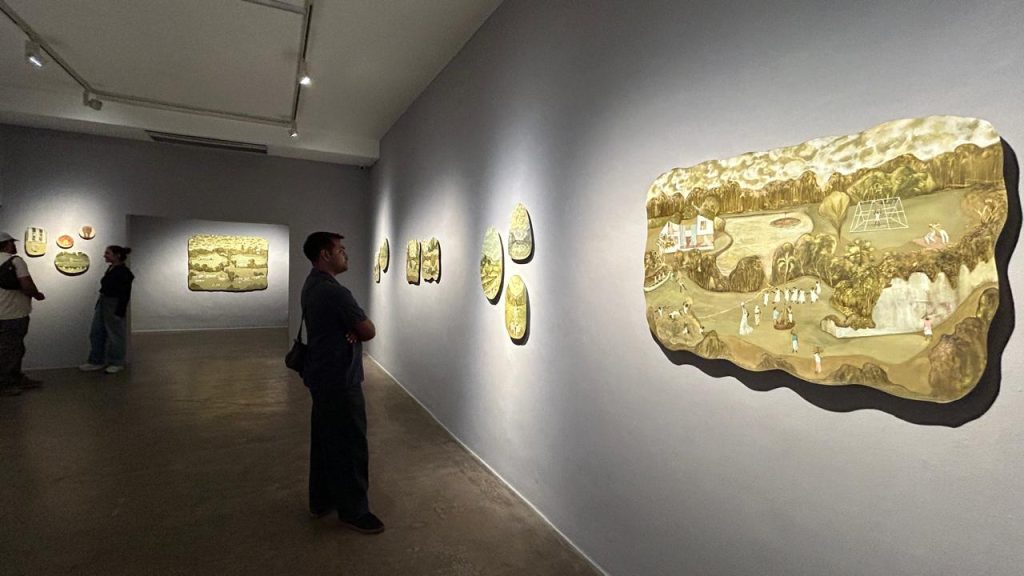
A choreography in green combines paintings from the Kochi-Muziris Biennale with new works. Smita’s paintings construct an inner world that blends experiences from the green islands where she grew up, from workplaces dominated and evolved around women, from the backdorp of theatre, and from churches, temples, open spaces, village paths, and villagers.
One can see the presence of various facets of the Communist Party, which has constructed and deconstructed the inner structures of the land, different human movements, stillness and in motion, children, the distinct elements of islands like boats, and those who travel in them, creating scenic views full of rustic charm.
The content of Smita’s paintings, as well as the way they turn it into canvas-like islands, can be described as fluid and fantastical environments. The artworks are displayed in a way that depicts sky landscapes. It is here that various scenes of village life—groups of sari-clad women holding hands and dancing, and many others narrated above—take shape.
None of these is specifically formed; the fact that they are the artist’s embodied experience makes these paintings a performative and mythic tradition that both emerges from and shapes the collective identity. In this way, it highlights the ritualistic and rehearsed elements of our shared histories.
It is indisputable that a person and her artistic creations are the eloquent history of that region. When a person tells stories of her rural life, they become her own story and also a historical and social record of the time she lives in. In this sense, what W. B. Yeats says is that a person’s solitary social act is art.
In Smitha M. Babu’s paintings, memory, performance, and landscape come together to express a sense of continuity, resilience, and connection in a changing world. It is both continuity and expansion. A woman is holding a child standing inside a roofless house, and a woman is walking in front of the house carrying a coconut leaf. We also see two girls who have turned the house’s surroundings into play spaces. One girl in front of the house is wearing a mask. The second child is partially hidden towards the back of the house.
On one side of the house, we can also see graffiti of the Communist Party. While the interconnected yet independent images carry their individual meanings, they also represent a world where everything comes together, representing another world. This makes the landscape’s performativity even more complex.
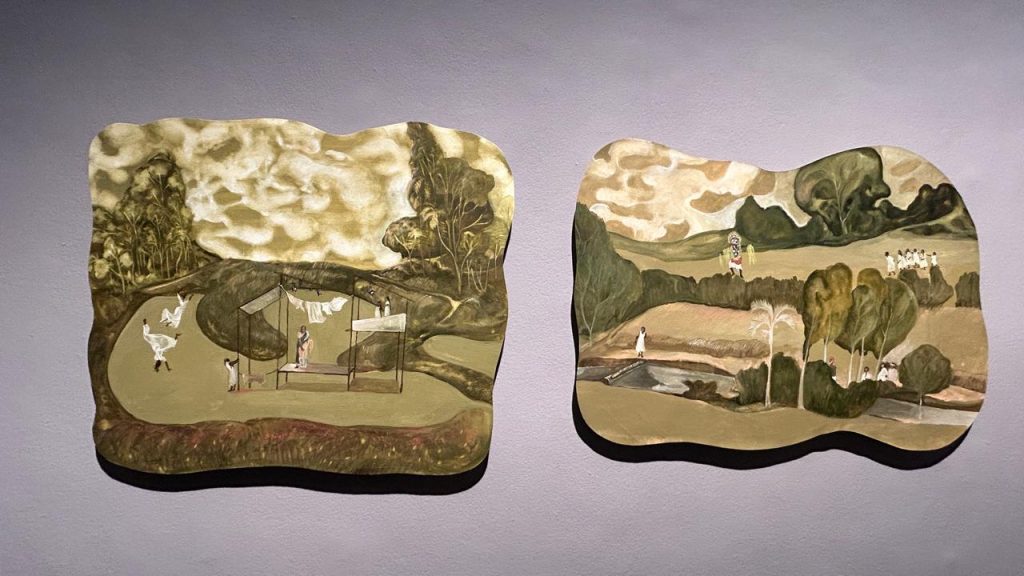
The realm of Smita’s work is complex. But within the beauty of watercolour, those layers blend together to form the place’s introspective, genealogical essence. Layers of colour combine to create a universe that is both abstract and fully meaningful. People own that world, it is freed and becomes the centre of attention for everyone, much like a stage. The place is illuminated by the light. The location, which is fundamental to the land and its inhabitants, is transparent even when a leaf falls.
In an interview with Smitha M. Babu, she replied to my question about the Biennale exhibited works as follows.
Q: Your Paakkalam series is deeply rooted in the geography of Ashtamudi Lake. How does the landscape itself shape the emotional and visual language of your paintings?
Smitha M Babu: I live in Neeravil, Kollam district, Kerala. It is an island surrounded on three sides by the Ashtamudi Lake. Weaving rope (coir out of coconut husk) has been a common occupation in the coastal area of Ashtamudi Lake for a long while. For this, women and children from every household go to places known as ‘Paakkalam’ to make coir. This work is a means of livelihood. It has become a major source of income and financial security for ordinary workers, and the workplace has become the centre of that village. In this way, the coir industry is interconnected. Just as separating golden fibres from a decaying substance and twisting them into new threads (coir), this rope industry plays a major role in intertwining the lives of people involved in various other sectors of that area.
In this modern era, it is my duty as an artist to remind people of that workplace, its conditions, its culture, and its endurance. In a situation where all our social bonds have changed, and people are becoming isolated and exploring things on their own, the Paakkalam series is an attempt to mark the existence of such a period. The sounds of the ‘ratt’ machine and the coir production (making threads out of coconut husk) had become the music of that land itself. My paintings are also attempts to bring the presence of that music into images, recognising that the rhythm within me remains the same.
Smitha M. Babu sees marking one’s homeland as an artist’s responsibility. The various layers in it need to be understood along with the self-expressions of different social groups. This is also one aspect behind the artist’s statement, ‘When the hands of women spinning coir move, a history is being created there.’ History has been constructed through the hands of the worker. History is mingled with the salt of the worker’s sweat.
In the ongoing exhibition at Vadehra gallery, the displayed works create a village life, sketches, and memorial moments, in interactions with colour, light, and shadow that merge with theatrical elements to form a staged reality. ‘Signs are not signs of a thing,’ says Deleuze. That is, everything we see as pictures or parts of a composition is not merely images and signs. Through them, the history and geography of a country are conveyed. There are some things that are conveyed that are greater than what is said. That is where its charm lies.
Even if we look at it through Deleuze’s statement, ‘linguistic relation between the signifier and signified has, of course, been conceived in many different ways,’ it can be understood in the same way. Just as flowers, when turned into pictures, are not just pictures of flowers, a person standing against the wall is, over time, transformed into a sign. The deserted road in front of the church and the faded stamps of the Communist Party are also some signs; pictures are a form of semiotic knowledge. They are images that the painter has found, recovered, and excavated to say something new, just as Deleuze himself says, ‘is assigned a new role by the new surroundings.’

Krispin Joseph PX, a poet and journalist, completed an MFA in art history and visual studies at the University of Hyderabad and an MA in sociology and cultural anthropology from the Central European University, Vienna.