We are now witnessing many wars. War on terror, war for oil, for power and so on. War creates a historical milieu; it divides history, memory and life into two: before and after the war. In the ongoing context of war, this article, as part of a series on war and art, examines the artworks of Iranian artist Sadegh Tirafkan. It is a fact that the background of war, the art of Sadegh Tirafkan, the recurring, ever-present atmosphere of war, and the migrations associated with it have become a source of inspiration for artistic creations.
Before the Islamic Revolution, which took place when the artist Sadegh Tirafkan was six years old, he left the country with his family, who later returned to Tehran. The artist, who later lived in Tehran, also served in the military for about 8 years in the 1980s. Various undercurrents and internal fractures of Iranian masculinity and its dominances are primarily what fall within Sadegh Tirafkan’s thematic scope. Sadegh Tirafkan began his attempt to view his surrounding society and topics from different angles with a degree in photography from Tehran University in 1984. Since that changed and shaped Sadegh Tirafkan, he uses various media, such as photography, video installation, and collage, to create new layers and surfaces of war and experience and to explore them on a new level.
Some of the things Janet Radi mentions in her writings about the artist, in particular, ‘he is very much a product of his circumstances, both on an international and an individual level, but this is clearly what informs his art’. Janet Radi sees Sadegh as the ‘epitome of an Iranian artist’ because his ‘innovative and utterly contemporary works are profoundly influenced by the legacy of his traditional Iranian heritage’.
Art of Iran and Sadegh Tirafkan
In an article by Iranian art historian Hamid Keshmirshekan said about art, generally, ‘artistic practices reveal a perception of history that maintains a constant connection to present understanding.’ History is a contemporary discourse, and while there is a place for history in the formation of art, literature, and thought, its various influences, along with conflict and other layers, shape them.
Regarding art, artists, and history, two major thoughts are relevant: the influence of history and the present on making art. One is Philosopher Preston King’s argument about the historical influences on the present, or the play of the present time in historical thinking and making art. King said, ‘to know about the past is to know about it in the present,’ emphasising thinking and making situated in the historical and the present. Second is from historian John Lukacs, who introduced ‘participant history’ to address this point and proposed a new dimension of knowledge that is not solely personal but inherently participatory (Lukacs 2008), that means, as explained by Keshmirshekan, ‘one’s comprehension of history and collective memory is intertwined with their active involvement, signifying that the appreciation of the past is continually rooted in a present understanding.’ Iranian art, in accord with Keshmirshekan, depicts a historical narrative situated within the present understanding, or, as Foucault argues on this, ‘the influence of one’s own time and values’.
The above points are shaping how we see Sadegh Tirafkan’s artworks as history, memory, and as contemporary discourse on war, identity, resistance, and creative revolt against war. Being rebellious against many odds in life is natural and lifelike for an artist. After completing the photography course, Sadegh carried his art into new forms through conceptual and installation works, as a rhetoric of the complexities of contemporary Iranian society. The main undercurrent of his work is his immense cultural tradition of ancestors and the changes that affect that great tradition within the engagement with the Western, globalised world.
Each of the continuities is historical, geographical, regional, personal, and collective. It is not easy to separate each one from the other. In that sense, art and literature, and any other creative forms, cannot be removed from history, nor history from the present, which is intertwined with everything within an artwork. This is, primarily, evident from the aforementioned arguments and also serves as an introduction to Iranian art. Andrea Fitzpatrick states, particularly in the context of the Iran-Iraq War (1980-88), ‘the prevalent culture of martyrdom in the region unveils a subtext of trauma. This exploration sheds light on the recurring visual motifs, symbols, and themes that persisted throughout the artist’s thirty-year career.’
Art of Sadegh Tirafkan
As one goes through the images in Sadegh Tirafkan’s Body Curve (2001-2002) exhibition, one can see that the artist conveys, through his creations, the silent revolutions he undertakes and the introspection they provoke. In this exhibition, the images meet at a point where Persian calligraphy merges with the curves of a human body, combining history and the present in a single place, grounded in the human body and its embodied experience.
In this piece, Tirafkan applies tattoos, calligraphy, and block stamping to pictures of nude men. The Islamic custom of veiling women is well known in the West, but we are less aware of the equally potent taboo against the representation of the nude, particularly the nude male. The calligraphic signs and stamps in these strikingly beautiful and unique images both expose and conceal the body. The stamps serve as emblems of Iranian popular culture and as recollections of Tirafkan’s early years, while words that spell fire, water, renewal, secrets, and single letters suggest the hidden language of Tirafkan’s mind. Ancient Iranian tattooing customs and wooden-block print stamps used to adorn textiles served as inspiration for the graphics in these series. However, Tirafkan “Text” uses the blocks to imprint the human figure. “Flesh is the canvas that culture has branded.”
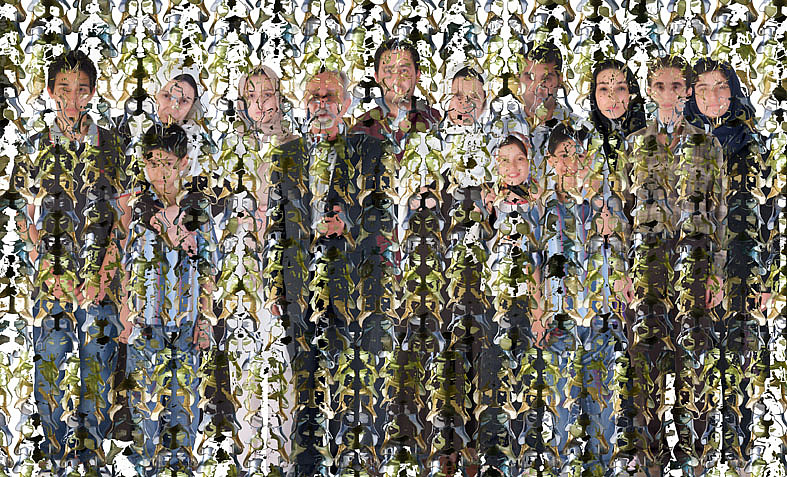
In Human Tapestry (2009–2010), Tirafkan connects us to a very ancient heritage by using ornamental wood blocks from traditional Iranian textile design. The canvas serves as a history of people and their subjects. The carpet, which represents seasonality, richness, diversity, and continuity throughout time and history, is a symbol of Iranian culture. By creating a parallelism and marriage between this symbolic, beautifully woven object and the people to whom it belongs, an artist brought attention to the population problem that Iran and the rest of the world face. The artist wants to show that everyone seeks inner peace and sanctity, regardless of gender, culture, or religion.
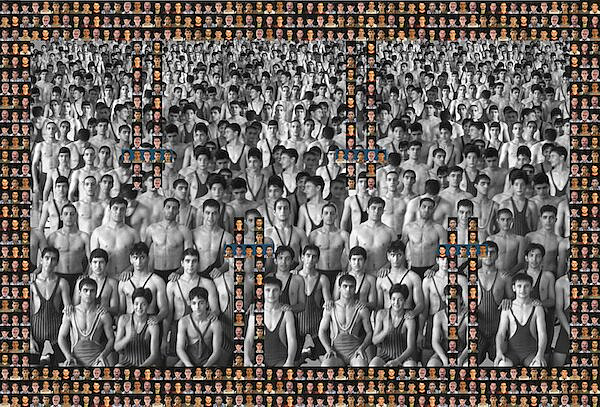
In Human Tapestry, Tirafkan created a modern artistic language that remains firmly anchored in Iranian visual heritage and Islamic cultural tradition by fusing photography with a range of media and uses visual metaphors to address several facets of modern, individual, and sociocultural identities in a complex, interconnected story. He alludes to Persian-style carpets, while in “Hijla, Always in Our Thoughts,” he refers to a makeshift shrine created in the Shia tradition to honour the deceased, modernising and transforming an age-old method of grieving.
In the artwork Endless (2009–2010), two of Iranian culture’s most important emblems of manhood are the sword and the long. The long is not an aggressive weapon; rather, it is meant to defend one’s honour and country. The artist’s emphasis on his exile caused him to clash with his nation once more. But this time, he was thinking about the outdated ideas of his instructors, who believed that photography was not a creative art but rather a literal tool for documenting news stories or depicting landscapes. When masculinity is viewed historically and territorially, it is a symbol of repressing many other things. Sometimes the artist himself and sometimes others become characters to depict this masculinity.
What makes Sadegh’s artworks notable is that they regularly focus on their narrative of bloody combat. However, like many other war arts, it is neither explicit nor clear. This is because the artist is inspired by Ferdowsi’s Shahnameh, an 11th-century epic dominated by men in which Rostam, the main character, demonstrates his legendary power through heroic acts.
Sadegh is not a man obsessed with fetishising a long-lost love past, despite the historical focus of his art. Sometimes, though, from a historical perspective, he is all too aware of the problems Iranians face now. Beyond that, however, the artist communicates through his works of art without explicitly discussing the past, the present, or the harm it has caused. War occurs both historically and in its ongoing conflicts.
Just as the conflicts currently happening in Iran trouble people all over the world, a war that happened once creates wounds that last for ages. Rather than turning war into art through rebellious, yet creative activity, it is turning the artistic creation into a frontline fighter and reminder against it. We can see that the impact of Sadegh’s artistic creations extends beyond the destruction/resistance of the Iranian people, reaching even those who have not directly experienced war.
Feature image: Multitude by Sadegh Tirafkan (image: oneart.org)
Krispin Joseph PX, a poet and journalist, completed an MFA in art history and visual studies at the University of Hyderabad and an MA in sociology and cultural anthropology from the Central European University, Vienna.