Pithora painting originates among the Rathwa and related communities in the Chhota Udepur and Panchmahal districts of Gujarat and adjoining areas of Madhya Pradesh. Families commission these large wall murals as part of vows to Baba Pithora, a chief deity who grants protection, health and prosperity. When a family experiences hardship and then witnesses improvement, they often fulfil the vow by inviting ritual painters called lakhindra or lakhara to create a Pithora in their home.

Historical accounts and archaeological comparisons link Pithora imagery to very old rock and cave painting practices, and some writers suggest a continuity of forms over several thousand years. However, the community primarily understands Pithora through oral stories about Baba Pithora, his horse and the divine journey that the mural narrates. The painting therefore functions as both a contract with the deity and a visual record of family and clan identity.
Structure, motifs and process
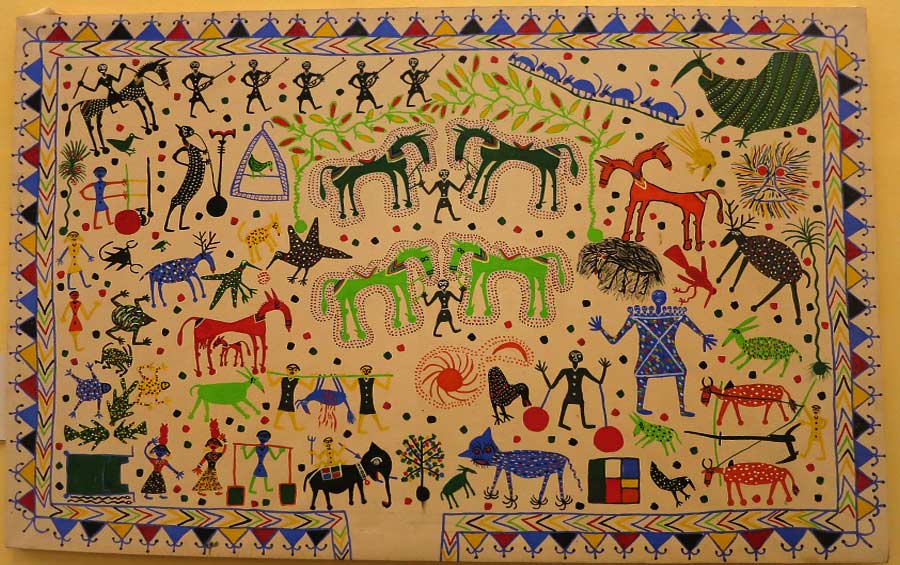
Pithora murals usually cover three inner walls of a house and can span several metres, with processions of horses, riders, animals, gods and village scenes. Artists begin with preparatory rituals, then sketch the composition and fill it with vivid colours derived from natural and commercial pigments.
The central figure of Baba Pithora often appears on a horse, surrounded by other deities, ancestors and symbolic creatures.
Painters use repeated motifs such as rows of horses, trees, birds and geometric borders, which viewers read as a cosmological map of the universe and the community’s place within it. The work involves collective labour, with groups of male artists painting while family members assist with preparation and ritual observances. Once completed, the mural remains an active sacred presence rather than a purely decorative element.
contemporary discourse
Heritage and craft bodies describe Pithora as a significant tribal and ritual art form of Gujarat and highlight its narrative richness in exhibitions and documentation projects. Artists like Paresh Rathwa play a mediating role between ritual practice and public art spaces, teaching workshops while continuing to paint votive murals in villages. This dual practice helps maintain ritual integrity while also allowing younger painters to reach new audiences.
Urban buyers increasingly collect smaller Pithora works on board or canvas that adapt wall compositions to portable formats. Cultural critics note both the economic opportunities and the risk that market demand might flatten complex narratives into standardised designs. Even so, Pithora painting still operates primarily as a ritual technology in many households and continues to anchor Rathwa cultural identity.
Athmaja Biju is the Editor at Abir Pothi. She is a Translator and Writer working on Visual Culture.