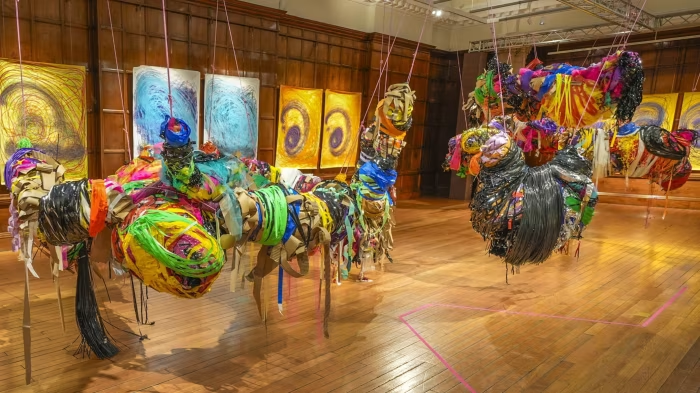
Sculptor and drawing-based artist Nnena Kalu has won the 2025 Turner Prize, becoming the first artist with a learning disability to receive the United Kingdom’s most prominent contemporary art award. The Glasgow-born, London-based artist was recognised for an installation of vividly coloured sculptures and drawings that judges described as “bold and compelling” in both material and form.
The award was announced at a ceremony in Bradford, the UK City of Culture 2025, where the Turner Prize exhibition is being hosted at Cartwright Hall Art Gallery. Kalu receives £25,000, while fellow shortlisted artists Mohammed Sami, Zadie Xa and Rene Matić each receive £10,000, with all four presentations remaining on view into early 2026.
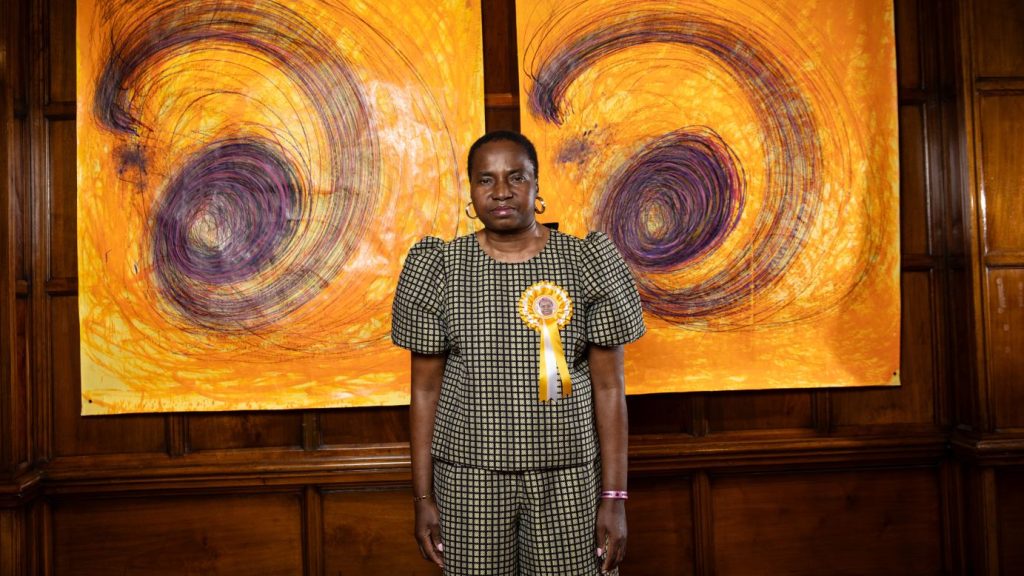
The jury, chaired by Tate Britain director Alex Farquharson, highlighted Kalu’s command of colour, scale and rhythm, and praised the “powerful presence” of her works in the galleries. The 2025 edition also coincides with the 250th anniversary of J.M.W. Turner’s birth, lending additional symbolic weight to this year’s decision.
Practice rooted in repetition and gesture
Kalu’s practice centres on sculptural installations and vortex-like drawings built through repetitive, physical gestures. Her sculptures often begin as compact “cocoons” or boulder-like forms made from recycled and donated materials such as cardboard, tape, cling film, fabric, rope and old VHS tapes, which she binds, wraps and layers into dense, colourful masses.
These forms are frequently suspended or clustered within architectural space, creating immersive environments that track the artist’s movements and sense of rhythm. Her two-dimensional works, composed of circular, layered marks, are similarly driven by repetition and are often produced in pairs, one work echoing another to emphasise process and duration.
Representation and access in contemporary art
Kalu’s win has been widely noted as a breakthrough for artists with learning disabilities in the UK and internationally. Commentators and jurors have framed the decision as a step towards dismantling entrenched divides between “neurotypical” and “neurodivergent” artistic production within major institutions and prizes.
The artist has long worked in supported studio contexts, including projects with ActionSpace and other organisations focused on learning-disabled artists, and her Turner recognition is expected to draw greater attention to such networks. Advocates suggest the visibility generated by this year’s prize could translate into expanded opportunities, resources and exhibition platforms for neurodiverse practitioners across the sector.
Exhibitions that led to the prize
Kalu was shortlisted on the strength of work presented in “Conversations” at the Walker Art Gallery in Liverpool and her installation “Hanging Sculpture 1 to 10” at Manifesta 15 in Barcelona. These projects showcased both the dense hanging sculptures and the drawing practice that together define her vocabulary of wrapped, layered and suspended forms.
The Turner Prize exhibition in Bradford brings key elements of these presentations together, allowing visitors to experience how her accumulative processes interact with the specific architecture of Cartwright Hall. The show is scheduled to remain open until February 2026, offering an extended window for audiences to encounter a body of work now formally recognised as central to contemporary British art.
Athmaja Biju is the Editor at Abir Pothi. She is a Translator and Writer working on Visual Culture.