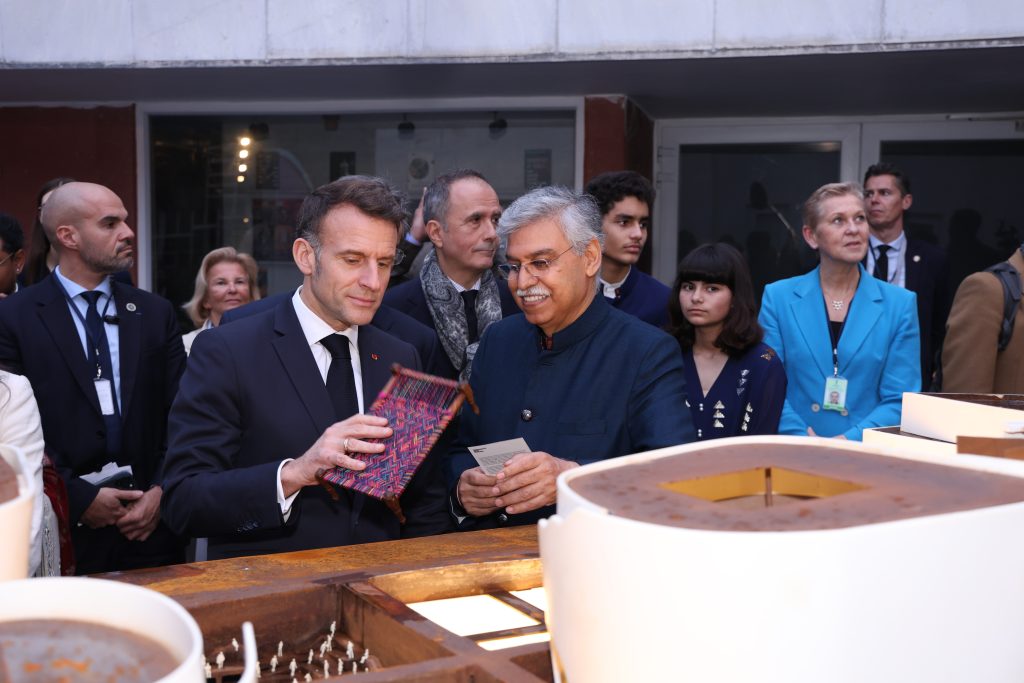
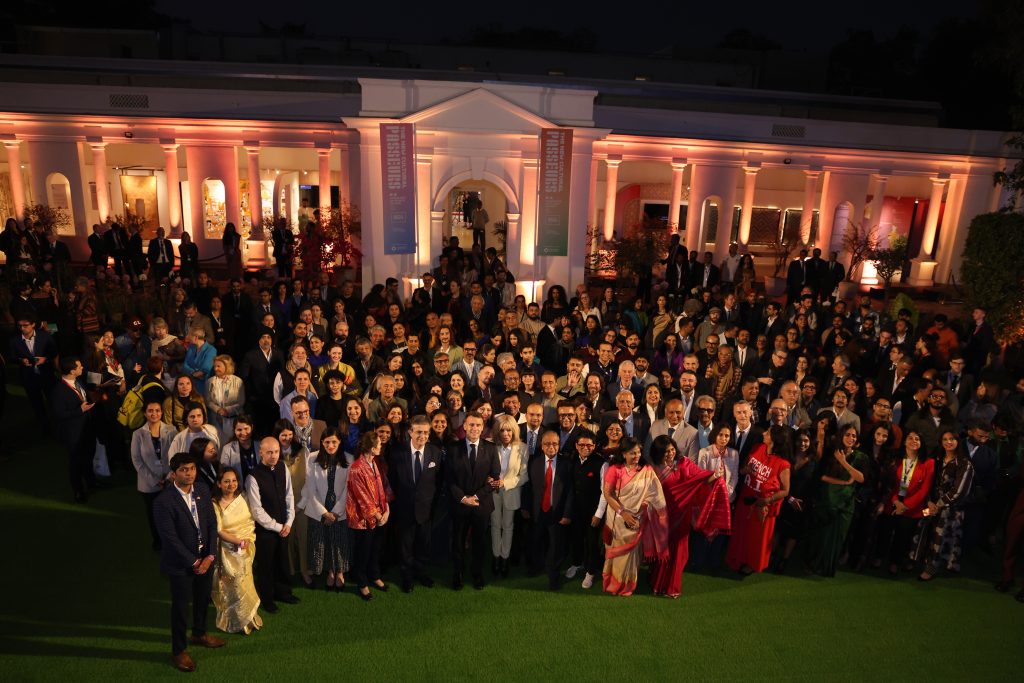
French President H.E. Mr Emmanuel Macron’s visit to the French Institute in India (IFI) on 18 February 2026 marked a significant deepening of Indo-French cultural ties, with a spotlight on artists, writers, designers and craftspeople as “new cultural passeurs” between the two countries.
Event overview and The Brij announcement
Held in New Delhi as part of Macron’s official India visit and the India–France Year of Innovation, “The New Cultural Passeurs” was organised by the French Institute in India in collaboration with Serendipity Arts. The evening was attended by the Ambassador of France to India, H.E. Thierry Mathou, and Sunil Kant Munjal, Founder-Patron of Serendipity Arts and Chairman of The Brij, among other cultural practitioners.
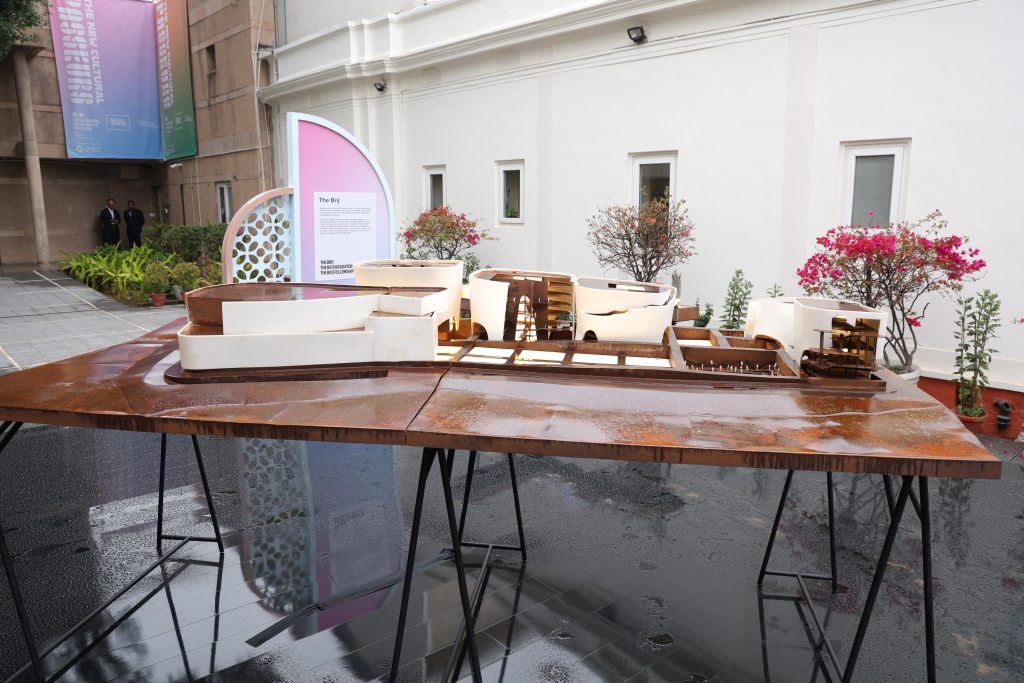
Macron’s visit began with a presentation of The Brij, Serendipity Arts’ upcoming art centre and cultural incubator in Delhi. Designed as an 8-acre, fully accessible cultural campus with a museum, academy and workshops, galleries, theatre spaces, craft centre and artisanal village, The Brij is envisioned as a major hub for experimentation, interdisciplinary collaboration and the revival of endangered crafts through research and incubation.
The Charpai installation and presidential walk-through
At the heart of the evening was The Charpai Project, an immersive installation in the IFI gardens conceived by curators and designers Ayush Kasliwal and Ramayudh Sahu, originally commissioned for the Serendipity Arts Festival 2018. The modular structure, created with traditional artisans and multidisciplinary artist-designer Goji, features a canopy of hand-woven panels made from post-consumer food wrappers and ropes, alongside rigid panels fashioned from upcycled Tetra Paks, mounted on scaffolding to form a flexible, reconfigurable community space.
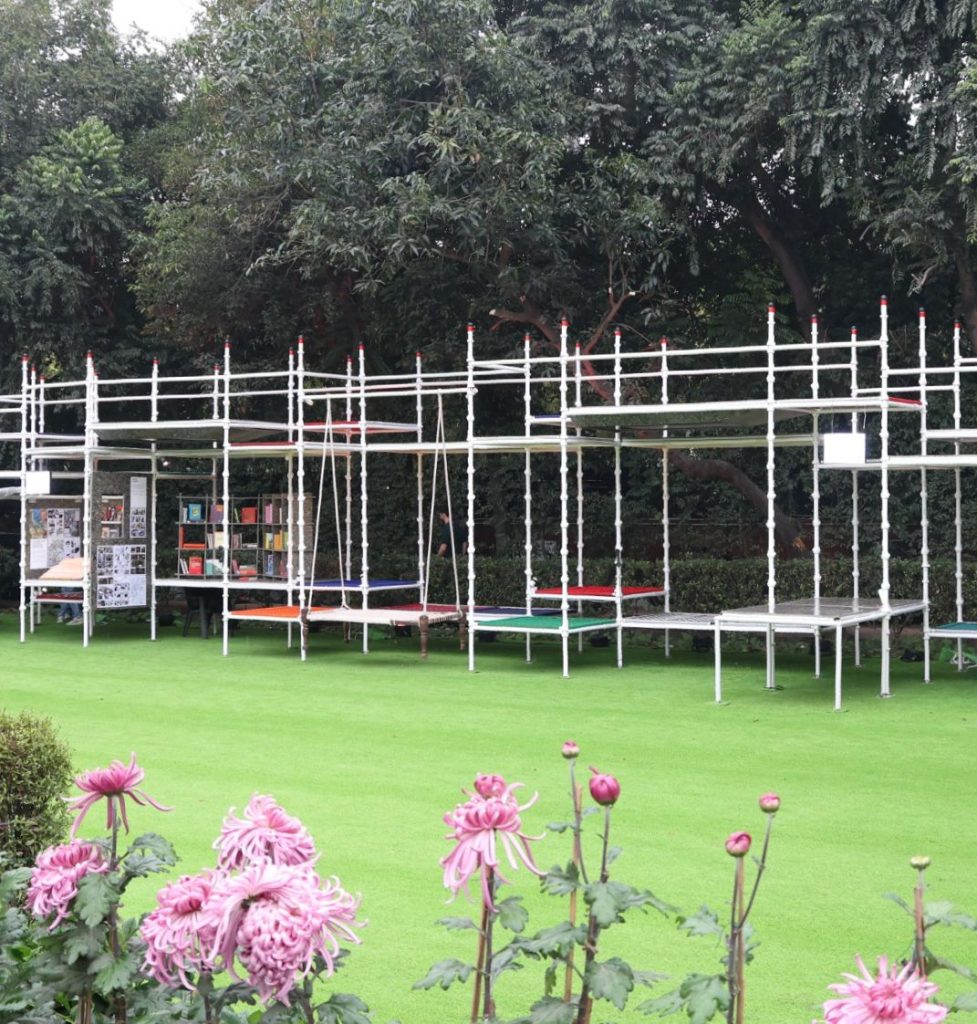
The charpai—traditionally a four-legged woven cot used across India as bed, sofa, gathering spot and outdoor platform became a metaphor for adaptable, sustainable design and collective encounter, with this sixth iteration demonstrating how a single idea can be continually reassembled for play, performance, dining and dialogue. Within this installation, four curated interaction stations enabled President Macron to meet practitioners representing different strands of Indo-French collaboration in design, literature, graphic storytelling and crafts-based entrepreneurship.
Four presidential interactions: design, literature, comics, craft
Design and savoir-faire
At the “In the eyes and gestures of the other” station, fashion designer Rahul Mishra and French designer Gabriel Hafner illustrated how traditional Indian craftsmanship can be reinterpreted for French audiences and, conversely, how French creators can draw on Indian textile traditions. Mishra, the first Indian designer invited to present at Paris Haute Couture Week and soon to open a Paris showroom, engages French publics through intricate embroidery that translates artisanal excellence into new aesthetic vocabularies. Hafner, a laureate of Design Parade Hyères currently in residence with Villa Swagatam at Jaipur Rugs, is working with Rajasthani weaving communities to rethink industrial and product design through local ornamental languages and gestures.
Poetry and translation
Under the theme “Poetry without borders,” writer Meena Kandasamy and Paris-based poet-performer Selim-a Atallah Chettaoui discussed how poetry moving between languages unsettles certainty, creates new echoes and keeps political and intimate dialogue alive. Kandasamy, widely translated into French, returned from a Villa Swagatam residency at Maison de la Poésie de Nantes, where poetry became a space of encounter and renewed political resonance; Chettaoui, fresh from a residency at Colombo’s Lakmahal Library, opened a long-term creative dialogue with South Asia by exploring how identities are composed and fractured across languages and media.
Graphic novels and visual storytelling
In “Shared Frames, Shared Futures,” graphic novelist and curator Amruta Patil and Sikkim-based journalist-author Pema Wangchuk Dorjee highlighted the growing ecosystem of comics in India and France. Their discussion touched on Sikkim Stories, the forthcoming graphic novel co-written by Dorjee and French cartoonist Simon Lamouret, which weaves together the paths of a yak herder, returning botanist and young soldier to address climate fragility, urbanisation and disappearing ways of life in the eastern Himalayas. They also introduced The Moving Line, a major exhibition on Indian visual storytelling co-developed by Museum of Art and Photography (Bangalore) and the Cité internationale de la bande dessinée et de l’image in Angoulême, opening at MAP in July 2026 before travelling to France in 2027 as part of the Desibel programme for AVGC-XR collaboration.
Craft, social enterprise and the future of making
The “Tomorrow Is Handmade” station brought together designer Ayush Kasliwal and Ekatra’s founding duo Minakshi and Aishwarya Jhawar to foreground Indian craft as a living, future-facing practice. Ekatra, a sustainable social enterprise based in Kota, Rajasthan, works with underprivileged homemakers to produce design-led, environmentally responsible products and is supported by The Brij’s Incubator and French funding; Kasliwal’s own practice, including the Charpai installation, bridges heritage and contemporary design, transforming vernacular forms into collectible design and advocating innovation rooted in local knowledge systems.
The Gallery of Passeurs and Villa Swagatam
Following the garden interactions, Macron visited The Passeurs’ Gallery, which presented projects linked to Villa Swagatam, the French Institute in India’s flagship cross-residency programme launched in March 2023 to foster reciprocity between France, India and South Asia. Villa Swagatam, now spanning 30-plus residency partners across France, India, Bangladesh and Sri Lanka, supports one- to three-month residencies focused primarily on literature and arts and crafts, with French and Indian laureates hosted on equal terms since 2024.
In his remarks, Sunil Kant Munjal emphasised that “enduring cultural partnerships are built not on ceremonial exchange, but on sustained dialogue,” describing The New Cultural Passeurs as an affirmation that artists, writers, designers and institutions are the most credible bridges between nations and positioning Serendipity Arts and The Brij as laboratories for long-term Indo-French collaboration rooted in reciprocity and mutual respect. Ambassador Thierry Mathou underlined the symbolic importance of hosting President Macron at the IFI during the inauguration week of the India–France Year of Innovation, calling the long-term association with Serendipity Arts a model for how cultural and creative industries can shape the future of both nations and stressing the responsibility to empower civil society and cultural actors with appropriate platforms.
The event also built on a decade of Serendipity Arts’ work, including its multi-disciplinary festival in Goa—now recognised with awards such as the Cultural Impact Award at the Business Goa Lifestyle Awards 2025, Best Cultural Festival at the LCD Berlin Awards, the Svayam Accessibility Award 2025 and the NDTV Masterstroke Art Award 2025—as well as international honours such as the French Chevalier de l’Ordre national du Mérite for Munjal.
Athmaja Biju is the Editor at Abir Pothi. She is a Translator and Writer working on Visual Culture.