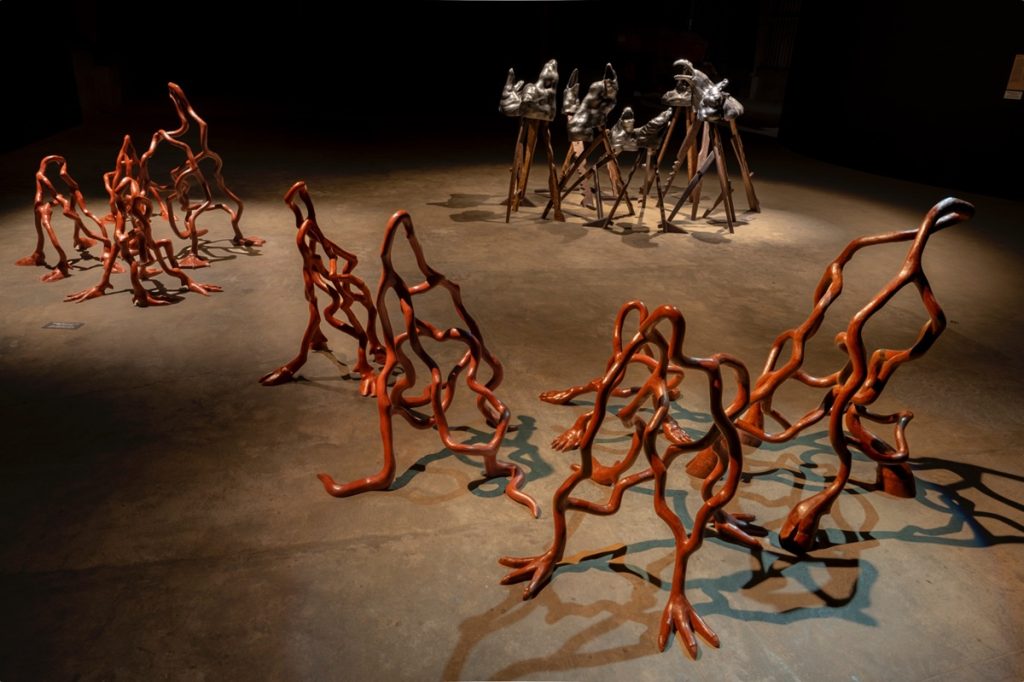
Kochi, Mar 30: The animal torsos in graphite, terracotta, and palm wood, propped on wooden legs with mouths open, provide a frightening reality check of today’s environs. Standing for the animal family, they seem to hint that the venue was once their habitat.
The sculptures, titled Resistance Prayer Song 2023, by Lakshmi Nivas Collective, featured at Island Warehouse, Willingdon Island, during the Kochi-Muziris Biennale (KMB), are a grim reminder of inequity among those entitled to the planet.
Their installation includes another set of sculptures, Faith Was Never About Us (2025), of entangled root-like forms with feet grounded in the shapes of cow and goat hoofs and legs of poultry; enfolding the man-animal bond in abstract imageries. It also includes a video titled “Wait” on the seasons cycling through humankind, animals, plants, and their coexistence.
Today, while the latter two strive for ecological balance, the former keeps disrupting the natural rhythms in human-centric ways.
Lakshmi Nivas Collective, comprising city-bred visual artist Sunoj D and Namrata Neog, who is into archaeology, anthropology and history, was set up in 2018.
“We wanted to explore nature, and we leased some land in Parudur, Sunoj’s ancestral place in Palakkad, Kerala, from a relative. We began to grow indigenous and extinct. For manure, we bought a cow, and over the days, each cycle of cultivation and foraging opened more insights into life. Animals are our lens to understand ourselves and the landscapes,” said Namrata.
The shift from the comfort of the city is not easy for the duo, but very enlightening, marked by complementarity in their fields of work. “This is our new university and our brainstorming on humankind in landscapes offered new perspectives and language for our works,” she explained.
The materials used are as ancient as the bond between man and nature, layered with narratives. ‘Resistance Prayer Song’ animal forms are made of graphite on terracotta and palmyra or the ice-apple palm wood. Terracotta was revered by the ancients as earth, used for pottery and toolmaking alongside iron before graphite took over, leading to more modern developments.
Palmyra has a long history too, dense and black and indigenous to the Palakkad and Tamil Nadu landscapes.
‘In Faith Was Never About Us’, the duo has used red oxide, cement, and metal, reflecting the flooring of homes in coastal areas of Kerala and Tamil Nadu. Even as the root-like forms are cemented, the human-centric work raises narratives on human and non-human connections and human intervention.
They raise questions on the domestication of animals and hierarchy, and how each structure and concept made in the name of development to ease human life has little empathy or thought for the non-human world, as seen in the treatment of domesticated animals, hybridisation, guinea pigs for experiments, over-production, artificial fodder, insemination, and even the privatisation of veterinary hospitals.
The video installation Wait (2025) showcases seasons and the human perspective on them. While humankind may dread monsoons, other creatures and plants await them, underscoring the importance of each ecological system to life. Humankind hardly sees it as a blessing, a time to take a break, rejuvenate, and ruminate on life and the need to coexist with the non-human.
The installation gives a visual language to the coexistence of landscapes and man-made structures, concepts of migrant-urban societies, industrialisation, gigantic structures that seem to ease life and their true repercussions on the planet that one is part of.

Contributor