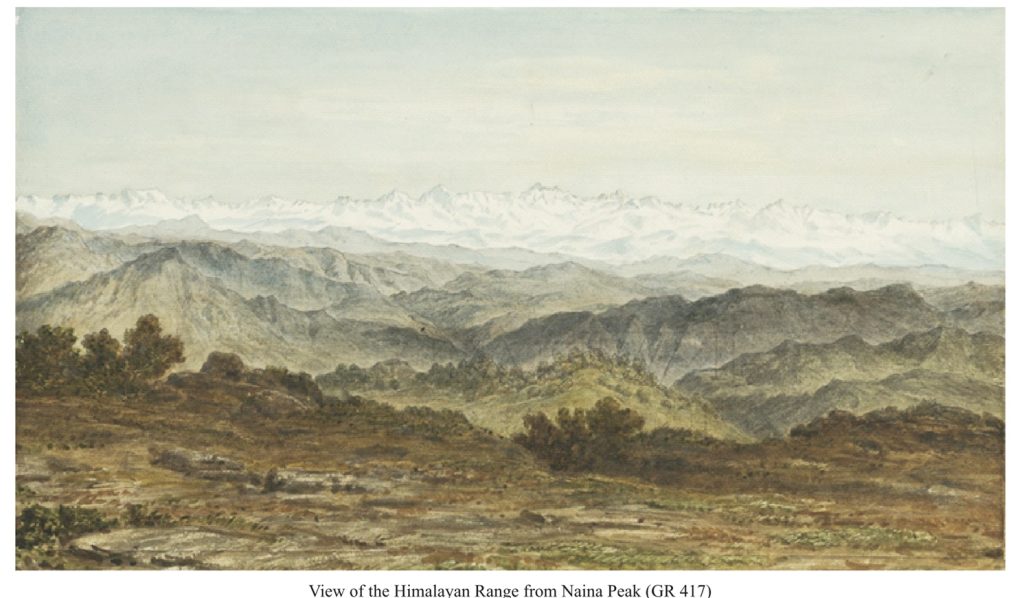
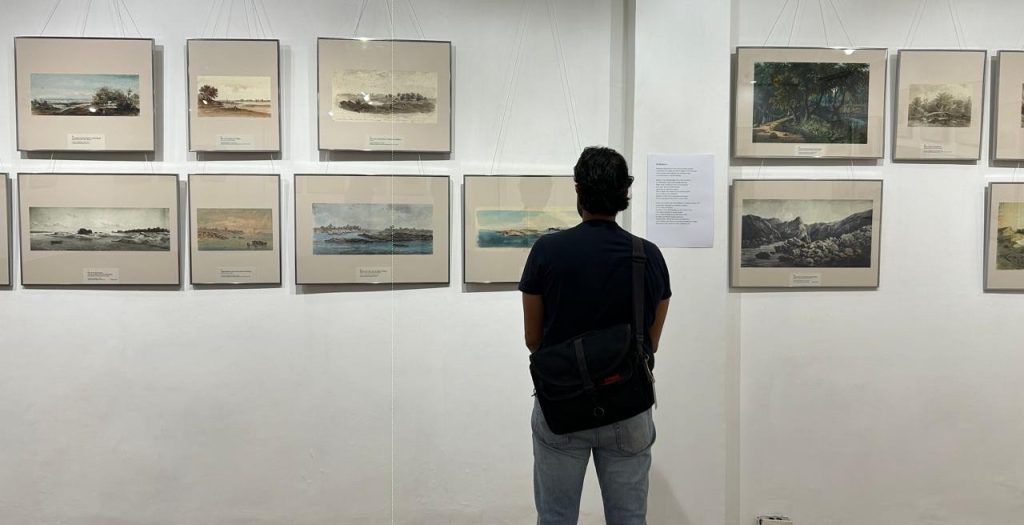
The exhibition ‘Himalayan Encounters- Hidden Views from 170 Years Ago: The Schlagintweit Drawings in India’ at the Indian International Centre, Delhi, presents a collection of Himalayan paintings that were never intended as art and never exhibited in India. Rather, they served as tools—records made in the midst of long journeys, often under difficult conditions. Looking at them now, 170 years later, they feel both precise and strangely distant, as if they belong to a world that has slipped out of view. This sense of distance leads naturally to questions about their origins and the context in which they were created.
The works come from the expeditions of the Schlagintweit brothers in the mid-nineteenth century, a time when the Himalayas were still being measured, mapped, and interpreted through new scientific methods. This was an era shaped by curiosity and ambition. Advances in surveying, atmospheric instruments, and geographical recording had made it possible to systematically examine landscapes. The brothers were part of this moment, but they were not working alone. Their expeditions drew on earlier travel accounts and visualisations and depended heavily on large, mixed teams—guides, translators, surveyors, and local experts—who made the journeys possible, providing essential support for both practical needs and cultural understanding.
The exhibition’s variety of styles is what makes it stand out. Alongside each other are pencil sketches, watercolours, oil drawings, and early pictures that were occasionally hand-colored. Drawing was still crucial because photography was still relatively new. The same environment was recorded in parallel using these methods. This diversity reflects the wide-ranging journeys the Schlagintweit brothers undertook: from Assam and the Khasi Hills to Ladakh and Baltistan, from the foothills of the Himalayas to the borders of Tibet and Bhutan. The pictures cover a wide geographic area. When combined, they create a tiered view rather than a single one.
A lot of the scenes are about movement. After surveying the geographic range, the exhibition’s focus shifts to the experience of travel itself. There are several instances of roads, bridges, river crossings, and mountain pathways. The paintings reflect the leisurely, unpredictable nature of travel, whether by boat, horseback, or on foot. Depending on the materials available, such as rope and iron chains in Tibetan regions, bamboo and cane in the east, and cedar and sal wood in the west, bridges are built with meticulous attention to detail. These are useful observations, not only picturesque details.
Following the focus on movement, the exhibition also closely observes settlements. Settlements seem small and frequently brittle. Houses are constructed using methods tailored to the climate and topography, while hamlets cling to slopes. These are commonplace homes, many of which no longer exist, rather than imposing structures. These structures are the subject of about 10% of the pieces, indicating a persistent curiosity in how people lived in these settings. Additionally, there is a subtle awareness of how construction varies from the plains to the mountains, from warmer to colder climates.
Beyond settlements, places of worship also feature in the drawings, though unequally. The brothers documented temples such as Badrinath and Kedarnath, river confluences, monasteries, and even internal prayer rooms, but they were drawn more to some traditions than others. These locations seem to be both spiritual hubs and hubs of movement, gathering spots for pilgrims, traders, and tourists.
From spiritual spaces, the collection shifts again to desolate landscapes: glaciated areas, desert regions of Ladakh, and the high plateaus beyond the main Himalayan range. Scientists were interested in these topics, particularly to understand river systems and glaciers. Early research on glaciology benefited from the brothers’ discoveries, which also helped link the Himalayan environment to more general issues of climate, water, and topography.
Threaded throughout all these subjects—movement, settlements, worship, and barren landscapes—is a sense of a greater purpose for these pieces. The notes and drawings were a part of an attempt to compile information about areas, resources, and routes that were yet only partially understood. Mapping was linked to political and economic goals as well as to science. The voyages occurred at a time when control over information and territory was becoming more crucial, shortly before the turmoil of 1857.
While this background adds depth to the collection, the exhibition ensures the images themselves remain central. The amount that has changed is what emerges. Although the landscapes depicted here have been altered, they are not the same as those of today. These areas have undergone significant changes due to migration, agriculture, infrastructure, and settlement patterns. Some of the settings and lifestyles depicted in these pieces have completely vanished.
That realisation has a subtle weight. Although it is not stated explicitly in the exhibition, it remains. These paintings serve as both records of loss and discovery. In many instances, what was formerly meticulously measured, sketched, and observed has been altered or eliminated. Adolph Schlagintweit’s description of Nainital in a letter—with its oak trees, crimson rhododendrons in blossom, and deep green slopes—comes to mind near the conclusion, reinforcing this sense of transformation. Even though it was a straightforward observation, the display as a whole exudes awe. Even though everything else has changed, that emotion is still present in the pictures.
Building on this sense of change and reflection, the show accomplishes something small but significant by assembling these pieces for the first time in India since their creation. The act of looking is slowed down. It challenges us to view the Himalayas as something that has been researched, traversed, and continuously transformed by empire, science, and time rather than as a static concept.

Contributor