Gond painting grows out of the visual and oral traditions of the Pardhan Gonds and related Gond communities across Madhya Pradesh, Chhattisgarh, eastern Maharashtra, Odisha and Andhra Pradesh. The word “Gond” derives from the Dravidian expression “kond,” which refers to green mountains and points to the community’s long relationship with hilly forested terrain. Historically, Pardhan Gonds served as bards who sang invocations to deities and narrated clan myths while also decorating walls and floors with ritual designs.

These wall paintings, digna patterns and bhittichitra murals marked festivals, life‑cycle rituals and moments when families sought blessings or protection. Artists used natural pigments from clay, stones, leaves and flowers, and they applied colour with fingers, twigs or simple brushes. The motifs translated stories about animals, spirits, trees and local gods into coded forms that the community recognised easily.
Style, imagery and technique
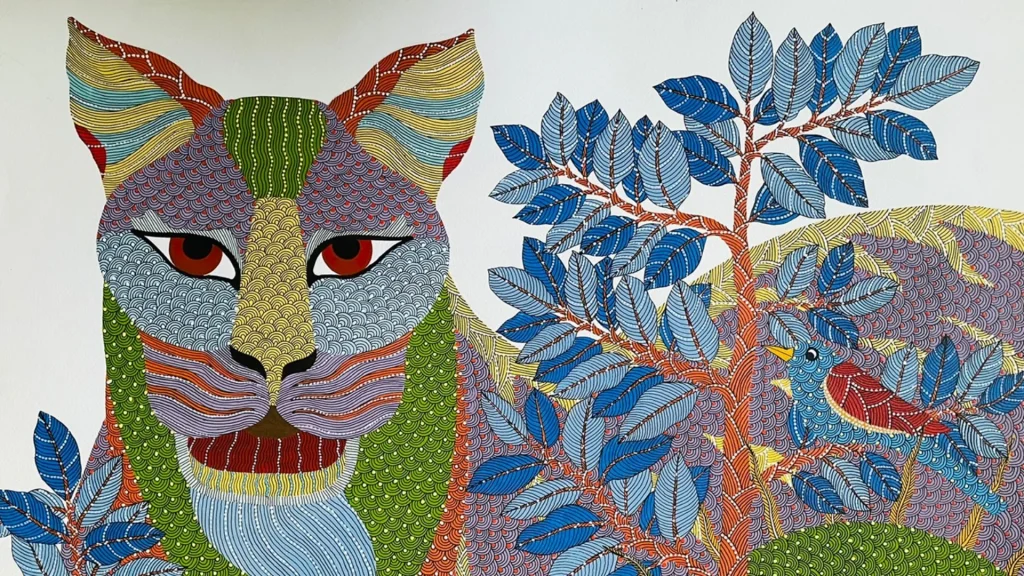
Gond paintings stand out through intricate patterning, bright colours and dense surfaces where artists fill every shape with fine lines, dots or cross‑hatching. Painters often outline figures such as deer, tigers, birds or trees, then subdivide these forms into repeated graphic units that create a sense of texture and movement. Four broad pattern styles include dotted lines that recall fading light, bark‑like textures, sparks rendered as coloured dots and repeated half‑moon shapes.
Nature and folklore dominate the iconography, alongside scenes from daily life, festivals and agricultural work. Artists frequently attribute spirit or personality to animals and plants, so the paintings read as both narrative scenes and cosmological maps. Many painters still mix natural colours, although the wider market for acrylic on paper and canvas also encourages the use of synthetic pigments.
Contemporary relevance and global circulation
The work of Jangarh Singh Shyam in the 1980s, including his exhibition at the Centre Pompidou, played a major role in repositioning Gond painting as a contemporary art practice rather than only a domestic ritual medium. He and his peers began to experiment with scale, composition and new themes while maintaining the patterned visual language that links the form to village walls. Subsequent generations of Gond painters now show in galleries, create picture books and collaborate with publishers and designers worldwide.
Indian state agencies and private initiatives promote Gond painting as emblematic of the cultural diversity of Madhya Pradesh and central India.
This visibility supports livelihoods in some villages, yet it also introduces questions of authorship, pricing and the sustainability of natural pigment sources. Despite these pressures, Gond art continues to evolve as artists respond to environmental change, migration and digital culture through new stories and visual experiments.
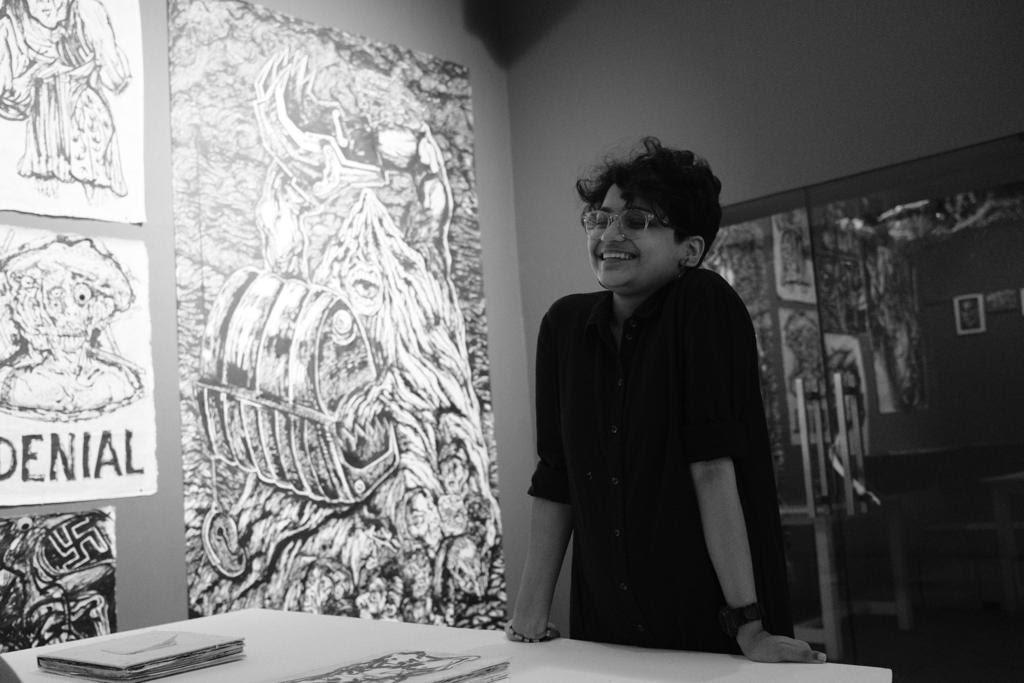
Athmaja Biju is the Editor at Abir Pothi. She is a Translator and Writer working on Visual Culture.