What is history? Is it a story that says ‘once upon a time’, or is it a continuous process? Is history only what has crumbled and fallen, abandoned and on the edge of destruction, or only the ‘preserved monuments’? The group show at Gallery Ske reminds us that history is many things. Everyone who goes through various processes is history. History cannot be reduced to buildings or monuments alone. Otherwise, buildings, their fragments, and the ‘lost grandeur’ are all parts of human history. The exhibition ‘Glyphs’, which showcases the sculptures/paintings of Ali Akbar PN, Suchender P, and Tarika Sabherwal, narrates various self-repetitions of different kinds of history, raising serious questions. Especially in this time when history is so twisted.

An exhibition that can be seen both as ‘history written by three people’ or ‘three narratives of history’, as well as in terms of interpretations or reinterpretations of history, opened yesterday at Gallery Space. The exhibition, which continues until the 20th of next month, mainly focuses on the artists’ analysis of history. However, it is not conducted in a complex manner; instead, it makes this possible by bringing together various monuments, people, historical contexts, and many things that have been lost or may be lost in the future.
Glyphs is the title of the exhibition. It should be interpreted as visual symbols or marks used in printing, writing, and symbolic communication that stand in for a character, word, sound, or idea. There are several glyphs. Any intentional mark or figure used to visually communicate information is called a glyph. The word comes from the French glyphe, derived from the Ancient Greek gluph?, meaning “carving,” and glúpho, meaning “I carve.” In the past, glyphs were carved or etched symbols that represented words, sounds, or ideas. Examples of this include Egyptian hieroglyphs and Mayan writing. When viewed in this manner, Glyphs establishes and stimulates reflection on history in modern situations, despite the fact that this group presentation is historical in character.
Three versions of History
Through diligent recording, historical research, and creative reconstruction, artist Ali Akbar P N brings the Gujarat Coast and the Malabar Coast—two parallel geographies linked by centuries of trade, migration, and cultural exchange—into conversation. These coastal regions were part of a larger cultural network that stretched across the Arabian Sea. Gujarati traders and Mappila sailors used these routes to transport fabrics, spices, and tales between ports like Cambay and Kozhikode. Centuries of trade, migration, and cultural interchange have bound these regions together. In the past, these coastal regions were a part of a larger cultural network that stretched across the Arabian Sea; Gujarati traders. However, individuals now live in quite different social environments and are sometimes purposefully ignored.
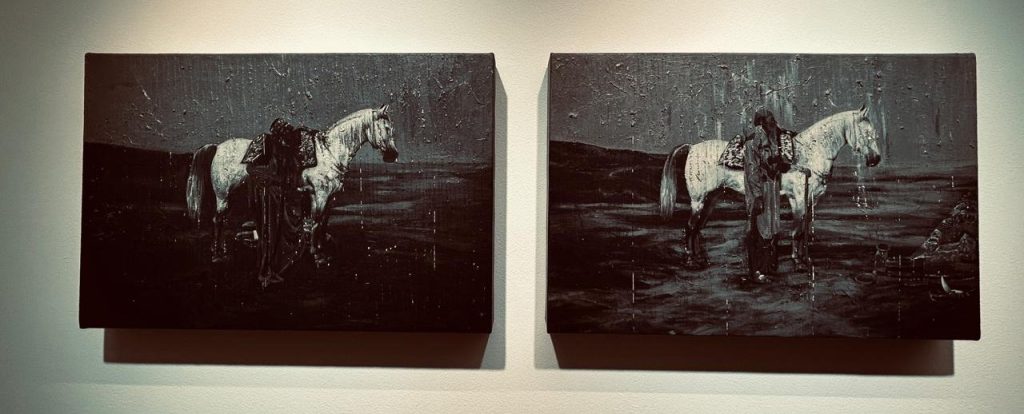
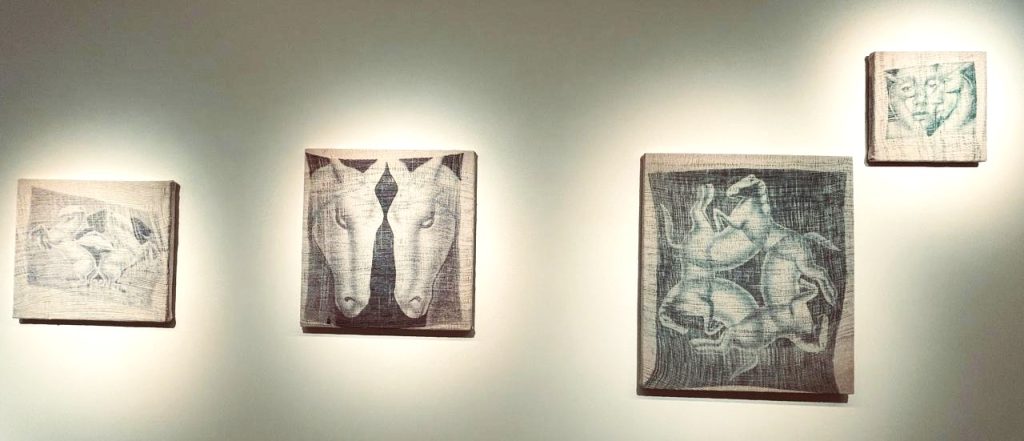
Oral histories frequently go in the opposite direction from monuments and photographs, which try to stabilise memory by cementing it into stone, bronze, or the still frame of the archive. They move from one body to another through gestures, speech, and pauses. Memory refuses to come to an end in this movement. Details can change depending on who speaks and who listens, because they float, change, and acquire sediment. Tarika Sabherwal‘s work exists in this state. She uses mythological stories and collective anecdotes to create her bizarre images. Her paintings begin to resemble story baskets, both porous and sturdy. Her approach is similar to Ursula K. Le Guin’s Carrier Bag Theory of Fiction, which views storytelling as a container for what has been gathered and carried on rather than as a valiant act of conquest. However, Sabherwal’s paintings also reveal this container. Similar to her canvases, where she employs additive and reductive painting techniques until they become diaphanous, like pictures hanging between presence and dissolution, she permits memory to remain suspended in this way.
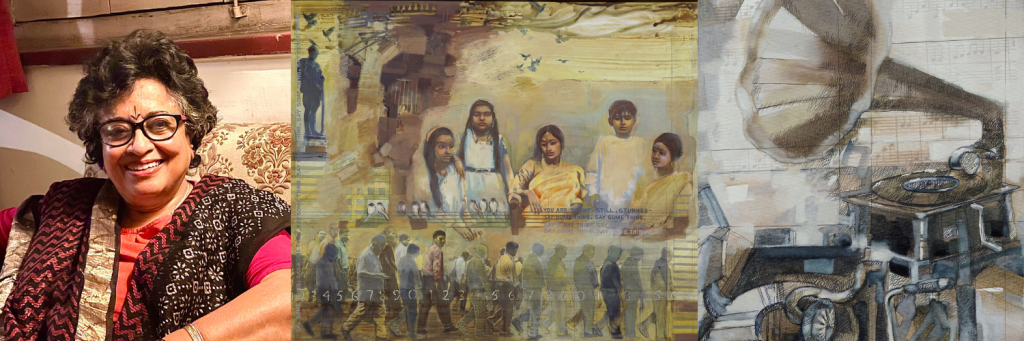
Suchender P‘s work exhibits a similar suspension of time, except it takes place in the shifting Mysore environment. He draws attention to how a city changes its signage over time. He revisits historical elements that subtly rewrite the city’s visual language through documentation that alternates between the fantastical and the evidential. In this body of work, he maps his personal recollections of Mysore using shopfronts, topographical locations, and decorative elements of colonial-era municipal buildings. These shifts are depicted in the paintings as a gradual change in background, with the metropolis continuing to expand over itself and prior surfaces becoming less visible.
Neglected, Yet Revival
Exhibition catalogue saying, it turns to the figure of the Glyph as an inscribed sign that once carried authority within stone, surface or speech. That is the twist of this exhibition, which is carried by the artworks exhibited.
This exhibition is not an archaeological site, nor a reflection of it. This is bringing the ‘history’ within it, the embodied experience of stories, pain, memories and abandonment. Where is our archaeology of emotion, or ‘sign’, or even our sense of knowing, preserving the mythical, yet historical lives of our past? What does that mean when we ask, ‘When do speculations begin, and when does nostalgia end?’?
History often comes to us in fragments. It comes through as either a doomed civilisation or something that has perished. What exists gradually becomes part of history. However, an individual’s or an artist’s emergence is an extremely personal matter. For a person to become an individual is a historical, social change. The fact that the formation of the ‘individual’ is a social construction, and that within a social construction the individual stands as an extremely personal entity, means that their ‘vision,’ perspectives, or retrospections become both personal and historical at the same time.
The exhibition’s philosophical foundation has been strengthened by the portrayal of British cultural theorist Mark Fisher, defined as a sensation produced by the strange interplay of absence and presence: when something appears where nothing should be, or when something that ought to be there is missing. The relationship between presence and absence extends historically and personally, connects, and at the same time links many people simultaneously. It is often the nature of a spider web to belong to histories and the narratives revealed and opened through it.
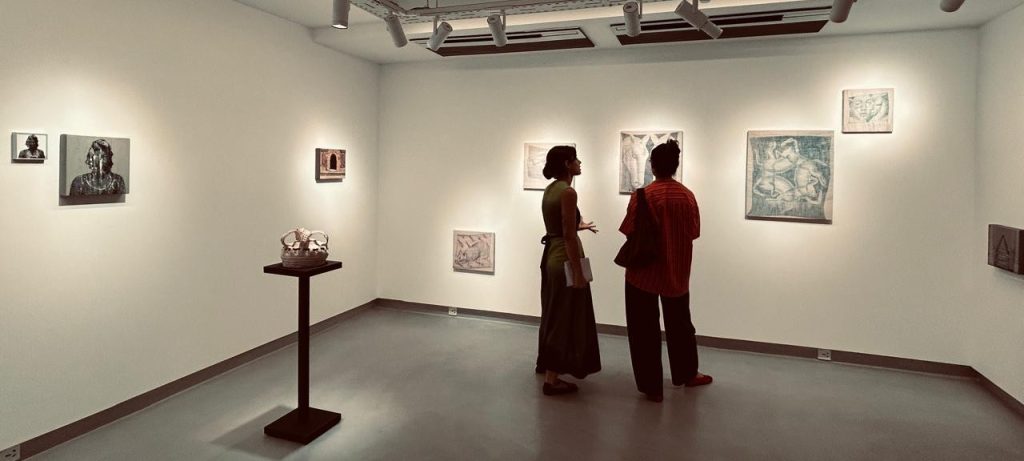
It becomes less of a nostalgic act to revisit such locations and tales and more of a means of bridging this gap and making an effort at exposure. The collection of visual narratives and artworks from many regions of India, displayed in a Delhi gallery, has enabled the creation of these photos in particular. “Stories, monuments, and images are not passive records” is an important statement. Each one creates a historical fact, a history, through the artworks in this exhibition.
‘Now’ or ‘today’ is a historical fact that may be lost, distorted, or misused tomorrow. However, the only possible thing is to translate it into narratives today itself; that is the only way. That is the only way it can be done through ‘designed to stabilise: to fix identity, anchor memory, and hold a narrative in place’. Over time, these forms accumulate symbolic authority, shaping how collective narratives are perceived and remembered; likewise, they have the power only to overcome neglect and to astonish rejection.
Glyphs encourages viewers to interact with history as a dynamic, unresolved issue. The exhibition unites three perspectives on how remnants of the past continue to emerge in the present through the unique practices of Ali Akbar PN, Suchender P, and Tarika Sabherwal: the movement of histories across geographies, stories carried in memory, and images that resurface from the archive.
Krispin Joseph PX, a poet and journalist, completed an MFA in art history and visual studies at the University of Hyderabad and an MA in sociology and cultural anthropology from the Central European University, Vienna.