“Art comes alive not in isolation but in lived experience — when it meets the rhythms of everyday life.”- John Dewey
BLR Hubba, anchored by ‘Unboxing Blr’, unfolds like a vibrant tapestry of Bengaluru’s soul- a two-week celebration where art, history and life intertwine across more than twenty of the city’s most iconic spaces. It transforms Bengaluru into a living gallery, breathing life into sites across the city. The festival invites audiences to wander through a mosaic of artistic genres, stories and traditions that echo dynamic cultural heritage.
A refreshing day unfolded under the open sky at Blr Hubba in Freedom Park- once a Central Jail- where art, curated by Kamini Sawhney, breathed beyond the confined walls of a gallery. Moving through the space, one felt both the breeze of freedom and the weight of history embedded in the former jail. In the pageant where BLR Hubba has collaborated with Zinnov Foundation, artists have transformed found objects, installations and digital representations into powerful metaphors of imprisonment and liberation. Each artwork seemed to converse with the surrounding architecture, making the viewer acutely aware of boundaries – visible and invisible. It was not just viewing art, but experiencing it in dialogue with space, memory and freedom itself.
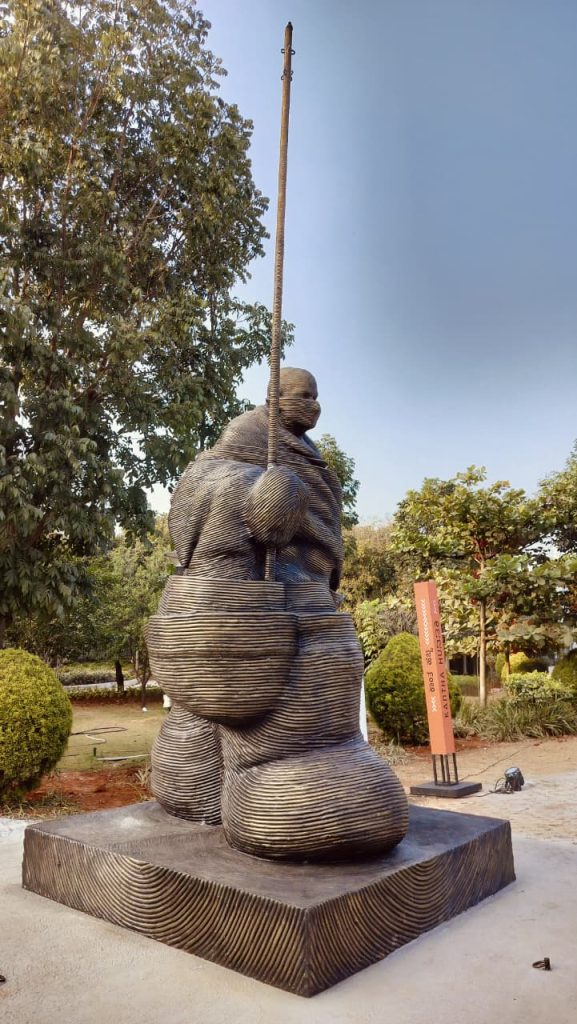
The space opens with a commanding and visually arresting sculpture by Tallur LN, a monumental figure encircled by a dynamic spiral motif, where the spiral winds around the body like an energetic coil. His other works titled ‘When Knowing Bends’ are being displayed in Gallery Kaash, Bangalore as a part of the event. The weathered surface with patina on the bronze sculpture shows how the Nagmandala ritual dissolves the boundary between a ceremonial rangoli and the living world of snakes, intertwined with their natural homes in termite mounds.
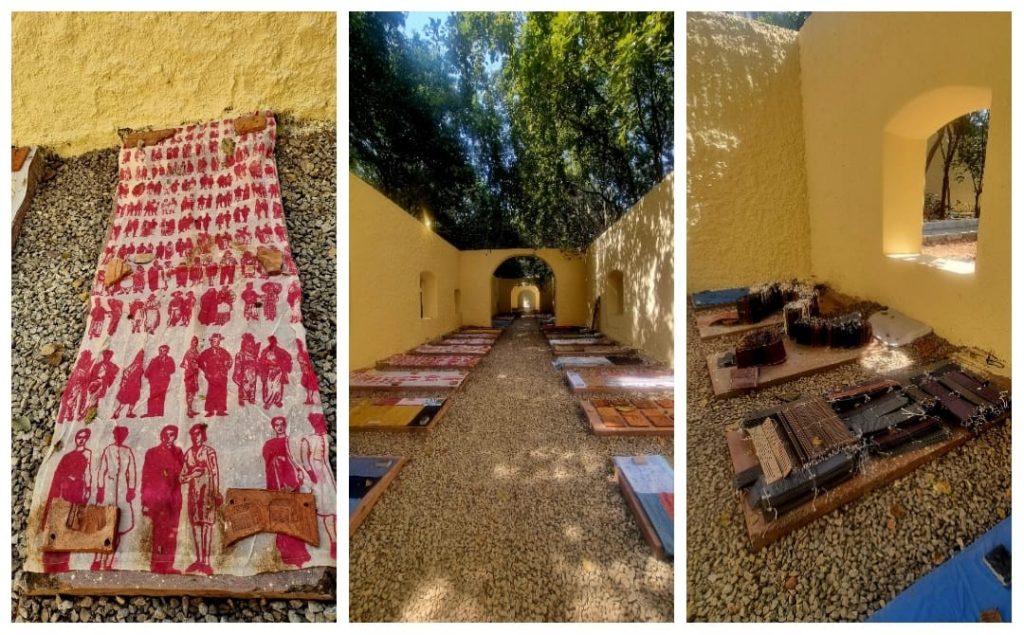
Archana Hande’s installation ‘Sweet dreams@ Barrack-E 100 bed sheets/blankets’ transformed the stark prison platforms into a vivid landscape of memory and habitation. Layers of screen-printed sheets and varied coloured and patterned fabrics lay spread across the beds, softening the brutal architecture while hinting at the lives that once occupied them. The textiles carried both warmth and unease – beautiful yet tied to histories of confinement, presence and absence.
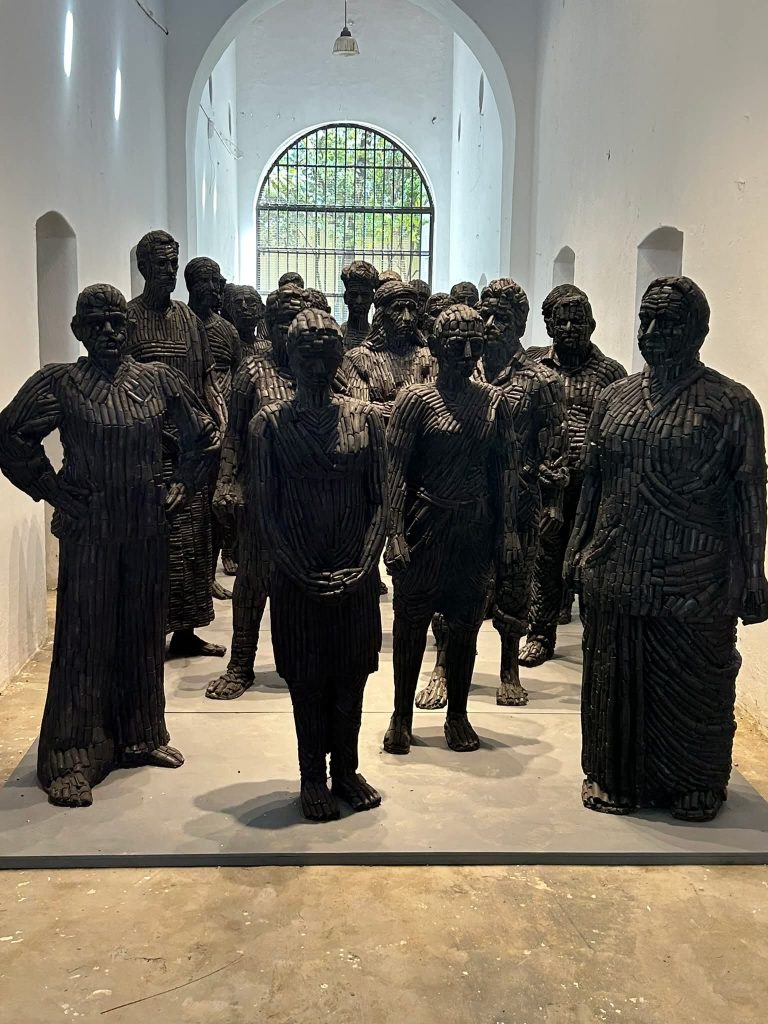
Shanthamani Muddaiah ‘s ‘Silent warrior’- a cluster of human forms standing together like a herd created a powerful sense of collective vulnerability. Their close proximity suggested survival, solidarity, and silent resistance, as if the figures were bound by shared experience rather than individuality. The gathering felt haunting, echoing the tension and entrapment.
Mahima Verma’s installation ‘Mapping discomfort’ powerfully embodied the degraded ecology, the idea of captivity through a raw, unsettling landscape of found objects. A massive wall appeared to clutch at clinging, decaying plants—where only stubborn weeds survived amid the dead—suggesting endurance within abandonment. The winding path led toward sharply pointed black bamboo sticks that ran along the entire jail wall, while encircling black stones echoed the weight of confinement. Together, these elements created a stark atmosphere of entrapment, hardship, and silent resistance, making the viewer feel both the cruelty of imprisonment and the quiet persistence of life. In ‘At a Comfortable Distance’, ropes stretched across former prison beds become a powerful metaphor. Conceived by Aastha Chauhan and Abhinandita Mathur with students of Shrishti Manipal Institute of Art, Design and Technology, the work draws attention to the Square Circle Clinic’s rigorous death penalty report and its commitment to justice—addressing mental health, poverty criminalization, and the legal struggles of marginalized groups. In their site-specific work ‘Reverse Migration’, father and son artists Valsan Koorma Kolleri and Vishnu Thozhur Kolleri foreground the value of traditional craft practices, shaping their installation from raw materials gathered from nature. ‘Political Freedom’ by Gigi Scaria, employs two adjacent doors that alternately open and shut to unveil shifting perspectives, suggesting the inadequacy of clinging to out-dated power systems while gesturing toward the possibility of forging new frameworks today.
The play areas burst with joyful energy, inviting children to paint freely; roll, dance and jump in the mud; attend storytelling sessions and explore puzzles; and colourful blocks that encouraged imagination and collaboration. Pulsating, ludo-like board games as wall display turned the jail space into a playful board of movement and laughter, making art feel participatory rather than distant. Interwoven with this lightness were tender displays of tying knots—simple gestures that symbolically ‘held back’ sorrow, reminding viewers that even in spaces marked by pain, care, healing and togetherness can take root.
In another venue- Bangalore International Centre, Ravikumar Kashi ’s hanging ‘Holding Pattern’ created from Pigmented Daphne fibre is so intriguing, gently swirling in the air and casting shifting; delicate obscurities that seemed to breathe with the space. Light, movement and shadow become inseparable, turning fragility into quiet strength. In Jahnavi Khemka ’s sensitive digital work ‘Letter to my mother’, the trembling voice of her late mother carried memory across time—intimate, tender and haunting—making loss feel deeply personal yet universally resonant. Nearby, the shared pickle recipes of grandmother and granddaughter transformed everyday domestic wisdom into art, preserving taste, tradition and affection as a living lineage passed from one generation to the next. In ‘Vanishing Relics of Safeguarding’, Shradha Kochhar’s suspended forms, enveloped in hand-spun and hand-knit kala cotton, emerge as gestures of care and preservation — moulded by time, touch, and human labour. As they hover in space, their shadows shift and pulse, taking on the quality of living, breathing beings.
The installation ‘Khadya Mart’, conceived by Chaitali Kulkarni, Axki with support from artists Shreni Sanghvi, Nikita Teresa Sarkar, and Supriyo Manna, presented an imaginative display of kitchen objects and hanging vegetables that blurred the line between marketplace and art. This was accompanied by the video performance ‘Indri Pickle Lab’ by Jasmeen Patheja and Inderjit Kaur – a moving collaboration between grandmother and granddaughter. Meanwhile, Harshit Agrawal’s work ‘Ritual Robots – Havan at the Data Kund’ reimagined the traditional havan kund through a modified metal structure integrated with robotic arms, offering bowls, LED lights, and microcontrollers. Penciljam group has also put up an installation with drawings of various artists attached to the group, drifting gently in space, tethered by threads on a bamboo scaffold.
Spanning 16th to 25th January 2026, the festival will continue to thrive in the days ahead with a vibrant line-up of programs, with an exciting mix of live performances and rich cultural engagements.
Cover image: Archana Hande
Alka is an artist and art writer with a diverse career spanning teaching, e-learning projects with the Ministry of Human Resource Development (MHRD), and editorial work. An alum of the Government College of Art, Chandigarh (BFA) and Banaras Hindu University, Varanasi (MFA, PhD), she has been recognised with numerous prestigious awards and honours.