A wave of prominent art galleries across the United States and even in Europe will shut their doors on Friday, January 30, in a coordinated act of protest against the Trump administration’s expanded Immigration and Customs Enforcement (ICE) operations and the use of deadly force against demonstrators.
The action, part of a nationwide general strike, marks one of the most visible and unified political interventions by the commercial art world in recent memory. The strike follows escalating public outrage over federal tactics, including the fatal shootings of Renée Nicole Good and Alex Pretti by federal agents in Minneapolis, and mounting allegations that ICE and related agencies are eroding constitutional protections such as free expression and due process.
The initiative was first reported by ARTnews .
Blue-Chip Powerhouses Lead the Shutdown
Some of the world’s most influential galleries have committed to closing their U.S. spaces for the day in solidarity with the strike.
Pace Gallery will shutter its U.S. locations, while David Zwirner and Gagosian will close their New York and Los Angeles galleries. Other high-profile participants include Almine Rech, Marian Goodman, David Kordansky, Galerie Lelong & Co., Greene Naftali, and Paula Cooper Gallery.
Their stance places the commercial art sector alongside museums and non-profits such as the Institute of Contemporary Art, Los Angeles, and the Walker Art Center in Minneapolis, which has also announced a closure in support of ongoing protests in the city.
This alignment of leading market actors with activist demands specifically calls for the abolition or radical restructuring of ICE signals a notable break from the art market’s traditionally cautious approach to overt political protest.
“I Have Not Seen Such Widespread Banding Together”
For many dealers, the scale and speed of the response reflect both the urgency of the current moment and the longer histories of artist- and institution-led activism.
Scott Ogden of Shrine Gallery emphasized how unusual this level of unified action is within the industry, remarking that he had not seen such widespread banding together by galleries “in a long time, if ever.” His comment underscores how the current crisis has galvanized what is often a fragmented, competitive sector into a shared front.
Alexander Gray, of Alexander Gray Associates in Lower Manhattan, explicitly linked the present mobilization to earlier landmark moments of cultural activism. He compared the rapid coordination to “Day With(out) Art,” the nationwide action organized by Visual AIDS in 1989 in response to the AIDS crisis. That earlier initiative saw museums and galleries across the U.S. darken galleries, remove works, or mount special programs to draw attention to the epidemic, at a time when coordination was far more logistically difficult.
The broader context includes scattered reports of U.S. citizens being detained, lawmakers and attorneys being denied access to facilities, and heated national debates over what constitutes “domestic terrorism.” Against this backdrop, Friday’s protest is expected to feed into what observers predict could be one of the largest civilian mobilizations in recent U.S. history.
Transatlantic Response: Solidarity from Paris
The wave of solidarity has crossed the Atlantic. In Paris, Brigitte Mulholland has announced that her eponymous gallery will close in tandem with the strike. Mulholland, an American immigrant living in France, wrote on Instagram that she grew up in New York “proud to live in the great Melting Pot,” and that her ancestors had fled to the United States to escape “famine, persecution, war.” She stated that the gallery would be closed in solidarity and that she would not be spending money with U.S. companies that day, highlighting how economic boycotts and cultural closures are being combined as tactics of protest.
A Growing List of Participants
The list of galleries and art spaces joining the January 30 shutdown continues to expand, with ARTnews inviting additional participants to report their closures.
As of publication, the following galleries and institutions have been reported as taking part in the national strike:
- Alexander Gray Associates
- Almine Rech
- Andrew Kreps Gallery
- Anonymous Gallery
- Bridget Donahue
- Brigitte Mulholland (Paris)
- Casey Kaplan
- Charles Moffett
- Chart
- Cristin Tierney
- Cue Art
- David Zwirner (New York and Los Angeles)
- Dimin Gallery
- Gagosian (New York and Los Angeles)
- Galerie Lelong & Co.
- Greene Naftali
- Half Gallery
- Hannah Traore
- Hesse Flatow
- Hoffman Donahue
- James Cohan
- Jacqueline Sullivan Gallery
- Jane Lombard
- Kordansky (New York and Los Angeles)
- Kravets Wehby
- Kurimanzutto NY
- Lehmann Maupin
- Luhring Augustine
- Magenta Plains
- Management
- Mendes Wood
- Michael Werner
- Nazarian/Curcio
- Olney Gleason
- Paula Cooper
- Paula Cooper Gallery
- P·P·O·W Gallery
- Regen Projects (Los Angeles)
- Sean Kelly (New York and Los Angeles)
- Shrine Gallery
- Swivel Gallery
- Sikkema Jenkins & Co. (referred to as Sikkema Malloy Jenkins in the list)
- The Empty Circle
- Tanya Bonakdar Gallery
- Uffner & Liu
- Ulterior Gallery
- White Cube
Art, Ethics, and the Shape of Future Engagement
The January 30 strike may prove to be a pivotal test case for how the art market understands its political responsibilities. For years, debates about ethics in the art world have largely focused on donors, trustees, and sponsorship—from fossil fuel companies to arms manufacturers and pharmaceutical dynasties. This action, by contrast, places the onus on galleries themselves to act as civic actors and employers, not just exhibitors and tastemakers.
By shutting down operations, redirecting staff time to protest organization and art-making, and publicly aligning with demands to abolish or restrain ICE, participating galleries are moving beyond statements and into coordinated collective action. Whether this marks the beginning of a sustained, structural shift in how commercial art institutions engage with state violence and immigration policy remains to be seen.
References
- Tessa Solomon, “Gagosian, David Zwirner, Pace, and Dozens More Galleries Join Anti-ICE National Strike,” ARTnews, January 29, 2026. Available at: https://www.artnews.com/art-news/news/art-galleries-join-anti-ice-national-strike-1234771368/
- “Walker Art Center Will Close Tomorrow in Support of Minneapolis ICE Protest,” ARTnews.
- Public social media statements and press communications from participating galleries as cited in the ARTnews report.
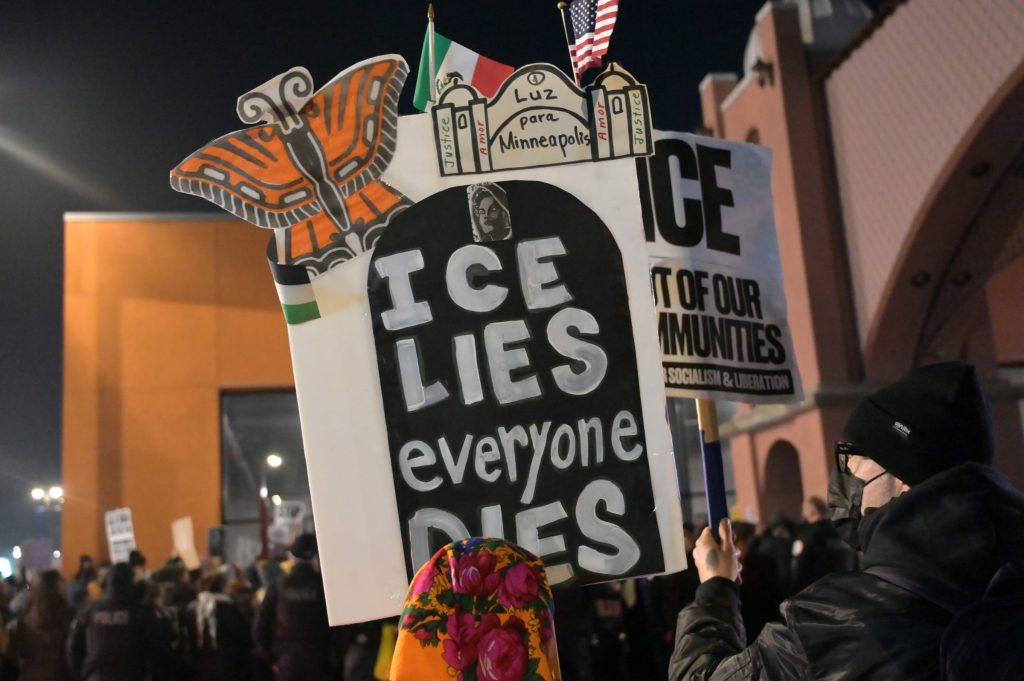
Cover image: Demonstrators and community members gather in Chicago’s Little Village neighborhood on January 7 in Chicago, Illinois. The emergency vigil and protest were organized by the Little Village Community Council and local activists. (photo by Jacek Boczarski/Anadolu via Getty Images)
Athmaja Biju is the Editor at Abir Pothi. She is a Translator and Writer working on Visual Culture.