The 11th edition of Chobi Mela International Festival of Photography kicked off Friday with a vibrant opening rally and inauguration ceremony that set the tone for a festival conceived as “a movement, a resistance, an awakening,” in the words of founder Dr. Shahidul Alam. Running through January 31 across five venues in the capital, this year’s biennial celebration of lens-based practice brings together 58 artists from 18 countries, marking the festival’s quarter-century milestone with a profound meditation on photography’s role in bearing witness and imagining new beginnings.
The festival’s theme, “Re”—a prefix resonating with meaning after half a year of political upheaval following Bangladesh’s July 2024 student uprising—signals collective imagination and the revival of dormant hopes. The opening ceremony at Bangladesh Shilpakala Academy featured a panel titled “Art as Resistance” with Shahidul Alam, American photojournalist Gary Knight, Indian curator Tanvi Mishra, Sudanese photographer Muhammad Salah Abdulaziz, and visual artist-curator Yasmine Eid-Sabbagh, establishing the festival’s commitment to photography as a tool for social and political interrogation.
Shahidul Alam emphasized the festival’s significance in contemporary Bangladesh, stating that after the difficult period following the ousting of an authoritarian government, “we are now looking forward for a Bangladesh that will truly be different.” He called for continued questioning through arts, journalism, and intellectual practice, arguing that institutions must hold power accountable. Filmmaker Mostofa Sarwar Farooki characterized Chobi Mela as “probably the only international art event in Bangladesh that we can feel proud of,” while noting a positive institutional shift: the Ministry of Culture has recently established a dedicated Department of Photography at Bangladesh Shilpakala Academy, signaling increased recognition of photographic practice as a legitimate art form.
The festival opened with a procession beginning at the National Press Club that moved through Dhaka’s streets to the Bangladesh Shilpakala Academy, embodying the festival’s commitment to public engagement and accessibility. The opening programme features nine exhibitions across five venues: Bangladesh National Museum, Bangladesh Shilpakala Academy, Alliance Française de Dhaka, DrikPath Bhobon, and the South Plaza of Jatiya Sangsad (Bangladesh National Parliament).
Featured exhibitions address urgent global and local concerns. “If the Land Could Speak,” curated by photographers Munem Wasif and Sarker Protick, explores connections between history, people, and environment through works by Adam Broomberg, archival photography by the late South African photographer Ernest Cole, and Bangladeshi artist Syed Mohammad Zakir. “un(learning) Palestine, embodying solidarity”—conceived by Yasmine Eid-Sabbagh in collaboration with Laleh Bergman Hossain—presents a reading room exploring Palestinian histories through books, letters, illustrations, and photographs.
Solo exhibitions include Amanul Huq’s archival retrospective at the National Museum, presenting the pioneering Bangladeshi photographer’s documentation of the 1952 Language Movement and 1971 Liberation War, and Bani Abidi’s “The Reassuring Hand Gestures of Big Men, Small Men, All Men” at Alliance Française de Dhaka, examining power through video, photography, and sound. The Chobi Mela Fellowship programme, titled “Dheu,” exhibits work by nine emerging Bangladeshi artists supported through the festival’s mentorship initiative.
The evening programme, beginning from a four-day series at Joyeeta Foundation in Dhanmondi, will feature artist talks, lectures, panel discussions, and screenings. Professional opportunities include portfolio review sessions with established photographers, curators, and editors, alongside workshops in storytelling, creative expression, and artistic practice.
Now in its 25th year of operation, Chobi Mela continues its mission as Asia’s first photography festival and the world’s most demographically inclusive photography platform, centring photographers and visual storytellers from the Global South while maintaining commitment to social justice, visual activism, and critical dialogue.
The festival runs free and open to the public through January 31, 2026.
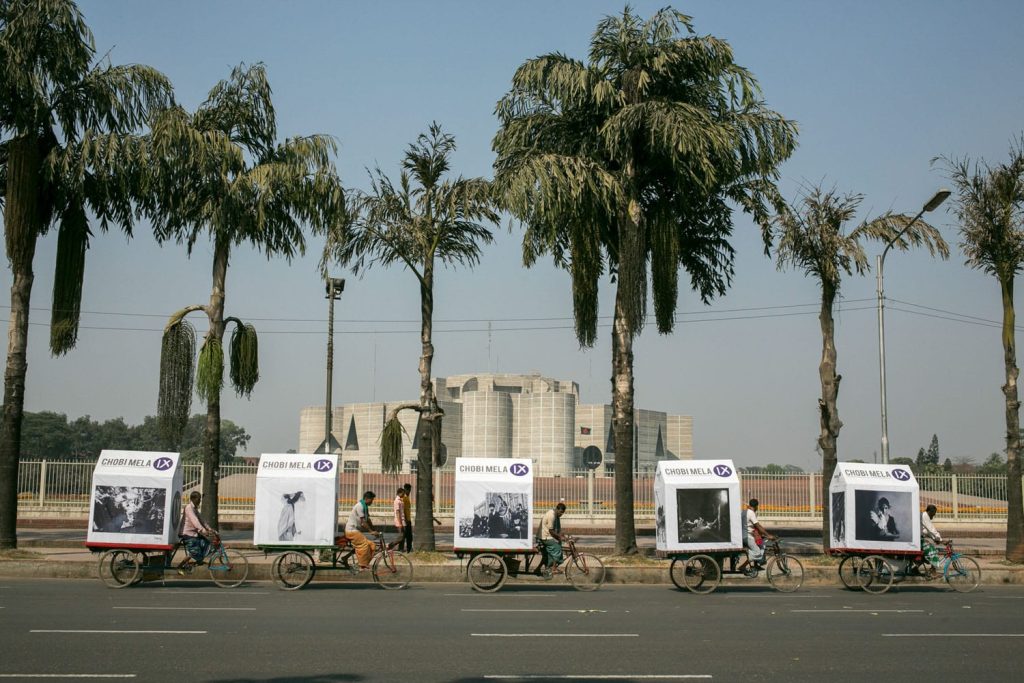
Cover image: Mobile exhibition, Parliament House, Chobi Mela IX
Athmaja Biju is the Editor at Abir Pothi. She is a Translator and Writer working on Visual Culture.