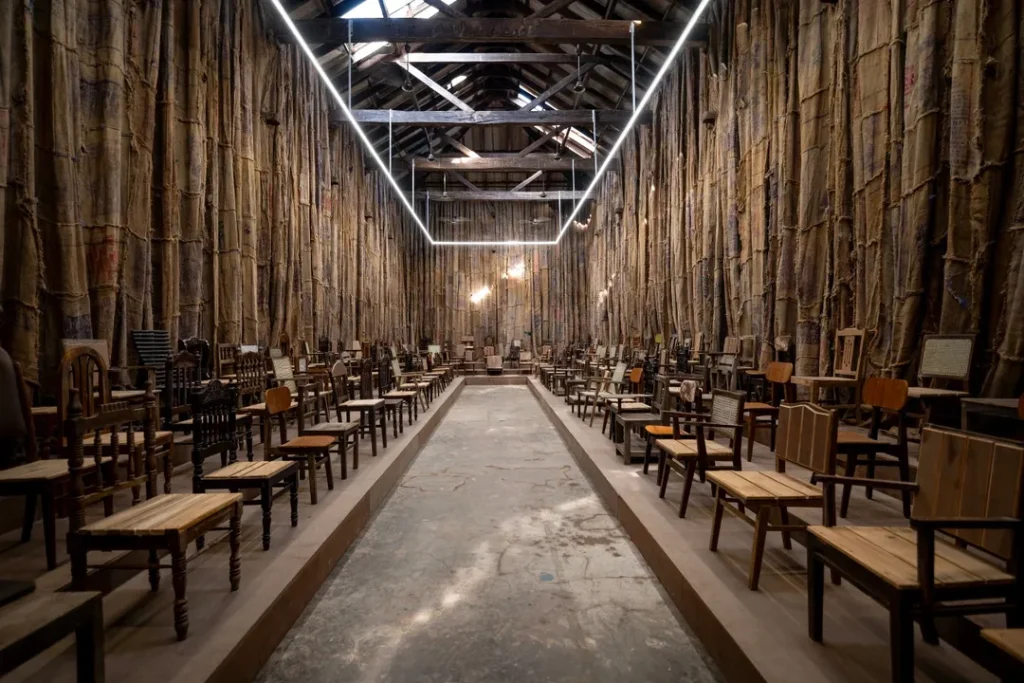
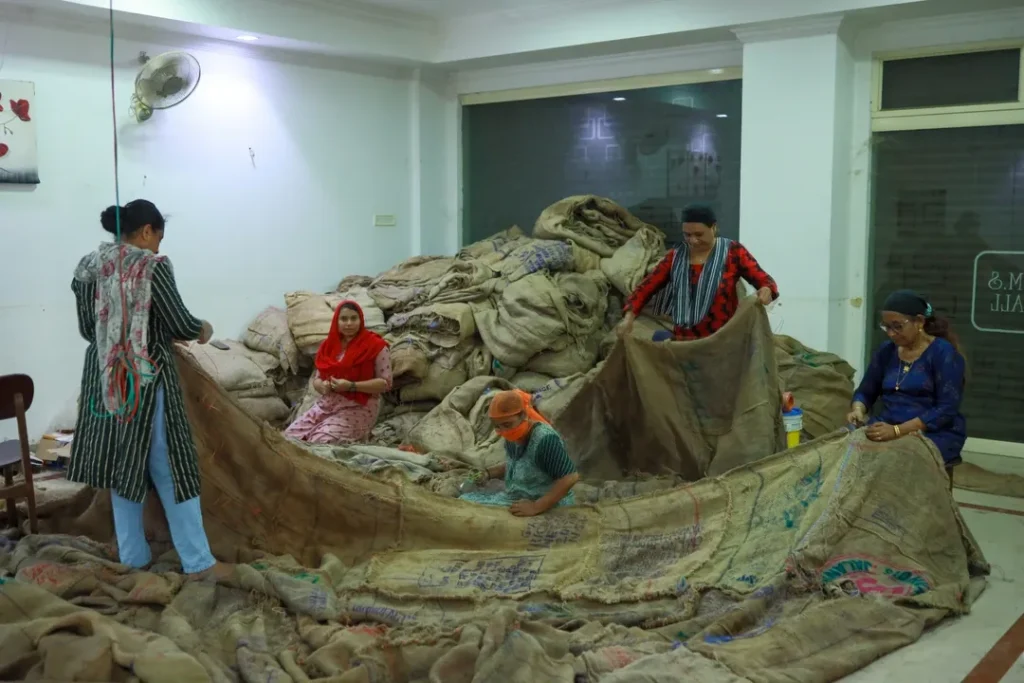
The installation “Parliament of Ghosts” by Ibrahim Mahama, displayed at the Kochi-Muziris Biennale, offers reflections on the politics of space, with its colonial undertone. Mahama’s work, which uses stitched jute sacks and chairs, portrays hidden chronologies of trade, labour, and colonial power. At the Biennale, Mahama transforms a room at Anand Warehouse, a colonial-era godown, into a space for dialogue about colonial atrocities and the ubiquitous struggle against them. There is no doubt that artists offer this ‘enclosed space’ for countless interpretations while challenging the viewer to engage with it and sit within it.
There are three main things to note: 1) the stitched jute sack wall, 2) the chairs arranged to face each other, anyone can sit anywhere, and 3) the name ‘Parliament of Ghosts’ and its haunting history. Before reading this work, it is essential to note, as a preface, that the British sociologist Stuart Hall argued in his famous essays that, following the end of colonialism, there is no longer even the concept of ‘original culture’ to return to. That means centuries of colonial rule have changed the culture of those places, created a new one. In short, the period before colonialism is a story that no one can return to. The old period, altered or reshaped by new cultural, political, social, and economic conditions implemented in accordance with the interests of the colonial regime, is referred to in this work. That we can count as the context of this work, and the particular point is that nothing is loudly mentioned here; only its invisible presence is present, and the viewer ought to complete this work.
This work performs as an archive of used materials, including jute and chairs, collected from localities, thereby linking it to material studies, which is not my aim. I am thinking about the (no)space created by the artwork itself.
This is an ongoing project since 2017. It is understood as a project that has been exhibited in various places and evolved through dialogues within it. This work simultaneously displays a material history, a memory, and the remnants of trade; beyond that, it is a rereading of colonial times and gives voice to those who were silenced then. What happened during the colonial period was aggression, exploitation, and countless cruelties. Frantz Fanon has written in detail about the ‘Other’ identities created during the colonial period. One of the most critical points seems to be this: ‘The black man has no ontological resistance in the eyes of the white man.’ Fanon points out that not only are the visible changes, both economic and social, created during the colonial period, but also that these changes are of a kind that erases the very essence of being human, affecting human consciousness itself. Colonialism becomes brutal when it has created a generation so deprived of awareness that they cannot say ‘I am someone’, a generation that has lost its identity and knows nothing to claim. This is where this work opens, its dialogical space.
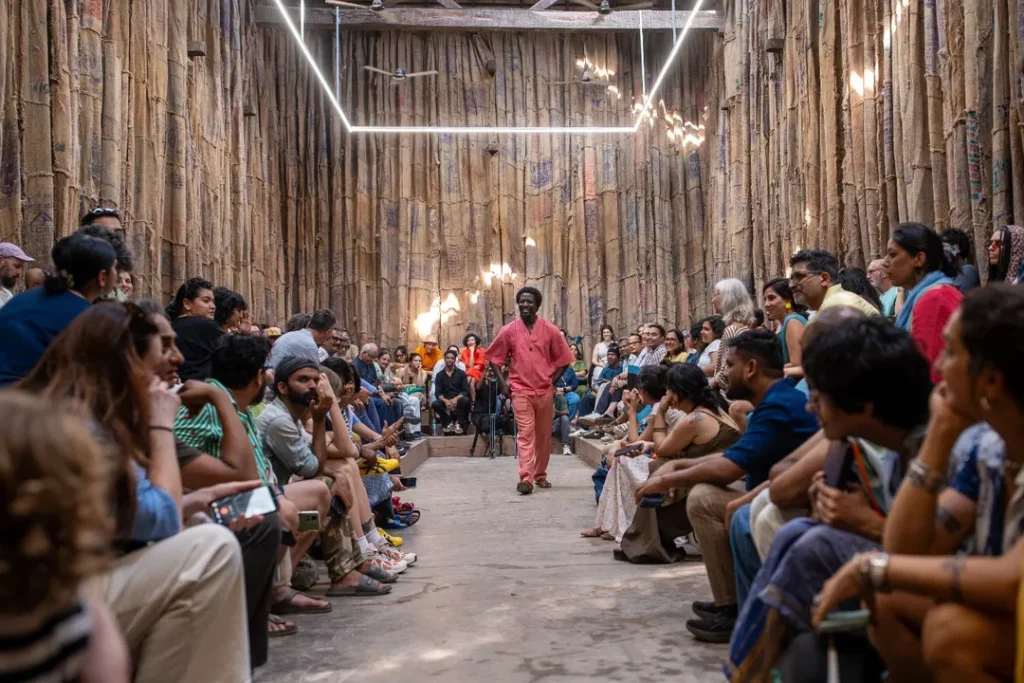
In this work, you can sit silently, relax, and/or check your phone. The main thing this work primarily advances is the world of dialogue. From silent stances to sitting, while looking at the phone, from selfies to lazy walks, all these can be seen as different states of dialogue. But we can have serious dialogues that touch on topics like post-coloniality, especially when this work brings them to the fore. The explanation given by the artist for using the materials here, especially jute sacks, is as follows: Changes in ownership over time, the marks of grain and spice production, rough histories of resource extraction and unequal returns, and so on, as well as the space being furnished with rows of discarded chairs from public institutions.
In some aspects of an artistic note, the artist’s perspective on this work is expressed. Mahama says, attempts to ‘overwrite parliamentary spatialities’, thereby presenting this piece as an agent. Given that the chairs were taken from institutions in Kochi, it can be inferred that the artist is raising a dissenting voice against the exercise of power.
The seats in public offices are seats of power. I think this is what the artist is considering, and he is following the notion that the chairs there were discarded because of that. Certainly, those chairs open up a space for dialogue against power, yet chairs facing each other have many stories to tell. To hear them, you too must sit on them. Here, one must sit and converse to see what art truly is. Mahama’s art must be experienced by sitting and engaging in conversation, not just by seeing. There is nothing to see or listen to. What is given is the art of experience through and within an enclosed space. Parliament, as we know, being a dignified centre of power, is also a place that carries countless problematic histories. It is likely to adopt highly anti-human policies and decisions. In that sense, the neatly arranged chairs bear the weight of intimidating choices, and one can hear the echoes of their daunting proclamations.
The idea of ‘hybridised spaces’ is shared by Stuart Hall. He explains that these are forms of hybridisation that emerge within one’s own identity as a result of generations of experiencing the hegemony. From this perspective, ‘post-colonial’ also refers to an identity crisis that one experiences within oneself. In the same way, ‘hybridised spaces,’ as Stuart Hall describes, are formed within one’s own body and consciousness. This is where the ontological problem, as Fanon points out, comes into play. Most people live without even realising whether they have an identity (coloured black, grey, red, yellow), and experience the various continuities of such states of life, at different levels, as post-colonial conditions.
Among the wounds inflicted by colonialism, the main ones that persist are economic and social inequalities and insecurities, followed by subsequent ethnic conflicts. Many of these ethnic conflicts are themselves the creations of the colonial period. In this way, against the backdrop of various colonial constructions, the Parliament of Ghosts articulated by Mahama comes into being. What is truly a ghost here? Is it time taking the form of a ghost, or the colonial atrocities of various eras, or the victims that those eras created? Whose life has been subjected to becoming a ghost? Who has passed through it?
Behind this site-specific work, the artists say there is an endeavour of local workers. Describing those workers as ‘marginalised in the forms of political decision-making,’ the artist incorporates their labour into the art and imbues it with meaning. Everything in art, even the slightest moves, becomes exquisite narration of the artist, like this ‘labour value’. This work encompasses the exploitation of various times and the unending chain of reminders against it. That effort deserves appreciation, and this work is presented in a way that sheds light on the diverse political and social norms it engages with. The chairs in it, linking to issues beyond them, are bridges to many directions. As we know, office chairs are not corrupt; the people sitting in them are. These chairs represent the misgovernance, dominance, and corruption that happened here and there, through the people who occupied them. Likewise, the chair itself does not produce reflections; you embody it, make art.
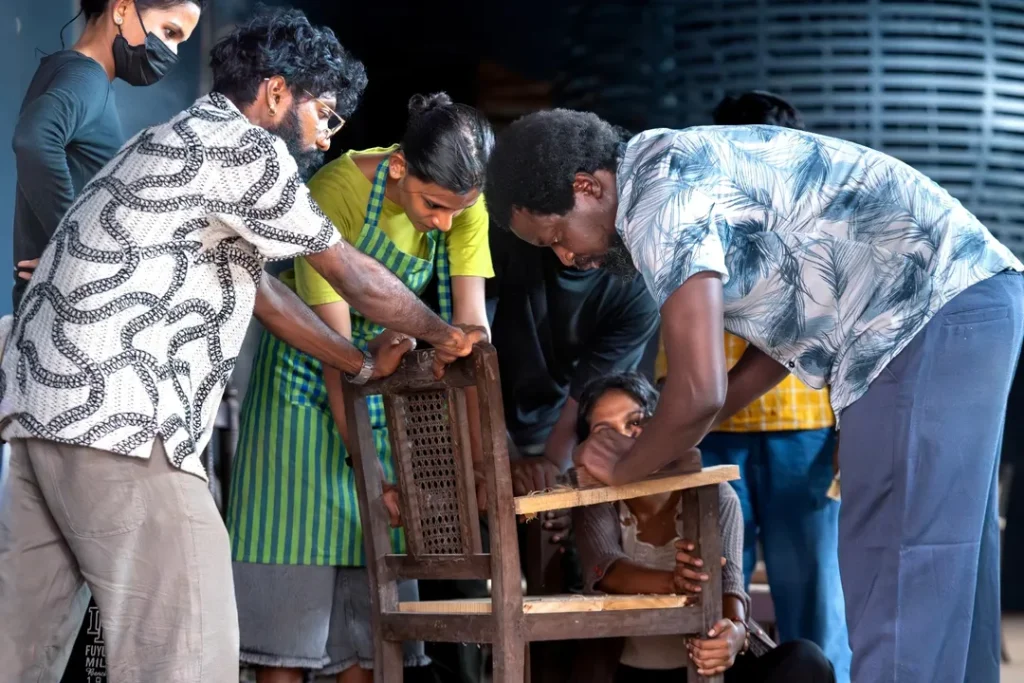
By creating a thought-provoking space in a colonial-period warehouse that explicitly emphasises the ‘post-colonial’ and foregrounds the problems colonial states face now, what Mahama is doing is a political act. While being a creation that redefines the ‘space’ in this way, what makes this work of art relevant is its ambiguity.
This colonial undertone artwork, especially a room covered with sacks and the chairs filled in, will create a feeling of ‘what’ when someone enters. In that sack-covered room, there are many things; the chairs in it are filled with stories, and every moment you spend in that room will undoubtedly become an experience with a profound impact. That work of art is a growing legend, destined to become a classic. It has reached Indian soil at some stage of its evolution. It owes its dignity to having developed through numerous discussions.
When saying ‘The task of life is to make all these repetitions coexist in a space in which difference is distributed,’ did Deleuze intend to refer to a complex narration that forms another space created within a space, the interjections in between, ‘like a viewer and the art’, and so on? Seeing and being seen are two kinds of continuity, two kinds of difference, both sides of the same flow. From a visual point of view, repetition and difference cannot be separated; each view is simultaneously both, renewed in the flow of moments. The moments of engagement with this work are the imprints left on those who go through it, because the artist envisions a space to foster dialogue on the potential of existing resources, reconfiguring them into new possibilities. As Deleuze says, in a space where difference is distributed, you can only make all these repetitions to the maximum. Both of these also coexist in the same space. Then, go to this room where wounds fester, sit, savour its hypnotic experience, and relish the absence in it.
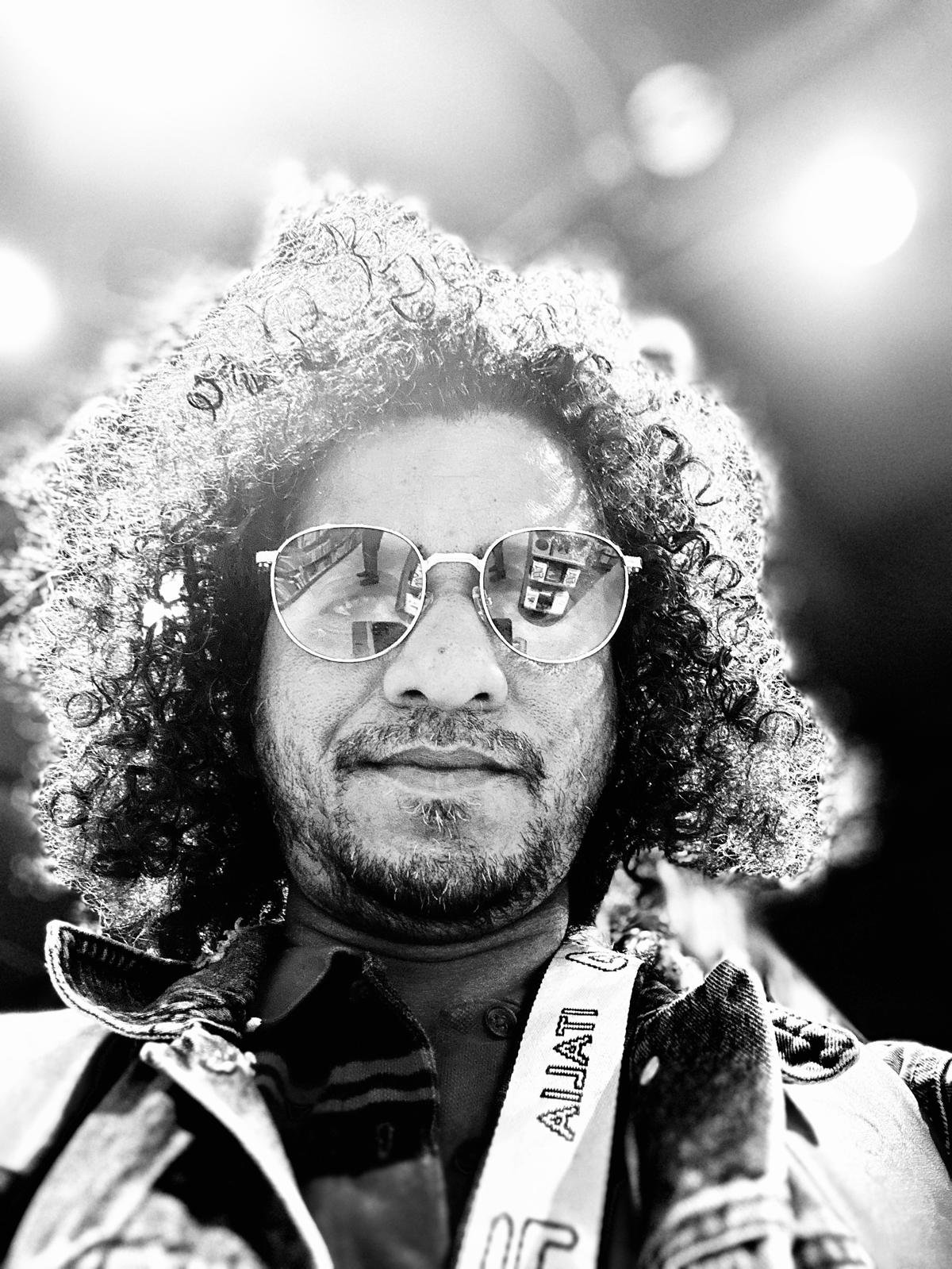
Krispin Joseph PX, a poet and journalist, completed an MFA in art history and visual studies at the University of Hyderabad and an MA in sociology and cultural anthropology from the Central European University, Vienna.