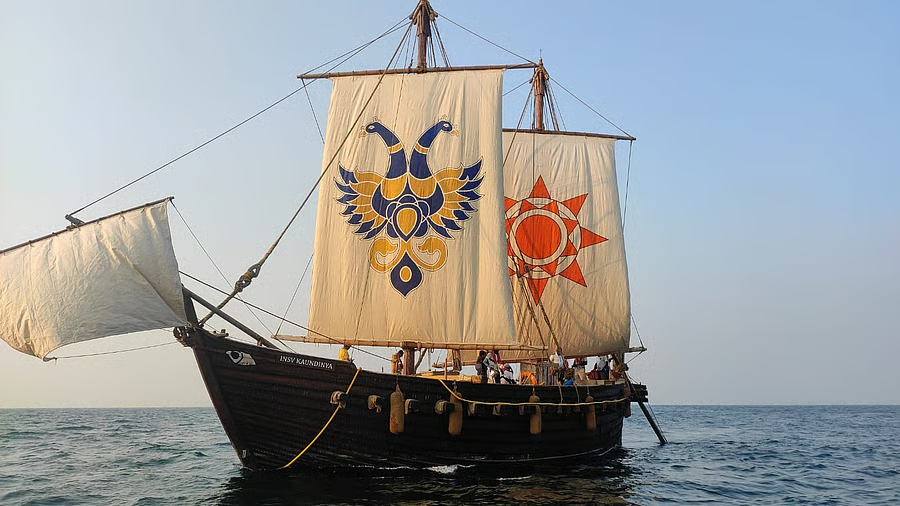
In a symbolic reclamation of India’s seafaring past, the Indian Naval Sailing Vessel (INSV) Kaundinya set sail Monday from Porbandar, Gujarat, embarking on a historic maiden voyage to Muscat, Oman. The engineless vessel, painstakingly reconstructed from fifth-century ship depictions, carries not just a crew but an entire civilisation’s maritime memory across 1,400 kilometres of Arabian Sea.
The 65-foot wooden ship, officially flagged off by Vice Admiral Krishna Swaminathan, Flag Officer Commanding-in-Chief, Western Naval Command, represents an unprecedented feat: the world’s first full-scale reconstruction of an ancient Indian stitched trading vessel. Under the command of Commander Vikas Sheoran, a crew of four officers and thirteen sailors will navigate using only wind, sails, and traditional seamanship over the next 15 days.
From Cave Walls to Open Waters
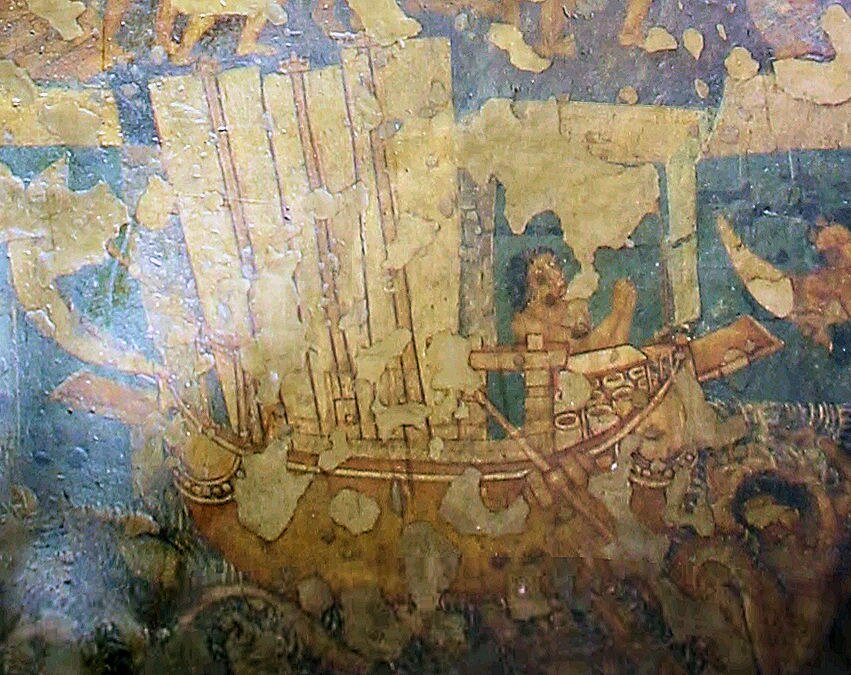
INSV Kaundinya’s genesis lies in the Ajanta Caves of Maharashtra, where fifth-century murals in Cave 17 depict ancient Indian merchant vessels navigating distant waters. Without surviving blueprints, the Indian Navy—partnering with the Ministry of Culture and Goa-based shipbuilder Hodi Innovations undertook a meticulous reconstruction grounded in visual interpretation and scientific validation.
Master shipwright Babu Sankaran and his team of Kerala artisans employed the Tankai method, an indigenous technique wherein wooden planks are sewn together using coconut coir rope and coconut fibre, then sealed with natural resin and vegetable oils. Not a single metal nail or screw marks the vessel’s primary structure.
The construction commenced in September 2023 and was launched in February 2025, with formal induction into the Indian Navy on May 21, 2025, at Karwar naval base.
A Living Testament to Heritage
The voyage retraces monsoon trade routes that once connected Gujarat’s western coast with Oman, facilitating not merely commerce but cultural exchange and civilisational contact spanning centuries. Prime Minister Narendra Modi congratulated the project, describing it as a “unique vessel” showcasing India’s “rich maritime traditions.” The Prime Minister further urged the crew to “retrace our historic links with the Gulf region and beyond.”
Aboard INSV Kaundinya, symbolic motifs tell India’s maritime story: the Gandabherunda (two-headed eagle) adorns the sails, the Simha Yali guards the bow, and a Harappan-style stone anchor rests on deck. Each element evokes the sophistication of ancient Indian seafaring.
The vessel’s namesake—Kaundinya, the legendary first-century Indian mariner—amplifies this historical resonance. Though absent from Indian historical records, Kaundinya’s voyages to Southeast Asia are documented in Cambodian and Vietnamese sources. He married Queen Soma of Funan (present-day Cambodia), founding a dynasty that seeded Indian cultural influence across the region.
Diplomacy Through Heritage
Beyond antiquarian interest, the expedition carries contemporary diplomatic weight. Defence officials characterised it as a “living ocean voyage,” strengthening bilateral India-Oman relations by emphasising shared maritime heritage and reinforcing cultural ties. The arrival in Muscat is poised as a symbol of enduring friendship between two maritime nations whose connection spans centuries.
Athmaja Biju is the Editor at Abir Pothi. She is a Translator and Writer working on Visual Culture.