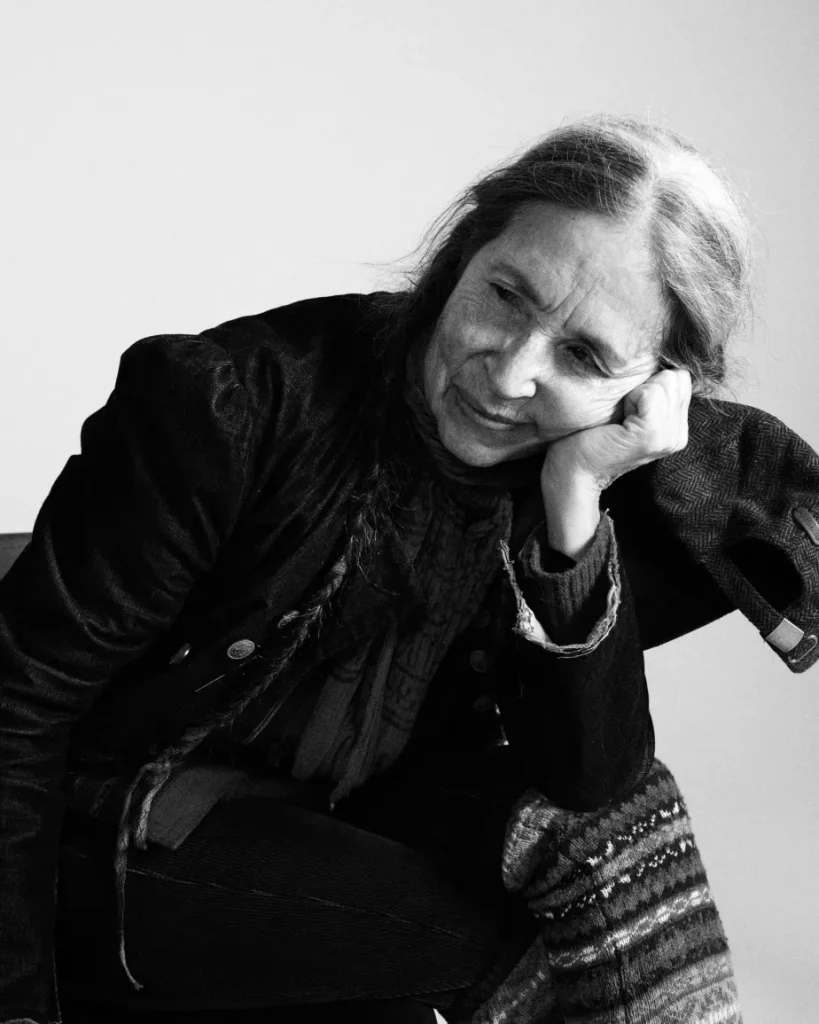
Chilean artist, poet, and activist Cecilia Vicuña has received the inaugural Art Basel Awards Icon Artist Gold Medal, the highest artist distinction in the fair’s new awards platform launched during Art Basel Miami Beach 2025. She is part of the first cohort of “Gold Awardees,” recognized in the Icon Artist category for a decades-long practice that intertwines aesthetic innovation with social and ecological engagement.
Vicuña’s work spans installation, sculpture, painting, film, performance, and poetry, often centering on indigenous knowledge systems, environmental justice, and collective memory. She is widely associated with fragile, provisional forms and textile-based works that propose art as a site of care for the earth and for threatened cultural lineages.
The Icon Artist Gold Medal recognizes an artist whose influence radiates beyond the art world into wider cultural and political conversations, and Art Basel cites Vicuña’s sustained commitment to ecofeminism, decolonial thinking, and activism as central to her selection. The Gold Awardees are chosen through a peer-nomination process and assessed by an international jury of curators and institutional leaders, underlining the prize’s emphasis on artistic and civic impact rather than market metrics.
At the awards ceremony in Miami Beach, each Gold Awardee received a hand-blown glass trophy designed by Jacques Herzog of Herzog & de Meuron, conceived as a sculptural metaphor for breath and inspiration. Artist categories, including the Icon Artist tier, are supported by nearly USD 300,000 in flexible funding distributed annually through honorariums and philanthropic contributions, aimed at sustaining ambitious and socially engaged practices.
Vicuña’s recognition at Art Basel follows a series of major international honors, including Chile’s Premio Nacional de Artes Plásticas, a Golden Lion for Lifetime Achievement at the 59th Venice Biennale, and prominent exhibitions and commissions in leading museums. The Icon Artist Gold Medal consolidates her position as a key figure in contemporary art, foregrounding a practice that treats artistic vision, environmental activism, and ancestral knowledge as inseparable.
Athmaja Biju is the Editor at Abir Pothi. She is a Translator and Writer working on Visual Culture.