What is the relationship between democracy and art? For clarity, ‘democracy’ here refers to a system of government in which power lies with the people, and ‘art’ denotes creative expression across various media. The notion that art often stands with the people and opposes authority is both ancient and trendy. However, that does not mean it must always happen that way. Now, on the occasion of five states in India heading towards the festival of democracy — elections — this essay, being examined, is how democracy, or art as ‘opposition to authority,’ manifests in art.
As an introduction to this topic, it would be difficult to provide clarity on art in the democratic era without referring to the art exhibition ‘Jana Shakti,’ held in connection with the centenary of the Prime Minister’s radio address series ‘Mann ki Baat.’ The art exhibition, featuring about a dozen celebrated Indian artists, was described as ‘government art’ and criticised in that context.
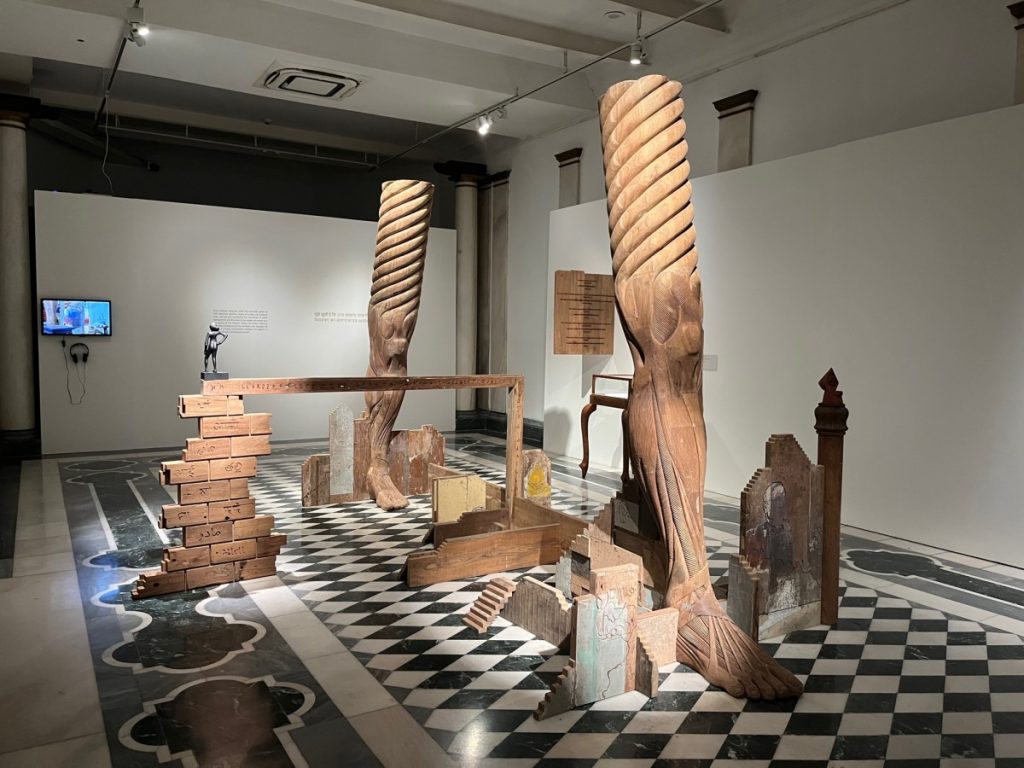
How inspiring it is, on one hand, for artists to draw inspiration from the radio speech of the Prime Minister, who is criticised for not holding press conferences in his entire tenure, and on the other hand, in an exhibition space celebrating extremely artistic inspirations of those radio speech, the show ‘Democratizes Power‘ has been criticized for including the inspirational aspects of the key quotes from the radio speech.
We can perhaps see that the statement in the article written by Ananya Vajpeyi (2023) marks this issue with seriousness: ‘These anodyne bureaucratic subjects, like the charges of union ministries and government departments, hardly promise to inspire great art. Nor is it clear why the artists, known for their liberal views, critical stances and secular politics, agreed to amplify the policies of a right-wing administration, and worse, legitimise the platform of a leader already prone to excessive self-regard.’
Art on Democracy
Srina Bose (2025) has stated that the Indian art market has grown by 250% over the past decade. However, there is strong criticism that this market serves only the interests of the Indian bourgeoisie. The criticism arises over whether art here is trying to protect democracy or, at the very least, raise dissenting voices. Beyond the question of whether democracy is a subject of art, the issue Srina Bose raises about ‘Bollywood’, a world of propaganda that hijacks democracy and constitutes propaganda-making, is not considered here, because only ‘art’ is the subject of consideration.
M. F. Husain’s paintings played a crucial role in critically shaping the theme of artistic activity, its subjects, and the spaces it represents at nuanced levels. The fact that a Muslim artist depicts Hindu deities, and sometimes this is considered improper (as alleged), makes the issue of democracy and art relevant in a time so drastically different from the period of a society trying to be as democratic as possible, that one cannot even imagine he is living in this era.
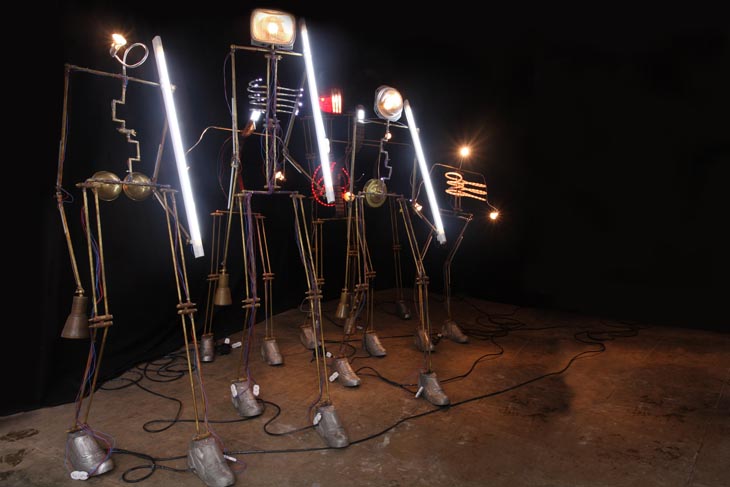
The Enlightening Army of the Empire by Tushar Joag (image: saatchigallery)
Belgian political philosopher Chantal Mouffe has said that public space is where different hegemonic projects confront each other without any possibility of reconciliation. In the competition among hegemonic groups at various levels, the artists’ group is on a mission to display their art and explore opportunities for sale. Meanwhile, how the protection of democracy becomes an artistic subject is only a matter of contemplation and discussion.
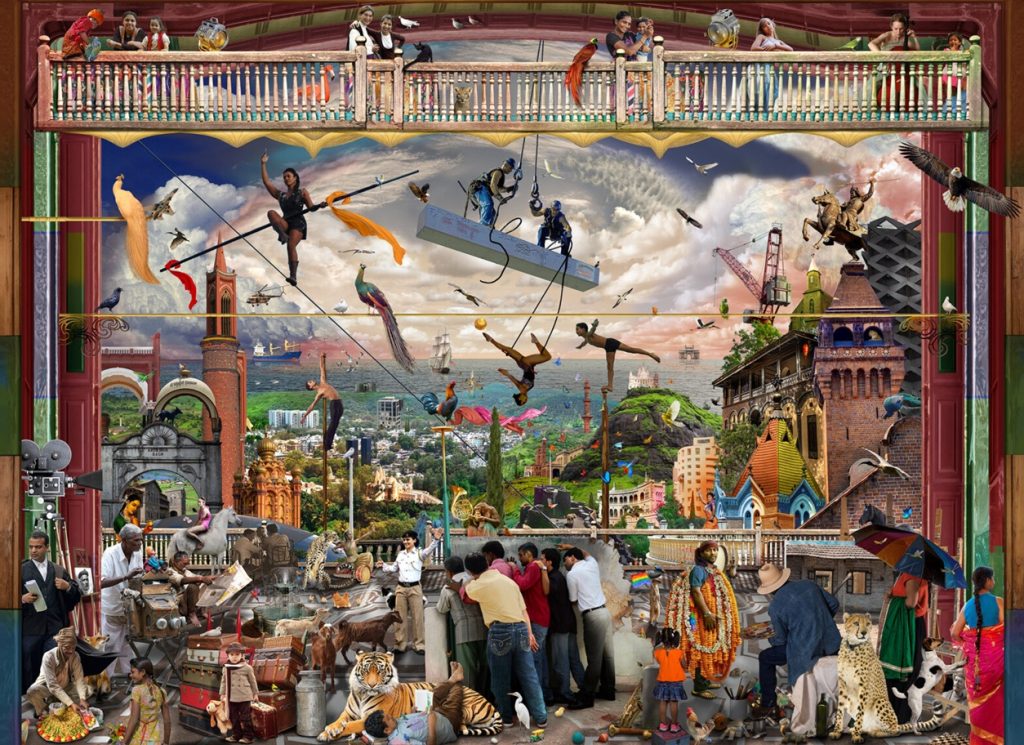
In post-independence India, nationalism and patriotism were subjects of art. Beyond the debate over whether the artworks of artists like Nandalal Bose were about democracy or nationalism, it is undeniable that the country, its people, and their aspirations were unified. Although it cannot be said that Ranbir Kaleka’s art piece ‘Snips and Figments from City as a Stage’ deals with democracy as a theme, it still contains people and their diversity, which is not so glorified in present-day, divided India. A dream-logic, refraining from coherent narratives, and a more internalised weaving together of seemingly unrelated and fantastic elements are what make this creation ‘Indian’.
We have seen that India reacted in a unique way during the COVID pandemic. One night, a nationwide lockdown was announced, and workers from many states were unable to return home from our metro cities. This led to migrations at many levels, described as the largest mass migration modern India has ever seen. Artist Jatin Das has turned it into an exhibition called Exodos. It was, in another sense, a compassionate perspective toward people forced to migrate.
Mumbai-based artist Tushar Joag mainly focuses on art in the public sphere, especially in the project ‘The Enlightening Army Of The Empire’ (2008). Here, the politics of segregation is reaching the largely Indian public domain contexts. He takes a sarcastic look at the urban classes as interventionists and creators of fictitious corporate identities, arguing that art is responsible for preserving cultural continuity. In a continent that depends on social and political solutions, this rhetoric inspires him to create unicell, a corporate body of one that imitates many of the absurdities of government bureaucracy.
In this art creation, the significance of political engagement within artistic practice itself becomes the subject. Another important topic related to art and democracy is not limited to how much artists express democracy and politics.
It is also important how much democracy artists feel. ‘Contemporary art is notoriously difficult to realise, although most modern and contemporary Indian art avoids politics’, whereas Ananda Karmarkar says that ‘when an Indian artist’s work sells for a world record amount at international auctions’. In that context, it is often through participating in exhibitions like ‘Jana Shakti’ that artists express their politics.
Malvika Maheshwari begins her book ‘Art Attacks: Violence and Offence-Taking in India’ by referring to protests against the artwork of S. Chandramohan at the MSU Baroda exhibition in 2007. When an artist (poet) is silenced, both that era and the people of that time are also silenced. While it may be questioned whether the artist can remain silent, it is also possible to question whether they can be silenced. No matter how much one tries to silence them (even if galleries try to silence them or Bayes does not like it), it is also true that art will continue to make its sound.
Feature image: Snips and Figments from City as a Stage by Ranbir Kaleka (Image: latitude28)
Krispin Joseph PX, a poet and journalist, completed an MFA in art history and visual studies at the University of Hyderabad and an MA in sociology and cultural anthropology from the Central European University, Vienna.