Art has long stood at the uneasy intersection of beauty and violence. It offers a space where the unspeakable realities of war can be confronted, transformed, and remembered. In the works of Sadegh Adham, Mohsen Keiany, and Sara Shamsavari, war is not merely depicted; it is portrayed. It is reimagined through myth, material, memory, and displacement. Their artistic practices reveal how conflict reshapes identity. Art becomes both witness and resistance.
The Silent Geometry of War: Sadiq Adham
In the sculptural world of Sadegh Adham, war is not directly illustrated. It is sublimated into form. His practice, spanning over two decades, explores ‘the tension between form and emotion through volume, line, and space.’ In what is described as ‘the Sadiq Adham space,’ legends and geometric forms die. Here, war becomes an abstract force—fracturing and reshaping matter itself.
Drawing from ancient Iranian visual traditions, Adham’s works—such as his bronze sculpture of Arash the Archer—invoke mythological heroism. The poised figure, ‘tense, bow drawn,’ embodies sacrifice and national identity. This suggests how legends are often forged in the crucible of conflict. Yet Adham’s own statement distances his work from overt political narratives. He speaks of creating ‘a flaw in the work’ to reveal deeper beauty. His approach merges the material and the metaphysical.
My works are influenced by the geography of my life in Khuzestan, which includes a mythical spirit and form. At the beginning of my activity, while making realistic sculptures and becoming dissatisfied with this style, I thought about how to create form through the construction of these works. And a different meaning was achieved: by creating a flaw in the work, by understanding and evolving the beauty of this work, and by creating double beauty, I have created these works, and I am trying every day to expand this perspective and meaning. I mixed the form to travel through the material world and travel to the meaning world. These works, free of bias toward political or social issues, have invited us on an aesthetic journey so that we can live in the moment for a short while– Sadegh Adham
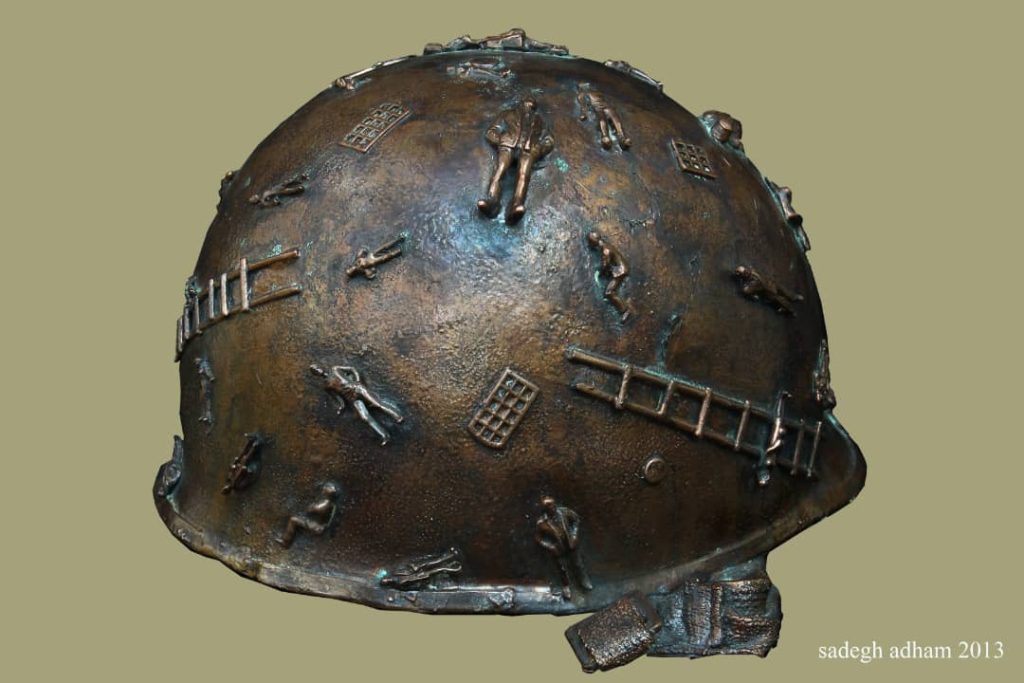
This approach transforms war into an aesthetic and philosophical inquiry. Rather than depicting violence, Adham captures its residue—its imprint on cultural memory and form. His sculptures are shaped by the geography of Khuzestan, a region deeply affected by the Iran-Iraq War. They carry a ‘mythical spirit,’ where destruction and creation coexist. War, in his art, becomes a silent geometry—present but transfigured.
The most surprising of circumstances marked the beginning of Sadegh Adham’s artistic career. He grew up during the Iran-Iraq war, surrounded by the noise of battle. Adham was born in Masjed Soleyman, a city in Khuzestan province, in 1978. The conflict and its long-lasting effects influenced Adham’s early years. He remembers fleeing to his maternal grandmother’s home in Shushtar when a missile damaged their home at age five. Despite the chaos, Adham’s inventiveness began to flourish.
Bearing Witness: Mohsen Keiany
In stark contrast, Mohsen Keiany confronts war with unflinching directness. A former child soldier in the Iran–Iraq War, Keiany’s art is inseparable from lived trauma. His work is driven by a moral imperative: “I wanted people to see the ugliness of war.”
Keiany’s 2019 collection, Desensitised, and his later works translate battlefield memories into haunting visual language. Metallic palettes—rusted browns and greys—echo decay and mechanisation. His use of scrap metal evokes both weaponry and the erosion of humanity. Figures in his paintings often appear dehumanised, transformed into ‘killing machines.’ This reflects the psychological toll of prolonged exposure to violence.
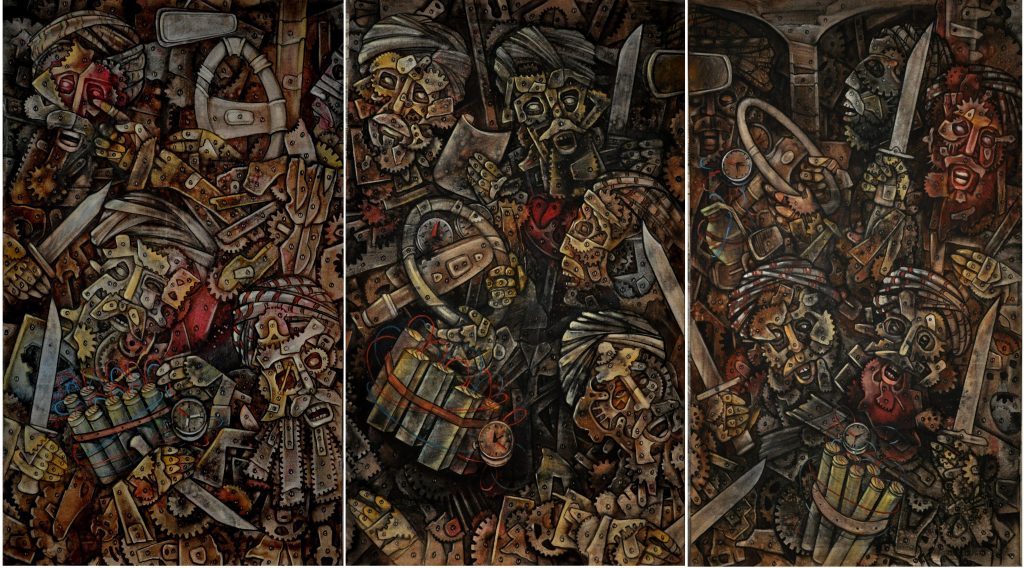
Crucially, Keiany intertwines ancient Persian mythology with contemporary warfare. Heroes from the Shahnameh are placed within modern conflict, collapsing temporal boundaries. This fusion underscores the cyclical nature of violence. Narratives of heroism persist, even as their meanings shift.
His award-winning painting, The Motherland, exemplifies this approach. Faceless soldiers stand as blank, spectral forms, symbolising both presence and absence. Here, war is not heroic but hollow—a temporary yet devastating rupture. Keiany also critiques media representations and Islamophobia. He uses exaggerated stereotypes—veiled women with grenades, armed figures—to expose how repeated imagery desensitises and reinforces prejudice.
For Keiany, art is survival and testimony. Having endured the front lines, he uses his practice to document what history might sanitise: the fear, the loss, and the enduring scars of war.
Fragmented Memory and Exile: Sara Shamsavari
While Keiany’s work confronts war head-on, Sara Shamsavari approaches it through the lens of displacement and psychological aftermath. Born during the Iranian Revolution and raised as a refugee in London, her art reflects the long shadow of conflict—how it persists in memory, identity, and belonging.
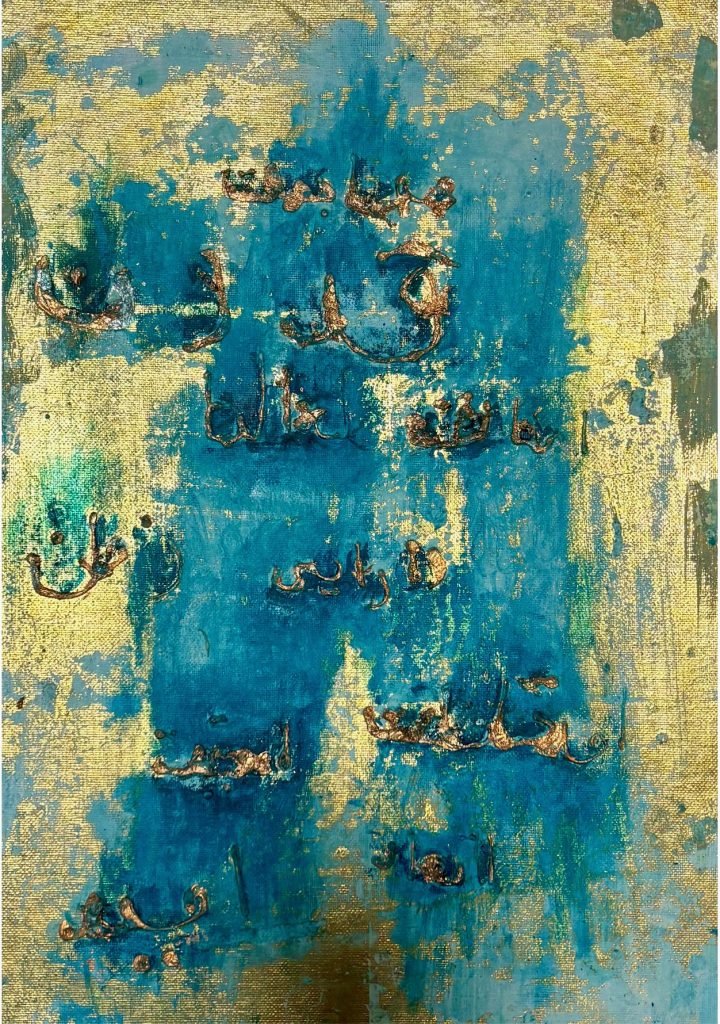
Her 2025 exhibition, Where the Soul Finds its Home (Riz Gallery, London), offers a deeply introspective response to war and migration. The exhibition explores ‘displacement, belonging, and rituals of resilience.’ She uses materials such as gold leaf, salt, and lemon to evoke erosion and endurance. Each canvas contains fragments of Farsi text—often obscured. These fragments symbolise loss, absence, and the fragility of existence.
Unlike traditional war art, Shamsavari’s paintings do not depict violence directly. They embody its aftermath—the emotional and cultural dislocation refugees experience. Her work suggests that trauma is not an event but a condition. It is ‘a type of death’ that survivors carry throughout their lives.
Earlier exhibitions, such as There’s a Good Immigrant (Publicis, London, 2017), positioned her within broader conversations on migration and identity. Her photographic and painted works challenge stereotypes and emphasise shared humanity. These works show that war’s consequences extend far beyond the battlefield, shaping the social and political fabric of host societies.
Shamsavari’s practice transforms personal history into a collective narrative. Her art becomes a space where fragmented identities are reassembled. Through texture, language, and material, she makes the invisible scars of war visible.
Art as Memory, Resistance, and Renewal
Across these three artists, war is neither a singular subject nor a uniform experience. For Sadiq Adham, it is abstracted into myth and form. For Mohsen Keiany, it is a visceral reality that demands confrontation. For Sara Shamsavari, war is a lingering presence shaping identity and exile.
Their works collectively demonstrate that art does not simply represent war; it processes it. Art allows for the transformation of trauma into meaning, and of destruction into creation. Whether through the sculptural evocation of ancient heroes, the raw imagery of dehumanised soldiers, or the textured canvases of displacement, each artist reveals a different facet of conflict.
Importantly, these practices also challenge viewers. Keiany forces audiences to confront uncomfortable truths. Shamsavari invites empathy for the displaced. Adham encourages contemplation of deeper, universal themes beyond politics. Together, they resist the normalisation of violence and the erasure of its consequences.
In the hands of Sadiq Adham, Mohsen Keiany, and Sara Shamsavari, art becomes a powerful medium through which the complexities of war are not only remembered but reinterpreted. Their work reminds us that while war may shape nations and histories, it is through art that its human impact is most profoundly understood.
Feature image: Sadegh Adham, ‘Soldier Helmet,’ ‘War’ Series 2013. Image courtesy of the artist.

Contributor