After a hiatus of almost 35 years, artist Inder Salim presents his solo show, “i belong to the missing side,” at Gallery ONKAF.
Within my dream, I woke up.
I went closer to the window of my room.
The landscape was turning papery.
At the window,
The paper-thick reality in my eyes turned heavier.
In my heart I screamed, I begged.
I want to be on the other side.
Can I never cut across the image?
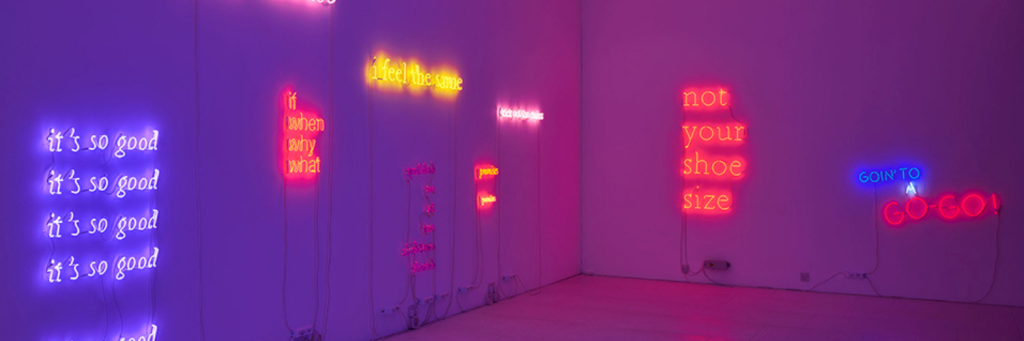
This excerpt from Inder Salim’s poem ‘Dil-e-Nadan –6’, beautifully sums up the emotions and thoughts that are reflected in his solo “I belong to the missing side,” which opened at Gallery ONKAF on Saturday, 28th Feb, 2026. The exhibition curated by Neha ‘Zooni’ Tickoo, features an arresting and powerful collection of original paintings, photographs and installations by Salim. We are told that it is almost after 30-years that the artist is actually doing a solo show.
Exhibition Opening and Notable Attendees
The inauguration was in the presence of eminent artist Ranbir Kaleka and acclaimed art historian and critic Geeta Kapur. The opening was well attended by other artists, poets, writers, art historians, filmmakers and activists, and even art enthusiasts from the corporate world.
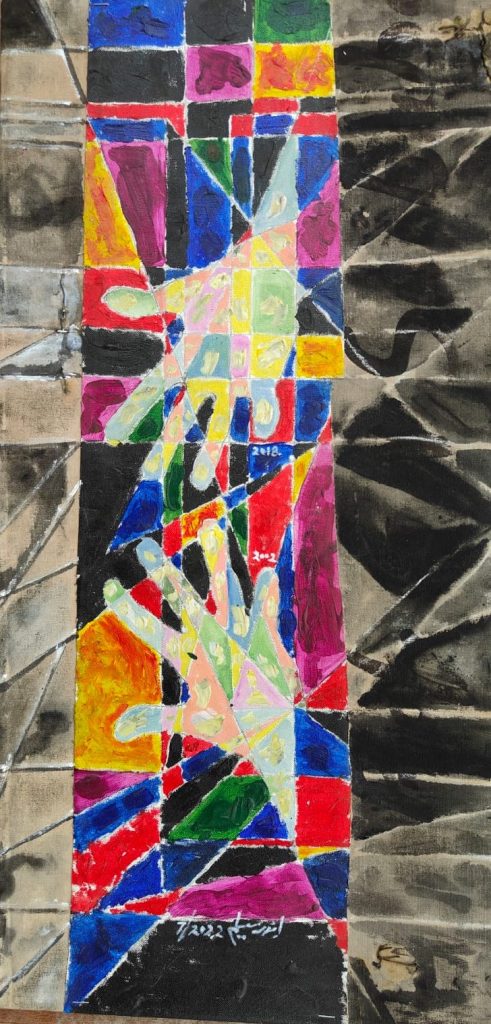
“Inder Salim is known for his fiercely radical and evocative art practice that includes performance, poetry, installation, video, and paintings. The exhibition ‘I belong to the missing side’ is a much anticipated and pronounced call for making space and offering a glance into the multi-faceted practice of a dynamic artist spanning more than 35 years,” says Tickoo.
“Part of the curation are a few paintings that have never been shown before. These were made around the 1990s, as a newly settled refugee from Kashmir (still known as Inder Tickoo), struggling to keep a bank-job with his artistic aspirations alive in Delhi; along with mixed media photo-prints from his Europe based art residencies and international collaborations from around 2004,” writes Zooni-Tickoo.
Inder Salim: Artist, Activist and Performer
For the unversed we revisit his past, Inder Tickoo ‘Salim’, was born in Kashmir in the early 1960s and exiled during the exodus and forced migration of over 100,000 Kashmiri Pandits (Hindus) in the 1990s—he currently lives and works in New Delhi. Salim’s ground-breaking, body-centric work has few parallels. He is a multidisciplinary artist, using video and photography as well as the Internet interfaces to expand upon his bodily interventions. Inder has foregrounded the role of art as activism. Reflecting upon the relationship between art and its relevance to the world he lives in, Inder has performed at different venues in India and abroad, including the Venice International Performance Art Week 2014.
Paintings and Self-Portraits Exploring Identity and Conflict
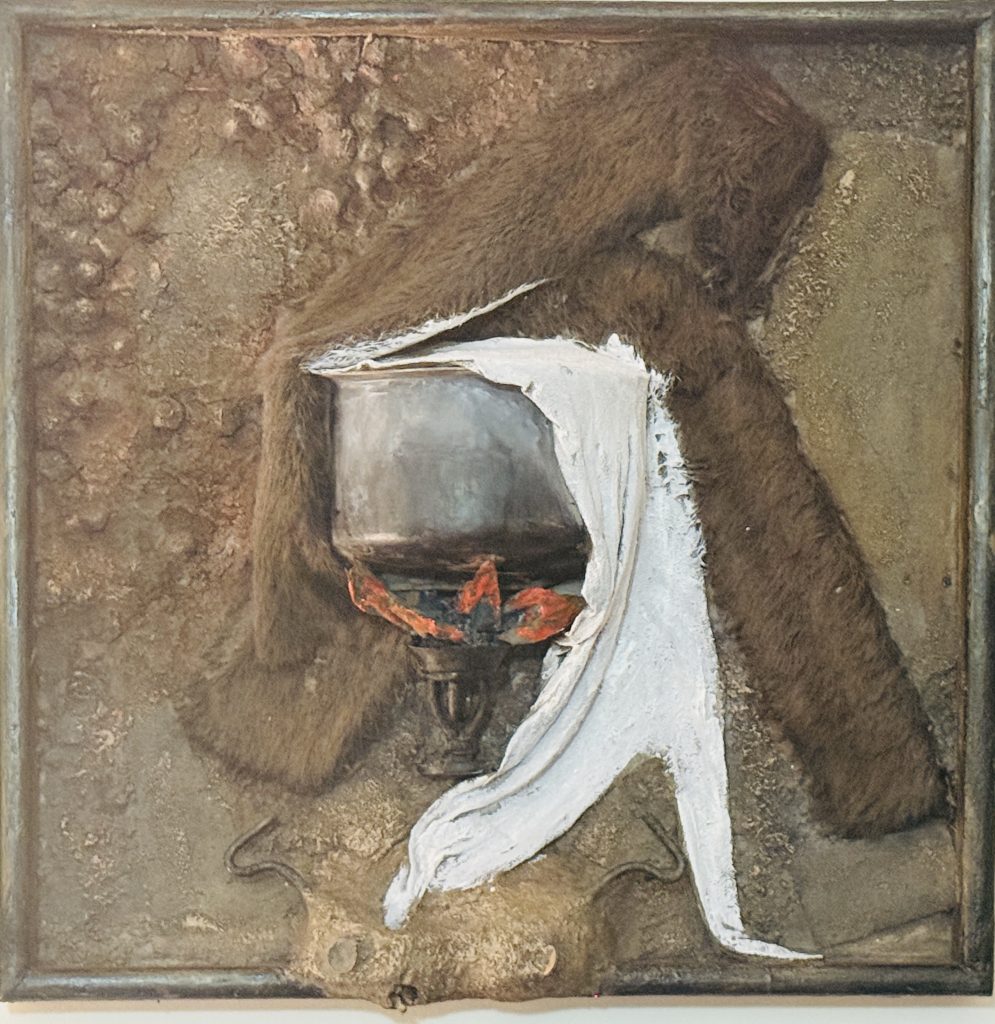
Currently at ONKAF, I am presented with a series of paintings, mostly self- portraits, that go back to 1998, one that was done with oil on paper in vigorous strokes, underlining that ‘art povera’ practices are as powerful as those that are elaborate and well-funded. There is an edge of the art povera element to almost all his works, be it the paintings, the photographs, the installations and the overall effect of the show. It is simple yet very powerful in its message, that speaks of these sides, the geopolitical lines that divide humanity, seen through the prism of art and poetry.
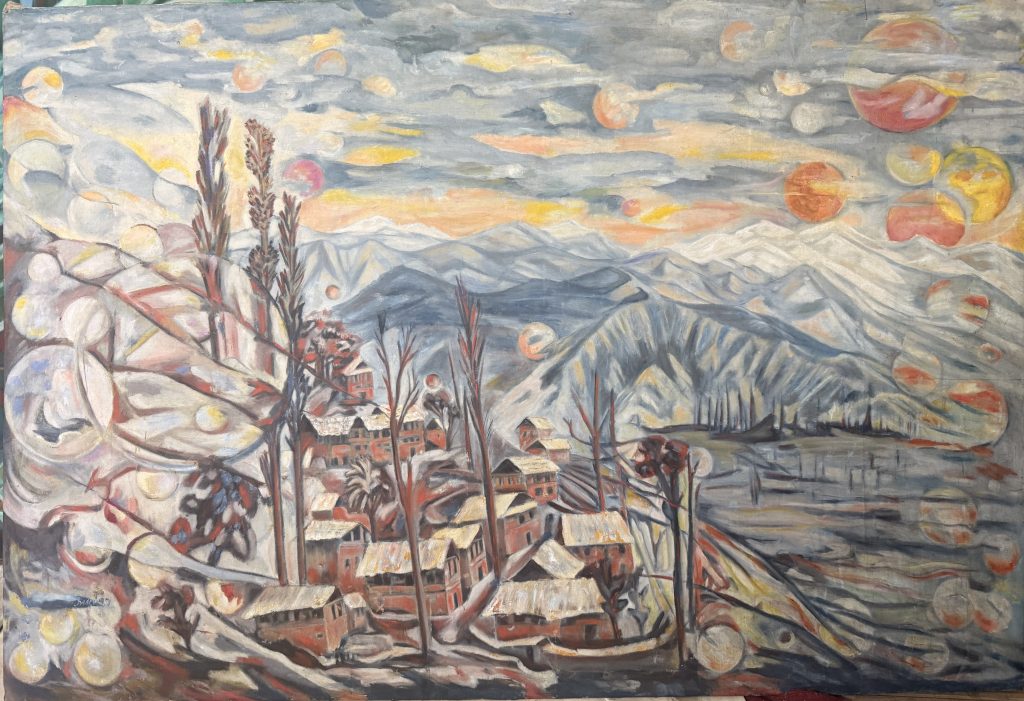
Moving from the primal self-portraits, one experiences paintings of idyllic landscapes juxtaposed with hooded figures and a body that hangs inverted, creating an air of foreboding. Another work quotes Pablo Picasso’s Guernica—an artwork painted as a protest to the Spanish Civil War (1937). It often serves as a powerful, universal anti-war symbol, created in response to the bombing of the Basque town of Guernica during the war, and Inder uses truncated elements of it mingled with his own experience of war and partition, that has left his life as well as the lives of many Kashmiri Pandits, fragmented.
Literary and Conceptual References in the Work
One even encounters a painting that uses the back side of the canvas to compose a work of art consisting of text and images. The image is a self-portrait of Inder Salim in a black garb and the text comprises an imagined conversation between QCC and ARV, two characters who discuss the existence of the Cheshire Cat and its smile, debating which is actually more relevant—the cat or the smile. It leaves one with many questions and provocations, recontextualizing Lewis Carrol’s Alice in Wonderland to a more contemporary context.
Installation Featuring the Kashmiri Gaba
Next, we are greeted with an installation. A lovely Kashmiri Gaba, hand embroidered in the style typical to Kashmir, faces the viewer. For the uninitiated, a Gaba is a traditional, hand-embroidered, often recycled, colorful woolen rug from Kashmir, used primarily as floor covering or insulation in winter.
The beautiful embroidered surface is interrupted by a photographic print of Inder wrapped in a shroud-like garment upon which calligraphic Kashmiri text has been rendered. This was part of a 2020 performance, but it has been remembered and reinstalled as part of this current work. Further, art historian Tanveer Ajsee, has done calligraphy on the other side of the gabba. The actual text that adorns the other side is referenced from a poem from Ghalib which when translated, captures the absence of celebrations and love in the achingly sad and humdrum life one can lead when one exiles from the place known as homeland.
Themes of Memory, Identity and Fragmentation
Traversing across the affect, memory and testimonies of his personal history and past performances, this compact yet significant solo exhibition allows one to witness the possibilities of re-iterations through the everyday existence of life. Installations and paintings made out of found objects and trash proclaim his body-centric and performative locus of identity and subjectivities. Several works here fairly trace the ruminations of one of his most radical early performance art pieces.
Radical Performance Art and the Yamuna Protest
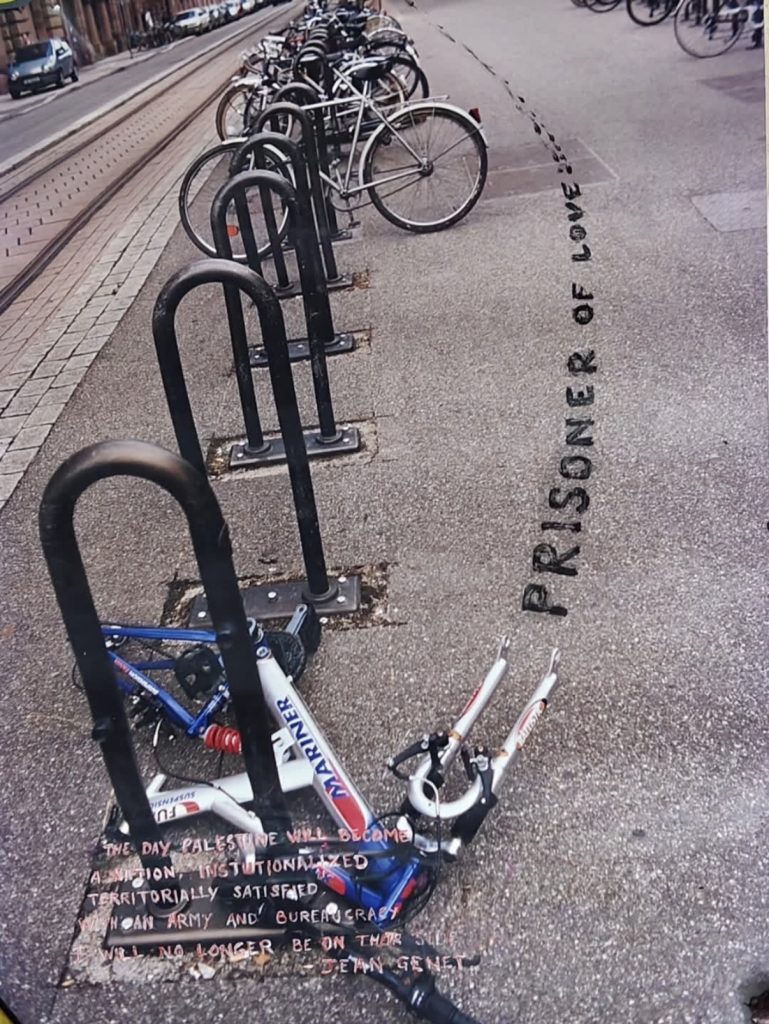
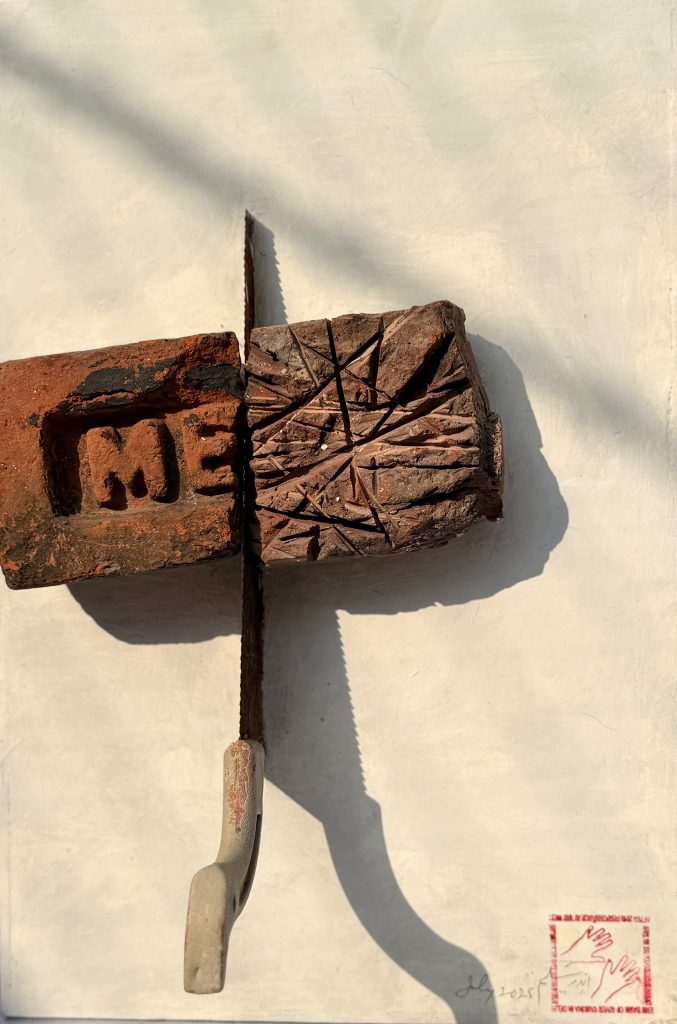
There are other works, especially photographs that capture his global performances and travels, inscribed with poetry and text, there are photo-installations of the brick that has been sown in half by a saw, and there are many references to Inder Salim’s hands that are missing two fingers. To quote the reference, it speaks of his 2002 performance where he cut off part of his small finger and threw it in the Yamuna. “One hot April morning, I chopped off the little finger of my left hand and threw it into the dead river called Yamuna. They call me crazy. But I call it art,” writes Inder. It was a protest against pollution and environmental degradation, against the violence in Gujarat and against the emptiness it made him feel as an artist. The work itself is titled ‘Dialogue With Power Plant, Shrill Across A Dead River’ (2002) and several references are made to it, including a tongue-in-cheek installation in the bathroom.
Works like ‘Aed Kaak’ (half-man), ‘Brick’ and ‘On my hands’ series are vocal attempts of the artist’s obvious return to the idea of a gash, of depletion and obliteration, augmented further with a rambling of thoughts represented through geometric colour fields and philosophical footnotes compounding as a visual discourse, as yet another creative tool and process of art-making.
Nonetheless, many works are brimming with wit and subversive joy sprinkled like ‘diamond dust’, discovered only if sought. This exhibition most importantly marks a humble celebration of Inder Salim’s never-dying endeavour for his own creative truth, which has forever been a private as well as a collective pursuit, shared always with love towards his friends and wider artists’ community. The exhibition may be enjoyed on a purely visual level, but for those who are familiar to his work, the readings can be multifarious and the sometimes rather dense references to socio-political contexts, as well as the epistemic metaphors that his work is rife with become easier to decode.
The exhibition will continue until 10th March 2026.
Gallery hours: 11:00 am – 7:00 pm (Sunday closed)
Venue: Gallery ONKAF, C-1/20, 3rd floor, Safdarjung Development Area, New Delhi – 110016
Georgina is an independent critic-curator with 18 years of experience in the field of Indian art and culture. She blurs the lines of documentation, theory and praxis by involving herself in visual art projects. Besides writing on immersive art for STIRworld, she is a regular contributor for The Hindu, MASH Mag and Architectural Digest.