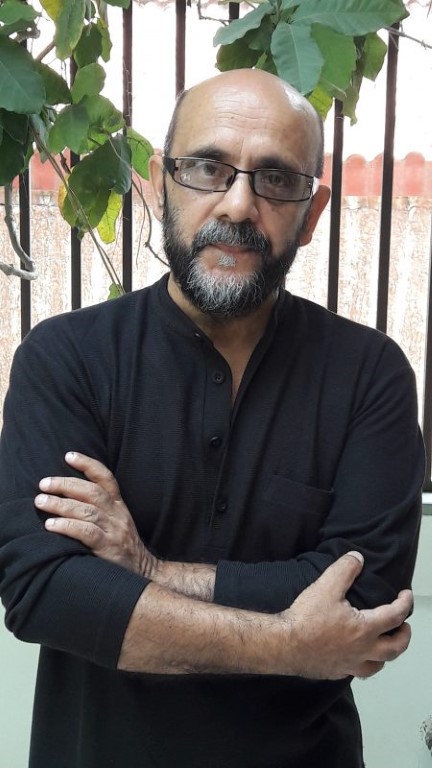
The idea of art for tribe and tribal people is not quite aligned with the world view of it. Art isn’t exquisite for the the tribe it is integrated in their life the way food is. Art is playful, experiential, raw and real. That’s what one feels when they look at the art created by the tribal Artist Belgur Mandavi.

Identity and Individuality
Belgur hails from the small village of Garh Bengal in the forests of Narayanpur district, Bastar in Chhattisgarh, where time itself is not linear. The village of Garh Bengal in itself holds a lot of magic. This is the very village of “The Tiger boy Chendru” . Chendru, the star cast of the film “The Jungle Saga” by the Swedish director Arne Sucksdorff. It’s important to draw the history of Garh Bengal from him, it highlights the spirit of the tribe, it shows the connection that nature has with humanity. It’s also important to understand that Garh Bengal, although might be a small village but has been globally recognised, time and again. Once by Chendru Mandavi whose best friend was a tiger and then a lot more to come.
Amongst these very talented artists is another name, Belgur Mandavi. Only recently, his art was put up in the India Art Fair which happened in Delhi between the 6th-8th February, which was a shared exhibition with two of his contemporaries, Pisadu Ram Mandavi, and Pandi Ram Mandavi, set up by Ojas Art. But a lot of questions around him still remain unanswered.
To look at Belgur, one would not immediately see an “artist”, not quite fitting the aesthetics, in the way he dresses or etiquettes that he carries. Art itself feels like it is full of a certain sort of people, people who seem sophisticated, intricate, soft and expensive. Belgur doesn’t look like those people, he looked like any other elder in his village, who wake up at dawn, eat paej and bhajee, and sit under trees, and watches the day unfold. There was no ceremony to his practice. Not a studio to work in nor a time schedule to follow, just genuine flow. Then it becomes more about the intuition of creating rather than the intention of it.
His paintings carry the language of his people—the sounds of the animals, the beats of the drum and the thumping of the dancing feet. Marked by a distinct dotted line pattern, Belgur wasn’t drawing complex figures which the world would like to call modern art. They are drawings of men going to hunt, or a snake or a tiger. They are rituals, nature and lived experiences. Usually set on a white canvas. But did it really all begin with a white canvas?
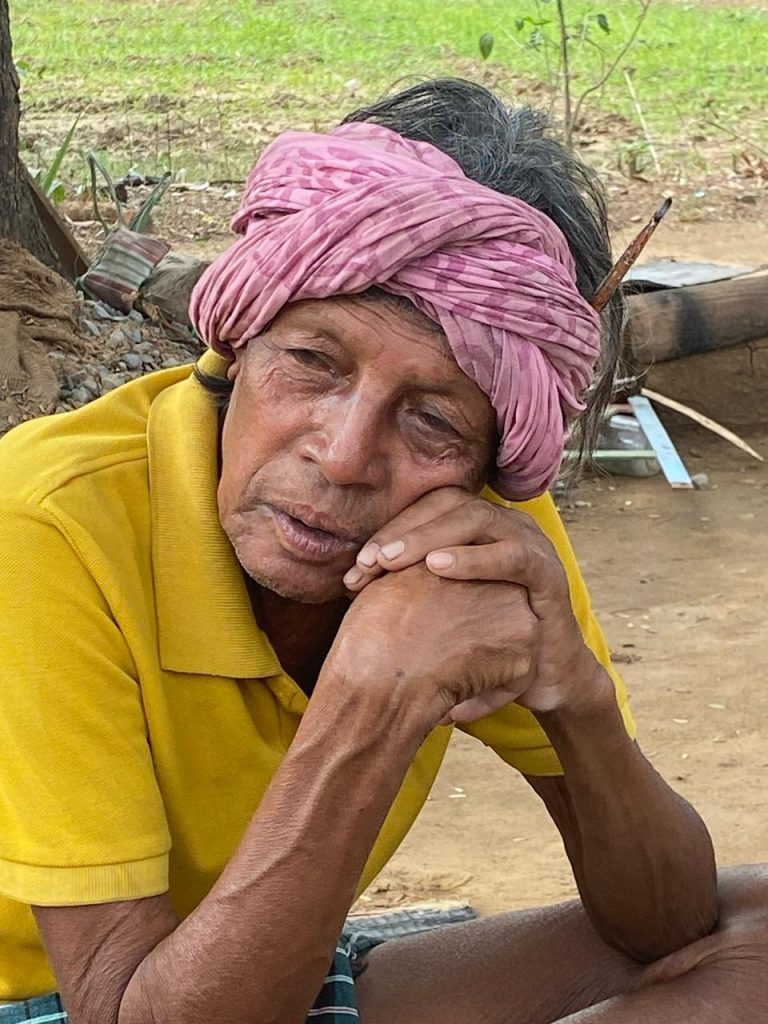
Belgur
Beautification of the Ghotul
In the tribal communities, creativity is not something you go to an academy for. There isn’t a singular space, a singular environment for it because creativity breeds with humanity. Amongst the green mango grooves, the Muria tribe births, grows and dies. Ghotuls are the Muria institutions which were responsible to provide knowledge and experiences to young tribal girls and boys. In simplified terms, it can be called a summer camp, but it was much more than that. It was a hub for socializing, education, and personality development.
A ghotul of the Murias is a rectangular-shaped house with bamboo walls plastered with mud, a thatched roof and a big courtyard and bamboo fencing. The cheliks (unmarried boys) and motiaris (unmarried girls) begin to gather here by nightfall, to sing, dance or just laze around. They learned about social customs, cultural heritages, clans and even sexuality. It was a place to explore and understand.
“As you move west across the centre of the Muria country you find more and more elaborate carving. The ghotul has stimulated artistic creation, not only in the realm of personal adornment but also in wall painting and wood carving. The chelik desire that their ghotul should really be ‘lovely as a bison’s horns’. In many of the Jhoria ghotul there are excellently carved pillars.” as Verrier elvin wrote about the Ghotul.
This exploring ground is where Belgur originally started his journey from. His lines carry the collective, not the individual. His figures are not portraits of singular glory, but embodiments of shared existence. Drawing intricate patterns of dotted lines which would develop as a whole, complete tangible form. Drawing these paintings on the Ghotul walls.
What can we say, the Murias are passionate about their Ghotuls.
When he started making art, he was doing nothing out of the ordinary, he was only trying to make his Ghotul beautiful.
Although not really having a name in the tribal context, this is the style that later got recognized as Bhitti Chitra or mural art for the rest of the world. For Belgur though and for his audience, who are the other people in the village, these are just animals, man huntings or people dancing, a representation of life at ghotul .
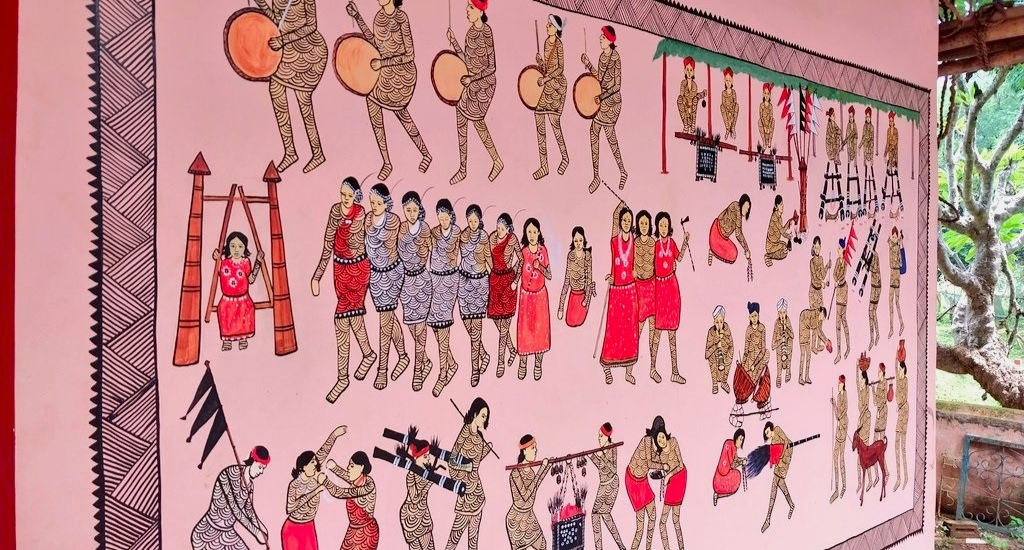
Mural on a Ghotul wall.
Rise to recognition
Now, when have the beautiful things existed in isolation? It’s true that a blue butterfly will surely catch one’s attention even if they just catch a glimpse. The uniqueness of Belgur’s art and the stories it told could not have stayed limited to the ghotuls.
Belgur Mandavi emerged as one of the early Muria artists whose visual language transitioned from customary wall and ritual imagery to works on paper during the early 1980s. His work came into wider recognition through his association with Bharat Bhavan, Bhopal, particularly the Roopankar Museum, which played a formative role in introducing indigenous artists to national art platform. For this, he was also awarded with the Shikhar Samman.
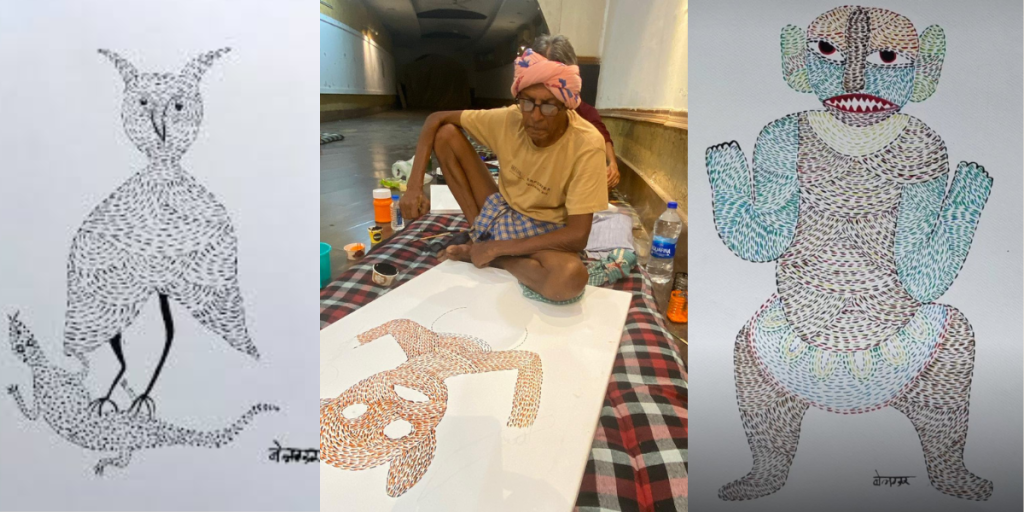
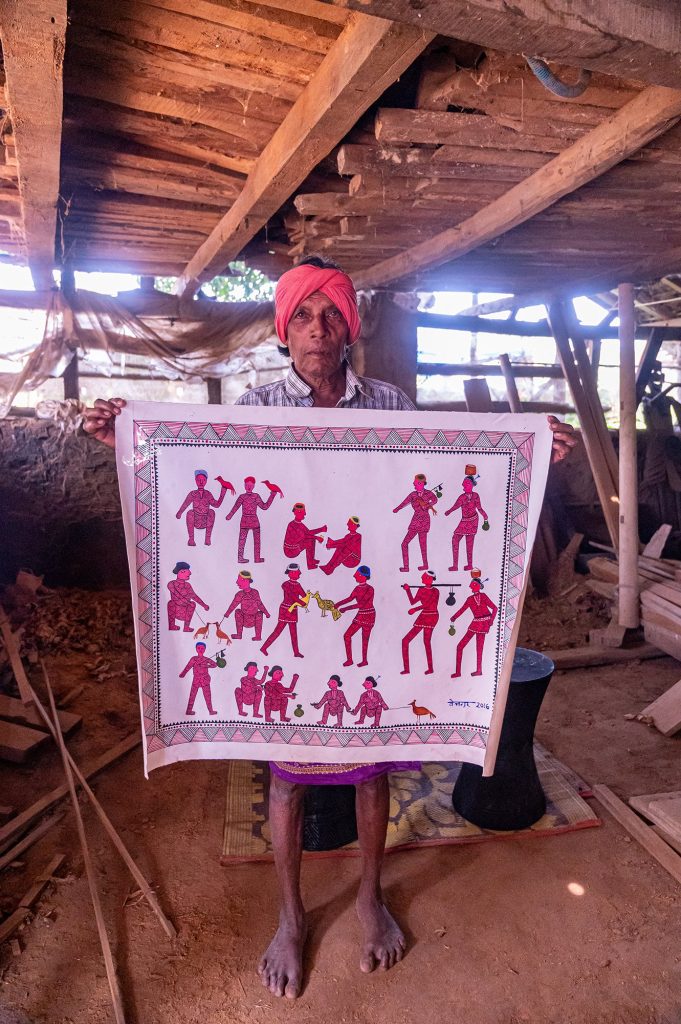
Belgur working on a painting, Belgur with his artwork from 2016.
Back to his forests
So, butterflies, other than being attractive, are also wild and carefree. Even if you manage to get some of their colours on your fingertips, you rarely can catch them. Belgur Mandavi was not much different from these butterflies. Showcasing the little of himself and of his art, he continued living the life he was accustomed to.
His paintings travelled farther than he ever did. They entered exhibitions, received state recognition, and found their way into huge institutions other than just the Ghotul, where they now hang under controlled light, protected and preserved. In those spaces, his work is named, catalogued, and admired.
But the man himself remained where he always was—in the village, unrecorded.
This is the paradox of tribal art. The work is celebrated, but the artist is forgotten. Their art is collected, sold, exhibited, and institutionalized, but their lives remain untouched by the systems that profit from their creativity. Tribal artists are often extracted without ever being included within. Their art gains value, but their names rarely do. Fame passes over them like wind—felt, but never held.
Belgur never painted for galleries. He painted because that was how memory moved through him, because that was how the forest stayed alive on surfaces that could travel beyond, because the ghotul lived in him, even as it slowly disappeared from the physical world.
Today, the ghotuls are fading. Their spaces are vanishing under the pressure of modernity, migration, and neglect. And with them, the scope of exploration, creativity, carefreeness and the ecosystems that sustained artists like Belgur are disappearing too.
His paintings remain. But the man has dissolved back into anonymity. And in that anonymity, in the September of 2025, Belgur breathed his last breath in the forests of Garh Bengal. Like a tree returning to the soil after providing all that it could, or rather, after we extract out of it, all that we could.
References:
- https://www.facebook.com/CultureDevi/videos/under-the-series-of-artists-and-artforms-here-is-belgur-mandavi-ji-from-garh-ben/1013679592697674/
- https://ojasart.com/artists-cpt/belgur-mandavi/
- https://gaatha.org/Craft-of-India/wood-carving-narayanpur/
- https://www.memeraki.com/blogs/posts/family-of-woodcarvers-preserves-chhattisgarh-s-muria-ghotul-art#:~:text=Muria%20Ghotul%20art-,Family%20of%20woodcarvers%20preserves%20Chhattisgarh’s%20Muria%20Ghotul%20art,its%20talented%20woodcarvers%20and%20painters.
- https://www.outlooktraveller.com/News/blog-chhattisgarh-ghotul
- https://www.ijcrt.org/papers/IJCRT1135348.pdf#:~:text=Ghotul%2C%20as%20indigenous%20institution%20practiced%20by%20the,dancing%2C%20storytelling%2C%20and%20discussion%20on%20cultural%20heritage.
- https://x.com/anzaarnabi/status/1373649107751903240

Aditi Shah Kunjam. An aspiring psychologist, storyteller and poet from the Gond tribal community. Exploring emotion, identity, and culture through a creative lens. I write about art as experience—where aesthetics meet feeling, feminism, and everyday life. Observing deeply, creating thoughtfully, and finding meaning in the details.