Artist Sumakshi Singh, known for her unique ability to materialise the intangible—memory, perception, fragility, and time—is a leading figure in contemporary Indian art, and represents India at this year’s Venice Biennale. She brings an artistic language composed of thread, translucency, stillness, and the delicate tension between presence and disappearance. Her delicate yet theoretically grounded paintings challenge viewers to reevaluate their appearance, the things they keep, and the ways they occupy their internal and external worlds. Her extensive work, spanning research, teaching, animation, installations, and drawings, Singh creates environments where monuments disintegrate into fragility, memory becomes apparent, and the terrestrial becomes self-archiving. Her work does more than portray the history; it reflects, challenges, and subtly rearranges our understanding of the connections between space, time, history, and imagination.
Sumakshi Singh is an artist and educator who holds a BFA from Maharaja Sayajirao University in Baroda, India, and an MFA from the School of the Art Institute of Chicago (SAIC), and has taught at SAIC for 5 years. She has also given lectures at several museums and schools, including Oxford University, Columbia University, and the Chicago Humanities Festival. In addition to serving as a visiting artist advisor at KHOJ Delhi, she has guided residencies for the Victoria and Albert Museum and TheWhyNotPlace in 2010 and 2011. Galleries and museums throughout India, China, the United States, Canada, France, Italy, and Switzerland have presented her interactive installations, paintings, drawings, and sculptures in both solo and group exhibitions.
Galleries, such as Saatchi Gallery, London, UK; Kochi Biennale, Kochi, India; Museum of Contemporary Art, Lyon, France; MAXXI Museum, Rome, Italy; UCCA Beijing; Mattress Factory Museum of Contemporary Art, Pittsburgh, PA; Van Harrison Gallery, New York, NY; Museum of Contemporary Art, Chicago, IL; Illinois State Museum, IL; Kashya Hildebrand Galerie; Zurich Halsey Gallery, Charleston, SC; and ArtHouse Texas, TX held some of her recent exhibitions.
Sumakshi Singh received awards from the Richard H. Driehaus Foundation in 2005, the Illinois Arts Council in 2007, and the Zegna Grant in 2009. Younger Than Jesus—the New Museum Catalogue, Art in America, the Village Voice, ArtLovers, Austin Chronicle, Chicago Tribune, Reader, Chicago Arts Critics Association, Charleston City Paper, New Haven Register, Platform magazine, Art Etc., Take on Art, and Andpersand are just a few of the journals and publications that have reviewed her exhibitions. Mac Dowell Colony, USA; Skowhegan, USA; Djerassi Foundation, USA; Fondazione Pistolleto, Italy; Camargo Foundation, France; CAMAC, France; and Sculpture Space, USA, are among the artist residences. Singh was a finalist for both the 2006 Rijksakademie and the 2014 Rolex Mentor Protege Award.
Self-Archived Terrestrial Stories
In the exhibition “Leaving the Terrestrial: Its Own Kind of Archive,” Sumakshi Singh says that we should leave the Terrestrial to archive itself in its own way. That is, the artist is merely a medium, and art carries out its practices independently, and what space has to tell is narrated by the space itself. Using delicate threads and wires, a vast world is presented referencing marine and botanical forms, nature, science, art, craft, and fantasy. Giant suspended corals made of metal and thread, fragile woven skeletons of algae, seaweed, and jellyfish, pressed flowers, leaves, and seeds floating in glass vitrines – seemingly embroidered on air – create an ethereal, natural history-style display of an invented memory of nature. Between fantasy and reality, the artist establishes their unreal presence.
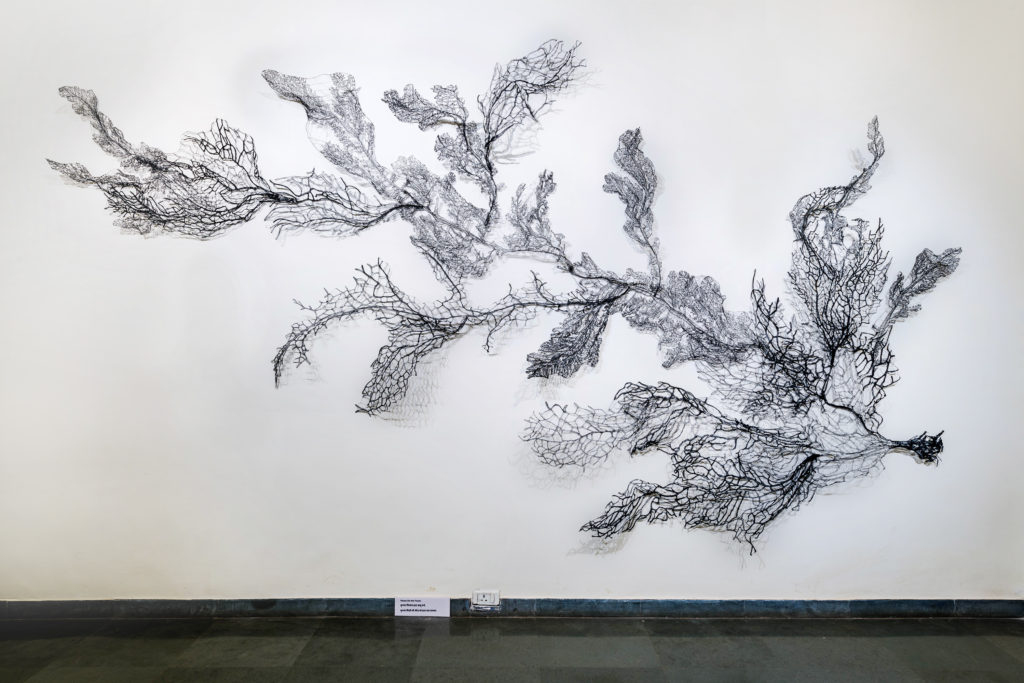
By “leaving the terrestrial,” the artist allows space to manifest itself, and fully, or to illuminate itself. Sumakshi Singh states that the artist becomes merely the mediator of that process. At the same time, it is the freedom of art practice. It is a redefinition of the relationship between the artist and the art, and while the art occurs through the artist, it still holds an independent existence. The artist often becomes just a medium. While the question of whether it is precisely what the artist wants to say or whether the art progresses through its own inherent creation remains relevant, it problematises both the art practice and the spaces that display it. From giant suspended corals, metal and thread, to fragile woven skeletons of algae, seaweed and jellyfish, to pressed flowers, leaves and seeds floating in glass vitrines, all are self-illuminating. The artist stages this self-illumination through her medium, “groundless thread drawings,” creating a setting for it through her work and her inherent ecosystem of introspection.
A second installation of the above project invites viewers to walk through stop-motion animations projected on transparent scrolls of hanging fabric and dried flowers, representing a luminous garden of evolving life forms. Many of the objects recreated here, along with the stop-motion animations reflected onto them, create a magical world. The world of meanings interwoven between the two generates an abstract version of reality. The animated visuals are reflected onto transparent scrolls of hanging fabric and dried flowers. What it creates is a new world that, in the old, produces a luminous garden of evolving life forms. Many elements from the old world are represented here. In art, the term “representation” has profound weight. The forms and memories of the past are imagined to acquire new meanings in the present; they recontextualise, enabling us to see and understand them in a new light.
A bridge of vision is being constructed between the old and the new, erasing both, renewed and reconstructed, a redefinition of time: set a fire on time. A world composed of fabric, dried flowers, and stop-motion animations projected onto it is a reenactment of the artist’s past, a self-illumination of that time, and a redistribution of past objects with their new meaning. Through this, a new world is revealed, a new world within the old, simultaneously created and read, as many things are formed, a unified text. In this world, each canopy carries a different meaning and is interpreted differently. The reflections of what has taken shape testify to and remind us that such a world, vision, and experience existed, and they are preserved so that memory is not lost. Memory is something that is renewed and refreshed, and the conveyance of objects can be used to describe life and the artistic activities that occur within it. Vision, too, is an enactment; it is a self-renewal and an interpretation of what is displayed. The expressions of what has been experienced transform, for those who have not experienced it, into a notion, an experience, and an engagement.
Voice of Monuments
Anannya Sarkar (2025) noted that ‘Sumakshi Singh is simultaneously grounded in form but fluid in spirit’; primarily immersed in form, its fluid, spirited nature serves as the inner inspiration for their creations. The artist herself says, “My practice is about holding what can’t be held. I make memory visible. Not to fix it, but to keep it alive.” Making memory visible is the potential of art. That, in itself, is political. Through visibility, memory is established, transformed into a ‘thing’ that can be seen and preserved. Objectifying memory, especially in thread, involves transforming it through the ‘metaphor of embroidery’ and converting it into an enduring object. Making memory visible is not about fixing it, but rather about keeping it alive—imprinting and venerating the past, its remaining elements, and what survives as memories, as a work of art and as a sensually resonant inheritance.
Following the questions, ‘What endures in a world shaped by transience? What is worth holding onto—in our stories, our identities, our beliefs? The artist raises the question of what happens next in Sumakshi Singh’s exhibition note. The phrase’ world shaped by transience’ is striking, especially given that the world is transient and composed of impermanent things. Forms that once existed can dissolve, people can part ways, many things, including homes and family members, can be lost, and legacies and heritage can disappear. Yet amidst all this, humans seek permanence. This irony is the inner fuel of the work exhibited in this show. Threading it together in an essence that transcends, to shape it once inhabited, as a legacy, or simply as the threads that bind us to something greater than ourselves. What can also be added is the reality that no one can dwell in the world formed in the thread. It is only a representation of a world, or a deep, at the same time, ironic presence of the past. ‘To be human is to navigate fragility, entropy, vulnerability, and loss’ is not only the theme of this exhibition, but also a prologue to that time, engraved in it.
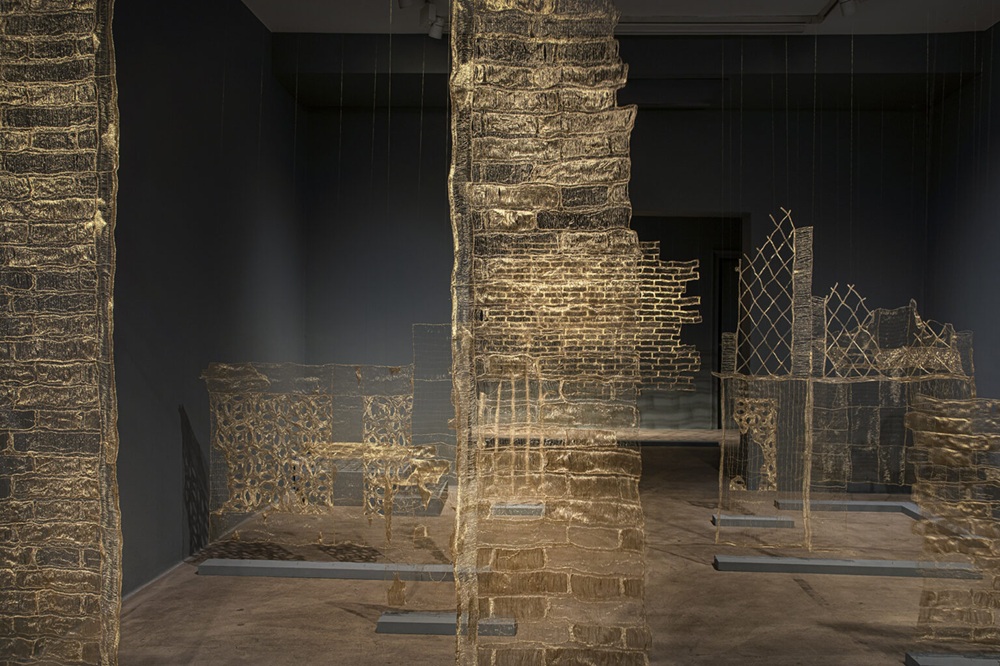
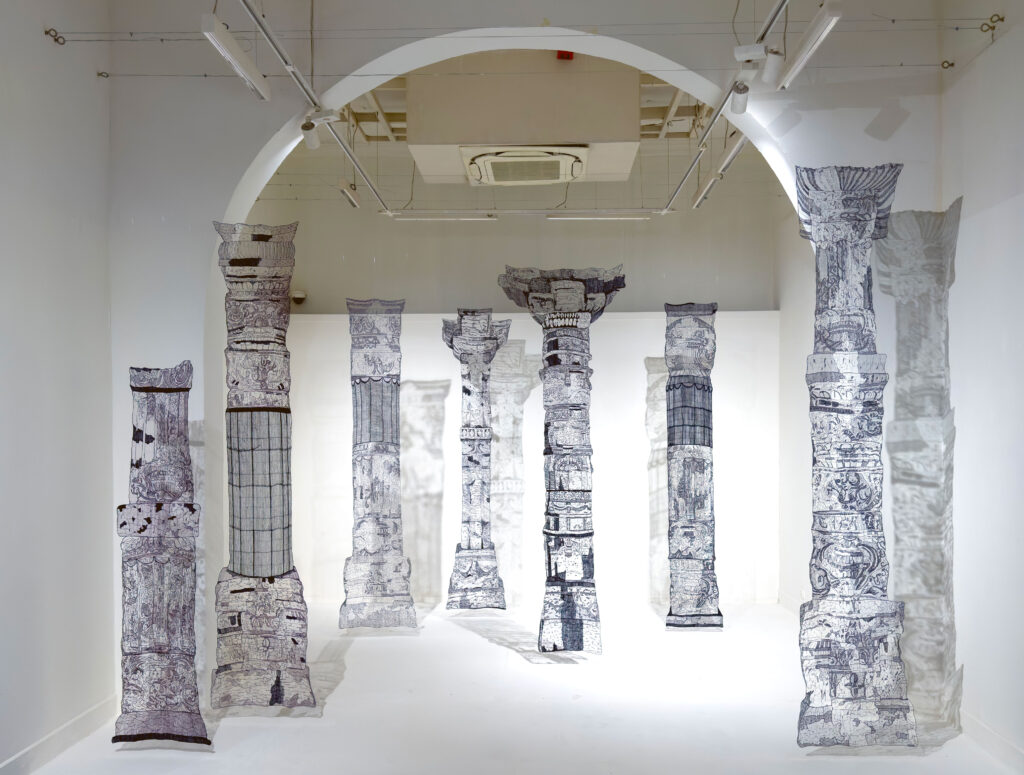
In the concept of monuments, Sumakshi Singh says they are ‘solid and defiant against time’. It is argued that through such a creation, its makers continue to exist as immortals. Any creation, whether an artwork or something else, immortalises its creator. However, to transcend that, like a threaded drawing, in the artist’s words, ‘there is something inherently vulnerable about them because they come from a human desire to outrun time, to last’. Longevity is the minimum requirement of monuments. It is here that Singh gives a new interpretation to his ‘Monuments’, redefining their ‘Eternity’ as ‘life-size re-creations of historic columns from Delhi’s Qutab Minar Complex are embroidered onto soluble fabric’.
Once part of a Jain temple but later absorbed into an Islamic complex, the redefinitions of a design fabric can be said to be silent witnesses to the shifting histories between them. The history built stone upon stone, rendering into fragile, porous membranes, their disintegrating images vulnerable to time and the erosion of history. We can see that vulnerability is not only a human trait but can also be found in objects, and their re-reading provides a new perspective on time. The “monument” can be seen as a fragmented memory stored and exchanged, and at the same time as an impression pressed between the pages of a book, suspended between presence and absence.
Embroidery, often seen as a domain of women’s labour, is becoming a medium that rewrites history. In that sense, this revisitation represents the historical denial that women have faced. As the artist herself says, ‘once the embroidery is complete, the fabric dissolves, transforming what was once mere surface ornamentation into the essential framework holding the narrative together,’ history is returning in new dimensions.
The work “Spanning the Void”, exhibited in the Cheongju Biennale, is a mysterious “garden” of light and memory. Here, visitors see floating, colourless, skeletal figures formed of thread and lace, created through stitching techniques, offering a ghostly experience of the garden’s memory. As a lens that illuminates the past, present, and future, the flexible, hanging object connects memories, history, and contemporaneity.
Sumakshi Singh redefines artistic practice as both a witness and a mediator of time. Her exquisite weaving of time, glowing gardens, decaying monuments, and intricate threads brought the monuments to life with untold stories. Through art, she highlights the conflict between permanence and impermanence, reminding us that memory ties even as it unravels. Singh offers an art of silent revelation in place of traditional ideas of authorship and objecthood by letting places, histories, and materials speak for themselves. In her universe, the transient becomes a place of deep reflection, and fragility becomes a kind of resistance. Her work asks us to look beyond what is readily apparent and consider the shaky structures of what endures, what changes, and what persists in the ever-changing landscape of humanity.
Feature Image: On Time as Memory- Installation view Synthetic Zari, wire (image- sumakshi.com)
Krispin Joseph PX, a poet and journalist, completed an MFA in art history and visual studies at the University of Hyderabad and an MA in sociology and cultural anthropology from the Central European University, Vienna.