Written by Myna Mukherjee

Musings from a Hospital Room
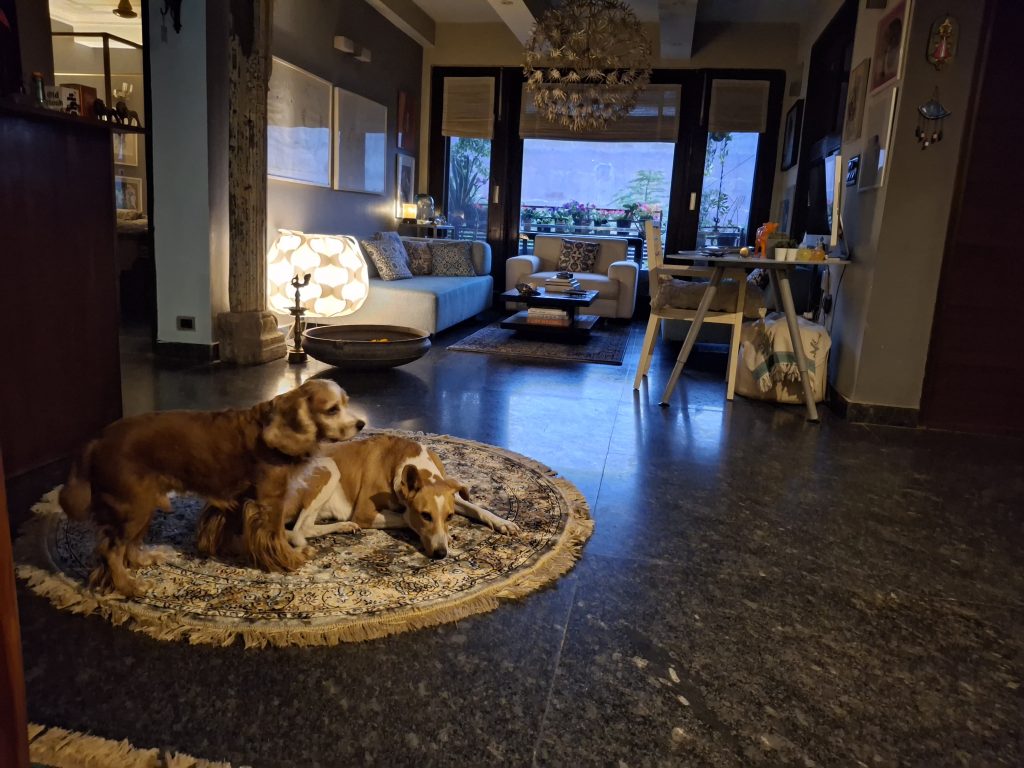
Right now, my two babies, my pets, sit facing the door. Through the distant, unblinking eye of CCTV, I watch them hold their position: expectant, unwavering, and just waiting. As if the act of waiting itself might summon my return. Time gathers strangely around them; it slows, thickens. Their vigil is not only about absence, it is a form of presence, held open. I am writing this while waiting in the ICU, where my father lies between outcomes, his breath partially carried by machines, his condition suspended in a fragile present.
Unequal Durations of Waiting
There are, I am beginning to understand, many kinds of waiting: private, institutional, collective.. and they do not unfold equally. Some are held in rooms like this one, measured in breath, in minutes, in the fragile extension of a single life. Others stretch across borders and conflicts, where time fractures and disappears into scale. And then there are the quieter forms of waiting embedded within systems I inhabit, including the art world – where outcomes are delayed, accountability is deferred, and certain silences are carefully maintained. What binds these disparate conditions is not their visibility, but their duration: the way they accumulate, unevenly, across bodies and structures, asking different things of those who endure them.
I think of ‘han’ that dense, untranslatable Korean register of feeling where sorrow, longing, injustice, and endurance settle into one another over time. It is not a sharp grief but a slow accumulation, a sediment of experience that does not dissipate. This is where I begin to understand han: not as an abstraction, but as something lived in real time: a dense layering of longing, quiet sorrow, injustice, and endurance that does not resolve. It accumulates.
Waiting in the Body, Waiting for Breath
In their waiting, there is already han, a belief that persists without reassurance, a hope that does not require evidence. And in this same present tense, my father lies in the ICU: not as a distant fact, but as an ongoing condition. Machines breathe alongside him; outcomes remain suspended. I move between temporary rooms near the hospital, living day to day, moment to moment, unable to settle into any fixed sense of time or place. Everything feels provisional. And yet, like that door my pets continue to face, some part of me remains oriented toward return, toward the possibility, however fragile, of continuation. There is, in truth, not much else to do but wait, and so I write. Writing becomes a way to mark time, to give contour to something that otherwise feels formless.
Waiting Under Conflict and War
In the hospital, surrounded by other bodies, other urgencies, other griefs, one becomes acutely aware of a shared, unavoidable humanity. Families sleep in corridors, speak in hushed negotiations with doctors, cling to fragments of hope that are recalibrated each day. And yet, alongside this recognition, there is also a strange doubleness: a quiet curiosity, and at times, an unspoken contempt: not for the people, but for the systems, for the repetitions, for the ways in which suffering becomes routine, processed, managed. Beyond these walls, wars unfold, often encountered only as headlines. Entire families are displaced overnight; homes collapse into debris; ordinary routines are interrupted and never resumed. A parent leaves to find food and does not return. A child learns to distinguish the sound of incoming fire. Grief here is not singular, it is multiplied, networked across communities. And yet, so much of it disappears into scale. Thousands die without their names reaching us, their lives compressed into numbers that circulate briefly before being replaced.
Care, Scale, and the Unequal Value of Life
There is a disquieting contrast here. In hospitals like this one, we mobilize everything to sustain a single life. Machines, expertise, vigilance, love: an entire ecosystem gathers around one fragile body, refusing its disappearance. Time bends to accommodate this effort. And yet, at the level of war, lives are extinguished in vast quantities with procedural efficiency. The same world that will exhaust itself to save one person can, elsewhere, absorb the loss of thousands without pause. As I wait I cannot but help think of my privilege even through my grief, and acknowledge how these forms of care and neglect coexist, revealing a profound asymmetry in how life is valued, seen, and mourned.
The Art World: Complicity, Silence, and Institutional Waiting
At the same time, the art world once again reveals the terms of its own performance. A sexual assault complaint is filed against the powerful co-founder of one of India’s most visible biennales. His resignation is first attributed to “personal reasons,” a framing the institution itself appears to uphold. Only after nearly two weeks of sustained investigative reporting does it formally acknowledge that the departure is linked to the allegations. What unfolds is not simply delay, but a form of institutional waiting, where acknowledgement itself is deferred, managed, and released only under pressure. What is equally telling is the silence that surrounds it. The biennale’s curator: an international figure whose practice has consistently foregrounded gender as a primary theme, remains publicly silent. Even after the allegations come into the open, no statement is issued. The absence is not incidental; it is structural. How can one not feel contempt?
Complicity and Waiting as Strategy
This pattern extends beyond a single instance. In the not-so-distant past, powerful artists have faced similar accusations, and yet have continued to be actively exhibited and promoted. Gallerists and curators have, at times, not only looked away but sustained these careers, their investments aligned as much with market value as with artistic merit. Art fairs, museums, and institutions that have collected or benefited from such artists have largely remained silent, even as they foreground the language of gender, care, and critique through exhibitions and programming.
I recall, in this context, an unexpected phone call from a famous gallerist: someone who had never reached out to me before or since. The call concerned an artist who had been accused, who had in turn filed for defamation, and who eventually reached a form of settlement that seemed to restore his position. I was asked, gently but persistently, to intervene, to say something in his defense. It was suggested that my voice, given my work around gender and marginalities, might lend credibility. The appeal was not framed in terms of accountability, but of sympathy: the suffering family, the children, the private toll. What struck me was not only the request, but the calculation behind it, the selective invocation of ethics when it could be instrumentalised.
I am reminded, too, of an encounter years earlier with a powerful curator, one of India’s best known internationally, and from the same gallery who once remarked that engaging with themes of gender and marginality would be “harakiri,” something he could not risk at the time. And yet, as legal frameworks shifted and activism reshaped the field, the same circuits began to embrace these themes so quickly, visibly, and with such alarcity confidence that it made me incredulous. What had once been dismissed for years and years became programmatic within weeks and months.
One could argue that this is change, but for those pushing, resisting, mobilising against discrimination it seemed like nothing but obvious appropriation. The language of gender and marginality becomes available once it is no longer risky, no longer requires spine or ethics, is circulated, aestheticised, and, at times, tokenised. Conviction gives way to alignment with novelty factors, shock value and of course market currents.
Meanwhile, there are artists who have continued to make work under far more difficult conditions: returning again and again to these very galleries, only to be told that their work is too political, too uncomfortable, too difficult to place. They persist nonetheless, often without institutional support, carrying the weight of these questions without the protection of trend or timing.
What emerges is not contradiction, but coherence. The system does not simply forget; it recalibrates. It waits. Waiting becomes a tactic and time is allowed to pass until attention shifts, until accountability thins. And the women: and others who remain committed to difficult positions, are asked to wait differently.
What Endures
All of this exists at once: this waiting, this suspension, systemic delay, these visible and invisible losses. This is han in the present: not memory, but accumulation, something still forming.
And yet, even here and now, something holds, it endures. My pets are still waiting at the door. My father is still breathing. Families continue to hope. Even in war zones, people continue to cook, to search, to rebuild in fragments, in whatever ways they can. Some even grow vegetables, artists paint free skies and trees.
Endurance then, is not a distant virtue. It is this: what is left to those who cannot afford the luxury of looking away. Endurance is learning how to live within waiting, staying with the weight of things as they are, without turning away even when nothing resolves, and yet the world, however fractured, despite everything continues, it keeps unfolding.
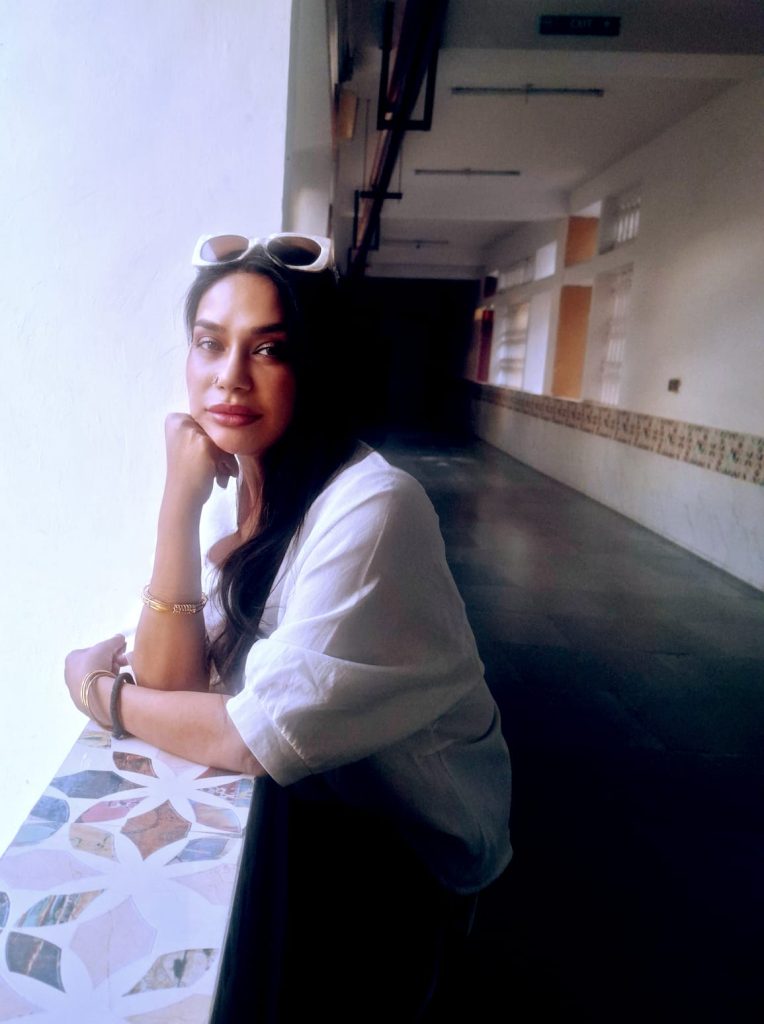
Myna Mukherjee is a cultural producer, curator, and the founder/Director of Engendered, a New York/New Delhi based Transnational Arts and Human rights organisation. LifeStyle Asia magazine lists her as one of the top 5 curators revolutionising the Indian art scene.
She is interested in art curation as a feminist practice, with a special a focus on the intersections of gender and marginalities in South Asia and is a leading curator in art, tech and the AI space. In 2021, she co-curated Hub India, the largest survey exhibition of Indian contemporary art to date with Fondazione Torino Musei, and Artissima, Italy’s most pivotal art fair. She has curated India’s first solo show on Artificial Intelligence (AI) art that was hailed by the MIT Media Lab as one of the best designed AI shows in the world.
Myna left a successful career on Wall Street, to produce and curate the best in contemporary South Asian art, cinema and performance festivals in New York. Her curatorial credits include Lincoln Center, Asia Society, Tribeca Film Center, Queens Museum, and others. She has co-curated and co-produced a film, SAMA, Symbols and gestures in contemporary art Italy and India.
In 2025, she curated and produced one of India’s largest multi-disciplinary art exposition exploring notions of home, migration, gender, race and memory across mediums and aesthetics for the leadership of the MOMA in association with the British Council and Australian High Commission, spanning three of India’s most prestigious venues in the nation’s capital.
In January 2026, she curated Inheritances of Light, Geographies of Loss, in association with the Embassy of the Netherlands. Conceived for a Dutch cultural delegation, the exhibition explored light as a cultural inheritance, connecting figures such as Rembrandt and Johannes Vermeer with Raja Ravi Varma and contemporary Indian artists, and couturier JJ Valaya, exemplifying her approach to ambitious, globally engaged curatorial practice.

Contributor