On February 24, the art world marks the birthday of Winslow Homer, an artist whose work continues to feel startlingly alive more than a century after his death. Born in 1836, Homer painted oceans, wars, and solitary figures with an honesty that resists nostalgia. His seas were never just blue, his landscapes never just beautiful—they were spaces of tension, endurance, and reflection. Today, as younger generations grapple with environmental anxiety, isolation, and shifting social realities, Homer’s paintings have found renewed relevance. His work does not offer escape from the world, but a deeper way of seeing it. On his birthday, revisiting Homer is not simply an act of historical remembrance, but a recognition of an artist who still speaks to the emotional and psychological conditions of the present.

The Use of the Colour Blue in Winslow Homer’s Paintings
The colour blue falls in the cool range of colours. It is supposed to ease the eyes, offering a sense of comfort and calmness. At least, that is what it does in theory and in isolation from context. The blues in Winslow Homer’s seas, however, have far more to say. They are not passive or soothing—they are alive, unpredictable, and psychologically charged. Homer’s blues carry tension, depth, and uncertainty, inviting viewers not into calm waters, but into confrontation.
Homer’s art was deeply inspired by nature and the rural surroundings of his upbringing. His luminous views transport viewers to the rugged Maine coast, the Adirondack Mountains, seaside England, and sun-drenched Caribbean waters. He used water not only as a subject but also as a medium. His watercolor techniques were passed down from his mother, an accomplished amateur watercolorist and his first teacher. They shared a close relationship throughout their lives, and Homer inherited not only her artistic skill but also her quiet strength, restraint, and perceptive sensitivity.
His introduction to watercolor coincided with the development of the American Society of Painters in Water Color, whose exhibitions helped establish watercolor as a serious artistic medium. Characterized by transparency, washes, and subtle color gradations, watercolor allowed Homer to explore fluidity and emotion in new ways. He adapted the English watercolor tradition to American subjects, capturing landscapes with immediacy and honesty. Through this medium, Homer gained greater confidence in his use of colour, allowing shades and emotions to blend with natural ease. His blues were never static; they shifted, deepened, and breathed.
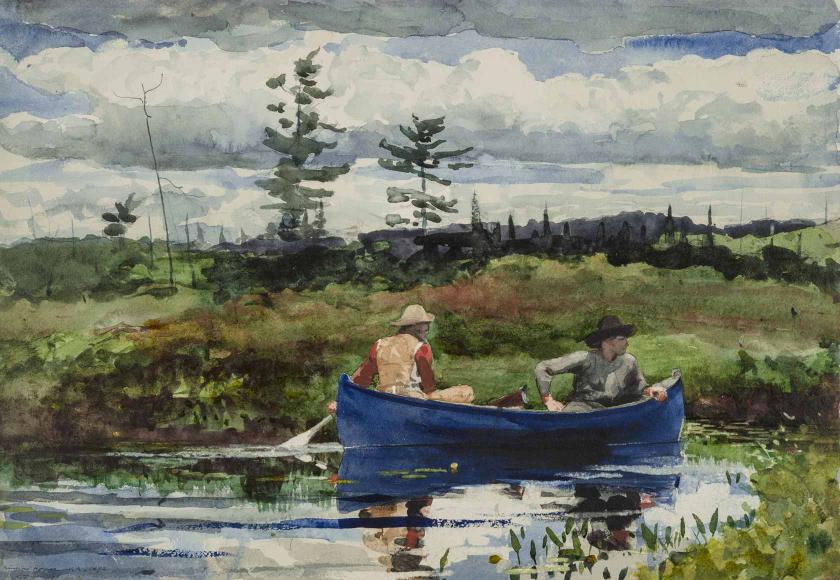
The Blue Boat (1892)
Nature and Landscape: Painting the Living World
Homer gifted viewers with dynamic depictions of nature’s power and beauty. “I prefer every time a picture composed and painted out-doors,” he stated in Art Journal (1880). “Out-doors you have the sky overhead giving one light… so that, in the blending and suffusing of these several illuminations, there is no such thing as a line to be seen anywhere.” This philosophy shaped his entire artistic practice.
Even after living in New York, Homer continued to dream of rural landscapes. His emotional longing for nature, away from urban noise, is evident in his paintings. His ability to paint outdoors translated into the brightness and vibrancy of his watercolors. An early critic observed how Homer “grabs nature and dabs her on his paper” (New York Evening Mail, 1874), capturing not just scenery but experience itself.
In these works, Homer repeatedly brings humans and nature into direct relationship. His paintings remind us that humans do not exist separate from nature, but within it. This connection is perhaps why younger audiences today find his work so compelling. In the rush of contemporary life, Homer’s paintings offer a rare pause—a moment to observe, reflect, and exist quietly.
After leaving England, Homer continued to explore the perils of the sea throughout his career. The timeless struggle between humans and nature became a constant theme, particularly during his later years at Prouts Neck, Maine, where the ocean became both subject and companion.
War, Race, and the Aftermath of Revolution
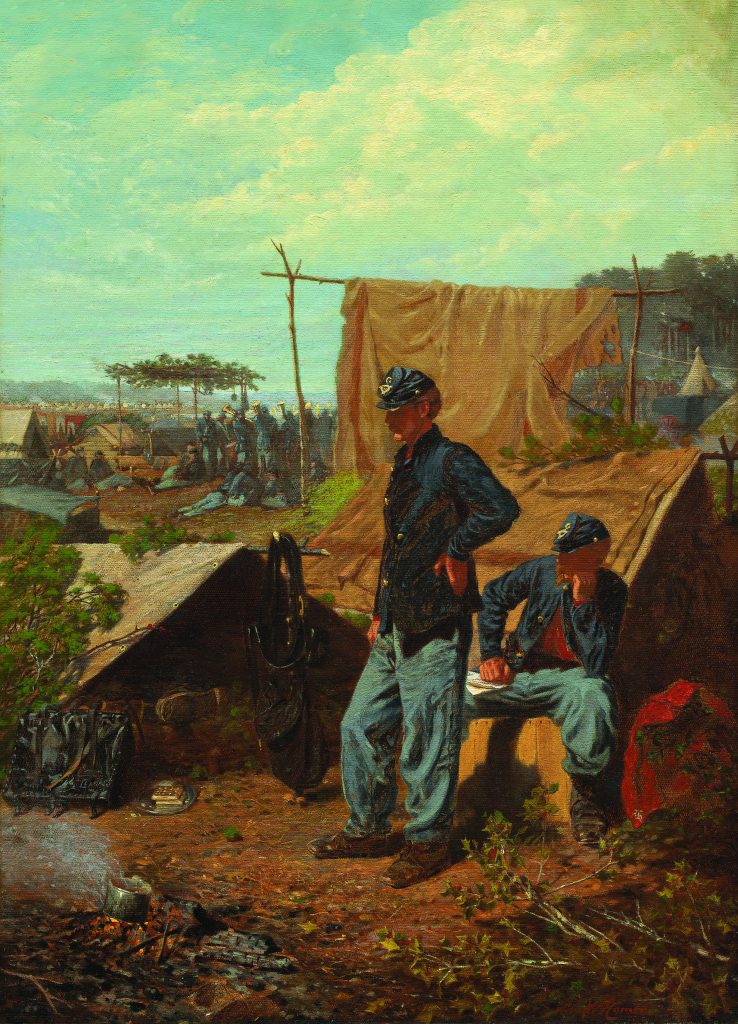
Before fully turning to landscape and marine painting, Homer worked as an illustrator for Harper’s Weekly during the American Civil War. His images documented not the spectacle of battle, but its emotional aftermath. Paintings such as The Veteran in a New Field (1865) depict a former Union soldier returning to agricultural labor, his military jacket set aside. Rather than glorifying victory, Homer presented war as a rupture in ordinary life. According to the Metropolitan Museum of Art, his postwar works explored recovery, reintegration, and the quiet psychological consequences of national conflict.
Homer was also among the first major American artists to depict the lives of newly emancipated Black Americans during Reconstruction. His painting A Visit from the Old Mistress (1876) presents a tense encounter between formerly enslaved women and their previous enslaver. There is no resolution—only emotional distance and quiet resistance. The Smithsonian American Art Museum notes that Homer’s work revealed the unresolved realities of freedom, power, and racial inequality. His paintings did not present emancipation as an endpoint, but as an ongoing social and psychological transformation.
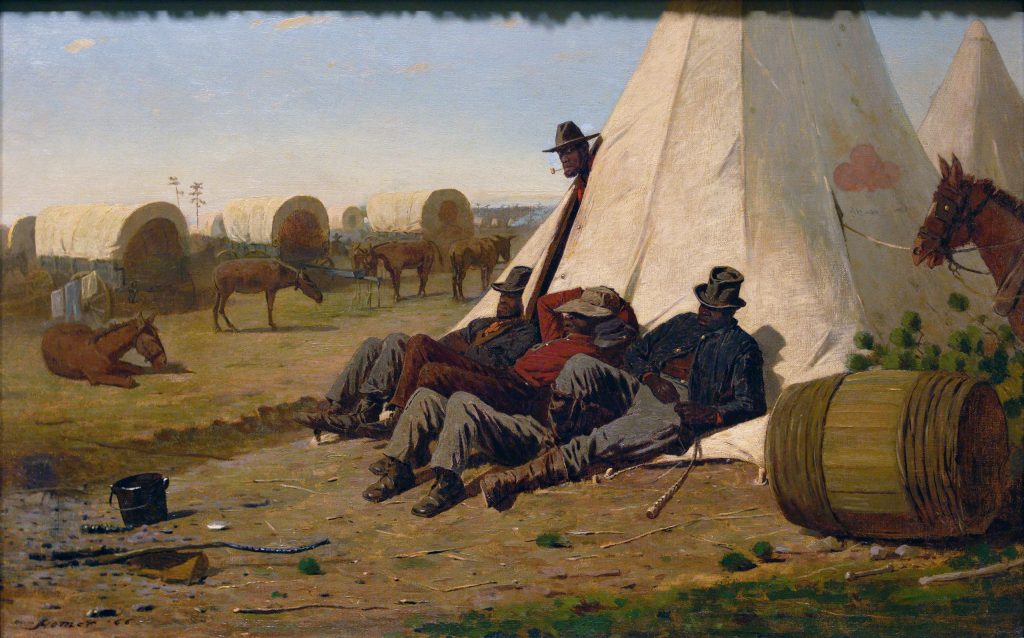
The Bright Side (1865)
Through these works, Homer became an artist of revolutions—military, social, and emotional. His paintings captured moments when identities and nations were being redefined.
Solitude, Isolation, and the Sea
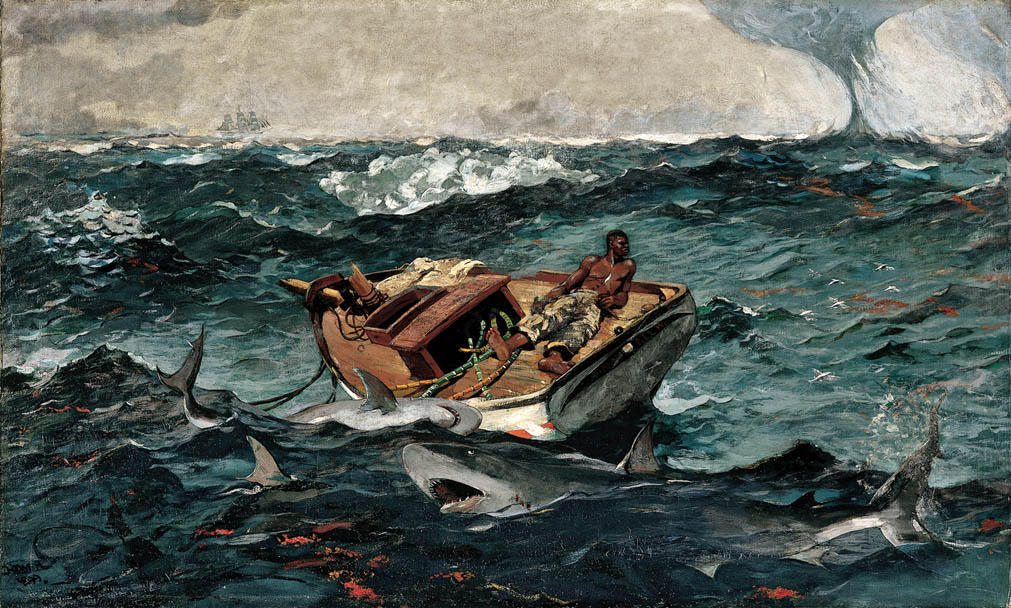
The Gulf Stream (1899)
In the late 1870s, Homer became increasingly reclusive, withdrawing from urban life and settling in coastal environments such as Gloucester and eventually Prouts Neck. There, he lived close to the sea, observing fishermen, storms, and shifting weather patterns. His work shifted in tone, focusing on endurance, isolation, and survival.
His pastoral calm gave way to images of struggle and resilience. Critics noted this transformation, recognizing a deeper emotional and artistic maturity. Living in near isolation, Homer found clarity. The sea became his constant subject and companion. He lived simply, painting until his death in 1910.
This solitude allowed Homer to develop a uniquely powerful artistic voice. His paintings no longer reflected national identity alone, but universal human experience.
The Artist Who Still Speaks to Us
Winslow Homer’s work endures because it speaks across time. His blues are not merely colours, but emotional landscapes. His oceans are not backgrounds, but living forces. His figures do not conquer nature, but exist within it. His paintings of war do not celebrate victory, but acknowledge survival. His depictions of race do not resolve conflict, but preserve its tension.
For contemporary audiences—especially younger viewers navigating uncertainty, isolation, and environmental anxiety—Homer’s work feels strikingly familiar. His paintings offer not escape, but recognition.
As curator Sylvia Yount observed, “There is a different Winslow Homer for every age.” Today, he remains an artist not of the past, but of the present—one whose winds and waters continue to reflect the emotional and existential realities of our time.
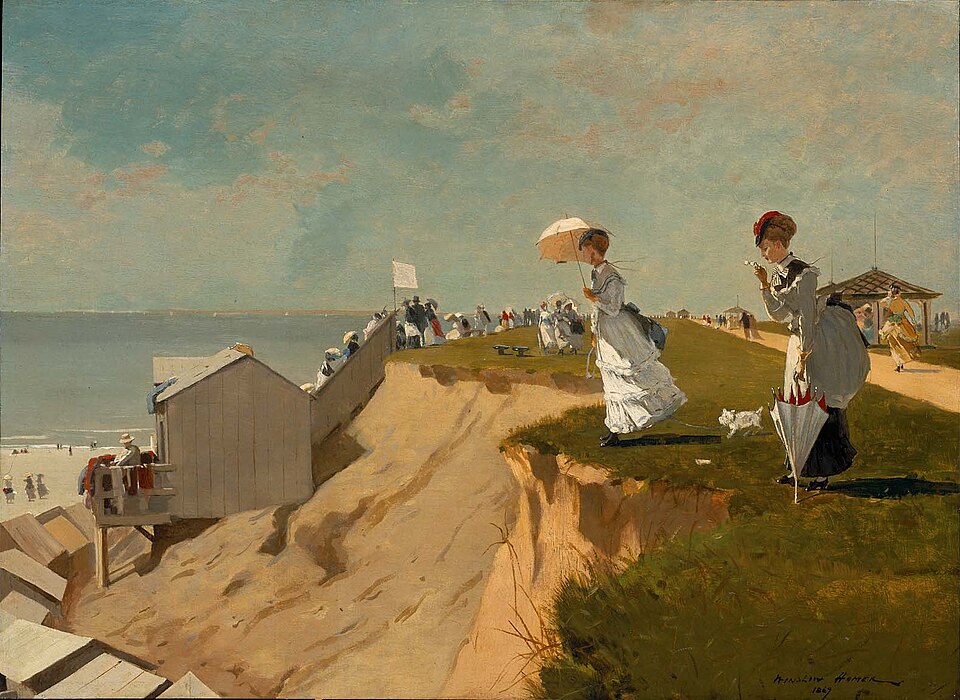
Cover Image: Long Branch, New Jersey (1869)
References
- https://www.metmuseum.org/art/collection/search/11147
- https://www.nga.gov/educational-resources/uncovering-america/civil-war-and-its-aftermath#a-section-header-p112361

Aditi Shah Kunjam. An aspiring psychologist, storyteller and poet from the Gond tribal community. Exploring emotion, identity, and culture through a creative lens. I write about art as experience—where aesthetics meet feeling, feminism, and everyday life. Observing deeply, creating thoughtfully, and finding meaning in the details.