The visual poems of sculptor Ranjani Shettar, a notable Indian artist, advance India on the international scene at the 2026 Venice Biennale. Drawing on customs, materials, and natural language, Shettar’s art offers a distinctively Indian yet global language of art that is sustainably created.

Born in 1977, Ranjani Shettar earned her BFA (1998) and MFA (2000) degrees in sculpture from the Karnataka Chitrakala Parishath. She has gained recognition as a gifted sculptor over the last 20 years. With pieces at museums including the Kiran Nadar Museum of Art, the Metropolitan Museum of Art, the San Francisco Museum of Modern Art, and the Museum of Modern Art, she has achieved international fame. Shettar’s inclusion in the Venice Biennale offers an opportunity to reflect on her continued interest in materials, embodied craft, and ecological theory.
Material as Metaphor
Shettar creates sculptures that occupy the tense area between direct representation and pure abstraction. Her statement, “As an artist, when you make something, the material becomes a metaphor too,” encapsulates the guiding concept of her work. Beeswax, repurposed wood, muslin, steel, organic dyes, vegetal pastes, cotton threads, lacquer, and other organic and industrial materials are all carefully and tactilely explored in her unique method. Rarely does Shettar cover up the natural roughness of these materials; instead, she lets their flaws and histories do the talking.
As Abirpothi noted, the artist deliberately leaves remnants of each element’s “past form” behind. Reclaimed teak is more than just wood; it bears the wear and tear, weathering, and life of its former use. Shettar creates works that incorporate the material world and its ghosts, present and memory, by keeping these markings intact.
Her 2005 piece A little more, which is now part of the Museum of Modern Art’s permanent collection, is representative of this delicacy: cotton threads threaded with hand-moulded wax beads. Similar to this, Seven Ponds and a Few Raindrops (2017), which is constructed from stainless steel wrapped in muslin stained with tamarind, generates a choreography of light and shadows—an “amoebic structure,” as it is called—that captivates onlookers with its subtle atmospheric presence.
An Ecological Imagination
Shettar’s work is sometimes described as ecological, not just because she uses visual references to nature, but also because her approach is environmentally conscious. Her choice to create a zero-waste studio in Malnad, Karnataka, was motivated by her move from Bengaluru, which is gradually becoming more urbanised. “When we do everything ourselves, there is a different kind of understanding about the amount of resources we are taking from the land,” she clarified in her Vogue interview. “What do we give back?” Her sculptural language and material choices are both influenced by this ethic. Though always through abstraction rather than imitation, Shettar’s artwork evokes seed pods, tendrils, leaves, bird wings, constellations, and cloud patterns. Nature is a place where we are born and a way of life, not just a motif.
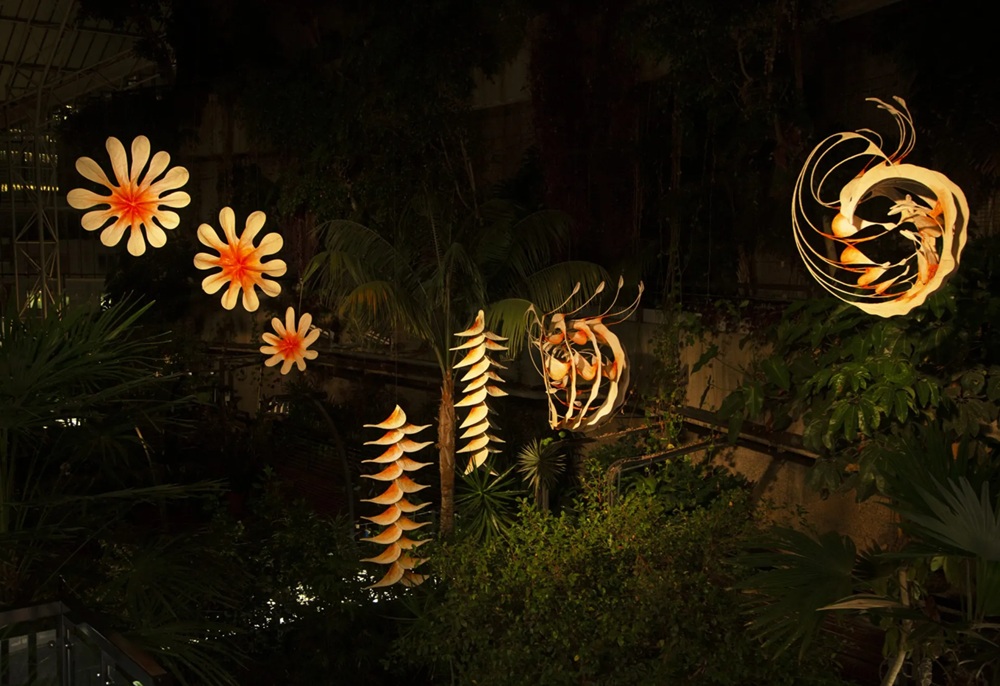
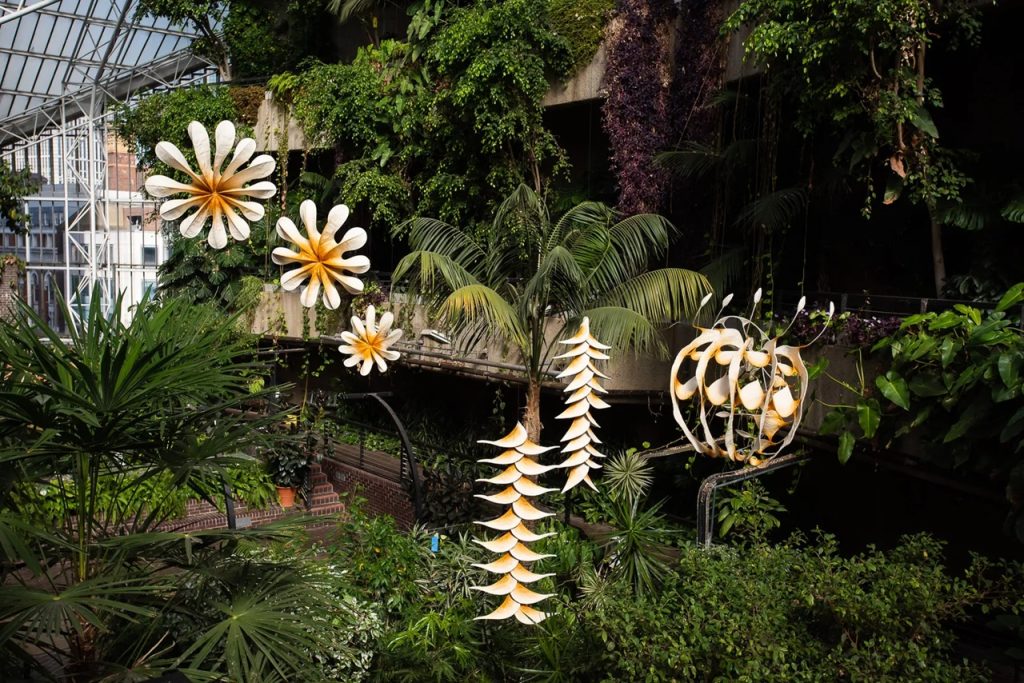
Shettar wrapped steel in muslin dyed with madder root to create sculptures that hung among 1,500 plant species in her installation Cloud Songs on the Horizon at the Barbican Conservatory, which was displayed in collaboration with the Kiran Nadar Museum of Art. “Where nature ends, and art begins,” visitors said, describing the strange feeling, according to Vogue. Shettar was the first Indian artist to exhibit a significant solo project at the Barbican Conservatory, making the work even more historic.
Dialogue with Craft Traditions
Shettar’s sensibility is clearly rooted in Indian craftsmanship, even though her work echoes Western traditions of minimalism, post-minimalism, and abstraction. In an interview that was published in Part of It: A Conversation with Ranjani Shettar, she clarified that she regularly researches and modifies methods that have been handed down “from generation to generation.” These include techniques for treating organic materials, wood carving, natural dyeing, and manipulating textiles. As a result, her relationship with material is both cultural and ecological. According to her, methods that develop via craft traditions “refine themselves over time,” attaining a level of knowledge that modern sculpture might benefit from.
Critical Perspectives and Global Recognition
Prominent foreign critics have praised Shettar’s writing. The New York Times’ Holland Cotter described her “transubstantiated modernism,” in which “local nature and culture have their way.” Shettar’s use of salvaged materials and her defiance of the strictures of modernist art history were commended by David Frankel, who wrote for Artforum: “Her work…constitutes its own delighted exploration of materials and space.”
Shettar grounds her practice on endangered natural areas and tackles the ecological and social effects of Indian urbanisation from “the vantage of non-figurative art,” according to Devika Singh of the Tate Modern. Together, these viewpoints position Shettar as an Indian ecological artist and a global modernist who uses material imagination to bridge and see the worlds.
The Artist in Context
Shettar’s “lace-like structures” that “defy gravity,” which explore impermanence and the interdependence of living things, are highlighted by Helen James, Nicholas Grey, and Mei Wang in their commentary on Shettar’s work (Design-Encyclopedia). Nicholas Grey highlights her immersive creations that manipulate space itself, often creating floating landscapes from jute, paper, stone, and natural fibres. Mei Wang highlights her expansive installations that combine traditional materials with contemporary media, like Gita Vatika and Women from the Garden. These evaluations support Shettar’s standing as a prominent modern sculptor whose work pushes the limits of form, material, and environmental awareness.
Working with Light, Space, and Rhythm
Light is essential to Shettar’s art; it is not merely a supporting element. When talking about the Barbican Commission, she said that light is a “critical part of sculpture-making.” Since there were no deep shadows in the glasshouse setting, she changed her shapes to reflect light rather than block it.
Her sculptures frequently float, hover, and stretch across space like webs or stars. Their rhythmic unfolding requires slow viewing, akin to meditation. “I am thrilled if people can pause and look,” she stated in Part of It. You will take care of anything you adore. In a society where velocity rules, this deliberate attentiveness is arguably one of Shettar’s most urgent gestures—a cry to calm down.
Toward the Venice Biennale 2026
Since India has only attended the Venice Biennale sporadically rather than consistently, each national representation is noteworthy. The country’s dedication to exhibiting artistic forms grounded in ecological consciousness, material innovation, and intellectual rigour is demonstrated by Shettar’s selection.
Her involvement in Venice will broaden her current investigations into plants, the environment, and crafts, placing them in the context of international discussions on climate change, sustainability, and the role of craft in modern art. Ranjani Shettar embodies ‘India’ profoundly, which nature is not separate from us, that materials hold memory, and that slow attention is an ethical practice.
Ranjani Shettar’s unbending dedication to craft, ecology, and material poetry has defined her trajectory, and we can see that her presence at the Venice Biennale in 2026 is more than just a personal achievement. In this cultural event that demonstrates the richness, complexity, and international significance of modern art, Ranjani Shettar presents her myriad body of work, grounded in land, craft, care, and imagination. That would show a picture of a time when art engages with nature’s rhythms, ethics, and sanctity rather than merely portrays them.
Feature image: Installation view of Cloud songs on the horizon, Barbican Conservatory, 2023–24. Photo: © Ranjani Shettar, Talwar Gallery, Courtesy Barbican Centre, KNMA, Ranjani Shettar, Talwar Gallery, New York | New Delhi
Krispin Joseph PX, a poet and journalist, completed an MFA in art history and visual studies at the University of Hyderabad and an MA in sociology and cultural anthropology from the Central European University, Vienna.