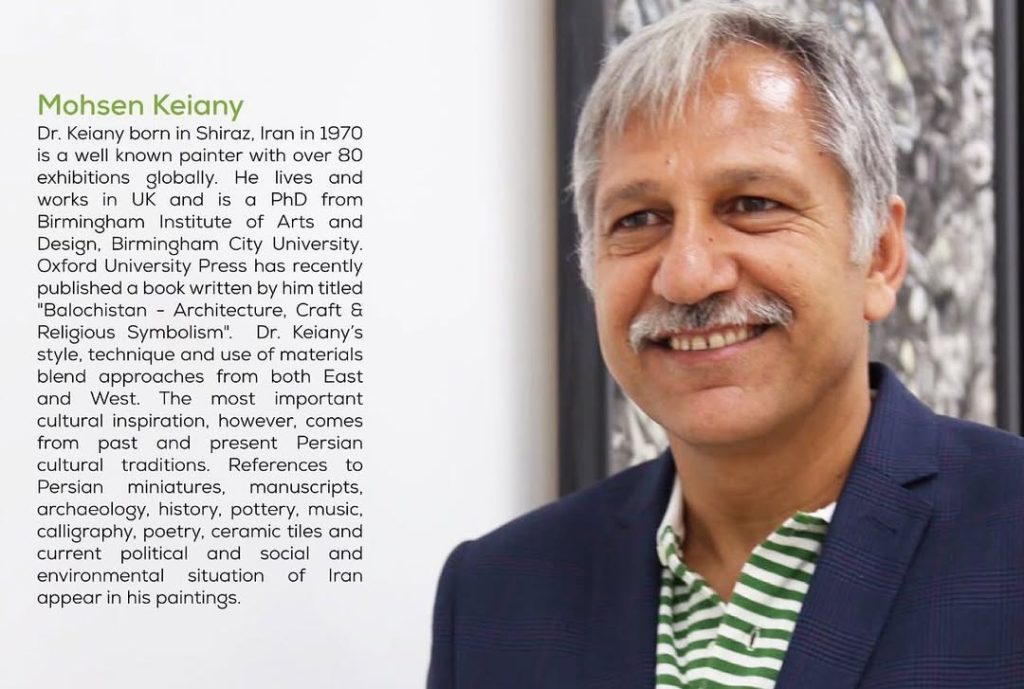
In the context of ongoing wars, there is a need to explore how artists in war-affected areas perceive and represent war. Iranian artist and academic Mohsen Keiany has been living abroad in European countries for the past one and a half decades, having left his home country, Iran.
Mohsen Keiany, on the other hand, faces conflict head-on. Keiany’s artwork is inextricably linked to his personal suffering as a former child soldier in the Iran-Iraq War. “I wanted people to see the ugliness of war” is the moral imperative that motivates his work.
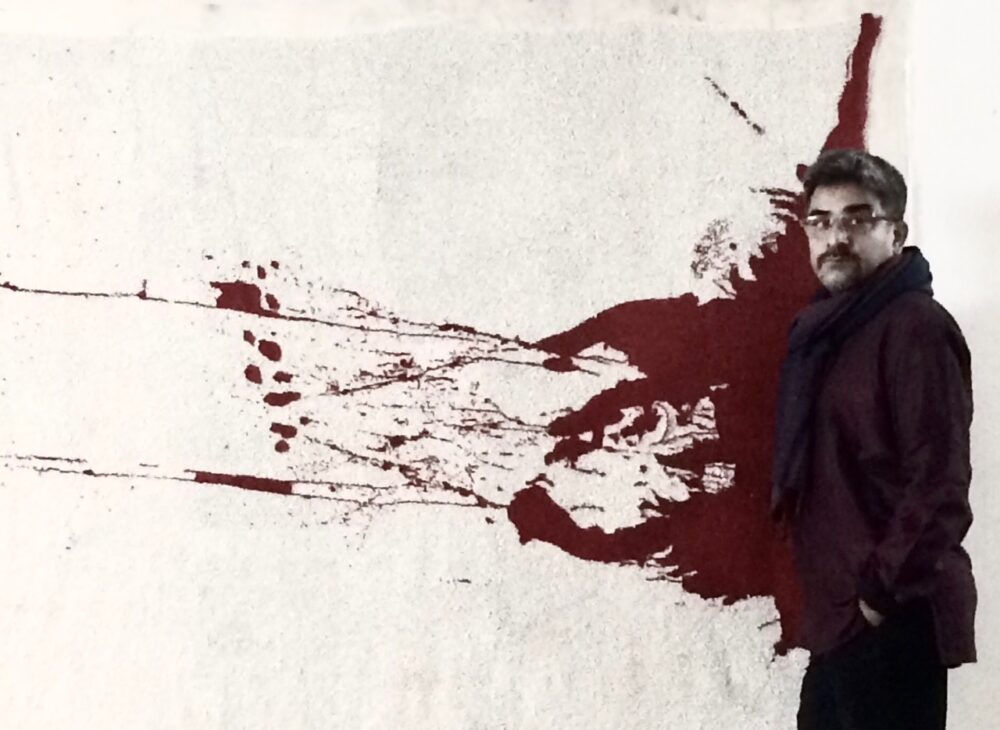
Battlefield experiences are translated into an eerie visual language in Keiany’s 2019 collection, Desensitised, and subsequent pieces. Rusted browns and greys are metallic colour schemes that evoke deterioration and mechanisation. His use of scrap metal alludes to the deterioration of humanity and of weapons. His paintings frequently feature dehumanised figures that have been turned into “killing machines.” This illustrates the psychological damage caused by extended exposure to violence.
Against the backdrop of war, Mohsen Keiany talks about his own art and artistic practices during wartime.’
Q: You were enlisted as a child soldier during the Iran–Iraq War. How do those early experiences continue to shape your artistic practice today?
Mohsen Keiany: My early experiences of war are not something I look back on. They continue to shape how I see, remember, and make. My work is less about representing those events directly and more about working through their residue: in material, in fragmentation, in repetition. Painting becomes a way of engaging with memory that is neither linear nor fully accessible, yet still present.
Q: Your work often speaks of a “moral imperative” to reveal the ugliness of war. Do you see your art as a form of testimony, protest, or something else entirely?
Mohsen Keiany: I am not keen on attaching any label to my artwork. My practice doesn’t really behave like a single category. If anything, it sits in the tension between them.
Maybe testimony feels closer to my starting point. Having witnessed war firsthand, my work carries a sense of bearing witness, not as objective documentation, but as lived, embodied knowledge. Like Francisco Goya in The Disasters of War, the force comes from insisting that something seen cannot be unseen. But my work complicates testimony because it isn’t just a recording. It is filtering through memory, material, and time.
Protest, perhaps, is less directly on my painting. I am not producing slogans or explicit political messaging. Instead, the protest is embedded in how I represent violence in my art. I see my work as a form of witnessing that moves between testimony and protest. It’s driven by a moral imperative to confront the realities of violence, but also to question how those realities are seen, remembered, and processed. Rather than offering resolution, the work holds viewers in a space of tension—between recognition and discomfort, distance and implication.
Q: In series like Desensitised, you depict figures as dehumanised “killing machines.” How do you approach representing violence without reproducing its harm?
Mohsen Keiany: That is a real challenge, and I cannot eliminate it completely. I can only handle it consciously in my artwork. In fact, any depiction of violence can risk repeating some aspect of it. The difference lies in how the artwork positions the viewer in relation to what they are seeing.
With my Desensitised series, the idea of figures as “killing machines” already points to a critical stance. I am not celebrating violence; I am exposing a loss of humanity. The challenge became how to make that legible without letting the image slip into spectacle or numb repetition. Instead of focusing on the act of violence itself, I emphasised what it does to bodies, to perception, to identity. Dehumanisation can be conveyed through fragmentation, repetition, or mechanical rigidity rather than explicit action. This keeps the focus on the state rather than the event.
In brief, I am not interested in reproducing violence as spectacle. In Desensitised, the figures are stripped toward a mechanical state to reflect processes of dehumanisation, but the work resists complete detachment. Through fragmentation, material tension, and interruption, I’m trying to create a space where the viewer confronts the condition of violence rather than consuming its image.
Q: Your painting, The Motherland, presents faceless soldiers as spectral presences. What does anonymity mean to you in the context of war and memory?
Mohsen Keiany: My painting, The Motherland, reflects the message of many young Iranians who have lost, and are still losing, their lives in the streets of Iran. I was not there to help them, to dress their wounds, to hold their families, or to offer my condolences. I was far away, alone in my studio, crying silently in the UK. Yet my heart and mind were with them in the streets. I promised myself to become their voice through my art. This painting is my attempt to bear witness and to record the horrifying reality of the present history of my motherland
Q: You often integrate elements from the Shahnameh into contemporary war imagery. What draws you to the collision of ancient myth and modern conflict?
Mohsen Keiany: What I have brought to my artworks is not just a stylistic combination; it is a way of collapsing time so that past and present begin to speak to each other. The Shahnameh is full of cycles such as heroism, betrayal, war, loss, and the fragility of power. When I bring those elements into my contemporary conflict imagery, I am not just referencing heritage; I am suggesting that what we call “modern” violence is not entirely new. It echoes older human patterns.
Figures and narratives shaped by Ferdowsi carry an archetypal weight. Heroes, tyrants, tragic fathers and sons, they aren’t fixed in one time period. When they appear alongside modern war imagery. Conflict has always been part of human history, but these stories of Shahnameh are morally layered, not simplistic. There is also a tension between myth and reality. Myth tends to structure violence; it gives it a narrative, meaning, sometimes even a sense of inevitability or destiny. Contemporary war, especially as experienced firsthand or through media, often feels chaotic, senseless, and unresolved.
Q: Having witnessed war firsthand, how do you respond to the way contemporary art represents violence and conflict?
Mohsen Keiany: I feel I am in a position that’s both powerful and difficult. I have lived what much contemporary art only references. That creates a gap I will inevitably notice and perhaps feel compelled to respond to.
One honest starting point is to acknowledge that not all representations of violence carry the same weight. Much contemporary work circulates through images, media, and secondary accounts. My experience gives me a different kind of authority, but also a different set of responsibilities. The question is not just what is being shown, but how and from what distance.
Many contemporary representations of conflict are shaped by screens, archives, or news cycles. I can position my work as resisting that distance not by claiming absolute truth, but by insisting on embodiment, materiality, and consequence. My use of texture, weight, and process already does this. There is a real tension in how violence can become visually compelling, almost seductive, in art contexts. Having witnessed it, you may feel the need to push back against that. Not by avoiding beauty entirely, but by making it uneasy, interrupted, or ethically complicated. Contemporary art often focuses on the moment of explosion or spectacle. My perspective might shift attention to aftermath, residue, memory, and survival. the slower, less visible dimensions that persist long after the event.
Having witnessed conflict firsthand, I am aware of the distance through which violence is often represented in contemporary art. My work doesn’t aim to entirely correct that distance, but to complicate it, reintroduce material weight, memory, and ambiguity, and to resist the ease with which violence can become image or spectacle.
Q: You’ve described art as a means of survival. Can you talk about how painting helped you process trauma after the war?
Mohsen Keiany: Painting gave me a visual language before language. Painting became a way for me to process experiences that resisted language. It allowed me to externalise fragments of memory and emotion, to hold them at a distance, and to return to them over time. I don’t see it as a resolution, but as a means of survival, of learning how to live with what remains.
Q: Many of your works use scrap metal and industrial textures. What role do materials play in communicating the psychological and physical residue of war?
Mohsen Keiany: The materials used in my artworks are not neutral. In fact, they are doing conceptual and emotional work before any image is even “read.” Using scrap metal and industrial textures immediately brings in a sense of aftermath. These are materials that feel used, damaged, or repurposed, so they carry an implicit timeline: something has already happened to them. That “something” doesn’t need to be illustrated—they embody it. Viewers register that history physically, not just intellectually.
There’s also a strong link between these materials and the infrastructure of war. Metal, corrosion, weight, sharpness, these echo artillery, machinery, debris, and urban destruction without you having to depict them directly. In that sense, the material becomes a kind of proxy for violence: not an image of it, but a trace of its conditions.
On a psychological level, texture plays a different role. Rough, scarred, or eroded surfaces can mirror states like fragmentation, trauma, or endurance. They resist smooth viewing—you can’t just glance and move on. That resistance slows the viewer down, which is important in a context where, as you mentioned, war is often consumed quickly through screens.
In addition, material interacts with a spiritual dimension. In Sufi-influenced thinking, there’s often an emphasis on stripping away surfaces, confronting the raw, or moving through destruction toward some kind of unveiling. Industrial materials—heavy, grounded, “of the world”—can act as a counterweight to the intangible aspects of spirituality. The dialogue between them prevents the work from drifting into abstraction or detachment.
Q: As both an artist and an academic, how do you navigate the balance between intellectual research and deeply personal experience in your work?
Mohsen Keiany: The tension between intellectual research and my personal art practice is not a problem to solve; they are indeed the engine of my work. My art practice has been and will be my priority forever. I believe pure research can feel over-determined or illustrative, while purely personal work can become cloudy or hard for others to enter. The balance is less about equal parts and more about how they interact.
One way to think, research gives me structure and lineage, while personal experience gives me determination. When they’re working well together, the research doesn’t sit atop the painting as an explanation. It is absorbed into decisions about form, material, rhythm, and symbolism. Artists who move between intellectual and personal registers often let theory operate indirectly.
Q: Your practice bridges Persian traditions and contemporary global concerns. How do you see cultural memory functioning in times of ongoing conflict?
Mohsen Keiany: Cultural memory in my context isn’t just background. It is, in fact, an active force. In times of ongoing conflict, it tends to do several things at once, often in tension with one another.
Drawing on my Persian heritage and traditions, such as miniature paintings, poetry, symbolism, and spiritual frameworks, I have tapped into a lineage that predates current conflicts. Figures like Hafez or Ferdowsi preserved cultural continuity through upheaval. In my work, cultural memory can function similarly: not as nostalgia, but as a reminder that identity is not reducible to present violence.
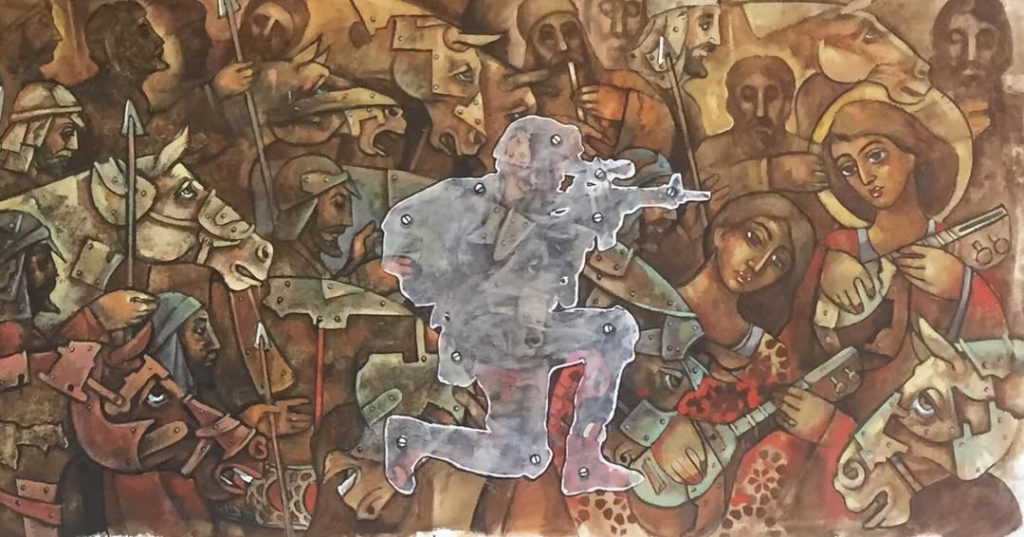
At the same time, cultural memory can complicate the present rather than simply comfort it. Persian visual and literary traditions are rich with ambiguity, beauty intertwined with loss, mysticism alongside political reality. When I bring that into dialogue with contemporary conflict, I resist simplified narratives (good/evil, victim/perpetrator) and instead open up layered readings.
Q: War narratives often oscillate between heroism and tragedy. How does your work challenge or complicate these conventional narratives?
Mohsen Keiany: It depends on how we define Heroism and Tragedy. Heroism focuses on courage, strength, and moral action. A hero is someone who faces danger, adversity, or hardship and acts bravely—often to help others or uphold a value. Tragedy, on the other hand, focuses on suffering, loss, and downfall. A tragedy often involves a character who experiences serious misfortune—sometimes because of fate, a personal flaw, or difficult circumstances. The war is full of tragedies.
Q: In the current global climate of multiple ongoing wars, do you feel your work is being read differently than before?
Mohsen Keiany: It’s very likely—yes. When the global context shifts, so does the way people interpret art. In periods shaped by conflict, audiences tend to read more politically, emotionally, and symbolically. Even work that wasn’t intended as commentary can start to feel like it is. Themes like vulnerability, power, displacement, identity, or even silence can take on deeper meaning when viewers bring their own anxieties and awareness of current events into the experience.
Historically, this has happened again and again. After World War I, art movements became more fragmented and disillusioned. Following the Vietnam War, audiences often read art through a lens of protest or scepticism toward authority. More recently, works have been reinterpreted in light of conflicts like the Russia-Ukraine War or the Israel-Hamas War, even when they weren’t directly about those events.
Q: What matters here is that meaning in art isn’t fixed—it’s a collaboration between what you make and what the audience is living through.
Mohsen Keiany: As an artist, you don’t have full control over interpretation by viewers, but you do have control over how you respond to it—whether by clarifying your intent, letting the ambiguity exist, or evolving your work in dialogue with the moment.
Q: You’ve spoken about spirituality, particularly Sufi influences, in your art. How does spirituality coexist with the violence you depict?
Mohsen Keiany: In fact, they don’t cancel each other out, but they can sharpen each other. In many Sufi traditions, spirituality isn’t about escaping the harshness of the world but about transforming how it’s understood. Think of the writings of Rumi or Al-Ghazali—there’s a constant tension between the material world (often chaotic, painful) and the inner search for unity, truth, or divine presence. That tension is fertile ground for art.
Q: So, when your work brings together violence and spirituality, it can be read in a few powerful ways.
Mohsen Keiany: The violence you depict might represent the external world—fracture, conflict, ego—while the spiritual layer points to something beneath or beyond it. Coexistence creates contrast: the louder the violence, the more viewers search for stillness or meaning within it.
Sufism often speaks about the “greater struggle” (the struggle within the self). What looks like physical or political violence can also be read as symbolic of inner fragmentation—desire vs restraint, ego vs surrender. Your imagery might be externalising that internal battle.
Spirituality doesn’t always “heal” or resolve violence in a neat way. Sometimes it simply holds space for it. Your work might be doing that—refusing to turn away, but also refusing to reduce violence to spectacle. That stance itself can feel spiritual.
Q: For younger generations who encounter war primarily through screens, what do you hope they take away from your work?
Mohsen Keiany: I probably can’t control what they take away, but I can shape the kind of encounter I am offering them. For younger generations who experience war mostly through feeds, clips, and headlines, the risk isn’t ignorance—it’s distance and desensitisation. Violence becomes scrollable, fragmentary, and strangely abstract. My work can interrupt that. So, what I hope they take from it is that the war is not “this is terrible,” but this costs lives. My depiction of ugliness can push against the flattened, almost frictionless way war appears online—reintroducing gravity, duration, and consequence.
Krispin Joseph PX, a poet and journalist, completed an MFA in art history and visual studies at the University of Hyderabad and an MA in sociology and cultural anthropology from the Central European University, Vienna.