In Manjot Kaur’s paintings, the lush, liminal world interprets the Indian miniature tradition and seeks novel ways to present it, producing a new lexicon and visual delight. As we know, painting is the art of seeing, and it enlarges and broadens the viewer’s world when engaged with. This is achieved in Kaur’s painting through translating the artist’s feminist-ecological stance into a work that presents mythologised worlds in which birds, trees, lakes, snakes, and forests are reconfigured beyond strictly biological categorisation and are witnessed as living beings.

In Manjot Kaur’s canvases, the purpose is a forceful recapture of the body as ‘fabulation’. As Deleuze argues, this gives marginalised voices—both human and non-human—the opportunity to express themselves and regain agency. This creative approach initiates easily interpreted paintings with numerous undercurrents by fusing myth, ecology, and feminine embodiment to imagine new kinds of kinship between species. Instead of recounting ancient myths, it creates new worlds in which animals, birds, and elemental elements communicate through altered bodies. Fabulation becomes a speculative and political weapon that questions prevailing narratives, blurs the lines between fact and fiction, and reimagines reality through feminist and posthumanist viewpoints, and more than just imagination or “make-believe” in the context of Manjot Kaur’s artistic vocation.
Instead, they serve as a means of imagining “what if” scenarios that contradict the ecological and gendered reality of today. Manjot Kaur creates a new mythology by depicting women whose reproductive systems either blossom into exotic flowers or merge with the anatomy of birds. These are not monsters; rather, they are “fabulated” representations of a culture that regards nature as a peer rather than an exploitable resource. Through the creative process termed Fabulation, Manjot Kaur depicts everything in contrast to straight storytelling, creating new worlds, viewpoints, and opportunities to challenge accepted facts rather than depicting the world as it is.
In Abirpothi’s interview series, artist Manjot Kaur discusses her artistic life and her art.
Your work engages deeply with the idea of fabulation. How do you see fabulation functioning within your paintings—as a political gesture, a myth-making tool, or a speculative feminist strategy?
Fabulation, for me, is all three — a political gesture, a myth-making tool, and a speculative feminist strategy — and I don’t think those can be cleanly separated.
At its core, fabulation is the act of world-making. It doesn’t describe the world as it is; it invents new worlds in order to question the ones we’ve inherited. In my paintings, this means taking figures like Yoginis, Yakshinis, Kuldevis, and the Ashta Nayikas from Indian mythology and ancient literature, and imbuing them with fiction — not to retell their stories faithfully, but to re-story the world through them. These paintings become visual fabulations: narratives that move between history, mythology, animism, and ecological crisis to imagine futures rooted in interdependence and symbiosis.
Philosophically, I’m drawn to how Deleuze understood fabulation — as a form of resistance against dominant narratives, whether colonial, patriarchal, or anthropocentric. In that sense, my use of fabulation is deeply political. When I paint hybrid deities in which the boundaries between human, animal, and plant dissolve, I am pushing back against the hierarchy of being — against the idea that the human is the only legitimate protagonist of history or the future.
Fabulation is also a feminist and ecological method. In the Chthonic Beings series, for example, fabulation allows me to envision new cosmologies where birds, animals, and elemental forces speak through transformed bodies — where myth becomes a language of repair, resistance, and reciprocity. These are not escapist fictions. They are speculative ecologies. The Chthonic Beings are fictitious, yes, but through them I am imagining a world where mythic figures act as ecological diplomats — holding space for non-human voices to be heard, to convene, to matter. Fabulation occupies the space between documentary and dream, between the sacred and the profane. It allows me to sustain ambiguity and abstraction as tools — not as evasions of
meaning, but as openings toward meaning that rational language often forecloses. Through fabulation, I am rewilding the imagination and asking what forms of kinship, governance, and becoming might be possible if we let myth lead us there.
Many of your hybrid beings merge human reproductive systems with botanical or avian forms. What motivated this reconfiguration of the female body, and what conversations around body politics do you hope it opens?
The reconfiguration of the female body in my work is, at its core, a refusal — a refusal of the ways in which women’s bodies have historically been controlled, classified, and contained. And this is not merely historical. It keeps on going. It is alive in workplaces and in everyday conversations, in the negotiations women make about their time, their bodies, their choices, and their silence. From there it echoes outward into every nuance of life— into law, into land, into who gets to speak and who is asked to wait. My paintings sit with that continuum of control and refuse it.
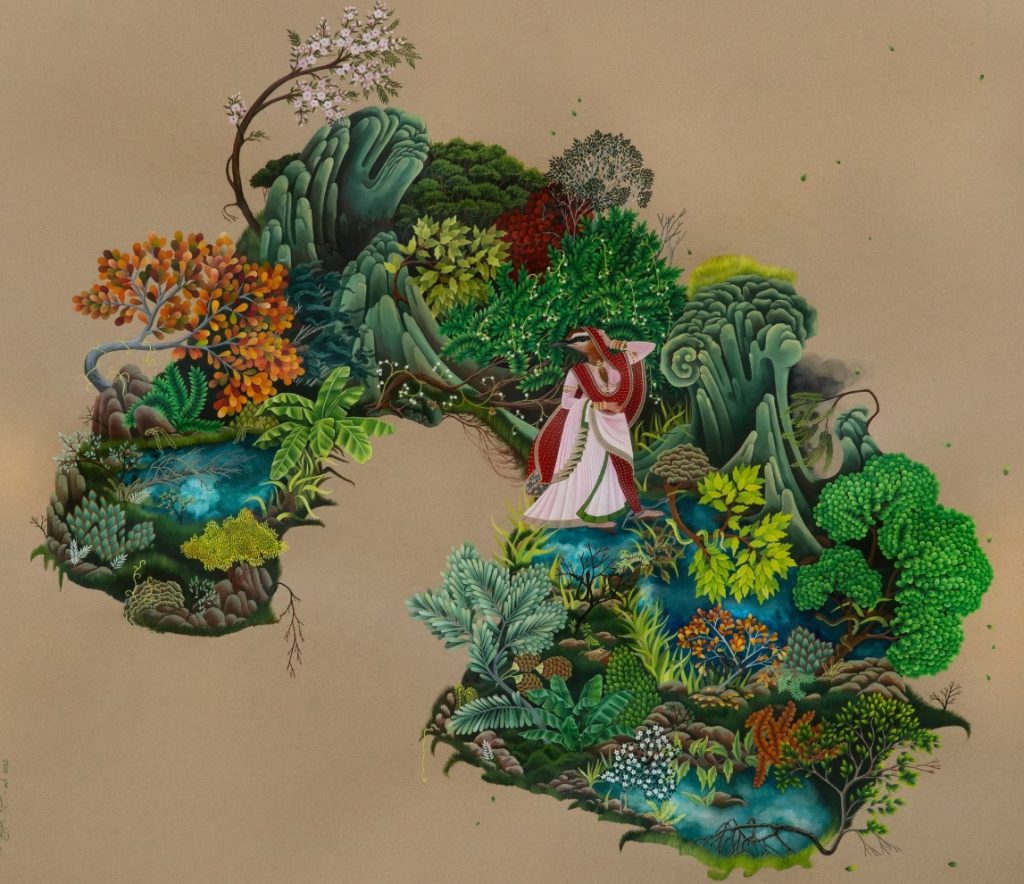
Across my practice, I am constantly moving between ancient history and contemporary feminist thought simultaneously — merging human identity with avian forms, and drawing on both pre-patriarchal cosmologies and rigorous theoretical frameworks to do so. I look to ancient hybrid goddesses who already embody this convergence — Lajja Gauri from Indian tradition, and Wadjet and Taweret from Egyptian mythology — beings who are already non-human in their form, already associated with fertility, protection, and generative power, and whose creative force was never purely human but cosmic, ecological, creaturely. At the same time, my paintings move alongside texts by contemporary feminist and ecofeminist thinkers such as Donna Haraway, Carolyn Merchant, Maria Mies, Vandana Shiva, Robin Wall Kimmerer, Daisy Hildyard, and Ursula K. Le Guin, among others. Their texts provide the theoretical scaffolding for what the images intuitively do. Together, the ancient and the contemporary form a kind of
double archive that is polytemporal, with species egalitarianism at its core: one reaching back to pre-patriarchal cosmologies where the female body was already more-than-human, and the boundaries between species were fluid and sacred, and the other offering rigorous frameworks for understanding why reclaiming that expansiveness — that egalitarianism between human and non-human life — matters so urgently right now.
From that foundation, I made a deliberate conceptual shift: rather than painting figures who bring forth human life, I imagined beings who bring forth ecosystems. This came from a very specific awareness of the imbalance between human and non-human populations — the fact that we are in the midst of a sixth mass extinction, that species are disappearing faster than they can be named, while the human population continues to expand and consume. In that context, centring human reproduction felt not only politically fraught but ecologically irresponsible. So the body in these paintings becomes a site of a different kind of generativity — one oriented toward wilderness, toward the restoration of fragile habitats, toward the regeneration of what we are losing.
When women shed their human heads and take on the visage of endangered birds, I am proposing that identity is not fixed, that the boundary between human and non-human is not sacred, and that women’s bodies and lives need not be defined by their place within patriarchal, religious, or nation-state structures. The Ashta-Nayikas of Hybrid Beings are released from their traditional relational bind to a human male lover and are instead entangled with endangered species — their desire becomes ecological, their grief becomes environmental.
Indian miniature painting is a key anchor in your visual language. How do you navigate the tension between honouring this lineage and radically disrupting its patriarchal foundations?
My relationship to Indian miniature painting is not one of replication or strict technical adherence — it is one of deep looking, critical dialogue, and contextual transformation. I work from within this lineage and expand it, drawn not to the technique in its orthodox sense, but to the visual logic and the symbolic vocabulary these paintings carry.
Moving comparatively across the Pahari, Mughal, Rajput, and Deccan traditions, I take references and consistently change their context — removing backgrounds, reorienting compositions, and rebuilding the colour world of each painting around the specific palette of the endangered bird I am representing. If I am painting a Steppe Eagle, the colours of that bird’s body become the chromatic logic of the entire work. The painting’s atmosphere, its emotional register, its palette — all defer to the non-human life at its centre. This is itself a disruption: in the classical miniature tradition, colour served the court, the patron, the human drama. In my work, it serves the bird.
This disruption extends across my practice in different ways. In Portrait of Trees, I take direct reference from Mughal miniature portraits — paintings in which kings and princes are depicted in grand architectural settings — and replace the ruler with a tree. The tree becomes the protagonist, acknowledging plant intelligence and giving voice to the botanical world. These works champion granting personhood to flora, challenging the prevailing patriarchal attitude toward ecology and asking: what kind of world would we inhabit if trees were the rulers and kings?
What I do consciously preserve is the intimate scale, the detailed botanical and natural elements, and the layering of colour — because these qualities are not incidental to the miniature tradition, they are political. The intimate scale demands that the viewer come close, slow down, and spend time. It refuses the spectacle of large-scale painting and instead insists on a quiet, sustained attention, which is exactly the kind of attention I want viewers to bring to endangered species and fragile ecologies. The botanical detail, so characteristic of Pahari and Rajput painting, especially, already positions the natural world as worthy of careful observation and devotion. I inherit that devotion and redirect it — but for me, the botanical world is not backdrop or decoration. It is a world of living creatures. When I add flora around my figures, I research it specifically based on the bird I am representing’s habitat. It begins in that ecological truth and then, from there, it sometimes travels into fiction — becoming more fantastical, more speculative, reaching toward a world that does not yet exist but that the painting is trying to imagine into being.
But the tradition also carries the weight of its patriarchal foundations — the Ashta-Nayikas waiting, longing, grieving for absent male lovers; women as objects of a gaze that belongs to the court, to the patron, to the male protagonist. These are structures I work from within precisely in order to disrupt them. By replacing the male lover with an endangered bird, by allowing the woman’s identity to merge with and become that bird, I am not abandoning the iconographic language of the miniature — I am turning it inside out. The heroine is no longer defined by her relationship to a man. Her desire, her grief, and her sovereignty are ecological. She becomes kin with the more-than-human world rather than subject to a human hierarchy.
In this sense, I see myself as a counter-narrator working from inside a living tradition. The miniature is not a historical artefact for me — it is a living visual language with which I am in conversation, expanding its possibilities while refusing to carry forward the hierarchies embedded in its origins. Honouring a lineage, for me, does not mean preserving it unchanged. It means taking it seriously enough to ask what it could become.
Your reinterpretation of the Abhisarika Nayika is striking, especially in Hybrid Being 3, where her face becomes that of Jerdon’s courser. Could you speak about how choosing endangered birds reframes the heroine’s agency?
The Abhisarika Nayika is, in her classical form, the boldest of the eight heroines — she is the one who ventures out into the forest at night, undeterred, to seek her lover. That quality of daring, of moving toward rather than waiting, is exactly what I am working with in Hybrid Being 3. But when her lover is the Jerdon’s courser, everything about that boldness shifts in meaning.
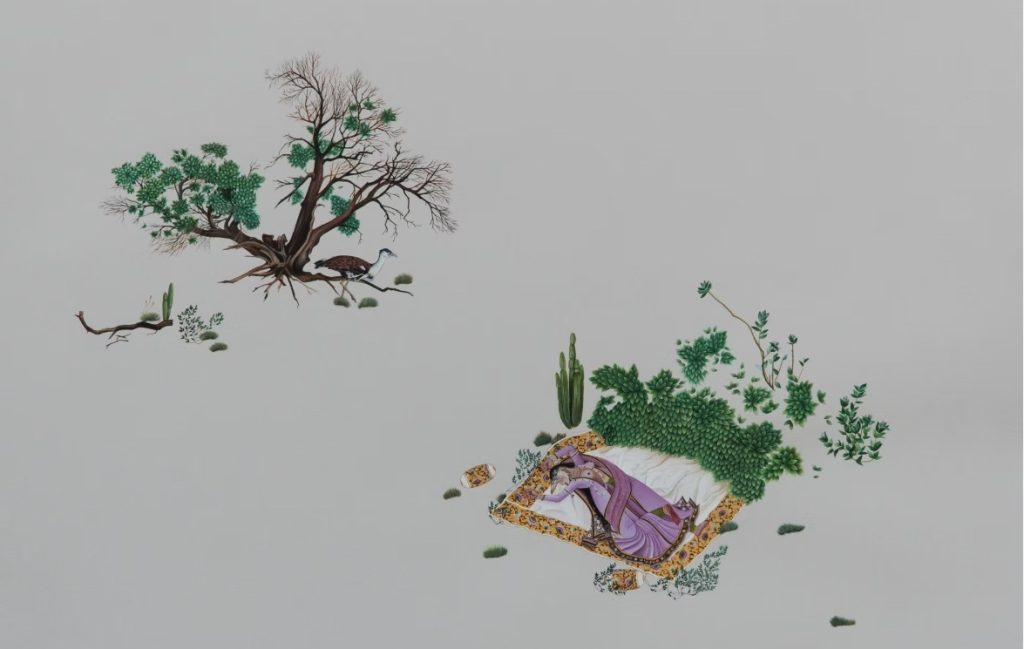
The Jerdon’s courser is a nocturnal bird — elusive, rarely seen, moving through darkness in habitats that are themselves fragile and endangered. To seek this bird is not a romantic gesture in any conventional sense. It is an act of profound ecological attention. The heroine ventures into the forest not toward a human lover but toward a creature that the world is on the verge of losing — one that most people will never see, existing at the very edge of visibility. Her boldness becomes a form of witness. Her desire becomes a form of mourning and devotion simultaneously.
In Hybrid Being 3, the heroine does not simply seek Jerdon’s courser — she embodies the bird. She is depicted within the bird’s habitat, her face transformed into the bird’s visage, her identity merged with the creature she has gone out to find. This merging is central to how I think about agency in this series. In the classical Ashta-Nayika tradition, the heroine’s agency is entirely relational — it exists in reference to the male lover, is oriented toward him, and is defined by his presence or absence. By replacing that lover with an endangered bird and then allowing the heroine to become that bird, I propose a completely different understanding of what agency means. Her sovereignty is no longer located in her relationship to a man. It is located in her capacity for interspecies becoming — in her willingness to shed her human identity and inhabit the life, the habitat, the precarity of another species entirely.
This is also where the choice of an endangered bird becomes a political act rather than simply an aesthetic one. Each bird I select carries with it a specific ecological crisis — a particular habitat under threat, a particular species pushed to the margins of existence by human expansion and consumption. When the heroine merges with the Jerdon’s courser, she is not escaping into fantasy. She is placing herself inside that crisis, making it personal, making it felt. Her agency is an ecological agency — an agency of care, of solidarity, of choosing to be in relation with what is most vulnerable rather than what is most powerful.
Across the series, this is the consistent reframing: the heroine’s emotional states — longing, grief, desire, sovereignty — are redirected from the human relational world into the ecological one. What she feels, she feels for the more-than-human. And in feeling that, she becomes that. That becoming, for me, is the most radical form of agency the paintings propose.
In your paintings, the human and the non-human cohabit and exchange forms. Do you imagine these hybrid beings as metaphors, as ecological warnings, or as actual alternate ontologies?
I would resist separating these three framings, because for me they are not alternatives — they are layers of the same act. My works are, at their core, an activity of storytelling, and storytelling has always carried metaphor, warning, and ontological proposition simultaneously. To tell a story is already to propose a world.
Metaphor is present, yes — the hybrid being is a visual language, a way of making felt what is difficult to articulate in discursive terms. When a woman’s face becomes that of a bird, or when a Chthonic Being presides over an assembly of endangered flora and fauna, these are images that think. They condense complex ideas about interspecies kinship, ecological crisis, and the limits of human exceptionalism into a single visual encounter. But I am cautious about letting metaphor become a container that keeps the work safely at a distance — as if to say, this is only a figure of speech, only a symbol. It is not.
The ecological warning is equally present and equally insufficient on its own. My paintings do carry an urgency — they are made in full awareness of the sixth mass extinction, of habitat destruction, of the accelerating disappearance of species. The birds I choose are endangered, near-threatened, vulnerable, or extinct. The ecosystems I depict are fragile and under threat. That is not incidental. But a warning alone positions the non-human world only as victim, only as loss — and that is not the full story I want to tell. The beings in my paintings are not passive. They are sovereign, they are agents, they are kin.
Which brings me to the third framing — alternate ontology — and this is where I want to linger. My works explore what it means to be human, what it means to be non-human, and where these meanings rupture and collide. That rupture is not decorative. When the woman merges with the bird, she is not escaping into fantasy — she is placing herself inside a crisis, making it personal, making it felt. Her agency becomes an ecological agency — an agency of care, of solidarity, of choosing to be in relation with what is most vulnerable rather than what is most powerful. That is a proposition about how to live, not just how to paint.
And yet I hold this question open, because I think that is where the most generative thinking happens — in the not-yet-resolved. What does it mean to be human? What does it mean to be non-human? And where do these categories rupture, bleed into each other, become insufficient? My paintings do not answer these questions. They inhabit them. They exist in that threshold — not as metaphors pointing elsewhere, not only as warnings about what we are losing, but as speculative entities proposing that other ways of being are possible, have existed before, and might exist again. They are world-building exercises that take the form of painting. And the world they are building is one where the boundary between human and non-human is
not a wall but a conversation.
You often refer to your works as “visual research.” How does research—ecological, mythological, historical—shape your studio practice?
I should clarify that others, not me, have called my works visual research papers. I find that description generous and interesting, but what I would say is that research is simply the atmosphere in which my studio practice breathes. It is not a separate phase that precedes the painting. It is continuous, plural, and often unexpected in its direction.
In practical terms, my research moves across many registers simultaneously. I read widely — about the relationships and interdependencies between species, between birds and plants, between plants and insects, about the intricate ecological webs that sustain fragile habitats. I follow the daily news about environmental crises, conservation efforts, and the ongoing political negotiations over land, borders, and personhood.
I read mythological stories from various cultures, trying to understand how myth shapes society and how certain stories slowly vanish in response to the needs of the time and scientific advancement. I trace how different civilisations have imagined gods in response to their fears of the natural world and to the advancement of their civilisations — what they forget and what they remember across generations, what gets silenced as progress accelerates and what stubbornly persists. There is something deeply telling in those patterns of remembering and forgetting — in which deities survive and which dissolve, in which relationships between humans and the natural world get carried forward and which get abandoned as inconvenient or
irrational. That is where I find the threads that connect an ancient Indian goddess to an Egyptian deity to an indigenous cosmology from another part of the world entirely.
But research for me is not only textual. I listen to podcasts about the histories and mythologies of different cultures as well as about contemporary philosophy — letting those narratives enter through the ear rather than the eye, which changes how they settle in the body and eventually in the work. Every day, I go out for walks in nature. This is perhaps the most essential research of all — moving between distance and closeness, between the broad landscape and the particular detail of a leaf, an insect, a bird call. That daily practice of attention is what keeps the paintings ecologically honest.
I also look at a great deal of art — not to borrow from it, but to understand how other artists have imagined solutions to particular problems, and how questions of interspecies kinship and personhood are being dealt with in real life — what kind of jurisprudence has been unfolding in various parts of the world around the rights of nature, rivers, and forests. Looking at art is, for me, a form of thinking in conversation.
All of this feeds the paintings, but rarely in a direct or illustrative way. The research does not produce a thesis that the painting then illustrates. It produces a kind of saturation — a density of knowing and feeling that the painting draws from intuitively, speculatively, sometimes in directions I did not anticipate. That gap between what I researched and what the painting becomes is where the fabulation happens. And that, for me, is where the most alive work lives.
Your canvases blur the binary between cultural memory and ecological urgency. How do you see Art participating in conversations about extinction, climate change, and the ethics of living with other species?
I want to be honest about what art can and cannot do. Art alone cannot stop an extinction event, reverse a warming climate, or legislate the rights of a river. But it can do something that data, policy, and science — as urgent and necessary as they are — often cannot: it can make people feel. And, I believe, feeling is where ethical transformation begins.
In Chthonic Beings, for instance, hybrid deities convene in multispecies assemblies alongside endangered flora and fauna — a river articulating its grievances, a forest negotiating its sovereignty — proposing a world where governance is interspecies, and reciprocity is the founding logic of cohabitation. That speculative gesture is, for me, what art can uniquely offer: not an answer, but an imaginative expansion of what we believe to be possible.
Art keeps alive the stories and memories of what we are losing. It creates space for grief, mourning, care, and imagining alternatives. It counter-narrates, refusing the dominant logic that renders the non-human world invisible or merely instrumental. I also think art has a particular capacity to hold contradiction — to sit with the simultaneous reality of devastation and beauty, of loss and resilience, without resolving either into the other. That capacity feels increasingly rare and increasingly necessary. I don’t make paintings because I think they will save the world. I make them because I believe that without the capacity to imagine otherwise, we will not even know what we are fighting for.
Many feminist readings of miniature painting highlight its patriarchal viewpoints. How do you reclaim agency for the women who were historically rendered as archetypes within this tradition?
Much of what I do to reclaim agency happens at the level of the image itself — in the quiet but deliberate choices of gaze, posture, adornment, and composition.
The women in my paintings are still, yet sovereign and self-contained. They do not lean toward anyone. Their gaze is not directed outward for approval or inward in shame — it is steady, absorbed, complete in itself. Their posture carries weight and presence rather than the yielding suppleness that classical miniature painting so often asks of female figures. Their adornment is elaborate and intentional — not decoration applied to them by a patron’s taste, but self-presentation that signals their own authority over how they are seen.
Compositionally, these women occupy space fully — they are not peripheral, not framed by the male protagonist’s presence, not waiting at the edge of the picture. They are the centre around which the landscape organises itself. And that landscape is not a backdrop — it is a living, breathing world of flora researched specifically around the habitats of the birds they are becoming. The landscape holds them, and they hold it in return. That reciprocity between figure and ecology is, for me, the visual language of a different kind of agency — one that is not about dominance or display, but about belonging, becoming, and quiet sovereignty.
The idea of creating “new mythologies” runs through your work. In your view, what is the role of mythology today—especially in a world grappling with ecological collapse and gendered violence?
Mythology, for me, is not only a repository of old stories. It is a living, symbolic language that connects humans to the more-than-human world — one that operated long before nature and culture were split apart by colonial and industrial modernity. And crucially, mythology is always in a state of becoming — it has never been fixed, never been finished.
The history of South Asian painting itself demonstrates this. The practice of album-making in the Mughal period, the spontaneous insertions of new characters and iconographies into existing visual traditions, the layering of successive interventions across generations — these were all acts of myth-making in motion, each era adding to and transforming what it inherited. My work sits inside that same genealogy of becoming. When I draw from Indian mythological lineages — Yoginis, Yakshinis, Kul Devis — I am reaching for a symbolic vocabulary that already understands the female body as cosmologically powerful and the natural world as sentient. These are not nostalgic gestures. They are acts of recovery and continuation — weaving back
what has been forgotten and offering it to the present as a paradigm of change.
Joseph Campbell urged us to produce myths that identify the individual not with their local group but with the planet. That feels more urgent now than ever. In a world grappling with ecological collapse and gendered violence, mythology matters because it exists outside the logic that produced these crises. Through figures like the Lajja Gauri — a goddess dating to the Harappan period, reactivated in my painting, While She Births an Ecosystem to birth not human progeny but an entire ecology — myth becomes a tool for rewilding thought, for feeling the world’s sentience again at a moment when that capacity has been systematically dulled. New mythologies are not invented from nothing. They grow from what came before, absorb the
urgencies of the present, and reach toward futures we have not yet found the language to name.
Your paintings are rich with scent, skin, texture, and sensory depth. How important is sensuality—rather than sexuality—in shaping your eco-feminist vision?
Sensuality, for me, is how the body knows the world before the mind does. In a cultural moment that processes ecological crisis primarily through data, reports, and policy, I am interested in what happens when we encounter it instead through the senses, because to feel something is already the beginning of caring for it.
In my paintings, sensuality lives in the surface treatment above all — in the depiction of skin against feather, bark against moss, water against earth, in the lushness of the botanical world that surrounds and embraces the figures. The intimacy of the miniature scale asks the viewer to come physically close, slowing the body down before the mind has had a chance to categorise what it is looking at. That slowness, that closeness, is deliberate.
And sensuality here is not about sexuality in any narrow sense. It is about a creaturely way of being in the world — one that celebrates the diversity of romantic and ecological relationships and refuses the heteronormative conventions that have historically contained both women and the natural world.
You have described your practice as part of a posthuman or post-queer “becoming.” What does becoming mean to you in artistic and philosophical terms?
Becoming, for me, is not a destination. It is a continuous process — one that refuses the finality of any category, whether human, non-human, gender, or species. It is the condition my paintings live in, and the condition they invite viewers into.
In post-queer terms, becoming means that gender is not fixed but diverse and multifaceted, that identity is evolving and adaptable, that desire and love move freely across forms and species. The women in my paintings are sovereign — with the potency to choose who they are, who they love, and if and when to reproduce, without explaining the whys of their decisions or proving the correctness of their being. They transcend heteronormative and hegemonic conventions not through argument but through the simple fact of their existence in the painting — creaturely, fluid, untethered. Becoming, in this sense, is a post-queer freedom — the freedom to be multiple, to be in motion, to be undefined.
In posthuman terms, becoming means something wider still. My hybrid beings are in a continuous process of evolving — they peer into different temporal dimensions, bridging past, present, and future, meeting beings that have become extinct and those that are yet to evolve. They place humans in a continuum of intelligence and evolution with other species of flora and fauna, accepting that consciousness, language, and perception are not exclusively human capacities. Rather than occupying the wild, they inhabit it — searching for relationality, reciprocity, and mutuality across natural, ancestral, and human worlds.
Becoming, then, is the philosophical ground on which the post-queer and the posthuman meet in my work. It is what happens when you release the fixed categories and allow identity, species, gender, and time to remain beautifully, productively unresolved.
The forest in your work is not a backdrop but an active protagonist. How do you conceptualise landscape—as character, witness, or collaborator?
The landscape in my paintings is never a backdrop — it is a living presence that holds, responds to, and participates in everything that unfolds within the painting. It is always, unambiguously, alive.
Daisy Hildyard’s idea of the second body resonates deeply with how I think about landscape in my work. We each have a first body — the one that occupies a room, a chair, a moment — and a second body that exists in relation to the entire world, to climate, to ecosystems, to the lives of other species. In my paintings, the landscape is that second body made visible. It is not separate from the figures — it embraces them, encapsulates them, grows through them. The flora is researched around the specific habitat of the bird being represented, rooted in ecological truth before it travels into speculation and fiction.
The English language, as a universal and colonised language, makes this thinking frustratingly difficult. The moment I refer to a tree, a river, or a bird as “it,” I have already reduced a living being to an object. Many Indian languages understand this differently — in Hindi, Punjabi, and Sanskrit, a river or a tree is never a neutral “it” but a “she” or a “he,” grammatically alive within the world. That feels far closer to how I see the landscape in my paintings — as a gendered, breathing, sovereign presence.
In your paintings, the line between predator and prey, fertility and decay, life and death is constantly shifting. How conscious is this fluidity during the painting process?
My process begins with intention — I plan the colour palette and the figure’s posture, and have a rough sense of the composition before I begin. But the fluidity between predator and prey, fertility and decay, life and death is not something I can fully plan, nor would I want to. These tensions are already present in the natural world I am researching — in the ecological relationships between species, in the mythological figures I draw from, in the very idea of a being that is simultaneously human and non-human, living and transforming.
What I consciously do is leave space for surprise. Certain nuances reveal themselves in the process of painting that I did not anticipate — a relationship between two elements in the composition, a colour that shifts the emotional register of the whole work, a detail that suddenly carries more weight than expected. I have learned to wait for these moments. They bring something alive to each painting that pure planning cannot. So the fluidity you see in the finished work is partly researched, partly intuited, and partly gifted by the process itself, which feels appropriate, because the natural world it is trying to honour operates exactly the same way.
Blake’s idea—“I must create my own system or be enslaved by another man’s”—echoes strongly in your visual universe. What systems did you feel compelled to reject, and which ones did you consciously choose to reimagine?
The systems I felt compelled to reject are interconnected: the patriarchal structures that define women’s bodies, roles, and desires; the anthropocentric logic that places the human at the center of all meaning and governance; the colonial frameworks that have determined whose stories survive, whose visual traditions are considered high art, on whom sanctions are placed and when they are lifted, who is made to abide by the rules and who is granted leverage. These are not separate systems. They are all expressions of the same underlying logic — that power determines whose life matters, whose sovereignty is recognised, and whose world is worth protecting. And we see this logic playing out in real time — the present wars that care nothing
for human life, nothing for the environment, nothing for the fragile ecologies caught in their wake, ignited and sustained by the egos of a handful of powerful men.
And these are precisely the systems I am reimagining and want to reimagine in my works. I chose to walk back into the inheritances that still carry living possibilities, where the natural world is sentient, women have power, where governance is reciprocal rather than extractive, where land belongs equally to all species and not just humans, where both biotic and abiotic elements of the landscape are recognised as living beings and not mere objects to be consumed. Where we ask — can land own itself? Can the judiciary and political assemblies make laws that uphold the life and ways of living of the more-than-human world? How do we learn to listen to the earth, given that humans and non-humans communicate in entirely different modes
and frequencies? This reminds me of the quote by Robin Wall Kimmerer — if grief can be a doorway to love, then let us weep for the world we are breaking apart so we can love it back to wholeness again.
Ultimately, what do Hybrid Beings offer us that traditional narratives cannot? Do you see them as proposals for future world-making, or as reflections on what our current world fails to see?
Both — and I don’t think those two things are as separate as the question implies. To reflect honestly on what our current world fails to see is already an act of world-making. The two move together.
What my paintings offer that traditional narratives cannot is perhaps this: they refuse resolution. Traditional narratives — whether mythological, political, or art-historical — tend toward a conclusion, toward a hero, a moral, a hierarchy restored. My paintings do not resolve. They stay in the threshold — between human and non-human, between ancient memory and speculative future, between grief and hope, between what we are losing and what we might yet become. That irresolution is not a failure. It is the point.
They also offer a different centre of gravity. Traditional narratives have centred the human, the masculine, the exceptional. My paintings centre on the endangered, the hybrid, the creaturely, and the ecological. They ask what governance looks like when a river has a voice, what heroism looks like when it belongs to a bird, what love looks like when it moves across species. These are not rhetorical questions. They are proposals — speculative, painted, felt.
And perhaps most urgently, they offer grief as a productive force. We are living through an era of accumulated loss — of species, of ecosystems, of ways of knowing and being in the world. Traditional narratives have not given us adequate tools to mourn that loss, let alone to imagine beyond it. My paintings try to hold both the mourning and the possibility.
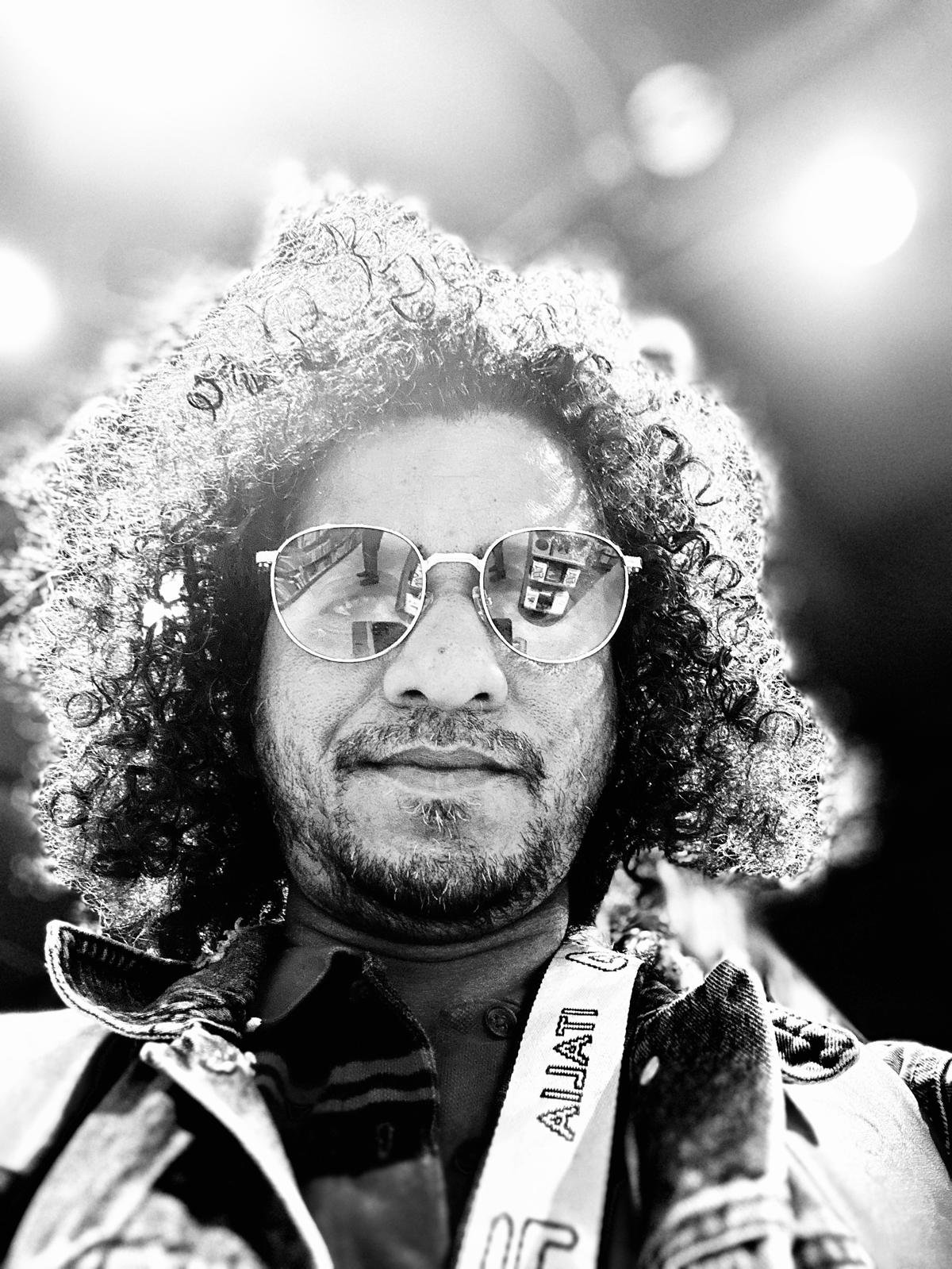
Krispin Joseph PX, a poet and journalist, completed an MFA in art history and visual studies at the University of Hyderabad and an MA in sociology and cultural anthropology from the Central European University, Vienna.