India’s only daily newspaper for Art, Architecture, and Design.
Cultural Dialogues at the Sixth Edition of Kochi Muziris Biennale
January 2, 2026
Living in the times of visual overdose; burdened with visual illiteracy; the responses to an art event could vary from complete dismissal to adulation.
I met a spectrum of these between the two extreme points at the sixth edition of KMB (Kochi Muziris Biennale).
The complexity of times we are living in and the demands of the fluid art world—have changed the vocabulary of visual art with such speed that sometimes the viewer fails to keep pace. Art is more layered, complex and at times obscure for the common man.
Therefore, interest and critique expressed by visitors for the biennale have grown over the years. This year, the grand show of art spans across Fort Kochi, Mattancherry, Willington Island and Ernakulam, covering 22 venues, spanning 110 days. With the involvement of eleven international organizations, the scope of KMB has grown phenomenally. From the characteristic Kochi biennale, its ambitious projections to become a major international art biennale in scale and scope, is evident.
A regular visitor to the biennale would go through a mixed feeling of missing the old intimacy and verve to the overwhelming presence of global practices in art. A viewer may find herself a bit wanting in her responses.
As a force of habit, I prefer not to read about the artists I am not familiar with; preferring the works to resonate with my sensibilities. In doing so, at times, I run the risk of finding myself completely unresponsive. A point from where begins a new curve of learning—a fresh window opens. Either you reject or absorb. At times, I find a work too cluttered, too obscure to make sense. Few works look pretentious with their overt political statements. One does not respond to all the works presented by over 66 artists, 8 collaterals and three verticals that involve many more artists and their works.
The sixth edition is curated by performance artist Nikhil Chopra and the collective H H Art Spaces of Goa; there is a performative element all across. Art is an evolving process here; like a performance–as one would witness at the venues. The process of creation does not seem to have a finishing line.
“For the time being”, the theme of the biennale sums it up. The president and co-founder of Kochi Biennale Foundation, Bose Krishnamachari puts it succinctly, “It is a temporary university for learning; a temporary museum.”
I would rather go with the temporary university; not a museum. Art is evolving at these venues—not frozen in time and space.
Many works in this biennale come from a point of intersection of time, conflict and expression or the suppression of expression—around rebellions and insurgencies—of rebuilding spaces and lives–from geographies one may not be familiar with. Human experiences though are the same across geographies and cultures. The idioms of expression vary. That makes the biennale interesting.
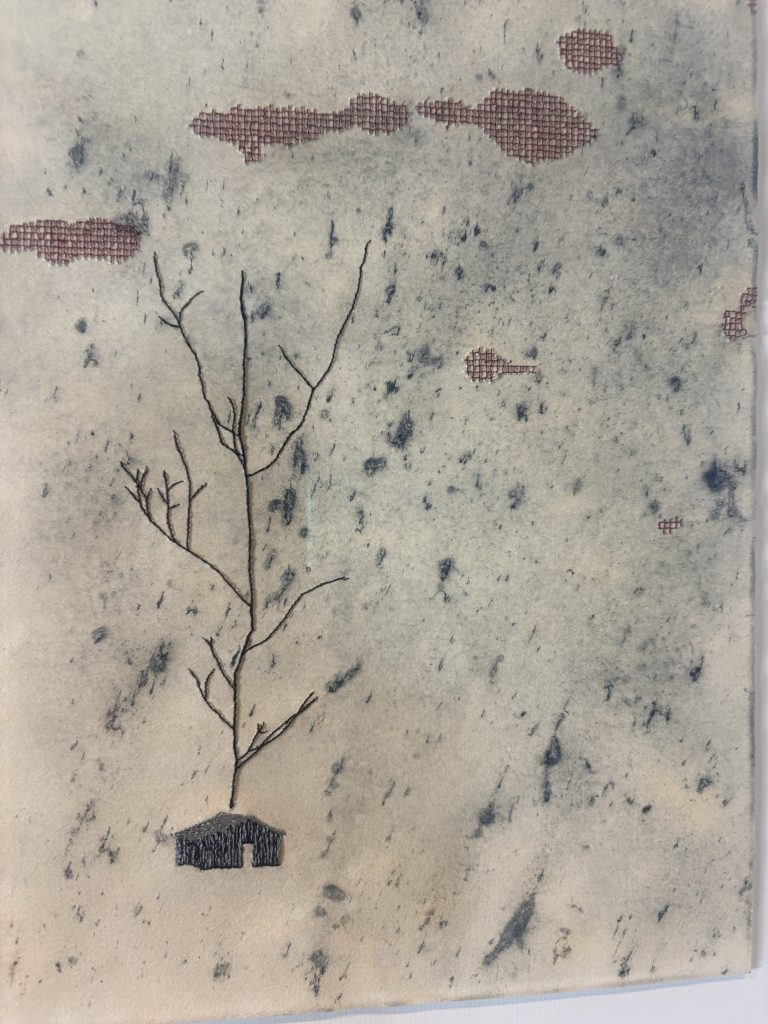
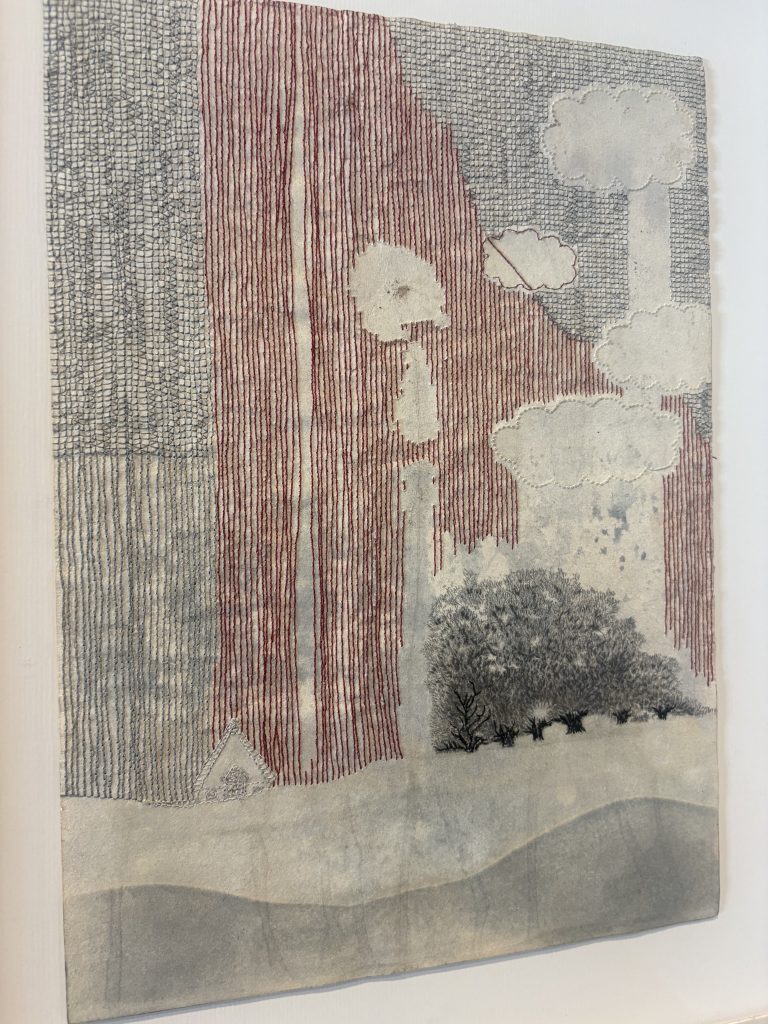
There is a baffling diversity of mediums used by artists; just a study of mediums is enough of an award. The unusual treatment of copper plates by Kirtika Kain, a Sydney based artist, Kulpreet Singh’s use of parali to highlight faulty agricultural policies, the delicate use of threads by Huma Mulji and the simple use of tools in an installation by Birender Yadav to show a migrant labourer’s world, resonate long after seeing the works. Ibrahim Mahama’s use of jute sacks to create an architecture of history is brilliant. Many artists have used fabrics as archives, for mapping of colonial trade, migration and endurance. Shiraj Bayjoo’s hanging indigo panels embroidered with botanical forms, hovering just above the ground map histories of botanicals and spices, their extraction and colonial trade. Bhasha Chakrabarti’s brilliant floating quilts bring quilting into conversation with migration, labour and collective memory. They have a feel of textile-based archives and as mapping tools. Yasmin Jahan Nupur from Bangladesh uses textile as a cartography tool. Her sail-like fabric panels embroidered with maps trace back pepper trade routes. Jompet Kuswidananto, of Indonesia displays shared colonial histories across the coastal world using worn everyday clothing and shoes sourced from Kochi and Yogyakarta.
Mediums alone offer a vast arena for cultural dialogue.
I overheard a Swiss visitor complaining to a tour guide (he must have paid between Rs 2500 to 10,000 – depending on the hours– 2 to 8 for a guided tour by a trained mediator; an entry ticket to the biennale is Rs 200 per day) that, he could not see anything worth remembering through the tour. In the last biennale, he added, only one work stood out for him but later he discovered it was plagiarized.
Any art form requires time and patience to establish a dialogue. It also demands freeing the mind of the anxiety to respond. A lot depends on one’s experiential maturity and sensibility. KMB is no exception. Art is a subjective experience. No two people would respond to a work of art in a similar fashion. One would see and absorb and respond from one’s experiential level.
The world is exploding with visual elements; the traces that inspire and become part of memory are hard to discern. The Jury must be aware of the risks of plagiarism.
A few works that I could recall for the freshness of idiom, treatment of the theme, use of materials, conceptualization, execution and research are described in the following passages. I do not claim to have seen all the works; it’s not possible to see the entire exhibition in a span of three days. Even if one spends seven days; the many performances associated with installations that add fresh dimensions; talks, film shows and evolving projects would be missed.
Healing Room
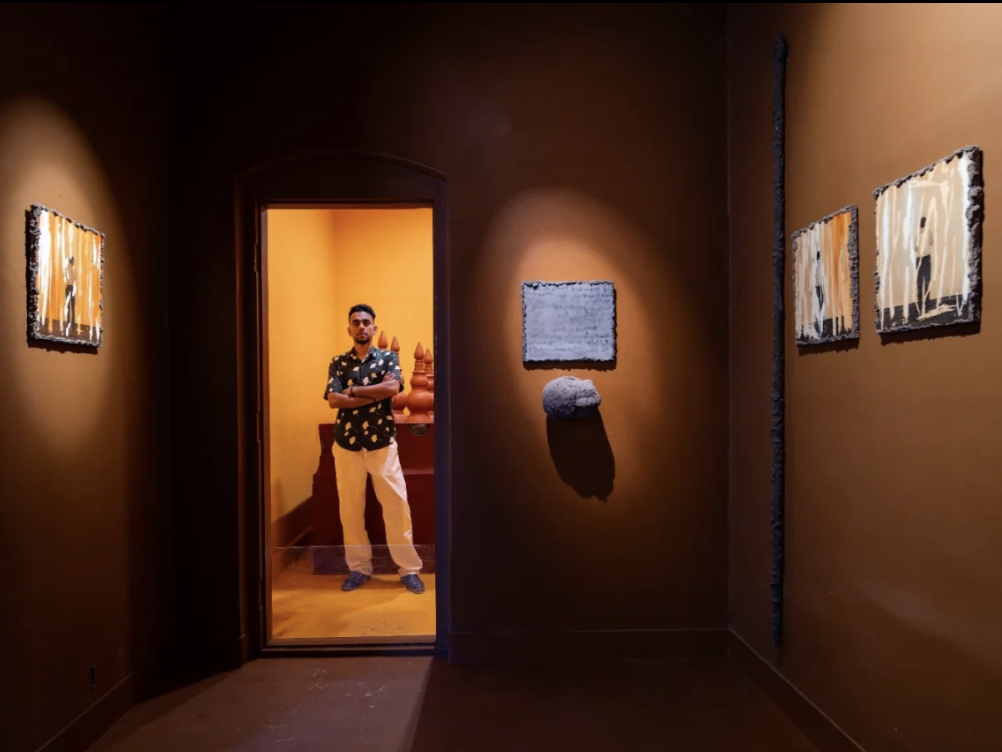
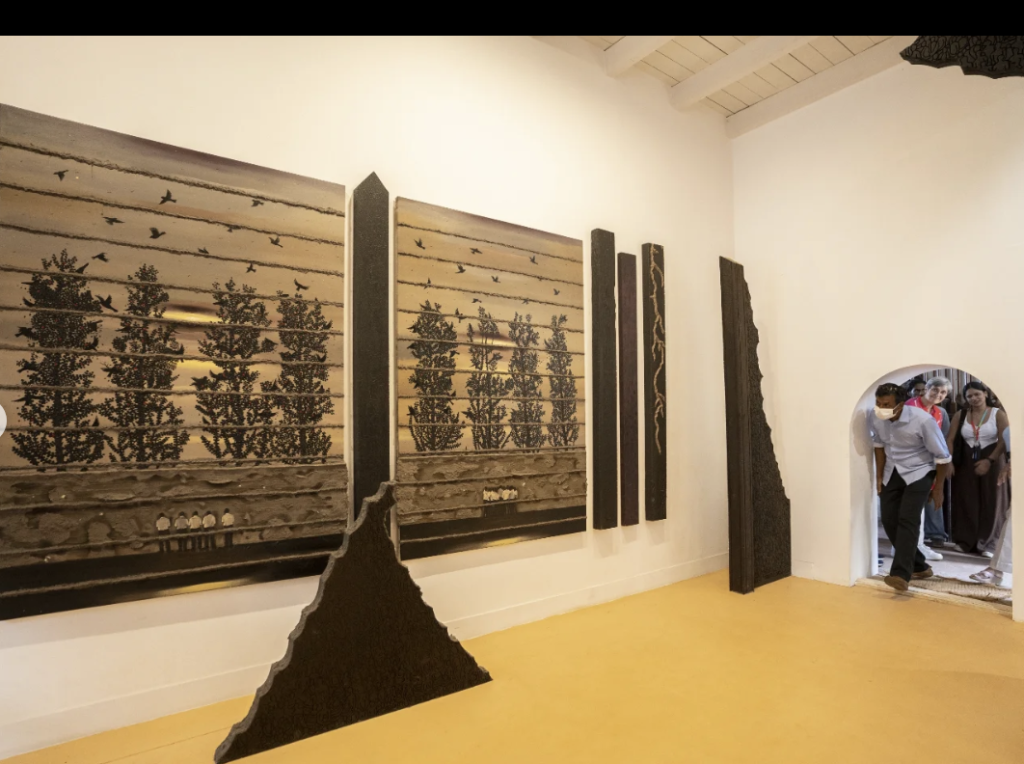
The overpowering presence of black wooden panels in different shapes overwhelm when you enter the space. Abul Hisham’s installation spans through three rooms in Aspinwall House. Before you are immersed, the visual stuns; it impels you to explore. A closer look and touch of the panels reveal added dimensions. The panels are finely engraved with the presence of humans, ghosts, even termites; few blocks are missing, like a jigsaw puzzle. The topography turns complex with the presence of a painting with barbed wires and trees and few men standing in prayer. Another room leads to a shrine-like space with aromatic pots. In a sanctum-like enclosure of wooden panels is placed another painting—of a man emerging from light—like birth of light. There are a few more clay framed paintings bearing vertical scratches of pain and memory. The ‘Healing Room’ is mnemonic; where the artist preserves as well as communicates the memories. To me it felt like the cycle of life with decay and regenerative forms. It offered a sensory experience with a mystical touch—the space creating an aura of spirituality with sensorial involvement.
Image Courtesy: Kochi Muziris Biennale Foundation
Hisham, born in Thrissur, Kerala, now lives in the Netherlands. He reconstructs personal memories and collective history in spatial, tangible forms.
A biography of pain
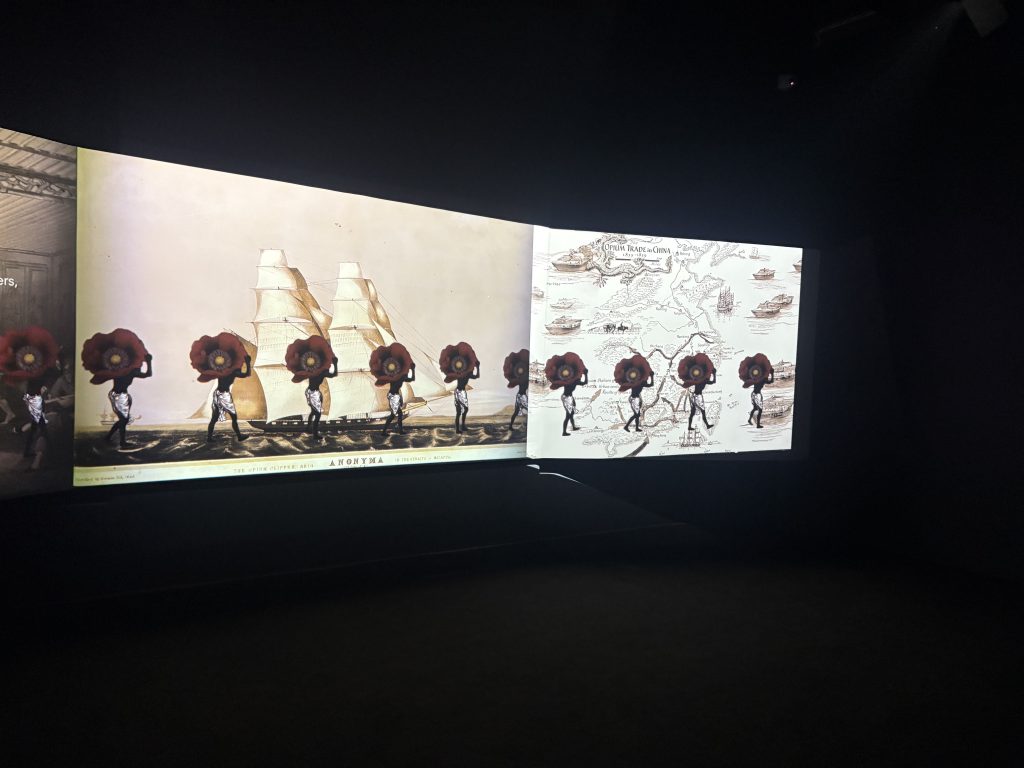
Sheba Chhachhi’s three- channel video Beauty/Pain is long; absorbing and enriching. An unlikely theme for an artistic expression—the video encompasses a large canvas of investigations on the body, cultural memory, ecology, the role of opioid analgesics on the neurological system as against the traditional systems of healing. It weaves many well-researched threads in the narrative– from colonial modernity to racial capitalism. In a nutshell, it talks of pain; its debilitating effects and the silence around it, from a woman’s perspective. The global narco- politics over the use to control the therapeutic use of opium adds another context to this aesthetically presented exploration of pain.
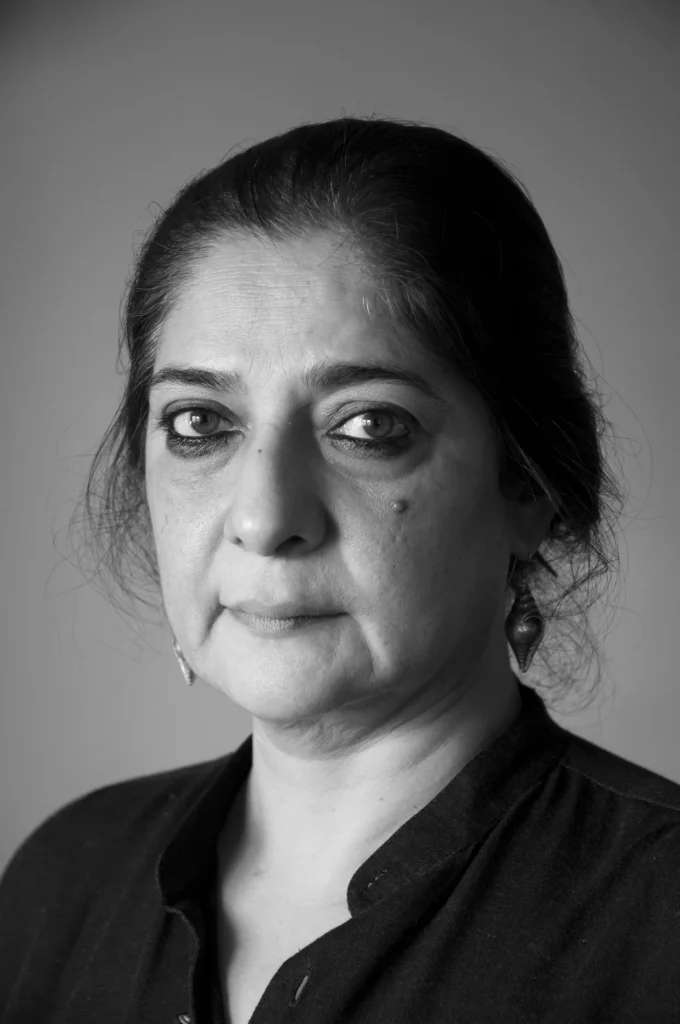
Sheba Chhachhi & Janet Price
It has a feminist perspective. Based on her ten- year-long, long distance conversations with disabled queer feminist artist Janet Price, known for her textile and fibre art pieces, Chhachhi explores debilitations in a biography of pain. She places chronic pain as a compass towards transformations—of the inner world. And treats pain as an unruly friend who can estrange one from the world or submerge in uncertainties. The beautiful fibre art works of Price are used to show the aesthetically designed inner neurological architecture of the human body.
Stills from Sheba Chhachhis installation video
The chapter, ballad of on opium explores women’s ageing process; aches and pains; the cultural history of opium for beauty and treatment of pain– from Harappan culture to Egypt, Greek, China; the East India Company’s opium plantations in India, the opium war with China and the Poppy Goddess found in Crete around 1100 BC. The leitmotif –never enough, never enough, for the growing demands of opium through centuries plays through.
The complex network of memory—of sorrow, pain, loss— that the medical infrastructure never grasps despite their ability to look at each nerve inside the body; Chhachhi balances it by delving into the systems of energy maps of the body to relieve pain through traditional systems of healing.
The film is a model of perfection for anyone who wants to make a sensitive documentary.
Two worlds
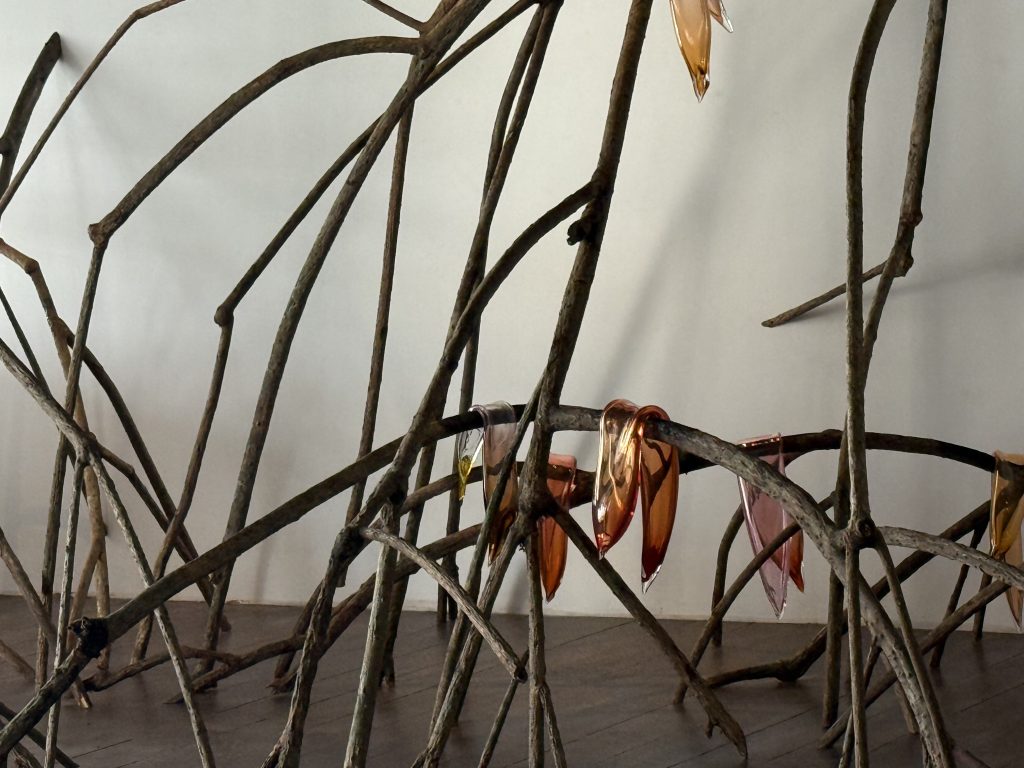
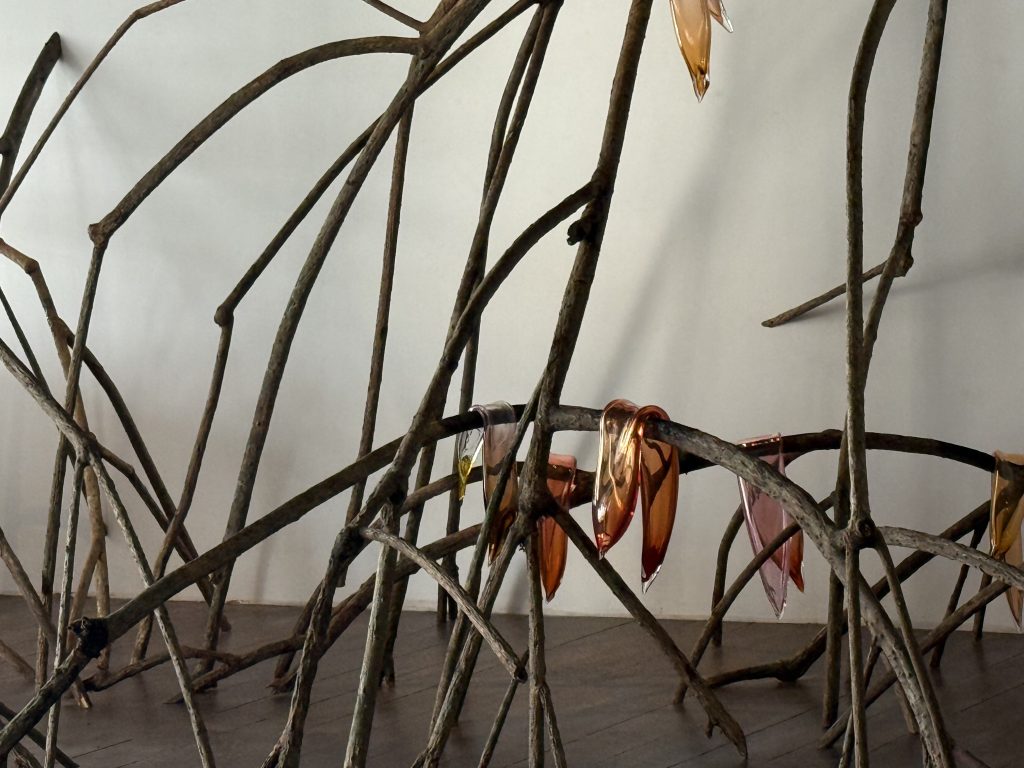
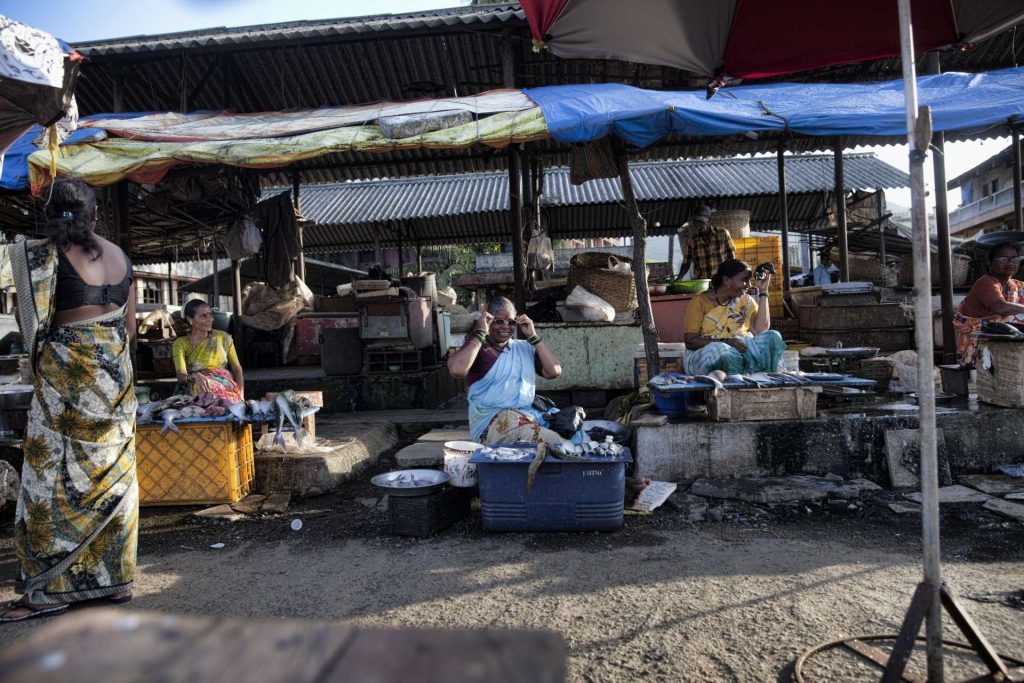
Karachi born artist Huma Mulji’s work is delicate in expression. Very fine lines of memory on landscapes appear like fragile threads; at times they become lyrical. She explores how interpretations of culture, context, and cognition are held in creative tension. At KMB her work Bombay Duck draws on port cities; their plurality and porosity; their quiet ways of tending and repair and the nurturing ecosystems of mangroves.
Using paper, threads, pieces of wire mesh– she explores cities as dense repositories of collective memories. I liked her manner of weaving complex narratives with simplicity. Her installation has objects retrieved from beaches, photographs, collages— with these she explores migrant life and its many negotiations in the city space. The memories of divisions and displacements.
By using glassblowing for creating the migratory fish of the mangroves– she deliberately involves a process that entwines the artists’ breath with the echoes of the sea encoded in underlying layers of glass as silica and sand.
Mangroves are found in the brackish waters of Kochi and Karachi –where she was born—the installation of mangroves highlights the paradox of a fragile ecosystem that offers protection and instability.
Huma Mulji | Bombay Duck
Smitha M Babu breaks the transparency conventionally associated with watercolours. She layers pigments to achieve an opaque density. Her earth toned palette and stylised gestures transform scenes of rural life into a living theatre. Smitha has a theatre career spanning over two decades; she extends her pictorial practice into a performative space. Lending them an element of drama, even around a life of labour.
In Pakkalam, a Malayalam word for the weaving workshop – which is conceived by her as an archive of personal memories and a sensorial documentation of Kollam’s coir making communities. Her paintings create a kind of resistance to erasure of a fragile micro-heritage.
She adds mystic overtones by not restricting her world of realism to labour and working- class chores—her visual field has fantastical presences like strangers in dancing poses, masked men etc. About thirty of her fantastic frames are displayed at KMB.
The shock of a lullaby
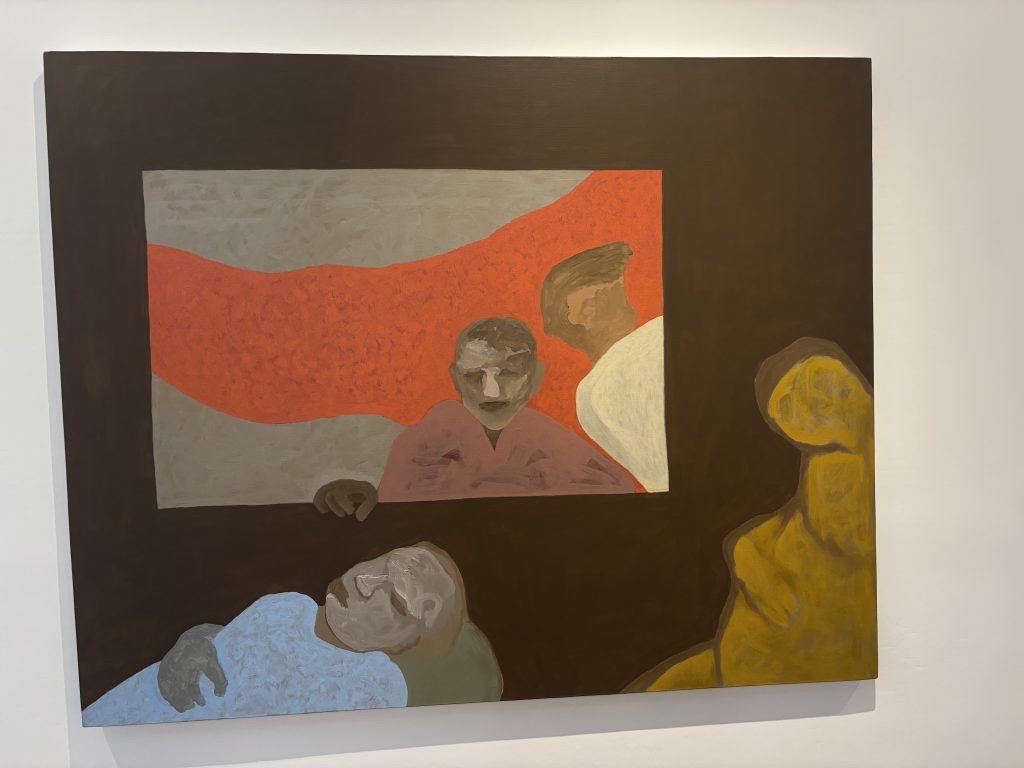
Four large canvases assault you with their chaotic, dense visuals at Pepper House. They force you to stop. To have a closer look; to respond. The canvases are teeming with micro stories—which collide and overlap– oscillating between real and fantastical. The excesses seem absurd to begin with; they open a dialogue with the viewer as the viewer begins to recall familiarity.
The paintings use a lexicon of existence in a landscape of devastation. In ‘All of Us’, the artist uses catchy one- liners and other elements from popular visual culture to open a field of association for the viewer. A crazy medley of events, persons and places open intimate windows of loss amidst dance of destruction as tenderness pulsate through it all.
‘Hymns for the Drowning’ is a messy unsettling entanglement of struggle, exploitation, inequality; the artist’s use of writing on the walls heightens the sense of disillusionment. Like a slow prelude to catastrophe in ‘Sing You to Sleep’ a domestic interior becomes a site of rupture; violence presses through bedroom walls, seeping through the windows and doors, as a child sleeps on a cot.
In ‘We’ve Got Tonight’, humanity is cooped up in the ruins; the weight of stillness and silence envelops the site after an episode of violence.
Nityan Unnikrishnan, the artist, is trained in ceramics at NID, Ahmedabad. He uses acrylic on canvas to paint.
A Strange Cabinet
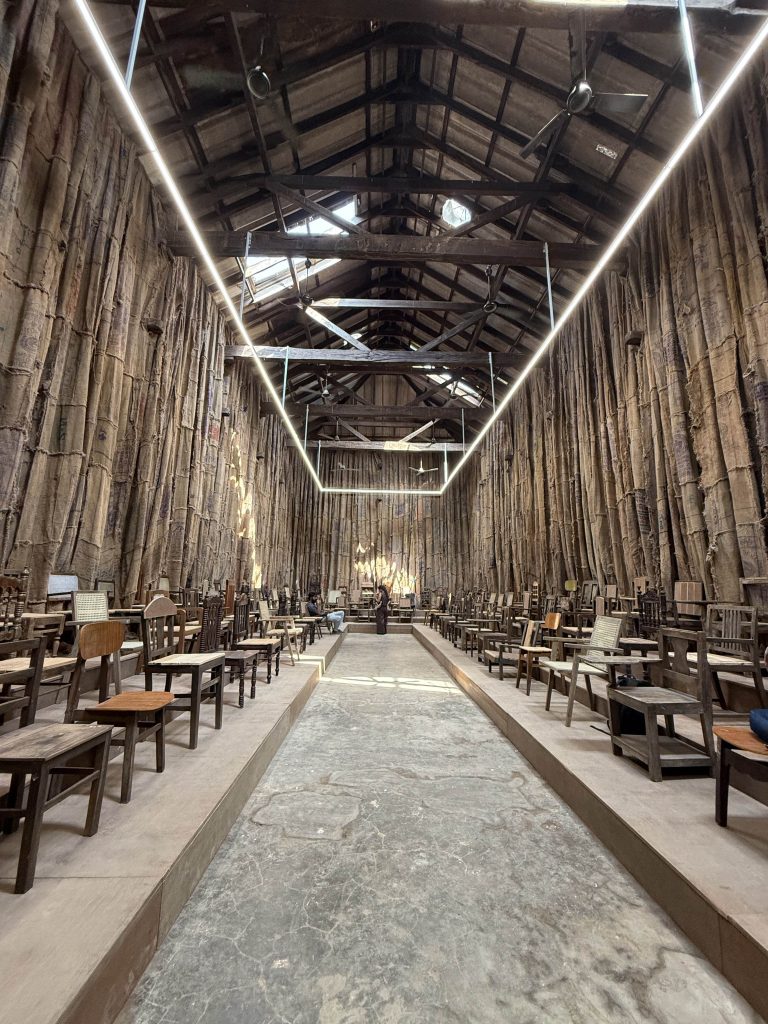
Ibrahim Mahama’s monumental installation, created with discarded materials, stages history as a space—that looks grand. Albeit, it is haunting—with unpaid labour, exploitation, abandoned promises that persist under postcolonial states.
One of the most spectacular installations, at Anand Warehouse, ‘Parliament of Ghosts’ disturbs with familiarity of narrative; the artist though is from Ghana and only 36. He uses locally sourced materials—with linkages of history.
Image Courtesy: Archana Krishnan K
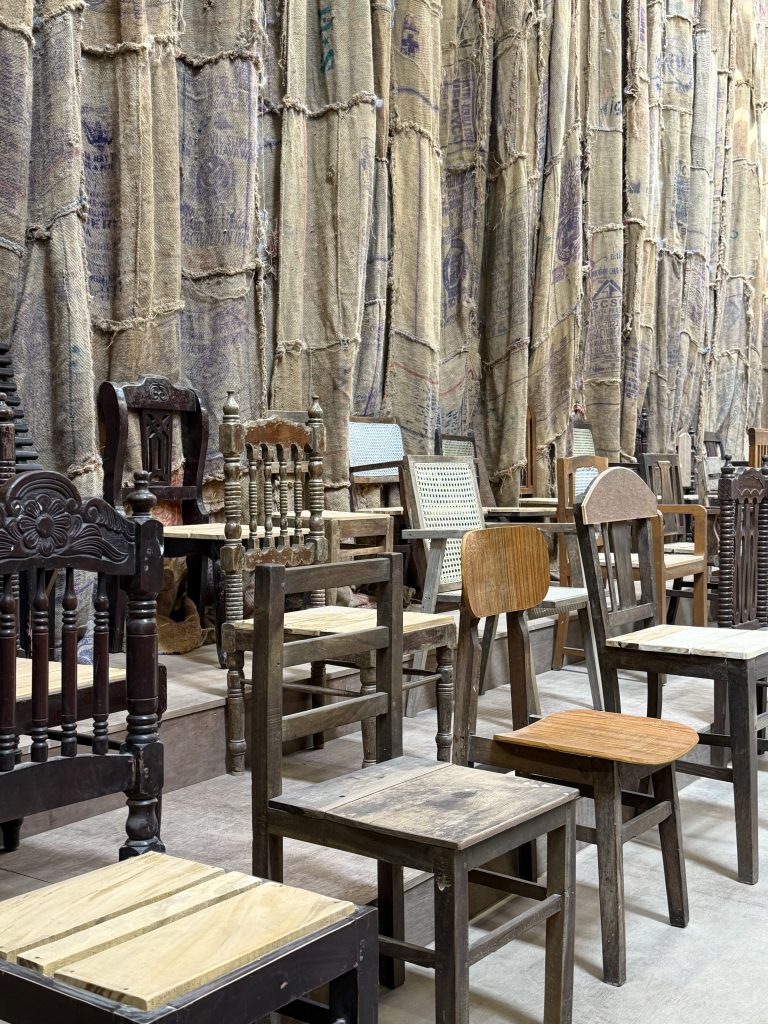
Mahama weaves Ghana’s colonial history with the jute sacks used as a symbol of continued exploitation. The British colonists used to transport cocoa- from the regions where it was grown in Ghana to ports. Jute sacks became a crucial part of the infrastructure, carrying cocoa to international markets, particularly in Europe. In Kochi—a historic port city shaped by Indian Ocean trade— the sacks echo parallel histories of commodity exchange, colonial infrastructure, and labour exploitation across geographies. He draws these trade histories into conversation.
The stitched jute sacks that cover the tall walls bear stains, marks and tags accumulated over years of circulation. They too carry traces of hard labour and exploitation embedded in capitalism and global commerce. The old, discarded wooden chairs are arranged in a stepped gallery, mimicking an assembly where debates are meant to take place; where the collective gathering is expected to share ideas and debates.
Placing the symbols of labour and exploitation in a parliament-like setting the artist invokes meditation on the unequal structures that continue to shape trade and commerce—an afterlife of colonialism in the existing capitalism. Local women stitched the sacks together, while old, broken chairs were brought to the site and repaired. Carpenters worked alongside students in assembling the installation.
The colonial structures survive; these are the metaphorical ghosts. The exploitative structures are adapted; not dismantled. The development models are based on these remnants that continue to regulate labour bodies. The installation –wrapped in history–offers no comfort.
The Harappan dancing girl and a nun’s mothers
It is an extraordinary exploration at the intersection of archives and artificial intelligence, aimed to dispel myths. An enquiry into what the artefact could have been about! ‘Hallucinations of an Artifact’ at SMS Hall, Mattancherry, is 50- minute-long performance work by Mandeep Raikhy. It resuscitates the Mohan- jo- Daro Dancing Girl; to examine the memory of the bronze artifact in public mind. AI generated images of the Dancing Girl appear on the screen; three dancers enact and probe the perceptions carried in popular imagination about the dancing girl that existed in Indus Valley civilization (c. 2300-1750 BCE). In the process of dance, the artist engages with the contentious politics—of gender and culture.
How does an ancient artifact think, move and respond to contemporary times? The performers push back at the multiple assertions that have been made on behalf of the figurine over the years. Can the “Dancing Girl” live, perspire, breathe, evolve and transform through her dancing body? Hallucinations of an Artifact performatively disrupts the linear articulations and narratives framed around Dancing Girl. The disruptive idea was exciting but thereafter where and how it led, left me wondering.
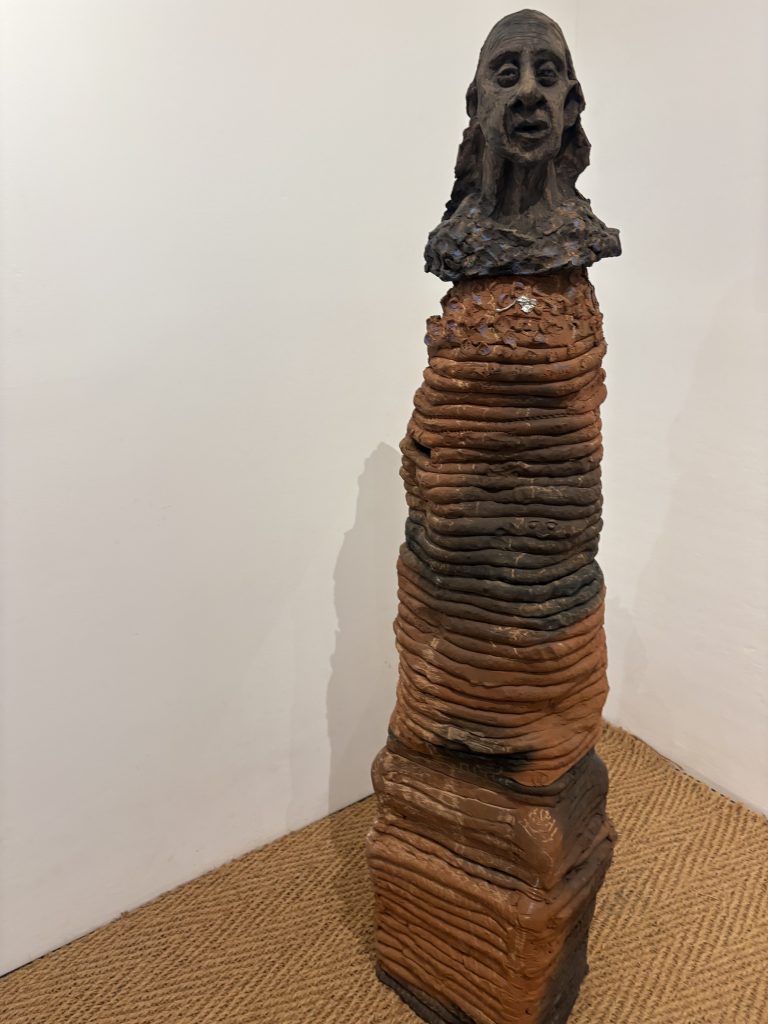
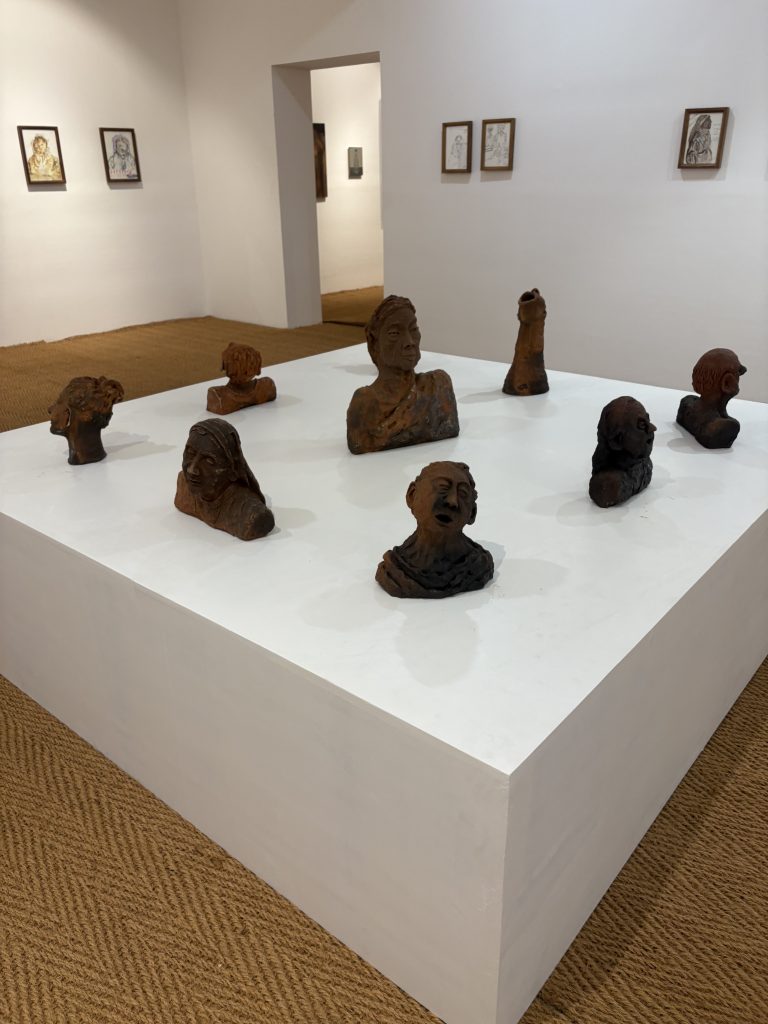
At first glance they looked like late Himmat Shah’s sculptures. The terracotta sculptures of Malu Joy (Sister Roswin CMC) are intense and deeply disturbing.
Sister Malu Joy’s sculptures
Surrounded by a community, based on service; she finds her subjects among old nuns and the sick people in the convent. Her works produce psychological intensity that seem to transcend realism, enunciating subtle intricacies of human condition. Pain is a recurring theme in her work. About 30 drawings titled Mother I and Mother II are displayed at KMB, these are psychological studies of senior nuns of the convent. I found her sculptures of human imperfections, frailty and exhaustion enduring works of art. They become more enduring because they don’t come from a professional artist; who is not familiar with the art lexicon.
The same venue has a few works of well- known painter, writer and physician, late Gieve Patel. Most of his works explore the violence and tenderness of the city of Mumbai. They offer a meditation on death and decay of the human body and destinies camouflaged by the city’s bustle.
Art work by Gieve Patel
Student’s biennale and Edam
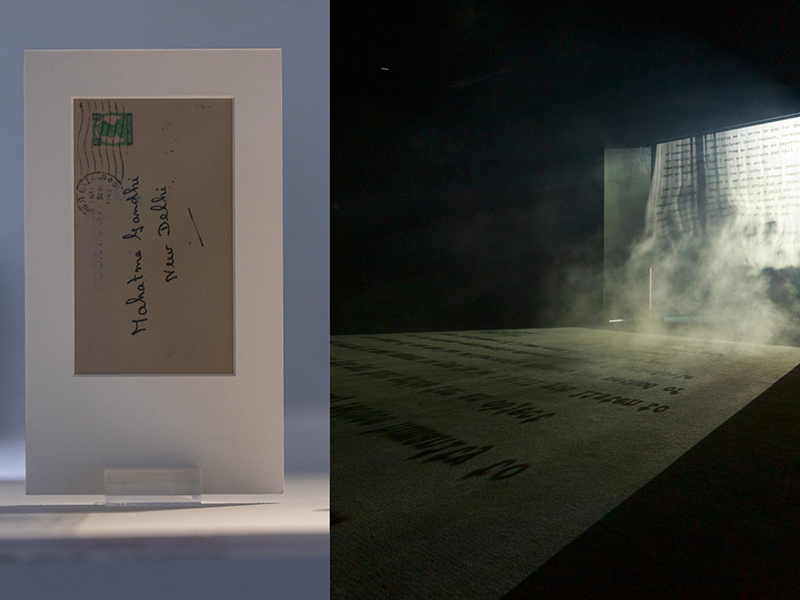
There is much to see and absorb. KMB has three verticals—Students’ Biennale, ABC (Art by Children) and Edam, a space for artists of Kerala. Even though a few works showing at KMB are from artists of Kerala, the state government’s grant of Rs 7.5 crore demanded that local artists be given adequate representation. Edam, in Malayalam means space, presents a survey of contemporary art practices rooted in the region and its diaspora. It features 36 artists and collectives. The jury that selected artists for Edam consisted of Aishwarya Suresh and K M Madhusudhanan. The show presents a number of painters whose works stand out—Ranjith Raman’s stitch-like lines on canvas are meditative. Vishak Menon’s repetitive mark makings create algorithmic abstractions. A collective also explores Gandhi’s non violence in contemporary times.
Vivan Sundaram’s last work, a photography- based installation titled Six Stations of a Life Pursued (2022) is also on display.
Student’s biennale has representation of 160 art colleges spread across India; a jury of seven eminent artists selected the works. I could see only two venues where the Students’ Biennale had completed installing works. Work was in progress at the remaining venues. Septhel Anna Eldho’s ‘Myths We Carry’, from J J School of Art, explores the Syrian Christian community’s myths, as both subject and lens. Tokmem Pertin and Yambau Kongkang of Rajiv Gandhi University work on women’s body’s unspoken realities in subtle, imaginative ways. In ‘Blind Command’ by the students of Rajasthan School of Art, reimagining of chair, as a symbol of authority is explored, initiating a dialogue with the viewer by altering the space; in ‘who is allowed to speak before authority?’
There are eight collaterals. Unlike the previous editions, for the sixth edition, of the 200 applicants only eight collateral spaces were given the logo of KMB, for which the applicant had to pay Rs eight lakh, the work was selected by a jury to maintain desirable standards.
The installations, paintings, sculptures, films and so much more are supported by 110 cultural programmes, curated by Keli Ramchandran for the 110 days of the biennale, closing on March 31, 2026.
Cover image: Art work by Huma Mulji. Image Courtesy: Archana Krishnan K