As India’s representative at the 60th Venice Biennale in 2026, Skarma Sonam Tashi is carrying an artistic career advancing at an incredible pace, as well as the spirit of an entire high-altitude culture in Ladakh. Tashi, a sculptor whose materials, philosophy, and form speak forcefully to the ecological and cultural crises of our time, was born in 1997 in Sapi, a pastoral village nestled within the rocky folds of Ladakh’s Kargil area. Since then, Tashi has become one of the most compelling voices in contemporary Indian art.

The Lalit Kala Akademi Scholarship, the Art for Hope Grant, the Space118 Grant, the Abir India Award, and, most significantly, the National Award at the 64th National Exhibition of Art—the first time a Ladakhi visual artist has received this distinction—have all been given to him in recognition of his visionary vision. After completing his MFA at the renowned Kala Bhavana, Visva-Bharati University, and his BFA at the Institute of Music and Fine Arts, University of Jammu, Tashi has used his academic knowledge as a lens through which his upbringing is given new meaning rather than as a break from it.
Landscapes of Memory and Matter
The magnificent Himalayan, which included houses made of sun-dried brick and stone, monasteries perched on cliffs, and the daily dance of survival in a place where resiliency and fragility go hand in hand, highlighted Tashi’s early years in Ladakh. At the heart of his work is this duality: endurance and ephemerality, strength and weakness.
He had a life-changing experience when he joined the Ladakh Arts and Media Organisation (LAMO). At the age of 14, he participated in a course there that exposed him to mentors who helped him discover his artistic orientation and to contemporary sculpture. Years later, he was back where he had started his adventure, returning to LAMO as a resident artist.
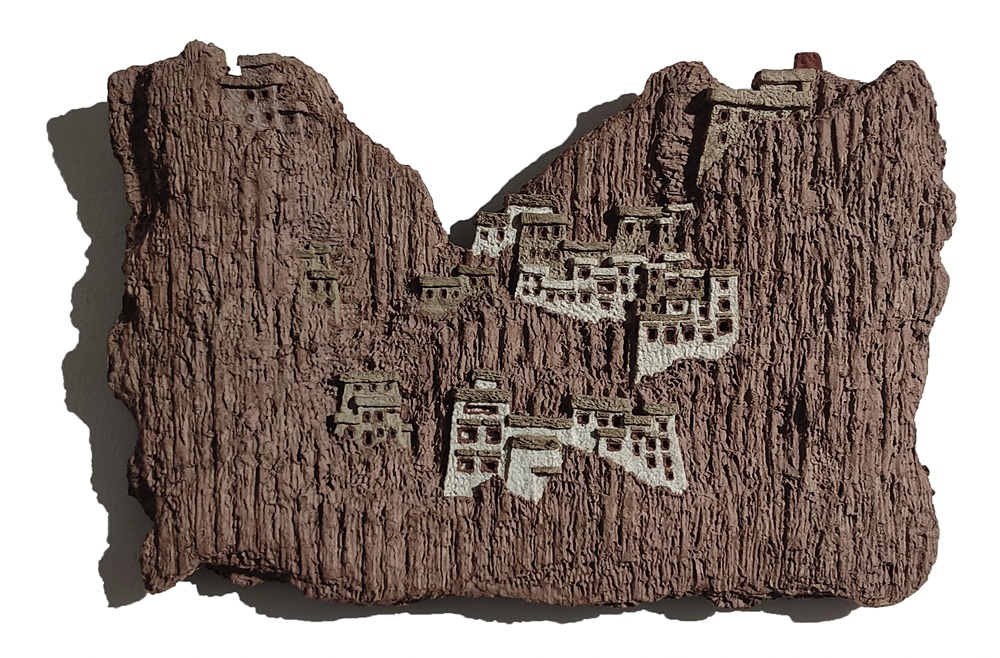
He often described his desk a “organised chaos.” That is littered with pulped paper, egg trays, damp cardboard, and old notebooks. These are not merely supplies; they are archives of touch and gesture, remnants of lived environments. In his hands, they become sculptures that represent the places they once called home.
The Transformative Logic of Fragility
Tashi is a paradoxical artist who uses the impermanent to discuss permanence. He uses crumbling materials to express strength. Fragility is a philosophical stance rather than a restriction. In his work, cardboard—which is commonly used in Ladakhi dwellings as insulation against harsh winters—becomes a symbol for both exposure and shelter. Old notebooks, which are stores of knowledge, degrade into pulp and then reappear in different forms. His birthplace’s jagged mountain ranges are echoed by the swaying rhythms in egg trays.
He binds garbage into substance by combining these shreds with a glue made from lime and tamarind seed powder, reminiscent of the old-fashioned bonding agents used in Ladakhi construction. Each sculpture is infused with the chromatic memory of the country itself—ochres of degraded slopes, greys of stone, and browns of earth after snowmelt—thanks to the texture and tone added by local clay.
Artist constructs forms that appear simultaneously delicate and monumental. An imagined architecture, fractured topographies, configurations that mimic the slopes of melting glaciers or the walls of centuries-old homes.
Sustainability as Aesthetic and Ethics
Environmental fragility is the foundation of Tashi’s art, not just a supporting topic. He grew up in an area where climate change is a lived emergency rather than a theoretical one. He has seen firsthand how quickly glaciers are retreating, how unpredictable snowfall is, and how fragile Ladakh’s ecosystems are becoming. Thus, his sculptures serve as warnings and elegies.
His dedication to ecological principles is exemplified by his participation in Sa Ladakh, Asia’s premier modern land art show. He used biodegradable materials to paint transient landscapes directly onto mountains for the exhibition’s site-specific piece in Disko Valley, ensuring nothing would leave a permanent scar on the earth. In addition to paying respect to the land’s beauty, the gesture served as a reminder that even artistic involvement must respect the land’s natural boundaries.
Through such gestures, Tashi positions himself within a global movement of artists reclaiming sustainability as an artistic imperative. He does not romanticise Ladakh as an untouched Shangri-La. Instead, he dismantles postcard clichés to reveal a region teetering between environmental vulnerability and cultural resilience.
Architecture and Cultural Memory
Ladakh’s architectural heritage lies at the heart of Tashi’s practice profoundly. The inward-sloping walls of old homes, their rammed-earth foundations, the patterned woodwork, the careful orientation that maximises winter sun, are not just visual motifs but embodiments of centuries of ecological knowledge.
Tashi’s sculptures do not imitate architecture, but rather reason it. Forms often appear as if shaped by wind erosion or tectonic compression, mirroring Ladakh’s geology. Others resemble miniature remnants of ancient dwellings, their contours suggesting both the presence and absence of human habitation.
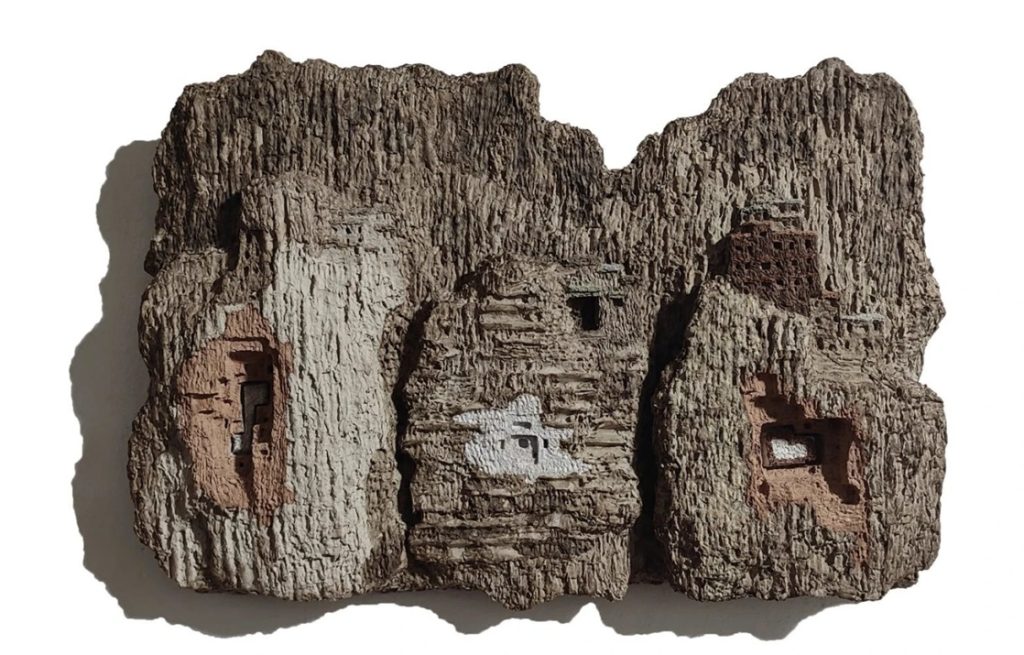
This preoccupation with architecture also reflects cultural identity. For Tashi, traditional Ladakhi structures are repositories of a worldview—one in which human life moves in consonance with the rhythms of the natural world. As modern construction begins replacing these forms with concrete and glass, his sculptures become quiet acts of resistance, holding space for memory amid rapid urban change.
“My Homeland – 3”
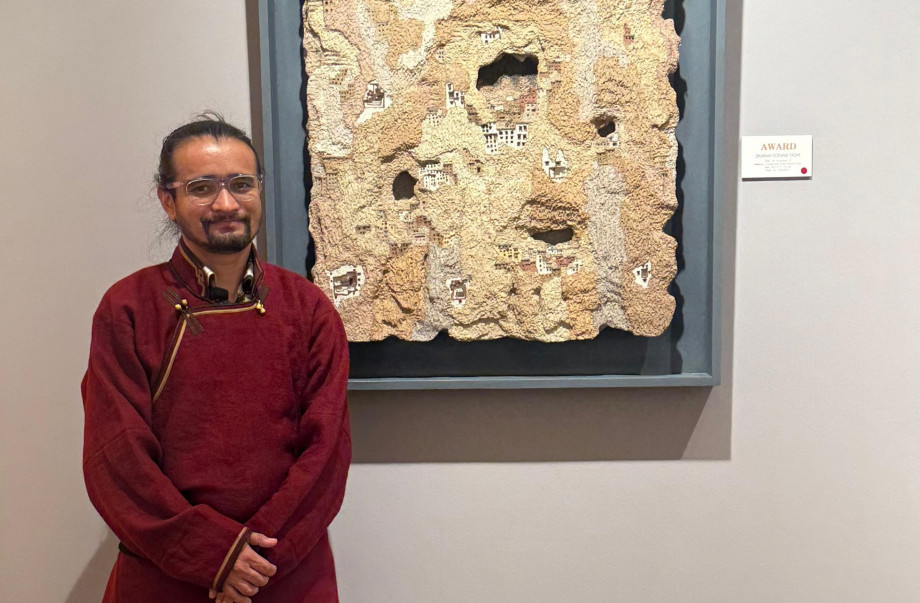
Many of his core themes are synthesised with remarkable clarity in his award-winning sculpture My Homeland – 3, which brought him national acclaim. The piece creates a tactile archive of Ladakh’s architectural and environmental elements by fusing wood, stone, sun-dried brick, papier-mâché, and natural pigments. It speaks to concerns about sustainability on a global scale while still being deeply personal—an expression of belonging.
The sculpture neither grieves nor idealises. Instead, it encourages viewers to reflect on the delicate balance that supports high-altitude ecosystems and the cultural worlds that are a part of them. The honour was more than just a personal triumph. It was a turning point for Ladakh, a province that had long been excluded from national art circles. Despite challenges, his accomplishment symbolises the Himalayas’ cultural awakening, where new festivals and collectives are fostering fresh creative ecologies.
Making of an Artist
Tashi’s creative growth is marked by extensive research and mentoring. He learned basic skills at Jammu University and was exposed to a teaching environment at Kala Bhavana in Santiniketan, founded on material experimentation, philosophical reflection, and the intertwining of traditional craft and modernism.
From senior artists he met during his Delhi scholarship year to Ladakhi sculptors he met as a teenager, mentors urged him to ground his work in the material and cultural realities of his native land. His development of a regionally grounded and globally conversant idiom has been made possible by this grounding and by exposure to global artistic vocabularies.
Art as Cultural Work
Tashi presents a broad perspective on the function of art in society. He points out that “Rignas Chu”—the 10 sciences crucial to human development—includes art in Ladakh. Art promotes cultural continuity, mediates between tradition and modernity, and retains memory. He promotes infrastructure and art education in Ladakh, highlighting the need for both local and national platforms for the area’s artists. Long-term growth requires state-supported galleries and cultural centres, even though independent studios and non-governmental organisations like LAMO play essential roles.
The Biennale and Beyond
A significant milestone for Ladakhi art has been reached with Tashi’s nomination for the 2026 Venice Biennale. His participation in one of the most important art shows in the world raises problems of cultural survival, fragility, and landscape that affect people far beyond the Himalayas.
His work serves as an example of how art may adapt in the face of climatic emergencies that are changing human identities and environments: via profound ecological empathy, material intelligence, and humility. His sculptures invite rather than preach. They invite spectators to feel, observe, and recall.
According to Tashi, sustainability is a strategy rather than just a concept. His own method—reuse, repair, reinterpret, remember—becomes an ethical principle. By turning trash into fragile memory structures, he serves as a reminder that care is always a part of creation.
Tashi is an artist and an advocate as he prepares for Venice, a messenger from a place that has long taught its people to live in harmony. In his practice, art becomes a tentacle of hope in a moment of ecological precarity, extending and yet staying deeply anchored in Ladakh’s soil. This may be the subtle force of his work. It serves as a reminder that fragility is not a sign of failure but rather a type of knowledge—a means of seeing the universe via reverence, interconnectedness, and attention rather than dominance.
Feature image: Skarma Sonam Tashi with his award-winning artwork ‘My Homeland – 3’. (credit- reachladakh.)

Contributor